Tourist in France
TRAVEL
By CARL de SUZE
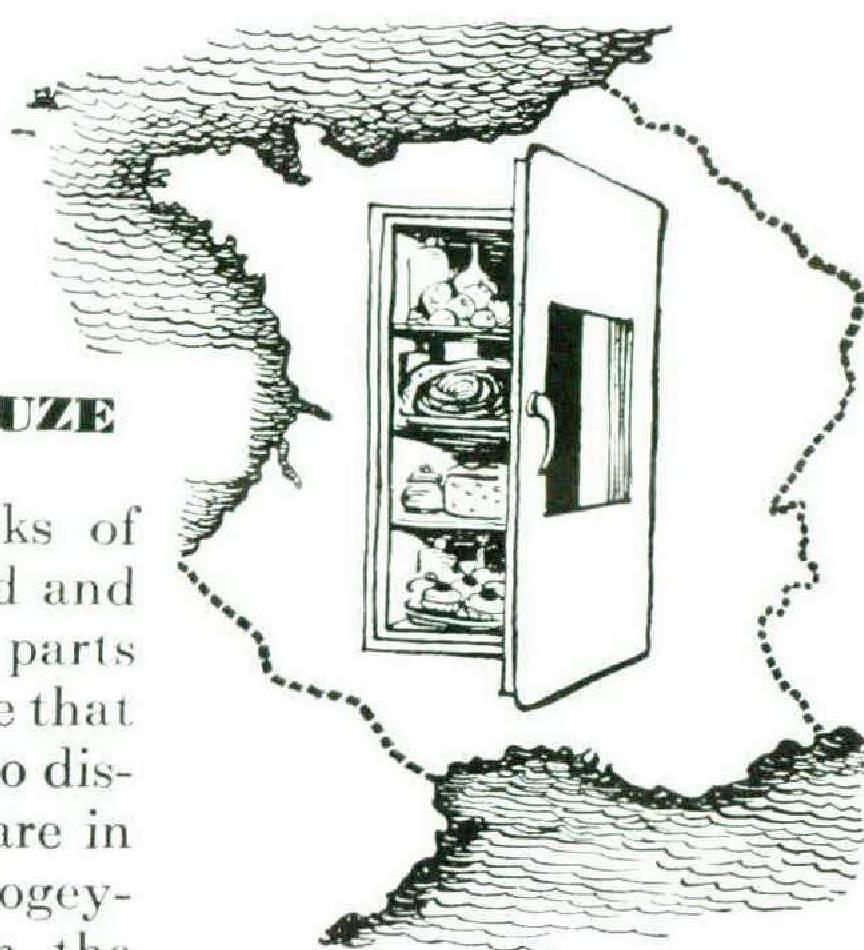
AFTER five weeks of sampling food and lodging in various parts of France, I believe that friends who tried to discourage my visit are in the clutches of bogeymen, and that on the subject of eating and drinking and getting around France these days American opinion is marvelously addled. The French, for whom the press insists on tolling the bell, are, on the contrary, bouncing back with great vigor. They are making a strong bid for the luxury markets and tourist trade, by which the country hopes to stabilize itself.
France is again a line place for the traveler. The $30 breakfast and the $50 room are a myth — except for those who want to sport with the international set. And you need not rough it with bicycle and pack in order to set aside enough money to dine superbly and see the sights. This resilient country can still show visitors good living at a moderate price. It does this at some sacrifice to its citizens, who are still tightly rationed. But abundance is available in the restaurants, pensions, auberges, and roadside inns, which are flung open in quantity to attract foreign exchange. The following are a few notes on what you could get for your money in the summer of 1947.
The legal rate of exchange was 119 francs to the dollar. Yet at a well-known foreign money mart in Radio City, New York, it was possible to buy 200 francs for the dollar in a perfectly aboveboard dealing. In Paris the black-market rate was 220. The French regard the legal rate as false and prefer to have visitors get the more favorable exchange since it encourages trade. Patriots insist that their government maintains the lower legal rate only at the behest of foreign countries that would not provide the necessary supplies if they felt that France was a powerful competitor. Some travelers deposit funds in America for French visitors to America and collect these amounts at a favorable rate in francs when they get over on the other side. A few daring souls simply smuggle in the dollars.
Since the average French pay check is about half the American one, and prices are somewhat the same as they are here, the Frenchman does have it twice as hard as we do. He doesn’t complain, because he knows that the more tourists there are, the quicker his economy can get back to normal. Restaurants all over France are divided into categories A, B, and C. In Paris the distinctions are most notable. Two people may spend 3500 to 4000 francs for a meal at the luxury restaurants like Maxim’s and the Tour d’Argent, which is less than what similar places would charge in New York, say “21” or Chambord. Atmosphere and tradition go on the bill also at Prunier’s near the Madeleine, Ciro’s in the Rue Daunou, or at the gilded Lapérousc, Joseph’s, Philippe’s, or the Café Véfour in the Palais Royal gardens.
Jean Casenave in the Rue Boissy-d’Angles continues to serve a handsome four-course category B meal for about 500 francs to the busy merchants of the Rue de Rivoli and to the wanderers overcome with hunger between the Place de la Concorde and the shops of the Faubourg St. Honoré. Prices in category B may vary sharply. For example, Burgundy snails and sole meunière are some 250 francs at Casenave’s, but at another B restaurant, the Chope du Pont-Neuf, they are just as tempting at 80 francs.
What increases the price of a meal anywhere is the wine. A bottle of very decent red wine is available in most B and C restaurants for 80 to 140 francs. Something special, like Beaujolais or a fragrant Burgundy, may cost as much as 230 francs. Nevertheless, a carafon (about ¼ bottle) or a half bottle is usually to be had at a modest sum even among the best wines. Beer runs from 5 francs 50 to 7 francs in this class.
A substantial and often lavish meal can be procured for 150 to 250 francs in such restaurants as the Ministères on the Rue du Bae, the Plat d’Argent on the Rue des Saints Pères, the Restaurant Gibert on the Rue Comte Rivière, L’Alsaeienne on the Boulevard St. Michel, the Petit Colombier on the Rue des Acacias off the Étoile, or any of the bistros along the Rue Monsieur le Prince up by the Sorbonne.
Here’s a sample meal selected at random from menus I brought home: —
| Francs | |
| Soup (sorrel or consomme aux -pates is fairly standard) | 5 |
| Hors d ’oeuvres (anchovy or sardine, deviled egg, radishes) | 20 |
| Fish — colin vinaigrette | 40 |
| Meat — beefsteak, the real thing, too! and tender!. | 80 |
| Tomato salad or fat asparagus vinaigrette | 20 |
| Strawberries, served with hulls on — all you can eat. (You rub them in sugar.) | 20 |
| Cafe filtre (individually made drip coffee) | 15 |
| Carafon of beer with the meal | 0 |
| Total | 200 |
The 10 per cent tip is offset by the deduction of the nationally imposed cut of 10 per cent, thereby causing the total price of the meal to remain at about 206 francs.
You may substitute for any of the above entrees, Parisian specialties such as tripe àa la mode (100 francs), sweetbreads with mushrooms (100 francs), chicken with mushrooms (100 francs), or a filet of some kind dredged in real butter and kissed by the broiler (80 to 100 francs).
Cheese in Paris is likely to be poor nowadays unless it is black-market Camembert. The best cheese is reserved for export. But several places serve portions that are fairly ripe and about the size of a lady’s compact for 10 to 30 francs. Bread is a scarce item even in the country, and bread tickets are requested in most restaurants. Although white bread is a rarity, the hearty chunks of good French bread still have their excellent crusts.
Two motor trips into the countryside of France revealed that despite the intermittent scars of the exodus on the road to Bordeaux and the destruction of some towns in Normandy — Caen, Faluise, Lisieux, Bayeux, and St. Fb—most of the country’s picturesqueness is preserved, and facilities of all kinds encourage the traveler. All the little inns in Normandy to which English and American tourists have traditionally repaired for their Continental holidays were booked solidly for the summer season. In the food-producing belts, butter, cream, and meat are abundant. Cheese improves as one journeys through the northwest. Although the food in Normandy is still cheap and good, most travelers bring with them their own towels, washcloths, and soap, and their own coffee and tea either to substitute for, or supplement, pension fare.
The Commissariat Général au Tourisme (French National Tourist Office) in Paris is especially helpful at arranging itineraries to suit the budget. They have found reservations in Normandy for English travelers limited by their government to a £75 holiday, and they will furnish lists of hotels which serve three good meals at prices starting at 400 francs a day. In Juan-les-Pins special rates are made for service people now demobilized. My advice is to consult the Commissariat au Tourisme and take with you on any motor trip a copy of . Auberges de France, an expert catalogue of rates with descriptions ot the food and lodging to be found wherever you may go. Bountiful meals are to be had in numberless spots along the main highways, and the wine of each region is inevitably good. At Bagnoles-de-l’Orne in Normandy, a fashionable thermal spot, there are many small hotels and pensions of modest price tucked into the recesses of its wooded valley. I can personally recommend the Auberge des Charmeltes, where both the view and the cuisine are inspiring — all found at 800 francs per person a day.
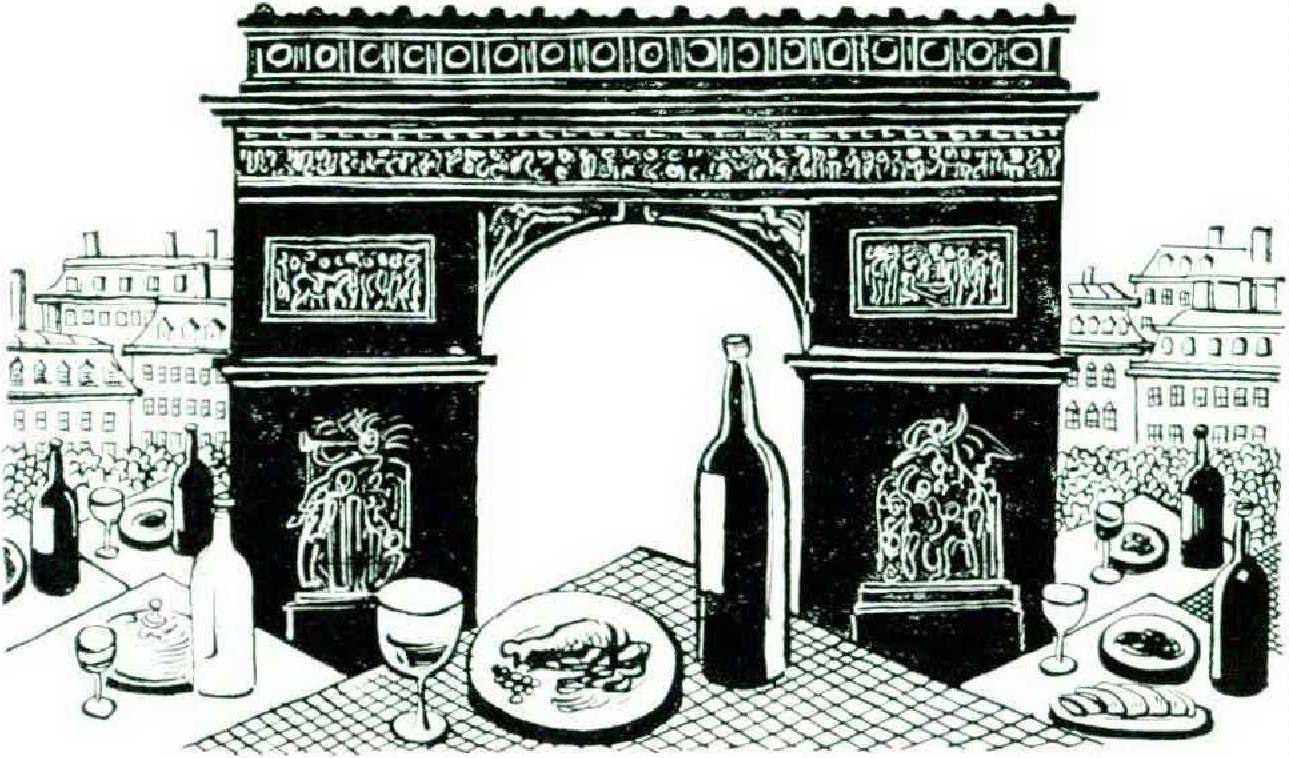
Driving toward Bordeaux through the broad plains of the Beauce we passed through Orléans, following the Loire through a countryside studded with good eating places and pleasant inns. One of the most distinguished restaurants, yet unpretentious in appearance, is the Val du Loire, outside of Blois. At table the vin du pays was a delicate white. Four of us enjoyed a meal consisting of a great variety of hors d’oeuvres, a fish filet in white wine and caper sauce, a juicy roast beef with a fragrant red wine, a fresh garden salad and green beans, two varieties of aromatic cheese, and for dessert, the fluffiest of chocolate cream-filled éclairs. Café filtré and cognac completed the meal. The whole bill for four came to less than 1200 francs including the tip.
At night we dined at the Hôtel de la Toque Blanche at Ruffec. Sorrel soup, thick with egg and barley, a daube or stew of venison, some pungent. Bordeaux red wine, salad, creamy cheese, caramel custard, and sablés came to about 200 francs per person. All through the Charente region down to Cognac and back to Paris by way of Poitiers, Tours, and Chartres, we found the food more than satisfying, the prices amazingly moderate.
Our next trip was by train from Paris to the Cote d’Azur, with stops at Lyon, Avignon, Arles, Marseilles, Beauvallon, Ste. Maximo, St. Tropez, St. Raphaël, Le Rayol, Cannes, Juan-les-Pins, Antibes, and Nice. This neighborhood lives up to its reputation, regardless of what the Germans did to it during the war. Despite shortages in machinery, materials, and manpower, the people of this region have cleaned their harbors of the ugly hulks that cluttered them, and are restoring the cities and gardens to their former beauty.
The most spectacular comeback has been made at Juan-les-Pins, where the Germans removed all the sand from the beaches to make cement, and erected a sea wall with connecting pillboxes extending for miles along the coast. The local citizenry took down the wall, replaced the sand, and have just completed a modernistic promenade raised above the beach, with sunken bathhouses and gymnasiums, gardens and play areas for children. The entire project is shaded by magnificent umbrella pines, from which the town takes its name. A new sewerage system has been laid to take refuse far away from the beaches.
All these towns along the coast echoed with the sounds of hammer and saw as new buildings went up to accommodate the influx of residents and visitors.
In many places we saw community-financed housing. jJ
Even in Nice and Cannes we found comfortable and often luxurious quarters with meals included for from 500 to 800 francs a day. If we ate in restaurants, we had the specialties of each region: around Lyon, quenelles and mushrooms at Mère Fillioux’s; snails at Juliett’s, washed down with the aromatic Julianas Beaujolais; chicken cooked with truffles in Vienne. Still, we never paid more than 500 francs apiece for the most sumptuous meal. There was one except ion — the Hotel du Cap at Antibes, where lunch of hors d’oeuvres (a huge table holding the largest variety I have seen in France), wine, cold lobster with real mayonnaise, salad, potatoes, and fresh garden peas, dessert, brandy, and coffee came to 4800 francs for four. I had practically the same, and just as good, the next day in Nice at La Marée near the fortress end of town on the Quai des États-Unis, and the price there came to only 1200 francs for four.
France opens up for any taste if you can travel leisurely by car. The Paris office of the American Automobile Association has cars to rent; and one can buy a French automobile in New York for delivery when one gets off the boat on the other side. If you can bring your own vehicle from America you won’t have any difficulty obtaining the gas you need. Much of it is reserved just for people like yourself, and Americans are granted six times as large a gas rat ion as the French.
On the other hand, train travel is pleasant and very cheap. We crossed nearly the whole of France by train for about 4000 francs apiece, which is a lot cheaper than what it costs to travel the same distance by train in the United States. Four-course meals are served on the main-liners, such as the Paris-Lyon express, and for 180 francs their chefs put American dining cars to shame. Good wines, spirits, and liqueurs are also available.
For out-of-the-way places, buses or the gasolinepowered trains (the Auto-rail or Micheline) connect with main stops. Air France has established an efficient network of flights from Paris to all the main resorts. On long trips sight-seeing tours now include food and lodging in ihe price of tickets.
In Paris the Métro connects with all the main points of the city and suburbs. A ticket which you can use twice costs 4 francs. Taxis are back in Paris this year for the first time since the war. Everyone scrambles for them at rush hours, and some of the citizenry have been known to take a cab just for the novelty of being able to hail one again.
So desperate is the need for foreign exchange that France urges all to come. My advice is, if you want to go there next summer, start making plans now.