Spinners in the Sea
FACTS
By LORUS J. MILNE
NATIVE North Americans eat few mussels. For some obscure reason, the bronzy blue-shelled clams have never taken their place among the oysters and quahogs, the littlenecks and scallops. On other continents, especially in Europe, mussels are recognized as a staple sea food. They are cultivated extensively and shipped inland just as oysters are here. Our Atlantic and Pacific coasts are well populated with mussels — just as edible as those of Europe — yet few know anything of their economic value. Only in the fish markets of the larger cities is there a sufficient demand from the foreign-born population to make the selling of mussels a commonplace.
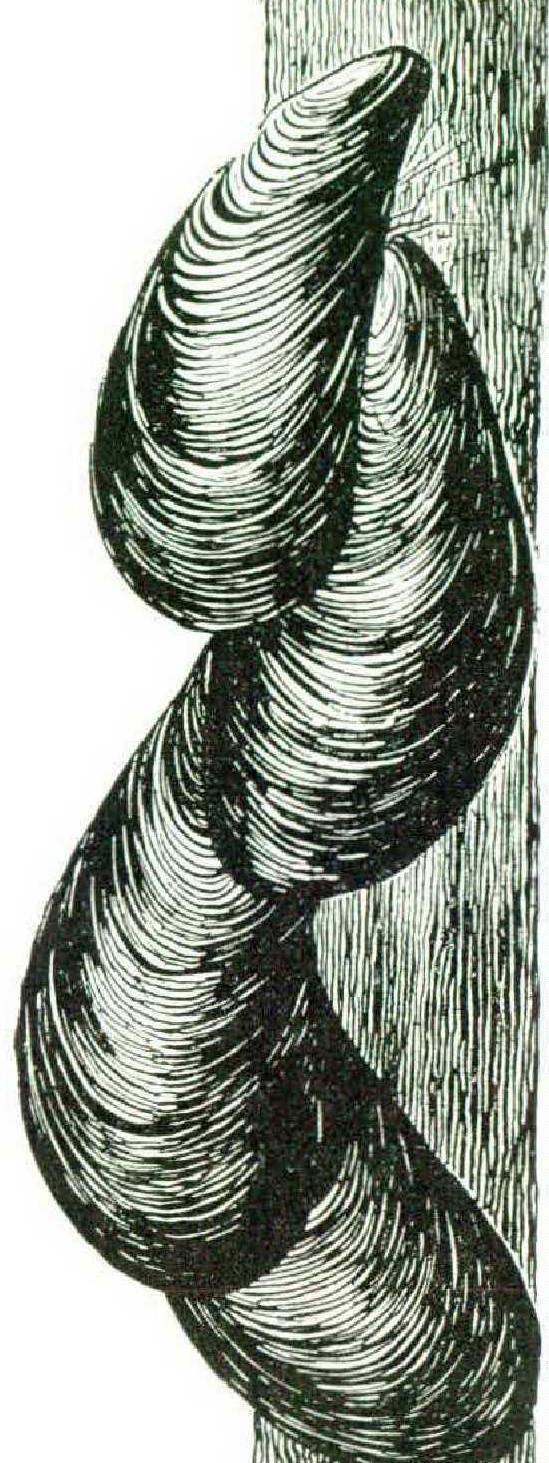
Mussels differ from other bivalves in that great numbers of them (of all sizes) cling side by side to wharves and pilings, to the bottoms of anchored ships and floats, to buoys and other firm foundations in shallow sea water and in tidal rivers. At low tide many of them are exposed to the air, each mussel held in place by a few dozen strands of brownish fiber — guy ropes fanning out from the edge of its shell. These threads are spun by the mussel with the help of a thin, tonguelike foot. The first man to watch a mussel produce its byssus fibers, and to record what he saw (about two centuries ago), summed up his impressions in a final sentence: “I could not doubt then that the Sea has her Spinners in the Mussels, as the Earth has in its Caterpillars and Spiders.”
Anyone enterprising enough can repeat Reaumur’s observations by detaching a small mussel from a piling and putting it in a dish of sea water. Torn from its mooring, tho elongate, rather pointed shell lies on its side. The stub of its broken byssus sticks out between tho valves and has the appearance of a brown, fibrous root with many branching rootlets. After a while the mollusc relaxes the strong muscle which holds its valves together, and in the region of the byssus extends a slender sensitive foot. The tip of the foot explores in all directions and soon locates the bottom of the dish. Stretching more and more, the foot tip turns this way and that to inform the mussel about its new and strange surroundings. Finally the sensitive tip curls back to touch a dark, glandular spot at the base of the foot. Rapidly the tip travels to a distant point on the dish bottom and is held there for a moment. When the foot is drawn back, a fine strand of clear brown material is seen, stretched taut between the point on the dish bottom and the base of the mussel’s foot. One fiber of the new byssus is in place.
Soon another is added by a repetition of the process, the second strand extending as far as the foot can reach in another direction. Slowly the mussel produces more of the anchoring strands. Six is a good day’s work. Six well-placed fibers will also allow t he mussel to right itself, so that the gap in the valves through which the foot is extended is turned toward the bottom of the dish. With this degree of security, the creature casts off its old byssus completely. Some mussels carefully kick the discarded support out of the way, using the foot to push the old byssus through the gaps in the circle of strands formed by the new. Day after day the mussel adds more threads, and holds the bases of the entire group in a groove along the under side of the foot. The same cement substance is added to the strands in the groove, until they are welded together to form a common stalk. From this main root, branches extend in all directions to the many adhesion points on the bottom of the dish.
Charles Lamb thought that a mussel, once anchored, was fixed for life. In one of his letters he wrote: “How much more dignified leisure hath a mussel, glued to his impassable rocky limit, two inches square! He hears the tide roll over him backwards and forwards . . . but knows better than to take an outside place a-top on’t. He is the owl of the sea, Minerva’s fish — the fish of wisdom.”Unfortunately for literature, the mussel can move about. If dissatisfied with one position, it extends the foot to its limit in some direction and a new byssus strand is produced there. Letting go of the old byssus, the mussel swings free. Again it stretches forth its foot. Again it moves along. In a few days the creature can crawl many inches, leaving behind it a series of single byssus strands which mark its route from the previous location.
Where the sea is full of microscopic plants and animals on which the mussel feeds, great numbers of these molluscs are found. Every solid support is encrusted with them. They extend their byssus lines over the layer of barnacles and tubeworms and smother them. The mussel is a dominant form. Even mud and sand may be held together by the countless byssus strands, and flat areas of shoreline often present unbroken acres of mussels. Such communal action is important to the molluscs because it keeps the silt from freeing itself and clogging their feeding mechanism. It is important to man in preventing the tides and currents from eroding the foreshore.
In Devonshire, at the town of Bideford, there is a bridge across the Torridge River. The two dozen arches are covered closely by mussels, which no man may disturb without involving himself with the local police. The natives of Bideford have great respect for an ancient ordinance protecting the molluscs, for the reason that the creatures save the bridge from the wear and tear of the tides. Neighboring villagers have spread the story that the mussels hold the stonework together with their byssus strands, and that the Bideford Bridge has no mortar in it. These rumors are groundless, but the protection given to the structure by its crust of blue shellfish is plain to all.
Byssus strands are strong and remarkably durable. They retain their flexibility for centuries. Along the coasts of the Mediterranean Sea lives a mussel which has a particularly fine byssus, with very long fibers of an attractive golden color. In ancient times, men armed with sharp knives dived into the warm water and carefully cut the adult molluscs from their moorings. The womenfolk severed the separate strands, washed them of debris, and wove them into cloth. This handicraft has persisted to the present in Sicily and some parts of southern Italy, where gloves and stockings of remarkable wearing qualities and handsome sheen are still manufactured, although chiefly as curiosities.
More beautiful workmanship has been found in pieces of this same false “cloth of gold” uncovered by archaeologists excavating the ruins of earlier Mediterranean civilizations. The color and flexibility, the luster and toughness, seem unchanged by such long periods of time. The gummy secretion of the mussel, stretched into fibers by the spinning action of the foot, could truthfully be termed one of the first successful plastics.
Like other bivalves, mussels draw water into one region of the shell (near the foot), through their platelike gills, and out a second opening. To enter the gills, the water must pass through moving curtains of mucus, which strain out any particles, digestible or otherwise. If the mussel is feeding, the sheets of mucus pass down the gills and are carried forward by the beating of millions of microscopic, hair-like cilia, to form food-laden ropes which enter the mouth continuously. If, however, the particles are not suitable, the ropes are dropped toward the edge of the shell to be east out as waste. Thus the breathing current is continuous, and the mollusc feeds whenever the water brings particles which are digestible.
During the winter, the mussel’s shell cavity becomes filled with tiny yellow eggs, and the mollusc is not suitable for human food. These are the R-less months for the mussel. Each adult liberates about a hundred thousand young into the water. Most of them fall on soft mud bottoms, where they suffocate, or into the mouths of slightly larger creatures. A number of the fry are left to settle upon various solid supports, where they commence at once to take on mussel form and make a byssus anchorage. In a region where food is plentiful, an egg may become an adult mussel, nearly Four inches long, within a year. If food is scarce or contaminated with many indigestible panicles, the mussel’s growth may be stunted. Those which live on vertical surfaces well above the bottom have the best chance to grow large.
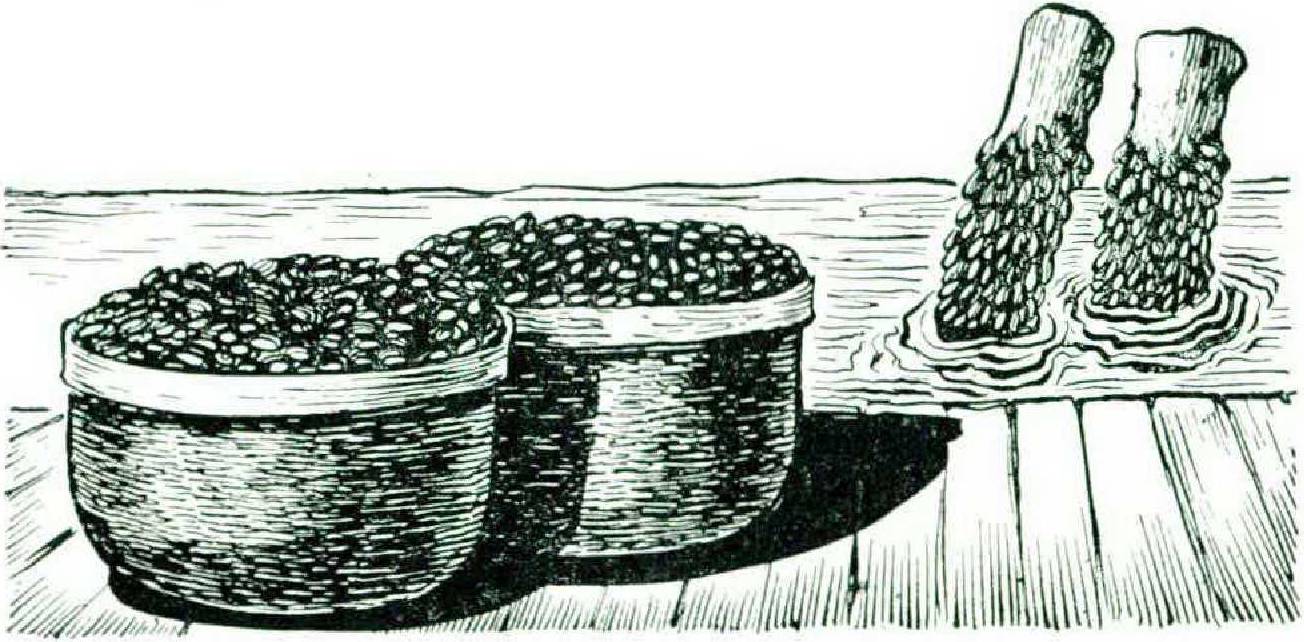
Providing vertical surfaces for mussels is characteristic of the peculiar farming which is carried on in several sections of the French coastline. Long poles are driven into the soft mud, and basket work is woven from pole to pole for a height of about six feet above low-tide mark. Fry become attached to the basketwork in great numbers. With proper care, in a year or two, as much as a cartload of mussels may be harvested from each square yard of wicker surface. A large “farm” may have a mussel-bearing surface totaling a hundred square miles, which means that tons on tons of shellfish can be sold from it each year. In less well organized coastal regions, tree boughs (commonly elm) are driven into the mud and left to accumulate fry. When the mussels are several inches long, the loaded branches are trimmed off and the molluscs arc sold by weight without even being removed from their support.