You'll Laugh, You'll Cry
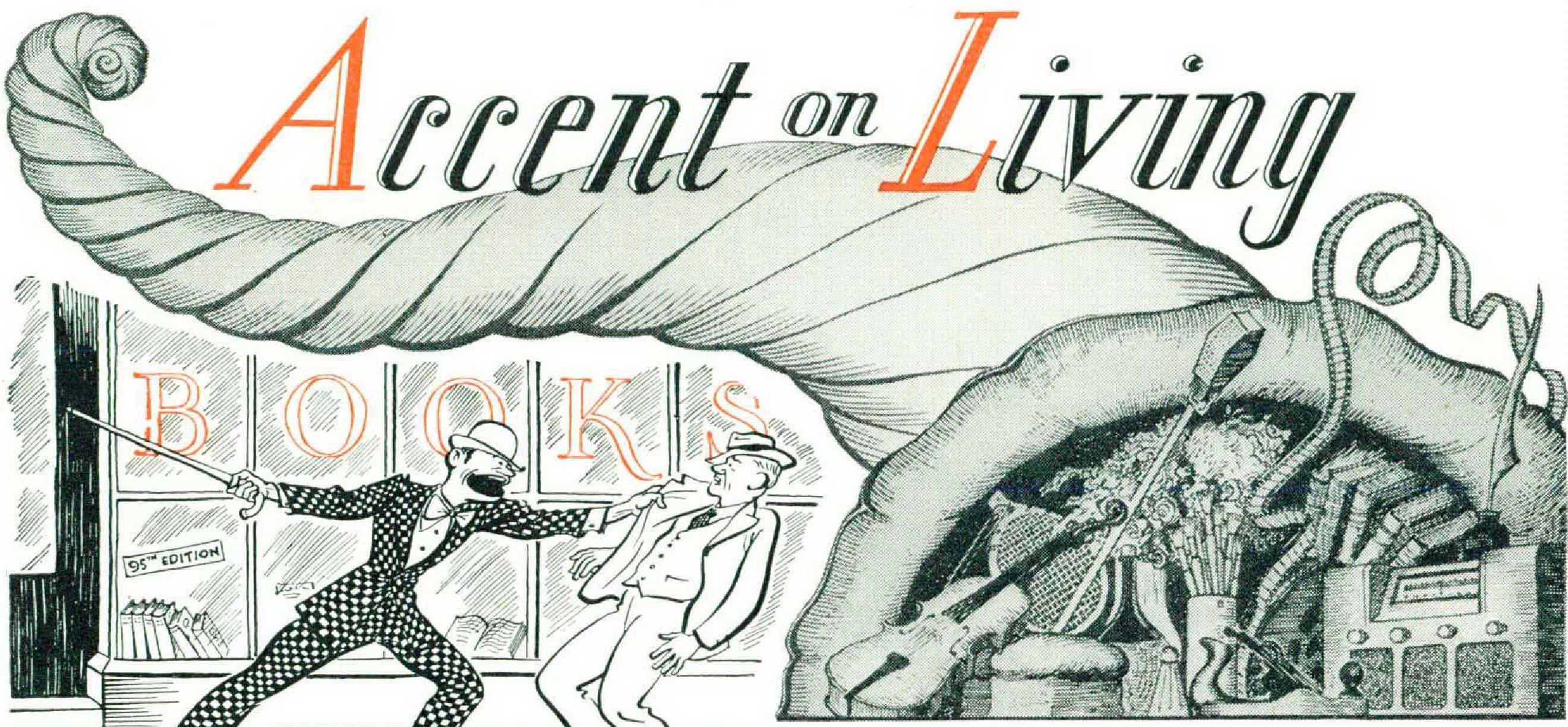
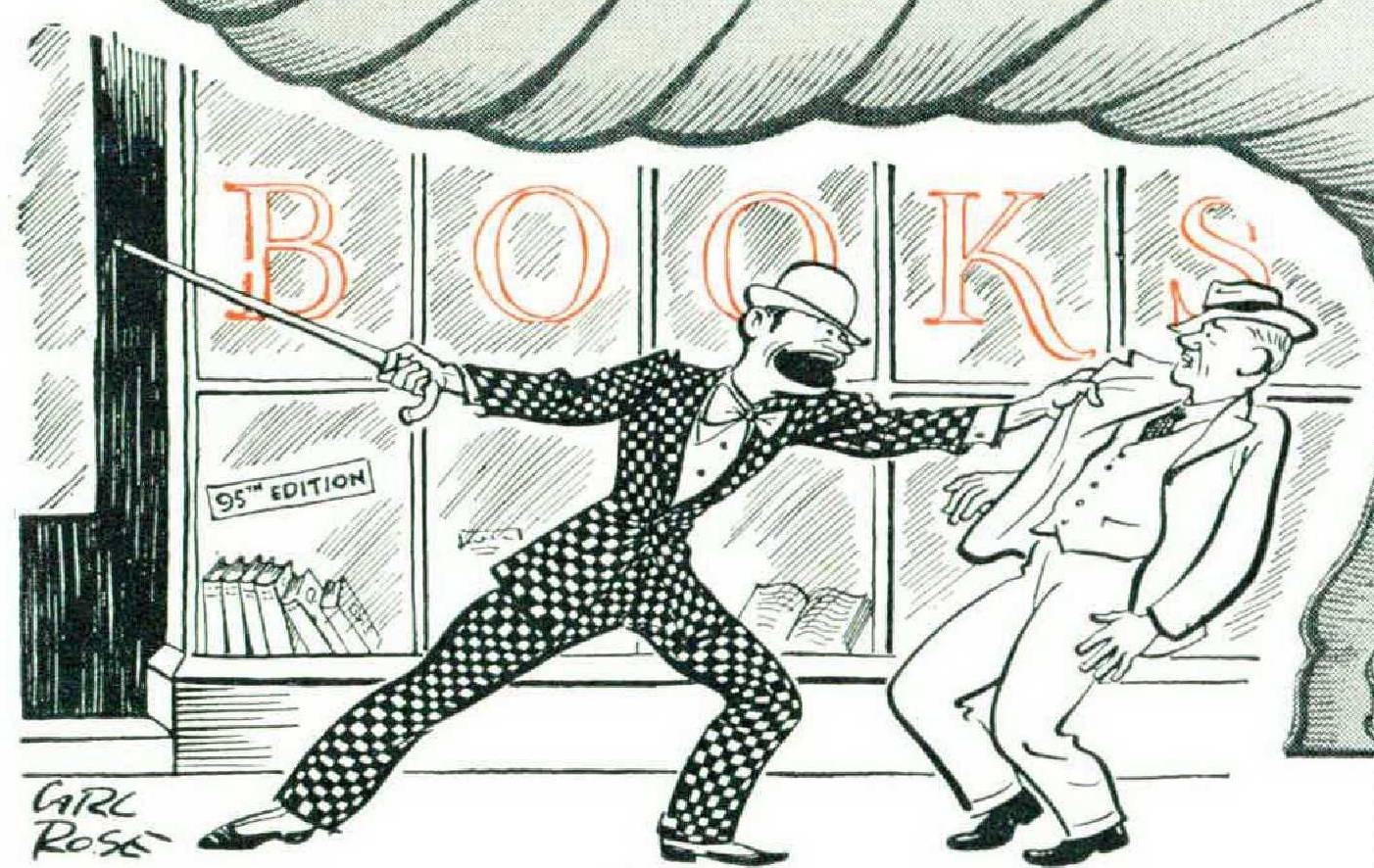
THE primary purpose of this paper is to destroy the libel that book publishers are less progressive than the makers of Bromo-Seltzer; for in our up-and-coming economy this is as damning as it is to say that a user of Palmolive Soap came down with blackheads. Its secondary purpose is personal apology. I, too, have written a book in my time and churlishly grumbled at the ineptitude and the paucity of advertising devoted to this masterpiece. Here let me make reparation and do penance.
In sober truth the publishers’ advertising lads, while retaining all the devices of Dexter Fellows, the once famous and self-effacing press agent of Barnum & Bailey, The Greatest Show on Earth, have invented others which make him seem oldfashioned and archaically innocent. Book advertising, in fact, often rivals in its excellence that lavished on Lady Esther’s All-Purpose Face Cream or White Owl Cigars. Proceeding, for example, upon the sound theory that anything which sells in great quantities is the best of its kind to be had, publishers use advertisements such as this: —
Read The Lives of Maizie White, by Helena Emerson Tittsworth, the first novel by America’s most beloved novelist since her sensationally successful Pappy Pass the Pickles, published three months ago. If you loved Sunshine, the heroine of that unforgettable book of which 8,200,000 copies were sold (not including South Norwalk), you will adore Buff Orpington and her Nine Lives of Romance-Packed Adventure crowned by her marriage on the flaming deck of a Whangpoo river pirate’s junk to Boy Bailey, the Fighting Medical Missionary of Pang-tu. ’The Lives of Maizie White, by Helena Emerson Tittsworth, America’s most beloved novelist, is destined to become the most talked-about book of the year.
First printing before publication 3,500,000 copies
Second printing (already sold out) 4,100,000 copies
Third printing (already sold out) 5,415,000 copies
Fourth printing (now on the press) 7,185,000 copies
It is common knowledge among the informed that we can achieve a wide dissemination of culture in this country if only we will actively ”promote" books. That’s how we got a wide circulation of other equally desirable things such as rayon underwear, vitamin pills, and Spam. Here the logic of the publishers is impeccable. It is obviously better for the people to read bad books than no books at all, just as it is better for them to wear rayon underwear than no underwear at all.
How do you promote books? For one thing, by using the ancient and honorable method of patent medicine advertisers — the testimonial of the satisfied customer. “I saw spots before my eyes, had constant backaches and headaches, and could hardly bend over the washtub until a friend recommended Wilber’s Australian Auriclo Kidney Kure. I’ve taken two bottles and am a happy, healthy woman again.” This technique has been improved upon by the publishers, who have taken a leaf (no pun intended) from Lucky Strike advertising.
What makes a good cigarette? The finest tobacco. Who are the best judges of the finest tobacco? Tobacco buyers. It follows, therefore, that the best judges of quality in books are booksellers. Consequently one reads advertisements of this kind; —
A Few Previews of
J. HARDING SNAVELY’S
New Novel
Love Laughs at Lockjaw
By America’s Leading Booksellers
Hilarious, delightful, astonishing. Please ship today 9000 copies by air express. — HILDEGARDE FITTS, THE GRAND LEADER, POTTS CAMP, MISSISSIPPI.
Hugely entertaining. I couldn t put the book down. My hands froze to the pages. Bound to become a sensational best-seller. — HILARY SCOOBA, THE BON TON, TUCUMCARI, NEW MEXICO.
Book publishing, as publishers sometimes indicate to authors with the souls of snake-oil salesmen, does not fall in the category of brawling business but is, rather, a dignified profession comparable with beekeeping or astronomy. Consequently book advertising often has the simplicity and restraint characteristic of the British Court Calendar. “Sir Ronald Higginbotham Pye had the honor of being received yesterday by His Majesty at Buckingham Palace and kissed hands upon his appointment as Governor General of Buna-Kabloona.”
From the Inner Sanctum, then, of Simon and Schuster, whose whisper is heard around the world, comes this fragile rondelle: —
James Leverett Hurd was loved by four women. The first was too good a loser. The second was a lady on the make. The third loved too much. The fourth was a perennial hockey captain. Their intimate letters and diaries are contained in the pages of The Whole Heart by HELEN HOWE. When they got through with Jim Hurd, it’s a wonder those pages show no signs of bleeding.
I have emphasized this phrase out of fear that the reader whose taste has been coarsened by moving-picture advertising will miss its exquisite subtlety, and because it is an excellent example of publishers’ understatement — of an objectivity toward their own publications bordering on nihilism. In a similar did-you-once-see-Shelley-plain mood, the Viking Press tells us that
A POWERFUL NEW TALENT
Has Riscn Across the Bolder
In this novel of the Mexico no tourist ever sees, Magdaleno pours out a violent and significant story. Nothing like it has ever appeared before in English. Tense to the point of explosion, it is a novel of bloodshed and terror but it is also a novel of deep sympathy. Diego Rivera has called this ‘’the best Mexican novel"; others are saying that it is the Mexican Grapes of Wrath. [My italics and for the same reason as above.]
It is therefore unfortunate that the shy, pipesmoking young men of tweedy charm who write these fugitive notes on books should be so often misunderstood by the gross creatures on the other end of the line. One of the more melancholy aspects of publishing is that publishers and reviewers do not always see eye to eye about the same book. But farmore perplexing is the plight of the would-be customer who encounters the ad and the review in the same issue of the same publication. Harassed and hunted creature that he is, whom is he to belive?
This is what Harper & Brothers said about Fannie Hurst’s Hallelujah in their New York Times advertisement, January 9), 1944: —
Hallelujah—The magnificent story of a woman who gave of her strength to all . . . and of the one man among many who had strength to give in return.
You will finish this story of Lily Brown with that sharpened sense of the living world that only an extraordinary work of fiction can produce. . . . For years to come, you will find yourself remembering Lily Brown. . . . Hallelujah is one of the most richly dramatic novels Miss Hurst has ever written.
Unhappily, Edith Walton, who reviewed this “extraordinary work of fiction” in the same issue of the Times, did not altogether share the copywriter’s enthusiasm. She said: —
Hallelujah — the latest Hurst opus— merely embroiders on a pattern established years ago in Lummox and repeated since. . . . Here is the same . . . emotionalism, the same sloppy writing. Here is the golden-hearted Hurst heroine whom one has met often before, and who is abused undeservedly by those who call themselves her betters. . . . Miss Hurst seems to have forgotten how to tell a good story. Her books, in the good old days, were never so devastatingly dull.
Conflicts such as this pose a fearful problem. They may even destroy the reader’s faith in book advertising, with dreadful consequences. Publishers would then stop advertising, book reviewers would be out of work, and we should drop into the state of barbarism in which we were once enveloped when the 3,000,000 people of this country, lacking both advertising and reviewers, bought only 500,000 copies of Tom Paine’s Common Sense.
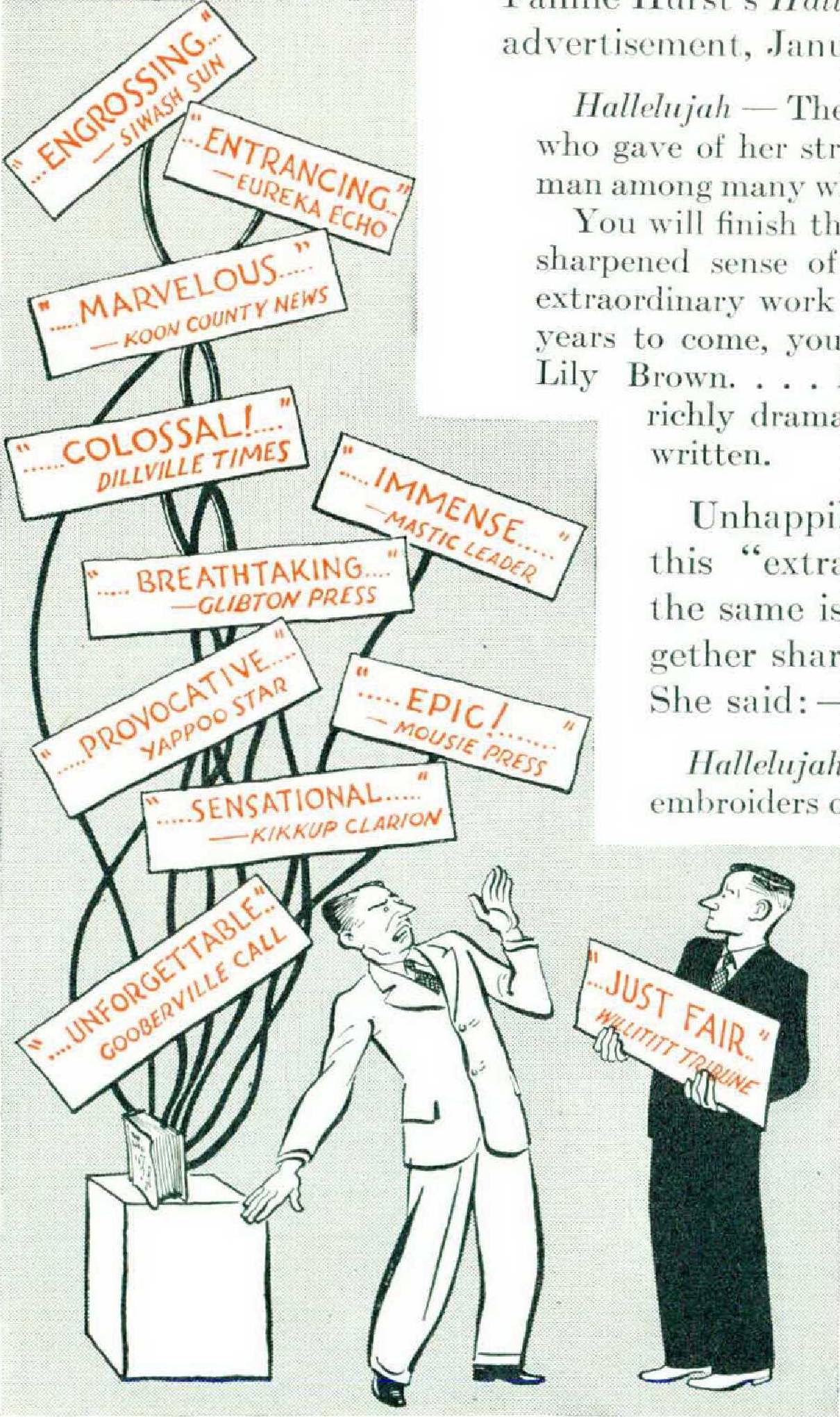
It is heartening to record that the men who make our books have done something in this case. Conscious of the delicacy of the situation, of their responsibility to the customer, and of the hypersensitive feelings of their authors, they have adopted a selective or filtering process comparable to the gills of a fish. When they quote reviewers in their advertisements, they considerately omit those whose praise has been faint and those who have not. praised at all, thereby effecting a smooth harmony between their own claims for the book and the remarks of the truly percipient reviewers who agree with them. Yet even this admirable practice has not satisfied an unreasonable and unappeasable minority who do not regard it as quite cricket.
Here, then, is something for publishers to think about as they sit in their ivory towers surrounded by autographed photographs of ingrate best-selling authors who have gone to their competitors. The saving grace for them perhaps is that, since they sometimes read some of the books they publish, they must know that even the weariest drivel winds somewhere safe to sea.