Eating for Causes
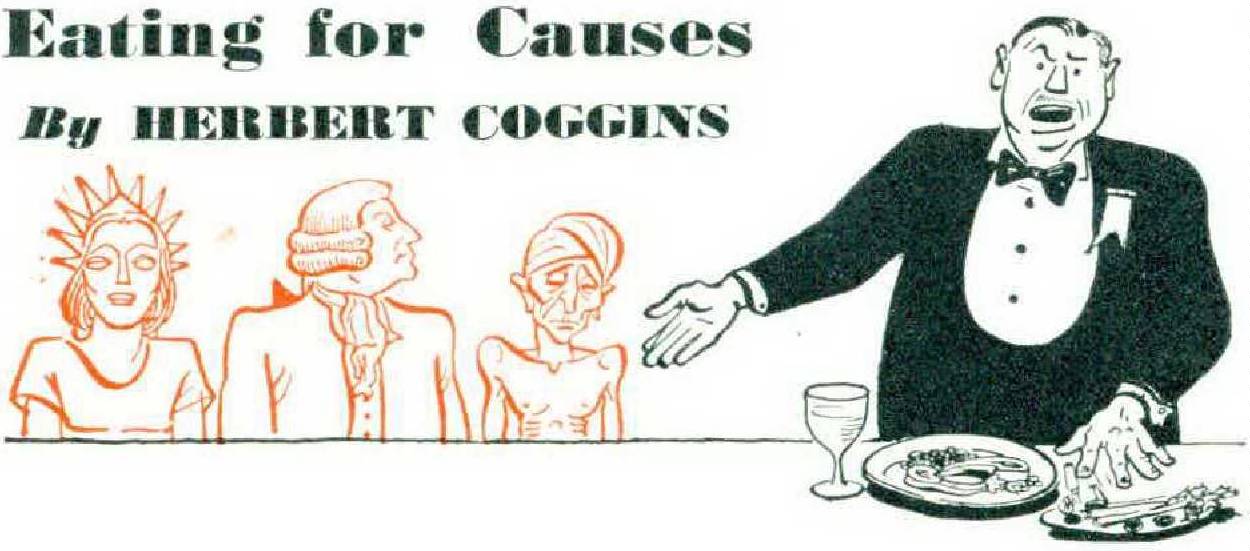
A MOST suitable vocation, with a great and worthwhile future, is one which I have classified as constructive gastronomy. In a way I pioneered it. I assume no great credit for it, but much of my life has been devoted to eating for other people — ample and nutritious dinners for the benefit of the poor and starving, for the downtrodden and oppressed, and for worthy persons and noble causes.
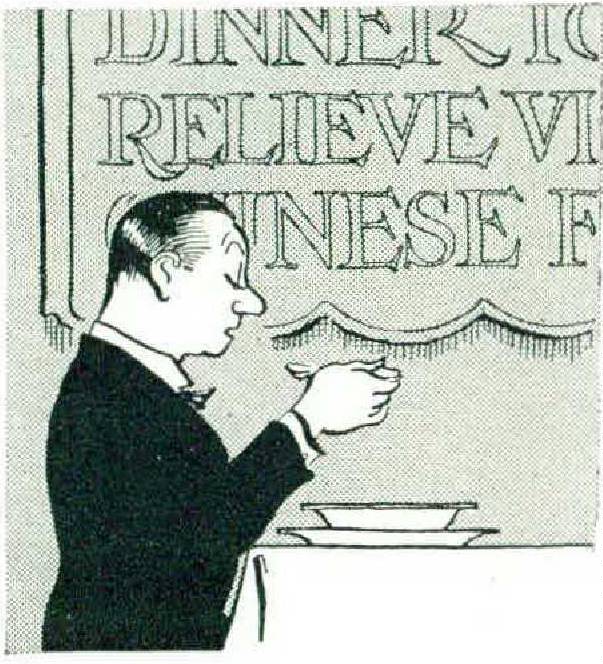
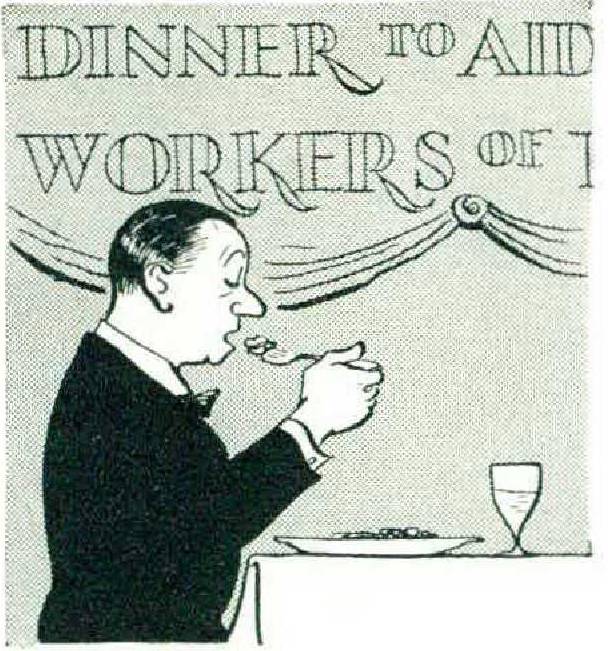
My first experience was a particularly abundant meal I ate for the benefit of the survivors of the Johnstown flood. This was the turning point in my life. I was young, and theretofore eating had been a personal matter devoid of idealism. But that experience opened a vista where duty and pleasure blended. I was soon giving a generous share of my time to dining for others: for the starving Armenians, the perishing Hindus, the famished Irish, the destitute Chinese, for the preservation of the Indian and the uplift of the Negro. Between times I did honor to many great persons: Washington, Lincoln, Jefferson, Henry George, Marx, Darwin, and Susan B. Anthony. I nearly sacrificed both life and digestion during a four-dollar dinner in honor of the father of American frugality — Benjamin Franklin. But I never held it against Mr. Franklin. The trouble was with the oysters.
As I matured, my efforts took on an economic as well as a humane trend. I ate regularly for the striking miners; for the closed shop and the lockedout shopworkers; for shorter hours and for longer pay; for the unorganized farm worker, for the I.W.W., and many times for the Socialist Party. As I recall my many efforts along this line, I am surprised that, the Revolution is still so far off.
Most of all, I have eaten for liberty and freedom. Causes of this type, as you will learn, require repeated honoring, since in any conflict both sides celebrate the same events. One side is fighting to get freedom, the other to preserve it. In fact, so numerous are the celebrations for freedom that anyone with a fair digestion might devote himself to this cause alone.
This kind of work inevitably broadens one’s sympathies. You just can’t eat repeatedly for people without feeling more and more kindly toward them.
It has its cultural side too. Recently I was invited to a dinner for the poets of my state, or for as many as could afford to be there. It was graced by the officially crowned poet laureate himself. Never before was my presence so needed. The poets are notoriously behind in their eating. Their lack of experience was most evident and the whole affair was dragging.
Time and time again I have been pressed into honoring some worthy and humane cause of which I had never even heard. During the war emergency there will be the inevitable need for more and greater banquets. Such causes as war relief, feeding foreign populations, reducing and rationing food at home, will require almost constant dining.
I regret that it is not yet the custom to pay people for eating — for the time consumed and the depreciation of the banqueter. But with the kind of food that is now being served, compensation will be imperative if constructive dining is to continue.
In retrospect, I can see that I have devoted too large a part of my services to what might be called liberal, if not downright radical, causes. As a pioneer I had to start where the need was most urgent. But to any young person who feels drawn to this work, I would suggest leaning a little more to the conservative side. Not only is the food better, but in future there will be a little more of it.
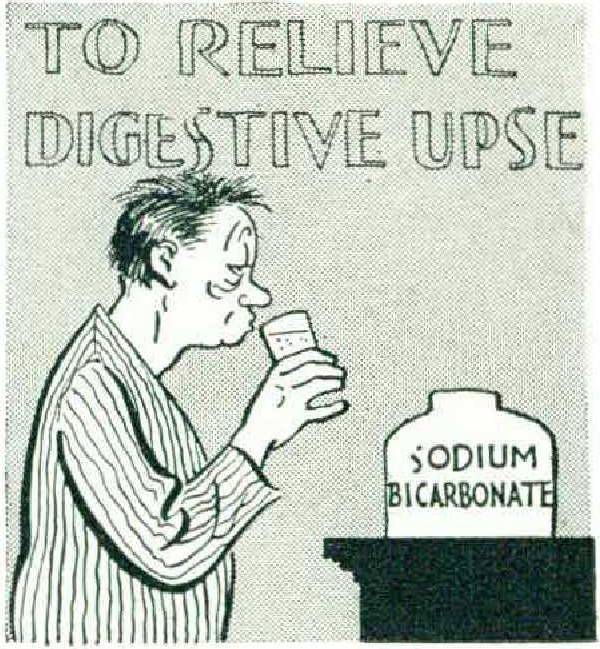
Since both my doctor and my dentist have warned me that I shall have to slow up, I am reluctantly forced to limit my engagements. I now favor only those causes that rate some kind of fowl or possibly a fillet. I no longer feel honestly justified in frittering away time and effort, on those cold and hurried noonday lunches which by their nature are obviously for causes of no great moment.
In the meantime I will continue the best I can. All my old friends on welfare boards, in patriotic and similar organizations, know that my heart and with reservations, my digestion are still with them; and in any crisis that threatens the foundations of our society they have but to call me, and I’ll stand by them to the last mouthful.

- HERBERT L. COGGINS has been an ornithologist, grape picker, publisher, cement contractor, and stationer. He is now engaged in an automotive parts and machine business in San Francisco.↩