That Is an Unlisted Number
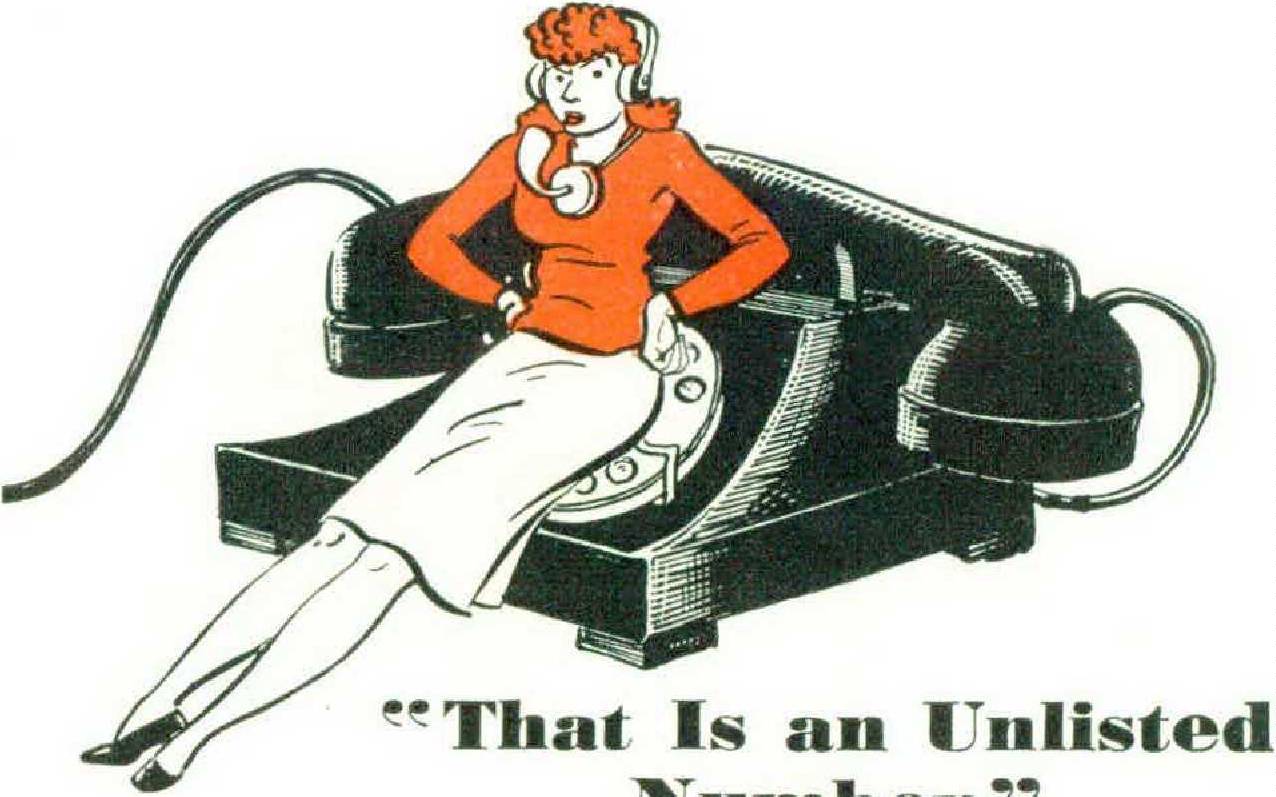
THE people who are listed in the telephone directory — and don’t misunderstand me, they’re the backbone of the nation — resent the people whose numbers are not listed. Reticence about one’s telephone number, they feel, is an act of social or professional striving, a symptom of a swelled head. Sometimes it is, no doubt; but the whole unlistednumber question isn’t that simple. The dividing line between listed and unlisted is, as the political economists say, vertical rather than horizontal, definitely not confined to any one class. Beyond that, it: is difficult to make any hard and fast rule.
I have observed that the very rich are usually listed; so are doctors, unsuccessful actors, bookmakers, and others whose careers depend more or less on telephone calls. Those who are only moderately rich tend to have unlisted numbers, probably because they have butlers but no private secretaries and are in some danger of being reached by somebody in the outside world and talked into an unwise investment or an overlarge donation. Successful actors have private numbers, and so do people who write pieces for magazines.
My own number, for example, is as unattainable as Katharine Cornell’s. I don’t know why, except that I found it was expected of me. When I first moved to the city and began to write pieces for magazines, my number was in the directory between the numbers of a hand laundry and a chiropractor, but apparently nobody thought, to look there for it. Occasionally one of my worldly new acquaintances would say, “Wish I could have got hold of you yesterday evening. We had an extra theater ticket, but I didn’t know your number. I called a couple of your friends, but they didn’t have it, either.”
“Why, it’s in the book,” I’d say. “Under M.” They would look at me strangely, and months later I would become aware that no further invitations had been forthcoming. Until I got my unlisted number, I was well on the way to being ostracized as a freakish Bohemian. Now, I’m glad to say, I get a lot of invitations — or would get them if my friends didn’t mislay my number. This situation leaves me a lot of free evenings in which to write pieces for magazines, thus maintaining my right to the proprietorship of an unlisted number.
In course of time an unlisted number becomes public property, but this is never the Telephone Company’s fault; if is the subscriber’s. The Telephone Company will never give you anybody’s unlisted number, even if you twist its arm and rub your knuckles in its hair. This was forcibly borne in on me on a recent morning when an operator called me at nine-thirty to ask if it would be all right to give the Army my number; it seems that, the Army, in the person of a Corporal O’Leary, had been trying to get me since 3.30 A.M. It turned out not to be anything very alarming — a soldier I know had been staying the night at my place, and the Corporal just wanted to tell him that my friend’s girl had sent a telegram asking him to meet her train at noon — but I was nonetheless impressed. Nine-thirty, it seems, is the earliest hour at which the Telephone Company can imagine an unlisted subscriber being up and dressed and ready to receive calls from the Army. I have a lot to live up to, you see.
As I said, it’s the subscriber himself who, in the end, violates his own telephonic privacy. When somebody who is practically a stranger to you (and who you hope will remain so) backs you into a corner at a cocktail party and says, “Well! Pretty exclusive, aren’t you? I tried to call you up—my little niece and nephew are in town and we wanted you to find us six seats for Oklahoma! — but the operator wouldn’t give me your number, it should theoretically be possible to toss him a steely smile and say, “That’s why I have an unlisted number.”That’s theory; actually, you begin to gabble with nervous politeness and practically foree your number on him, lending him a pencil if he hasn’t got one himself.
This sort of person never loses your number; he keeps it in a little book and gives it to his brother-inlaw, who sells insurance; his grandmother, who is soliciting contributions for a home for indigent dogs: and his daughter, who thinks you may be able to help her get Frank Sinatra’s autograph. The only people who ever mislay your number are your friends.
After a year an unlisted number becomes a liability— if it was ever an asset. An unlisted friend of mine, a man with a Statistical turn of mind, figured out recently that his number was in the possession of eleven girls he didn’t like any more, forty-three other people he had never liked, a former business associate who was suing him at the moment, a discarded masseur, three upholsterers who had made estimates on re-covering a sofa, a political group with which he was no longer in sympathy, a dealer who had sold him a car in ‘41 and was trying to buy it back, and an unidentified alcoholic who never called until after my friend’s bedtime. He’d like to start life over again with a list ing in the directory, he says, but he hasn’t the courage to face the consequent social disgrace.
All this would have been a surprise to Alexander Graham Bell. I have taken the liberty of composing a little drama about the unexpected development of the telephone, suitable for presentation at the next World’s Fair. It is called “Sixty Years of Progress.”
ACT I
SCENE: The laboratory of Alexander draham Bell. Dr. Bell (Don Amec he) is gazing at his recently invented telephone. Finally he picks up the instrument and speaks into it.
DR. BEEL: Come here. Mr. Watson. I want yon. (Enter Mr. Watson.)
CURTAIN
ACT II
SCENE: A public telephone booth. An excited citizen enters, puts a nickel in the slot, and dials “Information.''
CITIZEN: Listen, Information, I want the number of Mr. Thomas P. Lichen, 45 Pine Grove Avenue.
INFORMATION: I um sowry, that is an unlisted number.
CITIZEN: But listen, his factory is burning down. I thought he’d like to know —
INFORMATION: Sowry, we are not allowed to give out that number.
CITIZEN (fishing nickel out of coin-return slot and dialing another number): Hello, Mrs. Osterinoor? This is Henry Benson calling— B, E, N, S, O, N. We met last week at Mrs. Shillaber s. . . . That ‘s right. . . . How are you? Listen, Mrs. Ostermoor, I thought, being you’re a friend of the Lichens, you might have their number. I wouldn’t disturb you, only it’s rather —
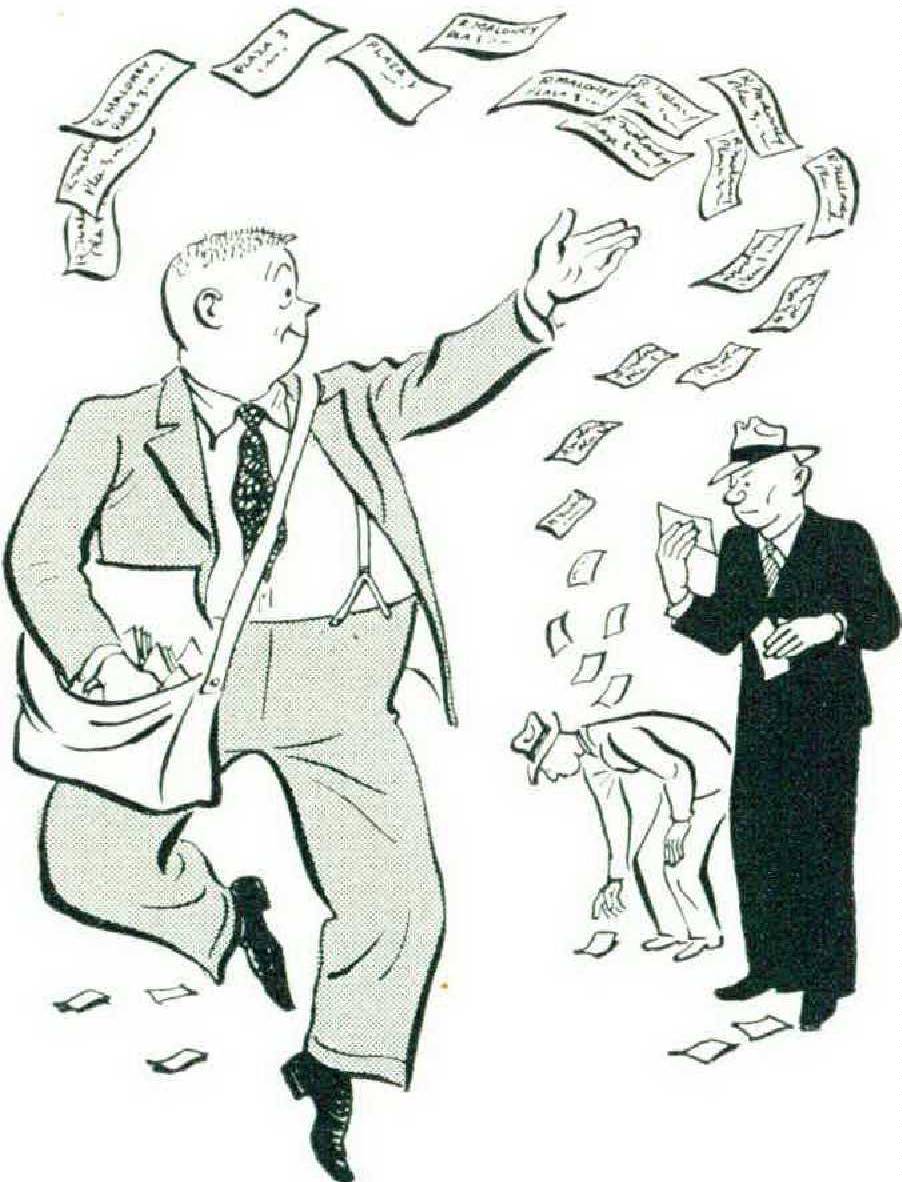
MBS. OSTER-MOOR: Of course! Let’s see now, Greta Lichen gave it to me again only yesterday — I’d had it before, of course, but it got lost whenI I was cleaning out my desk. Just wait till I get my bag. . . . No, I can’t seem to — Oh, I know what happened. I wrote it down on that letter from Cousin Hal in Algiers, and Myron took the letter to the office to show to his partner. But I’ll be seeing Greta in a day or so. Shall I tell her to call you?
CITIZEN (dully): Never mind. I’ll write.
SLOW CURTAIN