The Indian's Message
By JOHN J. ROWLANDS
WHETHER or not old Tibeash was a Cree chief by heredity, appointment, or common consent, I never knew. But if dignity and wisdom and concern for the welfare of his people are the qualifications of leadership, he was indeed chief of the Indians of the Larger Lake region.
The Chief was a little man, lean as a spa rerib and just as sinewy. His skin was the warm brown color of muskeg water, and in the glare of the sun his dark eyes would quickly narrow to thin bright slits that emphasized the lines webbing his face in a pattern as intricate as the filling of a snowshoe. For a Cree it was a remarkably sensitive face, with a narrow straight nose and a good mouth built around a short-stemmed pipe. I sometimes wondered whether, if his forebears could be summoned, there might not be a handsome voyageur among the darker skins.
It was a journey to test the value of a military gig in rough country that brought Chief Tibeash and me together in a Northern Ontario silver mining camp in the autumn of 1911. He was leaving for his w inter trapping and agreed to guide me across a hundred miles of trackless wilderness in return for the transportation of most of his winter supplies. I got the job because I was in from a prospecting trip and wanted something to do.
For the first few days I was uneasy, for Indians don’t always like prospectors, and I wasn’t sure how t he trip was going to work out. Although he was not unfriendly, the old man seldom spoke, and he went about his work in the manner of one who felt the easiest way was to do it himself. We forded icy brooks, built log bridges over deeper streams, and dragged the gig through tamarack swamps and muskeg. Twice we made rafts and ferried across lakes with the snorting and bewildered horse swimming behind.
Not once during that difficult and dangerous journey did Tibeash raise his voice or lose his temper. He was patient in the way of a man who knows you can’t hurry trees and water and hills.
At t he end of a week the Chief was talking a little more. Now and then he drew my attention to something that otherwise I should never have seen — a mink scurrying under the bank of a stream, a sharp hoofprint in the leaf mold, and geese out of Hudson Bay flying so high I could barely see the outlines of the wedge or hear their honking. And he could catch the scent of wild things to an extraordinary degree.
Tibeash had a sense of beauty. He liked the ragged shape of jack pine tops against the moon and the mirrored images of a white birch on quiet water. One night when the rose and green and golden streamers of the Northern Lights were rippling across the heavens he remarked: “When the ice is in the sky the rainbow dances to keep warm.” He liked to look at the stars and listen to night sounds. He knew them all, from the irresponsible frisking of wood mice to the much more cautious rustlings of a browsing moose.
JOHN J. ROWLANDS is Director of News Service for the Massachusetts Institute of Technology and was formerly Manager of the United Press Association’s Boston office. The experience which he has set down here for the Atlantic is true in all respects, reported precisely as it occurred on a Sunday afternoon in 1917.
How old he was the Chief didn’t know. That autumn he thought he must be seventy, but he wasn’t sure, for his mother had told him he was born in the year of many blizzards, which could be any year. Whatever his age, he traveled with the tireless easy gait of a young man, and his good quick eyes missed not the slightest movement of life in the woods. I was nineteen and just learning to see.
For me the triumph of that journey, when we finally reached t he prospecting road to Larger Lake, was not that the gig came up to expectations, nor that we had overcome the obstacles and dangers of a country that had never known the touch of a wheel before, but that as a woodsman I had won a measure of the old man’s respect. I was accepted as a working partner.
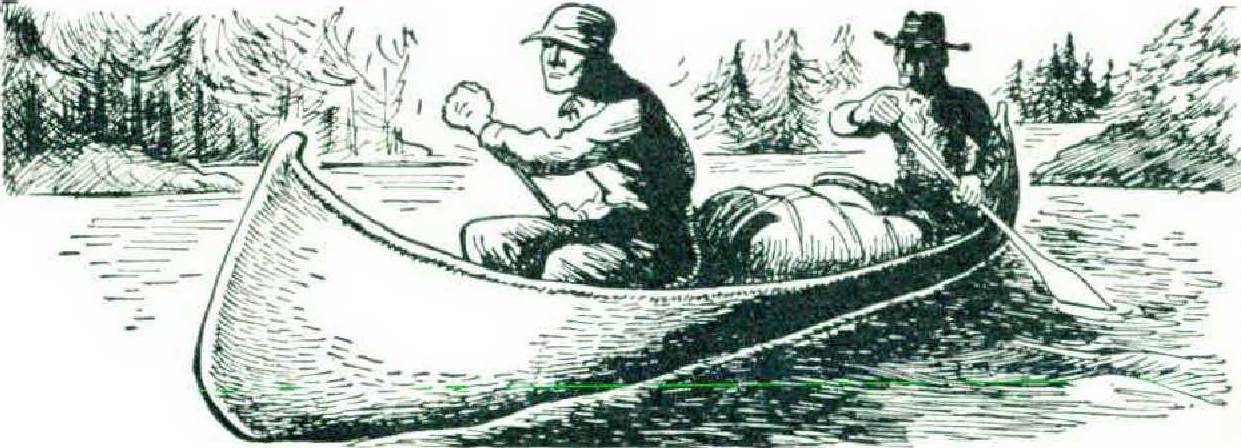
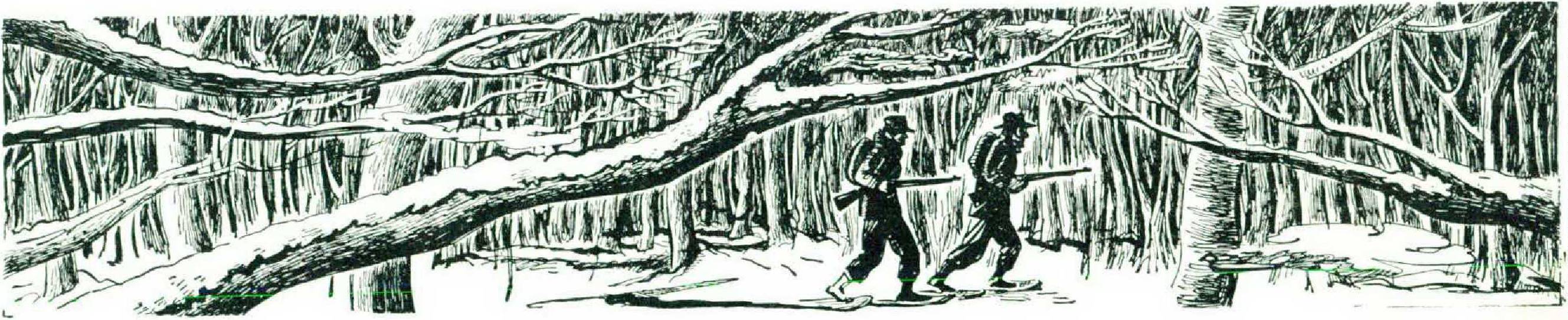
I had planned to take the gig back to the nearest railway as soon as we reached our goal, but I stayed on and time added up to a month and the freeze-up had come when I finally went out. In those weeks the thongs of our friendship became strong and secure, and I stayed with Tibeash for varying periods during the next five years. When I came to know him well, he began teaching me the Indian way of living in the north country. I learned to paddle a canoe with the short and powerful stroke of the Cree, until he said one day: “You paddle like my own people.” I went with him on his trap line, carrying pails of stinking rotten fish entrails, which is prime bait for bear. And the old Chief would swing along mile after mile with seventy-five pounds of bear traps in his pack-sack. He showed me how to aim my rifle with both eyes open, and to kill grouse with the edge of a paddle when they stupidly sat on the lower branches of the spruce. That saved ammunition. I learned to tan deer hides for moccasins and to smoke fish, and how to make a sort of jam from the delicious little high-bush cranberries that grow at the edge of the muskeg. I could call a moose.
From time to time I wondered why Tibeash took so much trouble to teach me his ways. It’s not like an Indian, and there was a strange eagerness in the manner in which he went about it. The more I thought of it the more I became convinced it was part of a plan. The answer came one night while we were sitting by the stove in his cabin. He was whittling a thin spruce slat for a water mouse-trap when he remarked without looking up that I had become a good man in the woods — “like an Indian.” He added that I could be a trapper. And then he did look up and I knew by the way he asked the question that the answer would mean a great deal to him. “Perhaps you would like to stay here with me, my son?”
Tibeash made no protest nor did he show any outward sign of disappointment when I told him that I had decided that I would go back to the States to begin newspaper work. He didn’t mention the subject again; he was too much of a realist for that, but I knew in my answer I had destroyed a hope that was founded on a deep affection for me.
I left the north country in 1916, and though I wrote Tibeash often, I never expected a direct reply. The Chief couldn’t write, but I knew someone would read my letters for him. Now and then a prospector friend sent me messages from him. He always hoped he would see me again.
In 1917 I was in newspaper work in New England and living in the house of an old lady and her widowed middle-aged daughter. They were kind people, hospitable to the point of embarrassment. Their one great interest in life was a belief in spiritualism and I had been with them only a few weeks when in their sincere enthusiasm they began trying to awaken in me an interest in communication with the dead.
I don’t like experiments in the supernatural and I dodged frequent invitations to séances. There came a time, however, when my excuses seemed too apparent to be convincing, and I finally accepted an invitation — not, however, for a séance, but to dinner one Sunday in September. There was to be company, “a lady from Maine,”they told me.
Just before dinner that day the daughter confided to me in tones of suppressed excitement that our visitor was a medium of extraordinary powers. Noting what must have been an involuntary sign of dismay, she quickly assured me that there was nothing to worry about. But, just in case by some remote and quite unexpected chance a spirit desired to express itself through our visitor, I was not to be in the least disturbed. Spirits, she gave me to understand, should not be turned away. In fact a good medium never denied them.
Our guest was a plump woman of the type common to any New England small town. You see her airing the pillows in an upstairs window after breakfast. She still believes in flannel on the chest for colds, her doughnuts are good but greasy, and she thinks linoleum rugs are lovely. You know what her hair is like— drawn back and held in a lump at the top by a comb ridged with rhinestones. Her conversation that Sunday was about the tricks of her tiger cat and the size of her dahlias. Her husband was about as well as usual and still liked whist. They often thought they’d try bridge but it seemed to take so much thinking, and anyway she liked to talk, which you can in whist. The only thing about the woman that stirred my interest was her very dark brown eyes. They had the peculiar fixed-focus expression of the zealot, and their steady gaze persisted much longer than polite attention requires.
The meal went along normally enough for a while and I was about to give expression to my increasing peace of mind by accepting a second helping of chicken when I noticed a change in our visitor. I heard her draw in her breath with a queer sucking sound and then she became almost rigid. Her eyes, now extraordinarily bright, were fastened on me. But fastened is not just what I mean, for although she was looking directly at me, I got the impression that she was actually seeing something beyond.
My landlady and her daughter were sitting spellbound, their faces lighted by expressions of ecstatic anticipation. I was almost as rigid as the woman opposite me. For a few seconds there was complete silence and then the woman from Maine began speaking in the voice of a child — not an adult’s imitation of a child, but what sounded very much like a little girl. At first I could make nothing of it and then a few sentences came clearly. Interspersed with the English words were Indian terms that I remembered vaguely. She went on for several minutes, and again I lost the thread of her message until suddenly, her eyes staring straight at me, she said: “Behind you stands an old, old Indian. He will alwavs be with you to watch over and guide you. And from him you will gain wisdom and your judgment will be good.”
Startled, I whirled in my seat. All I saw was the crayon portrait of the daughter’s dead husband hanging above the golden oak sideboard.
A little ashamed of myself, I turned back to the table. The medium was coming out of her trance and immediately I became the center of attention. There was great excitement. My landlady wanted to know whether I knew any Indians. Where had I known them and were they young or old? By that time I was thoroughly uncomfortable and I decided the quickest way to end the discussion was to deny all knowledge of Indians. And I did so emphatically. The old lady and her daughter were obviously disappointed that I could not confirm what seemed to be a most astonishing and unusual manifestation. Our guest appeared not at all disturbed, and while the two women talked she kept looking at me with that strange fixed-focus expression. When there was a momentary silence she said: “I am only the voice of the spirits.”
That night I decided to seek new lodgings. I knew that from that day on my kind but persistent friends would give me no peace. I was a person set apart, someone worthy of exhibition perhaps, and spirits would be my daily fare if I stayed on. So I found some friends to take me in, and departed much to the regret of my landlady.
So far as I was concerned that was an experience which, while interesting in retrospect, was not one to be repeated, and I had all but put it out of my mind when at Christmas I had a letter from a prospector friend in Northern Ontario. He gave me news of t he people I had known and their doings. There had been a gold strike in Northwestern Quebec and he was going to prospect the region. A number of people I knew had gone away, and several had died; I would be sorry to hear that my old friend Tibeash was among them. He had died on September 9. At first the date held no particular significance for me, but as I looked at it again it somehow seemed familiar. I flipped back the pages of my calendar. It was the day of my strange dinner with the medium.