Memoirs of a Monoclist
By GORDON KAHN
FOR thirteen years now, I have been viewing the world through a monocle. There will not be, I am afraid, a fourteenth. Until the day the lens was fitted to my right eye, or oculus dexter as it is known to the guild of optometrists, Creation for me had but two dimensions: height and width. A nimbus floated before everything. As in GENESIS, i, 2, “the earth was without form, and void.” Nothing had depth or substance until I touched it or fell over it.
I thought this was the way the world looked, hazily drab, but not unpleasant. How drearily mistaken I was, I realized one day in 1930 when I went to a flying school on Long Island and asked to be taught fo fly. Nothing showy — just enough to enable me to takeoff, scud about, and land with the flesh and the spirit in the same container. I was assured that it could be managed, but first would I submit to a series of simple tests.
My hearing was above average, my blood pressure normal. I was properly startled when a sudden loud noise was made behind me. The last test was for eyesight and depth perception, and it was here they returned my deposit on the lessons. I was assured that no offense was intended, bill that they were saving me money and the instructor’s neck. They gave me the address of an eye specialist and warned me not to browse around the landing field lest I be fanged by a propeller.
Two weeks later I stole into the city room with a monocle lashed to a silk cord and moored to a shirt button.
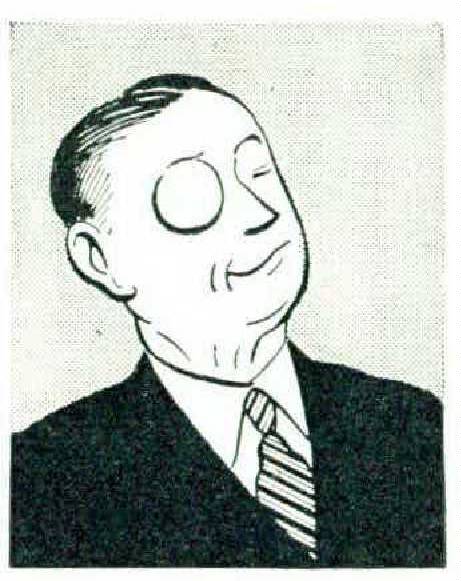
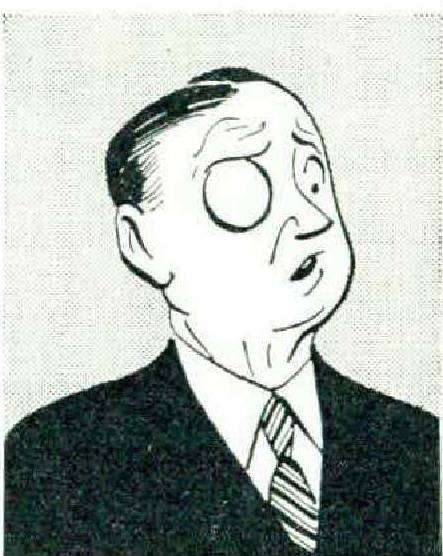
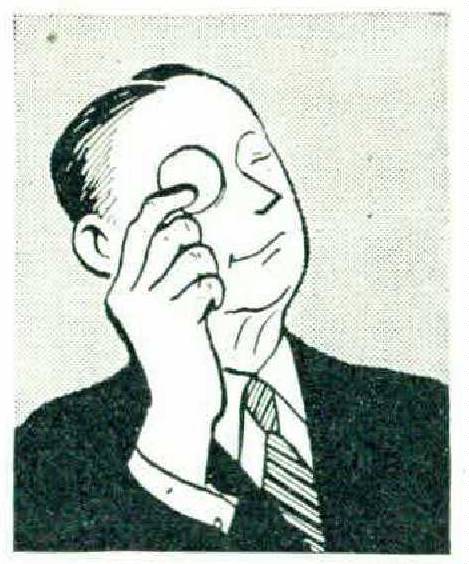
Today as a journeyman monoclist and not one of your desultory or secret wearers of the single glass, I possess two monocles. The spare is in my safedeposit box in the subcellar of a solvent bank. The working monocle is in my eye except when I retire, and frequently then as well, in the morning the muscles around the frontal bone, conditioned by more than a decade of unflagging embrace of the glass, virtually snap at the frame. I shave with it on, wear it in the shower stall, and frequently hunt for it, unaware that I’m wearing it.
Only twice has it fallen, and both times it remained miraculously whole. Once, during a blizzard, the whirling tire of a bogged automobile shot a stone off the roadbed; it struck me in the temple and sent my monocle spinning.
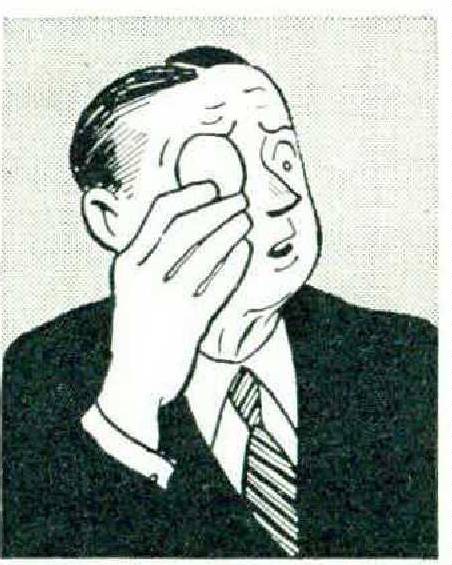
The second near-disaster occurred in a barroom and the offender was a woman. She advanced beerily upon me and asked to try my monocle. When, naturally, I declined, she returned to her escort and pleaded, “George, make him let me wear it.” It was either yield the glass, fight, or flee, so the woman pressed it in her eye. It clung for a few seconds and then catapulted to the floor. Again, preternaturally, no damage resulted.
Requests to handle the glass are not so frequent as questions about it. The commonest is not, “Why do you wear it ?” but, “How do you keep it in?” Most people assume that a monocle isn’t worn as an aid to sight, but is affected for reasons of vanity and unique adornment, like tattooing. During my monocular novitiate, self-consciousness made me defensively curt and often sarcastic with people who asked how I kept the glass in my eye. The simplest and truest answer of course is: “It stays in place naturally. If you stop to think about it, it falls out.”
The wearer of a monocle doesn’t shop for his glass as one does for spectacles, with an eye for such refinements as whiteor rose-gold, or embossing across the bow. A monocle must be tailored carefully with frequent fittings to a fraction of a millimeter. Even then the first few weeks are perilous. Each step seems to jar it from its anchor in the flesh. The horizontal axis must always be at a level with the center of the pupil; otherwise vision is distorted to a degree where every angular structure trails off in curves like a Doric pillar. But if the monoclist perseveres he can dispense with the silk lashing — let the slivers fall where they may.
My own confidence wavered for a long time until, at a horse show, I watched a monocled Frenchman take the loftiest hurdles and recover from every spine-jarring vault with his glass still in place. I went forth with fresh aplomb.
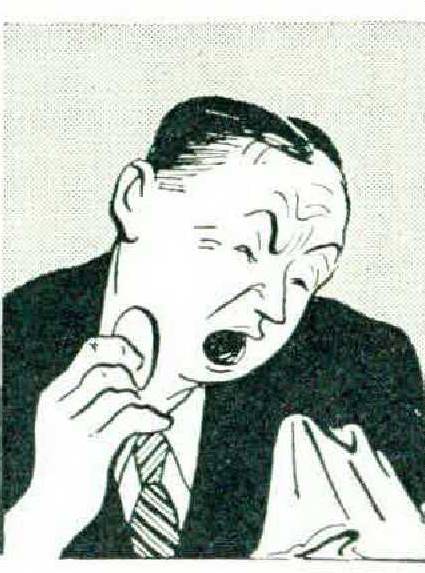
Rain, snow, and high winds may be inconveniences to the round-the-clock monoclist. But for actual terror, nothing equals the sneeze. If there is a warning of it, the subject is well-advised to pluck his glass out first or cup his hand over it. But the spasm which comes suddenly is quite likely to propel the monocle out of the head and dash it to powder against the nearest wall.
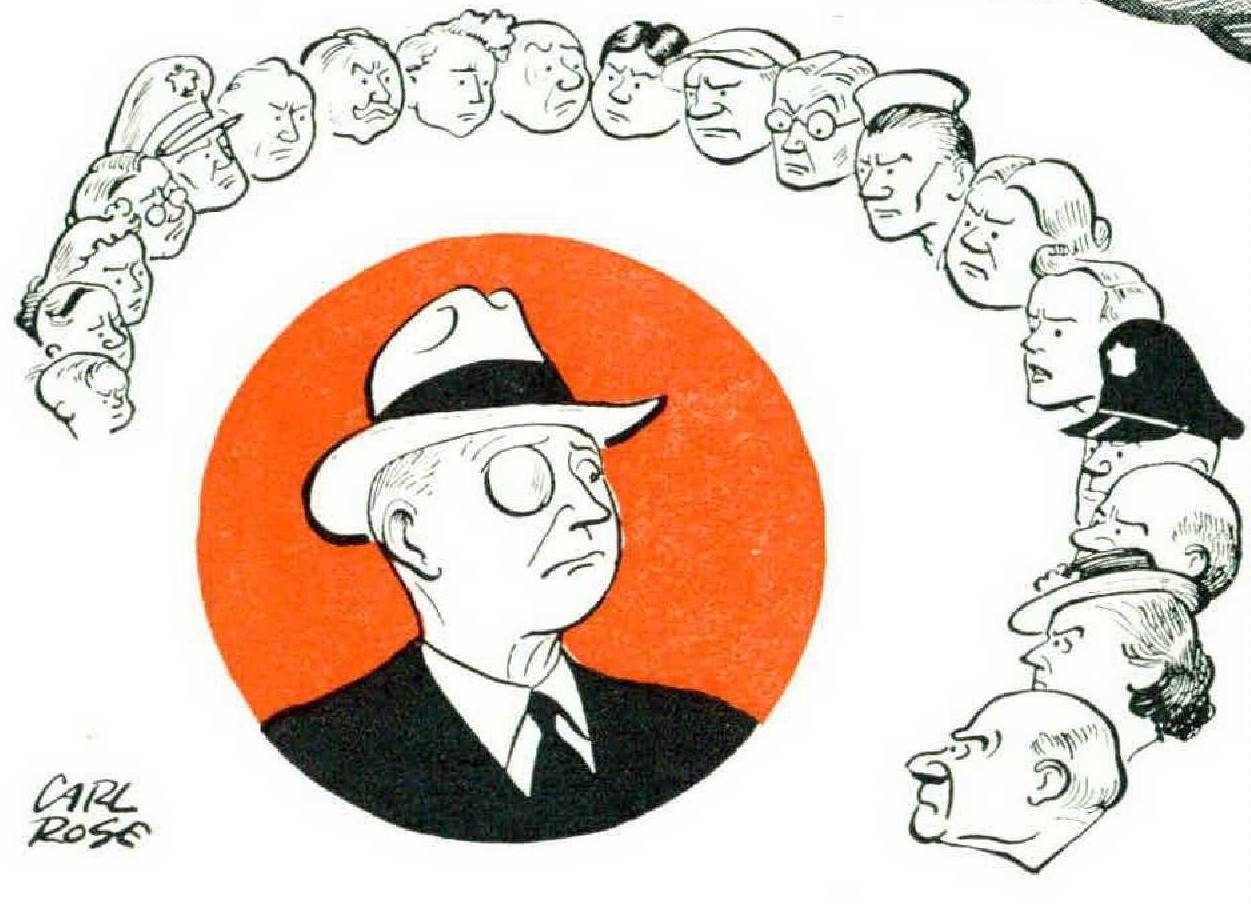
Although Hungarians and Italians actually outnumber all other Europeans in the per capita use of monocles, the device in the public mind is most often associated with the German Junker and the upper-class Englishman. Even Émile Gauvreau, my former managing editor, who knows me to have addressed copyboys as “Please, sir,” describes me in his book, My Last Million Readers, as “a peppery little man with the stern face of a Prussian officer, [who] wore a monocle.”
The popular affinity of monocle and Teutonism was assumed as well by fellow newspapermen who covered the Hauptmann trial with me in 1935. When Hauptmann finally consented to be interviewed, he made the condition that he would speak to only one reporter and only in t he German language. I was delegated, and when I pleaded that I didn’t speak German well enough to worm information out of a celebrated and canny criminal, the other reporters said, “ What do you mean, you don’t talk good German? You wear a monocle, don’t you?”
Recently I was asked to lecture to a group of soldiers who were preparing for duty with Air Force combat units as newsreel photographic teams. The officer who presented me felt constrained to assure my audience that, despite the monocle, I was a loyal American. Even then the discussion later was not so untrammeled as I should have liked.
That incident was the most recent of a series of embarrassments induced by the post-Pearl Harbor monocle. One involved a policeman who caught me redhanded in the offense of overtime parking a scant eleven miles from a war plant. Instead of the customary “Lemme see yer license,” he wanted to know my true nationality, and did I have proof or, failing that, my Selective Service card. I have since fattened my wallet with a birth certificate and a whole sheaf of documents to show that I am an honest, lawabiding, bond-buying and War Stamp-licking burgher. But that proved no talisman against another incident.
An investigator called upon me, politely enough at first, to inquire into the character and probity of a friend who had applied for a position in one of the Federal bureaus. The interview progressed agreeably during the oral questioning, but when he showed me some papers, I had to put on my monocle, which I did not happen to be wearing when he came in. That did it! The line of questioning took an abrupt jog. How long had I lived in this community? Did I correspond with members of the Armed Forces? Yes, with my brother, occasionally, a lieutenant in the Corps of Engineers. And then, of course, the inevitable, “Of course you speak German?”
The next day I went to an eye specialist. I told him frankly why I wanted to get rid of a perfectly practical monocle. Spectacles were out of the question with a condition like mine. There was, however, the contact lens, which is worn under the lid, directly upon the living eye. That, he warned, would be a nuisance since it couldn’t be worn for more than a few hours at a time, requiring frequent immersion in a special solution.
He fell upon me with instruments, with probes and with scopes, and dazzled me with wands that flashed lights of every color. He fastened to my head something that resembled the upper part of the Iron Maiden. With monocle and with naked eye I gazed upon pictures and read tracts. He conjured up a birdcage and told me to sing out whether it was a squirrel or a parrot inhabiting it. An hour later, when this ordeal by chimera was over, the specialist looked grimly at me. He asked me how long I had been wearing this monocle. I told him thirteen years, almost to the day.
“Throw it away,” he said. “You can see better without it than wit h it. Twenty dollars.”
Of course a man doesn’t cast away a monocle that has served him faithfully and well for thirteen years. I put it in my pocket and groped my way out, felling en wobbly route a coat-t ree. The specialist mercifully led me to the elevator. “I don’t mean,” he explained, “just throw it away. You’ll have to dispense with its use gradually. Try it a half hour tomorrow without the glass and increase it a half hour or so every week.”
So, at present, for two of the brightest daylight hours, my oculus dexter is unadorned. And at this rate, sometime next April I shall at last, sheathe my monocle in a little envelope of velvet and entomb it with its forlorn twin in the safe-deposit box.