Political leaders across the world voice their disapproval of Trump’s travel ban, U.S. soldiers killed in Yemen, Myanmar's ruling party lawyer is shot and killed at an airport, and the Philippines bombs suspected terrorists.
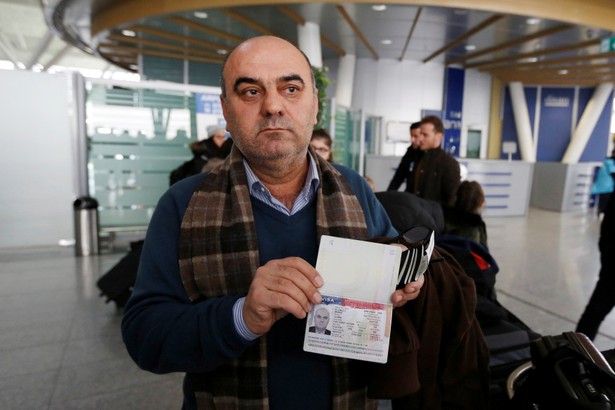
Fuad Sharef Suleman shows his USA visa to the media after returning to Iraq from Egypt.
Ahmed Saad / Reuters
—Some U.S. politicians on both sides of the aisle and world leaders voice their disapproval of Trump’s travel ban that targets seven majority-Muslim countries.
—U.S. soldiers targeting al-Qaeda militants in Yemen died in an operation, the first casualties of Trump’s administration.
—The legal adviser to Myanmar's ruling National League for Democracy was shot and killed by a gunman at the airport.
—The Philippines killed 15 Muslim militants in the country’s south with targeted airstrikes.
—We’re tracking the news stories of the day below. All updates are in Eastern Standard Time (GMT -5).
Gunmen killed at least five people at a mosque in Quebec City who had come for a Sunday evening prayer service, according to the mosques’ president. About 40 people were inside the Quebec City Islamic Cultural Center, located in the Sainte-Foy neighborhood, and two suspects have been arrested. Police have set up a perimeter surrounding the area. Quebec has seen increased incidence of Islamophobia in recent years, particularly after a 2015 political debate over whether the city should ban the niqab, a Muslim face covering; The majority of the city was in favor of the ban. This same mosque was the focus of an investigation in June, after a severed pig’s head was dropped at its doorstep, wrapped and left with the message, “Bon appétit."
The negative reaction to President Donald Trump’s ban on travelers from seven majority-Muslim countries came in the form of protest in cities across the country, at airports, and in the form of donations to The American Civil Liberties Union (ACLU), whose lawyers have filed suits against the ban.
Throughout the weekend lawyers with the human rights organization met banned travelers at airports all over the country, and in several cities they filed injunctions against Trump’s executive order, winning stays from federal judges.
From Saturday to late Sunday more than 290,000 donors had sent the ACLU $19 million—the organizations typical annual average is $3 million. That figure, as well as the growth in membership, was “unprecedented,” according to Anthony Romero, the ACLU’s executive director.
The donations were supported in part through social media, where celebrities like the singer Sia, and actor Rosie O’Donnell offered to match donations to the ACLU of up to $100,000. Tech companies like Lyft pledged to donate $1million to the ACLU, and tech investors like Chris Sacca, an early backer of Uber and Instagram, matched up to $150,000.
The French Left Chooses Benoit Hamon as the Socialist Presidential Candidate
Christian Hartmann / Reuters
In France’s primary vote to determine who will run for president under the Socialist Party’s banner, voters handed the election to the traditional leftist Benoit Hamon. His win is a rebuke of the more-centrist policies of his rival, Manuel Valls, a former prime minister. Polls give Hamon little chance of winning the two-stage presidential election, with votes in both April and and May. Analysts believe his victory will likely turn more moderate leftists to vote for Emmanuel Macron, a 39-year-old independent centrist and former economy minister who wants to bridge the Left and the Right. Macron, however, is polled behind both Conservative Francois Fillon, and the far-right leader Marine Le Pen, who are both seen as most likely to face off in May. The Socialist Party has suffered massive unpopularity after the presidency of Francois Hollande, who was criticised for U-turns on major policies, and because of several high-profile terrorist attacks, was perceived as unable to keep the country safe
Protests Against Trump's Executive Order Spread Nationwide
Trish Badger / Reuters
Late into the night on Saturday, protesters flooded airports around the country to condemn President Trump’s executive order on immigrants and refugees.
On Sunday, they flooded American cities.
Protesters seemed to have multiple goals as they carted banners and signs to various metropolitan downtowns: to tell the brand-new president that his executive order restricting immigration and refugees was un-American; to decry Trump and his top advisers personally; and to demonstrate to the world that U.S. citizens are actively rejecting the new policy.
The protesters came by the thousands, and by Sunday mid-afternoon showed little sign of dispersing. For some cities, this was the second straight weekend they’d seen massive protests: Last Saturday, women’s marches were held in the United States and internationally to protest Trump and his new administration.
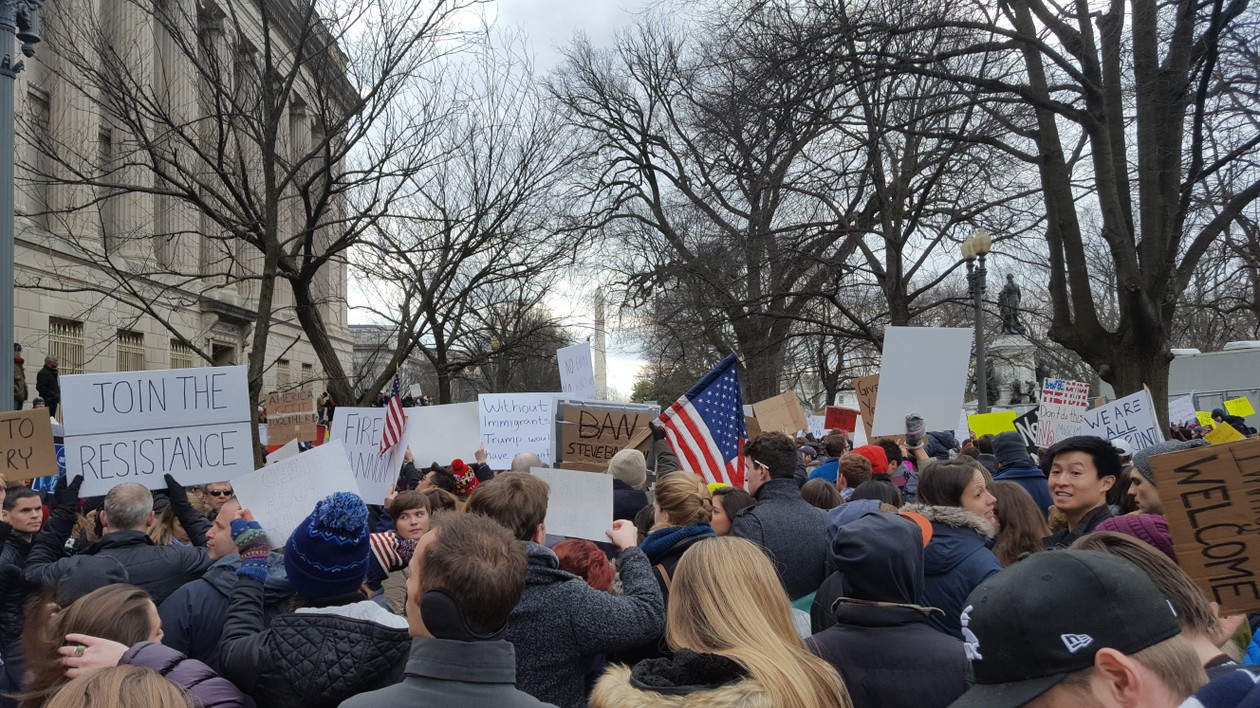
In Washington, D.C., demonstrators on Sunday took their chants to Trump’s new Pennsylvania Avenue hotel—and down the street to Lafayette Square, just outside his White House. Here are scenes from some of the protests:
An estimated 1,200 people at Turner Park protest today against Trump's executive order on immigration, W-H reporter says. Full story later. pic.twitter.com/iMAik7YSUp
Protest happening along Avenida De Las Americas in front of the GRB Convention Center. It is a peaceful protest with security everywhere. pic.twitter.com/S5KF64uYGU
Philippine Airstrike Gravely Injures the Top ISIS Leader in Southeast Asia
Bullit Marquez / AP
Philippine military leaders confirmed Sunday that an airstrike in the country’s south killed 15 Muslim militants with ties to ISIS, and seriously injured an Indonesian leader considered one of Southeast Asia’s top terror suspects. Isnilon Hapilon, who is also known as Mohisen, is the leader of Abu Sayyaf, a group of militants notorious in the region for kidnapping tourists and holding them for ransom. Last year the group beheaded two captured Canadian tourists, and the U.S. has placed a $5 million bounty on Hapilon’s head. Philippine military Chief of Staff General Eduardo Ano said Hapilon was believed to be seriously injured, and is somewhere on the outskirts of Butig, a town in the country’s mountainous south, which has long been a haven for extremists. Jet fighters carried out the strikes, dropping six 500-pound bombs Wednesday night and Thursday on the group’s encampment. Officials said that while Hapilon has not yet been captured, their intelligence says he is being moved around on a stretcher by his followers, who are surrounded by Filipino troops.
Protesters Outside the White House Chant Against Trump's Immigration Order
(Elaine Godfrey / The Atlantic)
Protesters have filled Lafayette Square outside the White House in Washington, D.C., in response to the executive order on immigration that President Trump signed Friday that severely restricts immigration from seven Muslim countries, suspends all refugee admission for 120 days, and bars all Syrian refugees indefinitely. Since they can’t get close to the White House, protesters are lining Madison Place, and climbing the steps of the nearby U.S. Court of Federal Claims. They’re chanting “Let them in” and “No hate no fear, refugees are welcome here.” A few are shouting “Fire Bannon,” a reference to Steve Bannon, the president’s chief strategist and senior counselor. After every round of chants, the crowd breaks out into cheers. On the perimeter of the square, I caught a young man named Tom, wrapped in the American flag, sprinting to the protest. The immigration order is, “just disgusting,” he said, and kept running. Four Iranians who said they had green cards told me they were afraid their family members won’t be able to visit them—and they won’t be able to see their relatives. One woman, who said her name was Mehnoosh, brought her two daughters to the protest. She cried telling me she isn’t sure her sister, who was supposed to be visiting soon, will be able to get in. “I’m very sad ... I’ve been crying the past few days.”
The First Combat Casualty of the Trump Administration
Fawaz Salman / Reuters
A U.S. soldier was killed Sunday in a raid in Yemen that targeted local al-Qaeda militants, making it the first casualty of President Donald Trump’s administration. The soldier was a member of a Navy Seal unit, and three others U.S. soldiers were injured during the crash-landing of their aircraft, which was later intentionally destroyed. The operation’s goal was to collect intelligence, including computer equipment, that was believed to be linked to possible future attacks. The local wing of al-Qaeda in Yemen, which is in the midst of a civil war, has proved a powerful threat. The U.S. has mostly relied upon drone strikes to fight militants in the area, and this operation had reportedly been planned for months. It received authorization by Trump, The Washington Postreported. Fourteen militants died in a firefight with U.S. soldiers, and there are reports of more than a dozen dead civilians.
U.K. Citizens Start a Petition Against Trump, and Other Reactions to the Travel Ban
Kate Munsch / Reuters
President Donald Trump and his administration stood defiant Sunday, despite growing, global criticism over his travel ban. Some world leaders have weighed in on the executive order, including German Chancellor Angela Merkel. She said on Sunday that she is “convinced that the necessary, decisive battle against terrorism does not justify a general suspicion against people of a certain origin or a certain religion.” Similarly, U.K. Prime Minister Theresa May said Britain does not support Trump’s ban, and citizens there started an online government petition titled "Prevent Donald Trump from making a State Visit to the United Kingdom." Its text reads, in part, that Trump’s "well-documented misogyny and vulgarity disqualifies him from being received" by Queen Elizabeth or Prince Charles. By Sunday at 1 p.m., nearly a half-million people had signed the petition, well beyond the 100,000 signatures needed for parliament to consider it. Among members of the U.S. Congress, the ban is also getting pushback. Ohio Republican Senator Rob Portman said: "I think we should slow down.” Arizona Republican Senator John McCain said “it’s been a very confusing process,” and that it would likely “give ISIS some more propaganda." Meanwhile, Trump’s team seems unfazed. A top adviser and former campaign manager, Kellyanne Conway, said Sunday on Fox News that the order was about "preventing, not detaining," and said not many people had been impacted by the travel ban. The day before, she’d tweeted this:
Get used to it. @POTUS is a man of action and impact.
Promises made, promises kept.
Shock to the system.
And he's just getting started https://t.co/AoUsZWClXt
When President Trump last summer implored Republicans to launch a nationwide gerrymandering blitz to pad their narrow House majority, the fight he started did not seem fair. GOP lawmakers had both the will and the power to draw their party new seats, while Democrats were hamstrung by limits of their own making. The question was not whether Republicans could expand their edge in Congress, but by how much.
This morning the landscape looks a lot different, after Virginia voters yesterday approved a lopsided new House map that could hand Democrats an additional four seats that Republicans currently hold. The Democratic redistricting victory is the party’s second in a statewide referendum. When combined with new lines that California voters endorsed in November, Democrats have now succeeded in drawing districts that will likely yield them nine more seats this fall, at least matching what Republicans have been able to achieve in states that they control. By some measures, Democrats have jumped into the redistricting lead, bolstering their chances of winning back the House majority in the midterm elections.
Patients are getting stuck in the emergency department for days while waiting for a spot in an inpatient ward.
In the last months, weeks, and days of his life, “I will not go to the emergency room” became my husband’s mantra. Andrej had esophageal cancer that had spread throughout his body (but not to his ever-willful brain), and, having trained as a doctor, I had jury-rigged a hospital at home, aided by specialists who got me pills to boost blood pressure; to dampen the effects of liver failure; to stem his cough; to help him swallow, wake up, fall asleep.
“I will not go to the emergency room”—emphasis on not—were his first words after passing out, having a seizure, or regurgitating the protein smoothies I made to pass his narrowed esophagus. He said it again and again, even as fluid built up in his lungs, rendering him short of breath and prone to agonizing coughing spells. He had been a big, athletic guy, but now, in the ugly process of dying, he was looking gaunt. Ours was a precarious existence, but I understood his adamant rejection of the emergency department. Most prior visits had morphed into extended trips into a terrifying medical underworld—to a purgatory known as emergency-department boarding.
This article was featured in the One Story to Read Today newsletter. Sign up for it here.
The mystery of the missing scientists began with a Silver Alert. In late February, a retired Air Force major general named Neil McCasland left his house in New Mexico for a walk and never returned. Rumors spread on social media that the elderly former astronautical engineer had been abducted or killed. Forget Nancy Guthrie, they said. Here was a guy who used to run a “UFO-linked” lab. Here was a guy with knowledge of “America’s deepest, darkest secrets.” So where was this guy?
McCasland’s wife did her best with a post on Facebook to address what she called the “misinformation circulating about Neil and his disappearance,” but wild notions only multiplied. Dots were added, then connected: Another scientist—an advanced-materials researcher at NASA’s Jet Propulsion Laboratory (JPL) named Monica Reza—had disappeared while hiking near Los Angeles in June 2025. A physicist at MIT had been murdered in December. “What is going on seems to be an enemy action,” Walter Kirn, the novelist and podcast contrarian, said last month.
For the richest men on Earth, everything is free and nothing matters.
At the end of Paul Thomas Anderson’s 2007 movie, There Will Be Blood, Daniel Day-Lewis’s oil-baron character, old now and richer than Croesus, beats Paul Dano’s preacher to death with a bowling pin. Dano’s Eli Sunday, a nemesis of Day-Lewis’s Daniel Plainview during his seminal, wealth-building years, has come to sell Plainview the oil-rich land that he once coveted. But Plainview doesn’t need the land anymore, because—as he explains in one of the most famous monologues in modern cinema—he has sucked out all the oil hidden beneath it from an adjoining property, like a milkshake.
Desperate for money, Eli begs for a loan. Instead, Plainview chases him around a bowling alley and murders him with great enthusiasm. Once it’s over, a butler comes to see what all the noise was about. “I’m finished,” Plainview yells.
Kash Patel has alarmed colleagues with episodes of excessive drinking and unexplained absences.
This article was featured in the One Story to Read Today newsletter. Sign up for it here.
On Friday, April 10, as FBI Director Kash Patel was preparing to leave work for the weekend, he struggled to log on to an internal computer system. He quickly became convinced that he had been locked out, and he panicked, frantically calling aides and allies to announce that he had been fired by the White House, according to nine people familiar with his outreach. Two of these people described his behavior as a “freak-out.”
Patel oversees an agency that employs roughly 38,000 people, including many who are trained to investigate and verify information that can be presented under oath in a court of law. News of his emotional outburst ricocheted through the bureau, prompting chatter among officials and, in some corners of the building, expressions of relief. The White House fielded calls from the bureau and from members of Congress asking who was now in charge of the FBI.
Even in the best of times, the annual White House Correspondents’ Dinner is an awkward and ethically fraught affair. Journalists spend the evening partying with the president and administration officials whom they’re supposed to cover rigorously and skeptically. I’ve been to the dinner several times over the years. It’s typically crowded and a little chaotic, and the ratio of non-journalists to journalists is about 10 to 1. The evening is promoted as a celebration of journalism and the First Amendment, but it has always been a bit of an embarrassment.
These aren’t the best of times for White House correspondents or, for that matter, the First Amendment. And this year’s gala figures to be even more awkward and embarrassing than usual.
Over the past 15 years or so, Democrats have won a lot of races because the opposing party’s primary voters decided to nominate right-wing ideologues (Christine O’Donnell, Todd Akin, Kari Lake) rather than normal Republicans. In all of these races, the Republican establishment warned that nominating an archconservative would undermine their chances of victory, and was proved completely correct.
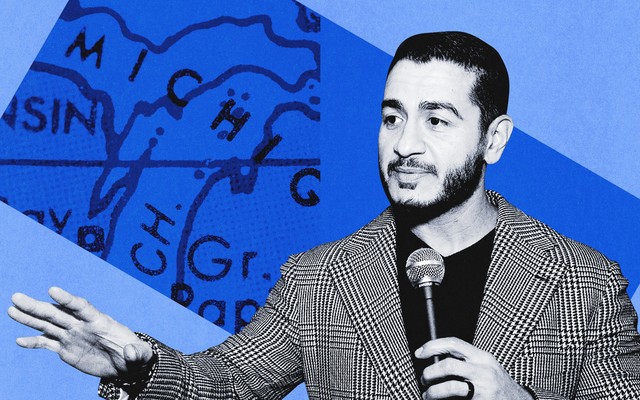
Now Democrats finally have the chance to do the same thing. In Michigan, a purple state that Donald Trump won twice, the physician Abdul El-Sayed is running a competitive race for the party’s Senate nomination. If successful, he would turn a very likely Democratic win into a jump ball.
The people we were died at the exact moment our child did.
This article was featured in the One Story to Read Today newsletter. Sign up for it here.
My husband, David, hates Valentine’s Day. He once called it “New Year’s Eve with nuclear weapons.” I pretend not to care. Still, when the day passes entirely unremarked on, a woman can’t help but feel overlooked.
On Valentine’s Day 2024, David found a way out. He booked a speech on February 14 that required traveling from our home in Washington, D.C., to Toronto. I couldn’t object—he was getting paid. Anyway, I had my own plans: an “anti–Valentine’s Day” dinner hosted by one of the foreign embassies.
As I got ready, I called our oldest daughter, Miranda. She answered from her Brooklyn bathroom, getting ready for her own party. She propped her phone up beside her sink and laughed when I told her about her father’s strategic Valentine’s Day escape.
Fifteen years after Steve Jobs’s death, the company is a successful, if unexciting, powerhouse.
Tim Cook’s job was to make Apple boring—and he did. Cook, Apple’s chief executive officer, is stepping down after 15 years in the role. He had succeeded Steve Jobs after the visionary co-founder of Apple Computer Company left only months before dying of pancreatic cancer in 2011. Since then, Apple has grown in market value by 2,000 percent. It has also transformed into a staid, if immensely effective, firm that sells people glass rectangles, wireless earbuds, and, sometimes, computers. This legacy is not tragic, but it is somber. The crucible in which the personal computer and the smartphone were forged is just a big company now.
Jobs and Steve “Woz” Wozniak started Apple Computer in 1976 to bring Woz’s design for an early personal computer to market, but Jobs did not serve as CEO until 1997, when he returned after years away. Before then, a series of more ordinary businesspeople had run the company—mostly former semiconductor executives including Michael Scott, Mike Markkula, and Gil Amelio, along with the former PepsiCo CEO John Sculley. But by the mid-2000s, after the iMac, iPod, and iPhone had appeared, Jobs had become the apotheosized Visionary CEO—a model for the technology industry and beyond. His exacting and sometimes unreasonable demands, which dated back to the design of the Macintosh in the early 1980s, had made him a singular and irreplaceable presence: a figure who could bend an organization, an industry, and the public who would be transformed by its products to his will.
WAR-FIGHTERS! As a step to making sure we are ready for warfare at all times, we have decided to ELIMINATE THE MANDATORY FLU SHOT! Nothing says “we are ready for war” like “we all have the flu.”
Get your hot-water bottles! Get your ibuprofen! Not Tylenol, though! It knows what it did. Because we are bringing FLU to the war-fighters! Are you ready to have a RUNNY NOSE and an ITCHY THROAT? Are you ready to get REALLY SERIOUSLY DEHYDRATED AND NEED MEDICAL ATTENTION? Hoo-RAH!
We will terrify the enemy by coming in hot! And when I say hot I mean our temperatures! We will need COUGH DROPS, and we will knock those back, CRUNCH CRUNCH CRUNCH, with a sound more frightening than gunfire. This will strike fear into the hearts of the enemy. They will say things like “Do you need a tissue?” and “Are you okay?,” and when they are offering us that tissue, we will strike. And then we will go back to bed and lie under a tactical pile of war-fighting blankets. Peak performance is when you have a terrible headache and want to be asleep, and whenever you open your mouth you sound like someone took lawn shears to your vocal cords. YEAH!