Senate Confirms Nikki Haley as Next U.N. Ambassador
Carlos Barria / Reuters
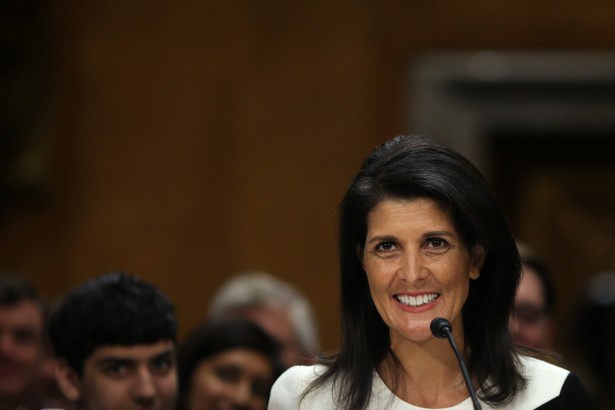
The Senate overwhelmingly voted for Nikki Haley to be the next ambassador to the United Nations. Haley, who has served as the Republican governor of South Carolina since 2010, was approved with a 96-4 vote. As my colleague Russell Berman writes:
Despite her lack of foreign policy experience, Haley faced little opposition from Democrats, who were impressed with her performance in private meetings and at her confirmation hearing before the Senate Foreign Relations Committee.
She is the fourth Trump nominee to get Senate approval.
Yahya Jammeh, the ousted president of Gambia, has found a new home in Equatorial Guinea. Jammeh fled Gambia last week after finally conceding defeat in December’s presidential race. For months, he said he would remain in power, only deciding to leave after West African troops, led by Senegal, invaded and threatened to remove him from power. Adama Barrow, who defeated Jammeh, was sworn in last week. He has not returned from Senegal, where he sought refuge during the political crisis. If Jammeh had remained, he would likely face charges related to human rights abuses over the two decades he was in power. According to Brian Klaas, a fellow at the London School of Economics, since the end of the Cold War, 23 percent of ousted sub-Saharan African rulers have been forced into exile. Jammeh joins that list. Equatorial Guinea is a Central African nation located around 2,000 miles southeast of Gambia. The oil-rich nation is ranked amongst the worst human rights abusers in the world.
LAPD Officers Won't Face Charges in Ezell Ford Shooting, DA Says
Jonathan Alcorn / Reuters
Los Angeles County prosecutors said Tuesday the Los Angeles Police Department officers who shot and killed Ezell Ford in August 2014 will not face criminal charges, the Los Angeles Times reports. The prosecutors concluded that Ford posed “an immediate threat” to LAPD officers Sharlton Wampler and Antonio Villegas, causing them to respond with deadly force. On August 11, 2014, the officers stopped and engaged in a physical altercation with Ford, who was diagnosed with schizophrenia and bipolar disorder. LAPD officials said the 25-year-old then grabbed Wampler’s gun, prompting the two officers to open fire. The shooting, which took place two days after the fatal police shooting of Michael Brown in Ferguson, Missouri, sparked large local protests. In 2015, the Los Angeles Police Commission ruled that though Villegas’ actions were justified, Wampler’s actions violated LAPD policy, including both his initial contact with Ford and well as his decision to use lethal and nonlethal force. Los Angeles Mayor Eric Garcetti, in response to Tuesday’s decision, said: “I accept the decision made by the District Attorney, but rededicate my administration to the search for better ways to protect the safety of all Angelenos, and reiterate my support for the Police Commission’s goal of reinforcing de-escalation in the training of our officers.”
Michigan Says Lead in Flint's Water Has Fallen to Safe Levels
(Rebecca Cook / Reuters)
Michigan’s Department of Environmental Quality says the lead in Flint’s drinking water has fallen to 12 parts per billion from July to December 2016—below the federally safe limit of of 15 ppb. Lead levels were 20 ppb in the first six months of the 2016. The city’s 100,000 residents have struggled without safe drinking water since 2014 because of the manmade crisis. The state acknowledged unsafe levels of lead last October. Residents have relied on bottled water since that time.
Trump Moves to Advance Construction of Keystone and Dakota Access Pipelines
Jonathan Ernst / Reuters
President Trump signed executive actions Tuesday to advance the construction of the Keystone and Dakota Access Pipelines. The projects, which are aimed at constructing pipelines from Canadian tar sands to the Texas gulf coast and from oil fields in North Dakota to southern Illinois, respectively, were blocked by the Obama administration. The move is one the Trump administration said it would tackle on Day One, and serves as a blow to environmentalists who opposed the impact both projects could have on the environment and, in the case of the Dakota Access Pipeline, the damage it could inflict on the Standing Rock Sioux Tribe’s water supply and sacred sites. Here’s more from my colleague Robinson Meyer on what the executive orders say here.
A worker overlooks the Israeli settlement of Ramot in the occupied West Bank on January 22, 2017. (Ronen Zvulun / Reuters)
The Israeli government approved Tuesday the construction of 2,500 settlement homes in the West Bank. The move comes two days after the Jerusalem City Council approved 566 housing units in East Jerusalem, which the Palestinians claim as their future capital, and two days after Israeli Prime Minister Benjamin Netanyahu spoke by phone with President Trump. Avigdor Lieberman, Israel’s defense minister, said the West Bank construction would take place in existing settlement blocs, adding: “There’s nothing new here. We always built, also under [President] Obama.” Indeed, Israeli settlement expansion thrived under the Obama administration, though it was usually met with disapproval. Trump is expected to take a softer position. David Friedman, Trump’s pick for U.S. ambassador to Israel, has argued that Israel’s settlements are legal; Trump called for the Obama administration to veto the U.N. Security Council resolution last month criticizing Israeli settlement activity in the Palestinian territories. The Israeli announcement Tuesday was condemned by the Palestinian leadership, which called the move “a deliberate escalation of Israel’s illegal settlement enterprise.”
Iraqi Government Announces Recapture of Eastern Mosul From ISIS
Iraqi forces gather during an operation to clear Mosul’s al-Zirai district of ISIS militants on January 18, 2017. (Muhammad Hamed / Reuters)
Iraqi Prime Minister Haider al-Abadi confirmed Tuesday the recapture of eastern Mosul from the Islamic State. The announcement comes less than a week after Lieutenant General Talib Shaghati, head of the country’s counterterrorism service, said Iraqi forces had reclaimed the eastern portion of the country’s second largest city, which was first seized by ISIS militants in 2014. The city was the last remaining urban center under ISIS control, and the recapture of its eastern portion marks a major blow to the group, which has lost territory in both Iraq and neighboring Syria. ISIS still maintains control over parts of Mosul west of the Tigris River, where the United Nations estimates 750,000 people remain.
'La La Land' Ties Oscar Record With 14 Nominations
La La Land co-stars Ryan Gosling and Emma Stone pose during the 74th Annual Golden Globe Awards on January 8, 2017. (Mario Anzuoni / Reuters)
La La Land, the musical set in Los Angeles, received 14 Academy Award nominations, including Best Picture, a record that it now shares with Titanic and All About Eve. Also among the Best Picture nominees announced Tuesday by the Academy of Motion Picture Arts & Sciences are Arrival , Hacksaw Ridge, Hidden Figures, Lion, Moonlight, Fences, Hell or High Water, and Manchester by the Sea. Three of those films—Hidden Figures, Fences, and Moonlight—feature predominantly black casts in leading roles—a departure from nominations in recent years that prompted the hashtag #OscarSoWhite. My colleague David Sims has more on the nominations here. Full list of nominations here:
Russia, Turkey, Iran Strike a Deal on Syria Ceasefire Mechanism
(Mukhtar Kholdorbekov / Reuters)
Russia, Turkey, and Iran have agreed to monitor a ceasefire between the Syrian government and rebels at the second day of talks in Astana, Kazakhstan. The government of President Bashar al-Assad and Syrian rebel groups agreed on December 30 to the truce, which has mostly been holding since then though each side has accused the other of violations. The talks in Astana, which were brokered by Russia and Iran, which back Assad, and Turkey, which backs the rebels, began Monday and were intended as a step to end the more than five-year-long civil war.
U.K. Supreme Court Says Parliament Must Approve Brexit Trigger
(Reuters)
The U.K. Supreme Court ruled Tuesday that Parliament must vote on when the government can invoke Article 50 of the EU charter, the mechanism by which the U.K.’s departure from the European Union is triggered. Prime Minister Theresa May had previously argued lawmakers did not need to approve the trigger. Having said that, Parliament is expected to approve the start of the process before the government’s deadline of March 31. Britons voted last summer to leave the EU. Although there was much consternation at the idea of a departure from the bloc, the margin of victory for the remain side (52 percent to 48 percent, or about 1.4 million votes) makes the prospect of reversing that decision slim to none. Invocation of Article 50 would result in negotiations between the U.K. and the EU on what a future relationship would look like. Last week May argued the U.K. isn’t isn’t seeking “membership of the single market, but the greatest possible access to it.”
When President Trump last summer implored Republicans to launch a nationwide gerrymandering blitz to pad their narrow House majority, the fight he started did not seem fair. GOP lawmakers had both the will and the power to draw their party new seats, while Democrats were hamstrung by limits of their own making. The question was not whether Republicans could expand their edge in Congress, but by how much.
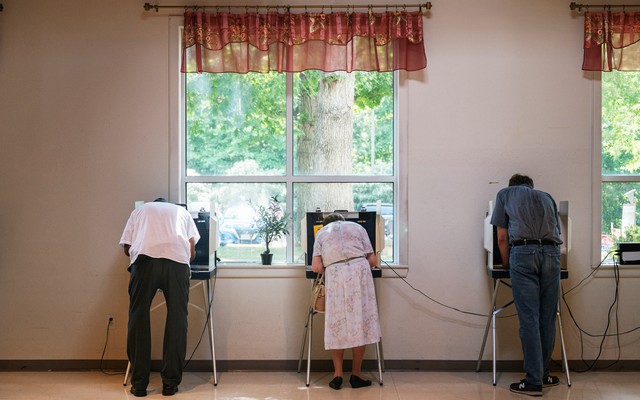
This morning the landscape looks a lot different, after Virginia voters yesterday approved a lopsided new House map that could hand Democrats an additional four seats that Republicans currently hold. The Democratic redistricting victory is the party’s second in a statewide referendum. When combined with new lines that California voters endorsed in November, Democrats have now succeeded in drawing districts that will likely yield them nine more seats this fall, at least matching what Republicans have been able to achieve in states that they control. By some measures, Democrats have jumped into the redistricting lead, bolstering their chances of winning back the House majority in the midterm elections.
Patients are getting stuck in the emergency department for days while waiting for a spot in an inpatient ward.
In the last months, weeks, and days of his life, “I will not go to the emergency room” became my husband’s mantra. Andrej had esophageal cancer that had spread throughout his body (but not to his ever-willful brain), and, having trained as a doctor, I had jury-rigged a hospital at home, aided by specialists who got me pills to boost blood pressure; to dampen the effects of liver failure; to stem his cough; to help him swallow, wake up, fall asleep.
“I will not go to the emergency room”—emphasis on not—were his first words after passing out, having a seizure, or regurgitating the protein smoothies I made to pass his narrowed esophagus. He said it again and again, even as fluid built up in his lungs, rendering him short of breath and prone to agonizing coughing spells. He had been a big, athletic guy, but now, in the ugly process of dying, he was looking gaunt. Ours was a precarious existence, but I understood his adamant rejection of the emergency department. Most prior visits had morphed into extended trips into a terrifying medical underworld—to a purgatory known as emergency-department boarding.
This article was featured in the One Story to Read Today newsletter. Sign up for it here.
The mystery of the missing scientists began with a Silver Alert. In late February, a retired Air Force major general named Neil McCasland left his house in New Mexico for a walk and never returned. Rumors spread on social media that the elderly former astronautical engineer had been abducted or killed. Forget Nancy Guthrie, they said. Here was a guy who used to run a “UFO-linked” lab. Here was a guy with knowledge of “America’s deepest, darkest secrets.” So where was this guy?
McCasland’s wife did her best with a post on Facebook to address what she called the “misinformation circulating about Neil and his disappearance,” but wild notions only multiplied. Dots were added, then connected: Another scientist—an advanced-materials researcher at NASA’s Jet Propulsion Laboratory (JPL) named Monica Reza—had disappeared while hiking near Los Angeles in June 2025. A physicist at MIT had been murdered in December. “What is going on seems to be an enemy action,” Walter Kirn, the novelist and podcast contrarian, said last month.
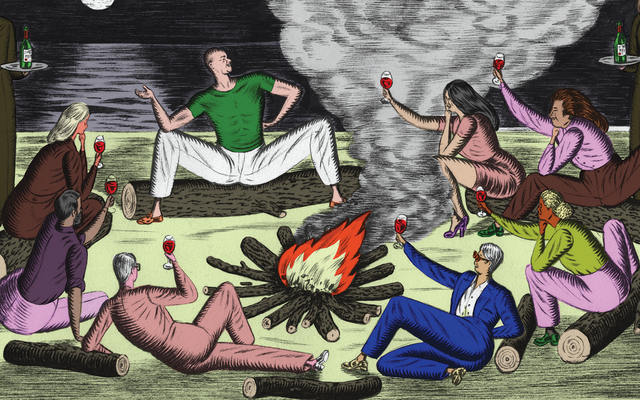
For the richest men on Earth, everything is free and nothing matters.
At the end of Paul Thomas Anderson’s 2007 movie, There Will Be Blood, Daniel Day-Lewis’s oil-baron character, old now and richer than Croesus, beats Paul Dano’s preacher to death with a bowling pin. Dano’s Eli Sunday, a nemesis of Day-Lewis’s Daniel Plainview during his seminal, wealth-building years, has come to sell Plainview the oil-rich land that he once coveted. But Plainview doesn’t need the land anymore, because—as he explains in one of the most famous monologues in modern cinema—he has sucked out all the oil hidden beneath it from an adjoining property, like a milkshake.
Desperate for money, Eli begs for a loan. Instead, Plainview chases him around a bowling alley and murders him with great enthusiasm. Once it’s over, a butler comes to see what all the noise was about. “I’m finished,” Plainview yells.
Kash Patel has alarmed colleagues with episodes of excessive drinking and unexplained absences.
This article was featured in the One Story to Read Today newsletter. Sign up for it here.
On Friday, April 10, as FBI Director Kash Patel was preparing to leave work for the weekend, he struggled to log on to an internal computer system. He quickly became convinced that he had been locked out, and he panicked, frantically calling aides and allies to announce that he had been fired by the White House, according to nine people familiar with his outreach. Two of these people described his behavior as a “freak-out.”
Patel oversees an agency that employs roughly 38,000 people, including many who are trained to investigate and verify information that can be presented under oath in a court of law. News of his emotional outburst ricocheted through the bureau, prompting chatter among officials and, in some corners of the building, expressions of relief. The White House fielded calls from the bureau and from members of Congress asking who was now in charge of the FBI.
Even in the best of times, the annual White House Correspondents’ Dinner is an awkward and ethically fraught affair. Journalists spend the evening partying with the president and administration officials whom they’re supposed to cover rigorously and skeptically. I’ve been to the dinner several times over the years. It’s typically crowded and a little chaotic, and the ratio of non-journalists to journalists is about 10 to 1. The evening is promoted as a celebration of journalism and the First Amendment, but it has always been a bit of an embarrassment.
These aren’t the best of times for White House correspondents or, for that matter, the First Amendment. And this year’s gala figures to be even more awkward and embarrassing than usual.
Over the past 15 years or so, Democrats have won a lot of races because the opposing party’s primary voters decided to nominate right-wing ideologues (Christine O’Donnell, Todd Akin, Kari Lake) rather than normal Republicans. In all of these races, the Republican establishment warned that nominating an archconservative would undermine their chances of victory, and was proved completely correct.
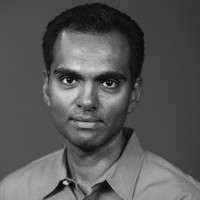
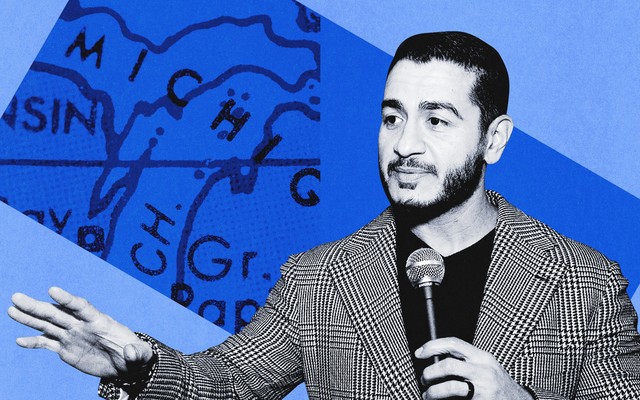
Now Democrats finally have the chance to do the same thing. In Michigan, a purple state that Donald Trump won twice, the physician Abdul El-Sayed is running a competitive race for the party’s Senate nomination. If successful, he would turn a very likely Democratic win into a jump ball.
The people we were died at the exact moment our child did.
This article was featured in the One Story to Read Today newsletter. Sign up for it here.
My husband, David, hates Valentine’s Day. He once called it “New Year’s Eve with nuclear weapons.” I pretend not to care. Still, when the day passes entirely unremarked on, a woman can’t help but feel overlooked.
On Valentine’s Day 2024, David found a way out. He booked a speech on February 14 that required traveling from our home in Washington, D.C., to Toronto. I couldn’t object—he was getting paid. Anyway, I had my own plans: an “anti–Valentine’s Day” dinner hosted by one of the foreign embassies.
As I got ready, I called our oldest daughter, Miranda. She answered from her Brooklyn bathroom, getting ready for her own party. She propped her phone up beside her sink and laughed when I told her about her father’s strategic Valentine’s Day escape.
Fifteen years after Steve Jobs’s death, the company is a successful, if unexciting, powerhouse.
Tim Cook’s job was to make Apple boring—and he did. Cook, Apple’s chief executive officer, is stepping down after 15 years in the role. He had succeeded Steve Jobs after the visionary co-founder of Apple Computer Company left only months before dying of pancreatic cancer in 2011. Since then, Apple has grown in market value by 2,000 percent. It has also transformed into a staid, if immensely effective, firm that sells people glass rectangles, wireless earbuds, and, sometimes, computers. This legacy is not tragic, but it is somber. The crucible in which the personal computer and the smartphone were forged is just a big company now.
Jobs and Steve “Woz” Wozniak started Apple Computer in 1976 to bring Woz’s design for an early personal computer to market, but Jobs did not serve as CEO until 1997, when he returned after years away. Before then, a series of more ordinary businesspeople had run the company—mostly former semiconductor executives including Michael Scott, Mike Markkula, and Gil Amelio, along with the former PepsiCo CEO John Sculley. But by the mid-2000s, after the iMac, iPod, and iPhone had appeared, Jobs had become the apotheosized Visionary CEO—a model for the technology industry and beyond. His exacting and sometimes unreasonable demands, which dated back to the design of the Macintosh in the early 1980s, had made him a singular and irreplaceable presence: a figure who could bend an organization, an industry, and the public who would be transformed by its products to his will.
WAR-FIGHTERS! As a step to making sure we are ready for warfare at all times, we have decided to ELIMINATE THE MANDATORY FLU SHOT! Nothing says “we are ready for war” like “we all have the flu.”
Get your hot-water bottles! Get your ibuprofen! Not Tylenol, though! It knows what it did. Because we are bringing FLU to the war-fighters! Are you ready to have a RUNNY NOSE and an ITCHY THROAT? Are you ready to get REALLY SERIOUSLY DEHYDRATED AND NEED MEDICAL ATTENTION? Hoo-RAH!
We will terrify the enemy by coming in hot! And when I say hot I mean our temperatures! We will need COUGH DROPS, and we will knock those back, CRUNCH CRUNCH CRUNCH, with a sound more frightening than gunfire. This will strike fear into the hearts of the enemy. They will say things like “Do you need a tissue?” and “Are you okay?,” and when they are offering us that tissue, we will strike. And then we will go back to bed and lie under a tactical pile of war-fighting blankets. Peak performance is when you have a terrible headache and want to be asleep, and whenever you open your mouth you sound like someone took lawn shears to your vocal cords. YEAH!