Senate Confirms Nikki Haley as Next U.N. Ambassador
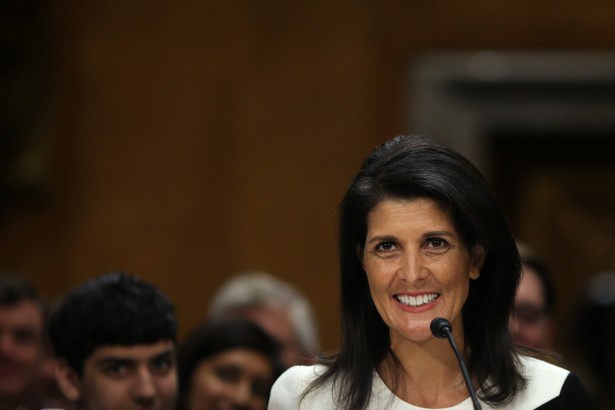
Carlos Barria / Reuters
The Senate overwhelmingly voted for Nikki Haley to be the next ambassador to the United Nations. Haley, who has served as the Republican governor of South Carolina since 2010, was approved with a 96-4 vote. As my colleague Russell Berman writes:
Despite her lack of foreign policy experience, Haley faced little opposition from Democrats, who were impressed with her performance in private meetings and at her confirmation hearing before the Senate Foreign Relations Committee.
She is the fourth Trump nominee to get Senate approval.
Yahya Jammeh, the ousted president of Gambia, has found a new home in Equatorial Guinea. Jammeh fled Gambia last week after finally conceding defeat in December’s presidential race. For months, he said he would remain in power, only deciding to leave after West African troops, led by Senegal, invaded and threatened to remove him from power. Adama Barrow, who defeated Jammeh, was sworn in last week. He has not returned from Senegal, where he sought refuge during the political crisis. If Jammeh had remained, he would likely face charges related to human rights abuses over the two decades he was in power. According to Brian Klaas, a fellow at the London School of Economics, since the end of the Cold War, 23 percent of ousted sub-Saharan African rulers have been forced into exile. Jammeh joins that list. Equatorial Guinea is a Central African nation located around 2,000 miles southeast of Gambia. The oil-rich nation is ranked amongst the worst human rights abusers in the world.
LAPD Officers Won't Face Charges in Ezell Ford Shooting, DA Says
Jonathan Alcorn / Reuters
Los Angeles County prosecutors said Tuesday the Los Angeles Police Department officers who shot and killed Ezell Ford in August 2014 will not face criminal charges, the Los Angeles Times reports. The prosecutors concluded that Ford posed “an immediate threat” to LAPD officers Sharlton Wampler and Antonio Villegas, causing them to respond with deadly force. On August 11, 2014, the officers stopped and engaged in a physical altercation with Ford, who was diagnosed with schizophrenia and bipolar disorder. LAPD officials said the 25-year-old then grabbed Wampler’s gun, prompting the two officers to open fire. The shooting, which took place two days after the fatal police shooting of Michael Brown in Ferguson, Missouri, sparked large local protests. In 2015, the Los Angeles Police Commission ruled that though Villegas’ actions were justified, Wampler’s actions violated LAPD policy, including both his initial contact with Ford and well as his decision to use lethal and nonlethal force. Los Angeles Mayor Eric Garcetti, in response to Tuesday’s decision, said: “I accept the decision made by the District Attorney, but rededicate my administration to the search for better ways to protect the safety of all Angelenos, and reiterate my support for the Police Commission’s goal of reinforcing de-escalation in the training of our officers.”
Michigan Says Lead in Flint's Water Has Fallen to Safe Levels
(Rebecca Cook / Reuters)
Michigan’s Department of Environmental Quality says the lead in Flint’s drinking water has fallen to 12 parts per billion from July to December 2016—below the federally safe limit of of 15 ppb. Lead levels were 20 ppb in the first six months of the 2016. The city’s 100,000 residents have struggled without safe drinking water since 2014 because of the manmade crisis. The state acknowledged unsafe levels of lead last October. Residents have relied on bottled water since that time.
Trump Moves to Advance Construction of Keystone and Dakota Access Pipelines
Jonathan Ernst / Reuters
President Trump signed executive actions Tuesday to advance the construction of the Keystone and Dakota Access Pipelines. The projects, which are aimed at constructing pipelines from Canadian tar sands to the Texas gulf coast and from oil fields in North Dakota to southern Illinois, respectively, were blocked by the Obama administration. The move is one the Trump administration said it would tackle on Day One, and serves as a blow to environmentalists who opposed the impact both projects could have on the environment and, in the case of the Dakota Access Pipeline, the damage it could inflict on the Standing Rock Sioux Tribe’s water supply and sacred sites. Here’s more from my colleague Robinson Meyer on what the executive orders say here.
A worker overlooks the Israeli settlement of Ramot in the occupied West Bank on January 22, 2017. (Ronen Zvulun / Reuters)
The Israeli government approved Tuesday the construction of 2,500 settlement homes in the West Bank. The move comes two days after the Jerusalem City Council approved 566 housing units in East Jerusalem, which the Palestinians claim as their future capital, and two days after Israeli Prime Minister Benjamin Netanyahu spoke by phone with President Trump. Avigdor Lieberman, Israel’s defense minister, said the West Bank construction would take place in existing settlement blocs, adding: “There’s nothing new here. We always built, also under [President] Obama.” Indeed, Israeli settlement expansion thrived under the Obama administration, though it was usually met with disapproval. Trump is expected to take a softer position. David Friedman, Trump’s pick for U.S. ambassador to Israel, has argued that Israel’s settlements are legal; Trump called for the Obama administration to veto the U.N. Security Council resolution last month criticizing Israeli settlement activity in the Palestinian territories. The Israeli announcement Tuesday was condemned by the Palestinian leadership, which called the move “a deliberate escalation of Israel’s illegal settlement enterprise.”
Iraqi Government Announces Recapture of Eastern Mosul From ISIS
Iraqi forces gather during an operation to clear Mosul’s al-Zirai district of ISIS militants on January 18, 2017. (Muhammad Hamed / Reuters)
Iraqi Prime Minister Haider al-Abadi confirmed Tuesday the recapture of eastern Mosul from the Islamic State. The announcement comes less than a week after Lieutenant General Talib Shaghati, head of the country’s counterterrorism service, said Iraqi forces had reclaimed the eastern portion of the country’s second largest city, which was first seized by ISIS militants in 2014. The city was the last remaining urban center under ISIS control, and the recapture of its eastern portion marks a major blow to the group, which has lost territory in both Iraq and neighboring Syria. ISIS still maintains control over parts of Mosul west of the Tigris River, where the United Nations estimates 750,000 people remain.
'La La Land' Ties Oscar Record With 14 Nominations
La La Land co-stars Ryan Gosling and Emma Stone pose during the 74th Annual Golden Globe Awards on January 8, 2017. (Mario Anzuoni / Reuters)
La La Land, the musical set in Los Angeles, received 14 Academy Award nominations, including Best Picture, a record that it now shares with Titanic and All About Eve. Also among the Best Picture nominees announced Tuesday by the Academy of Motion Picture Arts & Sciences are Arrival , Hacksaw Ridge, Hidden Figures, Lion, Moonlight, Fences, Hell or High Water, and Manchester by the Sea. Three of those films—Hidden Figures, Fences, and Moonlight—feature predominantly black casts in leading roles—a departure from nominations in recent years that prompted the hashtag #OscarSoWhite. My colleague David Sims has more on the nominations here. Full list of nominations here:
Russia, Turkey, Iran Strike a Deal on Syria Ceasefire Mechanism
(Mukhtar Kholdorbekov / Reuters)
Russia, Turkey, and Iran have agreed to monitor a ceasefire between the Syrian government and rebels at the second day of talks in Astana, Kazakhstan. The government of President Bashar al-Assad and Syrian rebel groups agreed on December 30 to the truce, which has mostly been holding since then though each side has accused the other of violations. The talks in Astana, which were brokered by Russia and Iran, which back Assad, and Turkey, which backs the rebels, began Monday and were intended as a step to end the more than five-year-long civil war.
U.K. Supreme Court Says Parliament Must Approve Brexit Trigger
(Reuters)
The U.K. Supreme Court ruled Tuesday that Parliament must vote on when the government can invoke Article 50 of the EU charter, the mechanism by which the U.K.’s departure from the European Union is triggered. Prime Minister Theresa May had previously argued lawmakers did not need to approve the trigger. Having said that, Parliament is expected to approve the start of the process before the government’s deadline of March 31. Britons voted last summer to leave the EU. Although there was much consternation at the idea of a departure from the bloc, the margin of victory for the remain side (52 percent to 48 percent, or about 1.4 million votes) makes the prospect of reversing that decision slim to none. Invocation of Article 50 would result in negotiations between the U.K. and the EU on what a future relationship would look like. Last week May argued the U.K. isn’t isn’t seeking “membership of the single market, but the greatest possible access to it.”
Thirteen thousand miles. Infinite contenders. One beautiful loaf.
This article was featured in the One Story to Read Today newsletter. Sign up for it here.
Here is the promise you and I must cling to across the thousands of words that follow: At some point within this text, I will reveal to you what—after 555 responses, 13,000 miles of travel, and months of monomaniacal research—I have determined to be the best free restaurant bread in America. I will not attempt to slither to the moral high ground, arguing that best is a meaningless measure, or insisting that all bread is dear in its own way. Even if you attempt to betray me—for instance, by merely scanning the text that follows for the phrase Here it is: the best free restaurant bread in America—I will uphold my end of the bargain.
The president is on a losing streak, and even some of his aides are dismayed by his choices.
This article was featured in the One Story to Read Today newsletter. Sign up for it here.
You’ve heard the joke: The White House is going to start talking about the Epstein files to distract from how badly the Iran war is going.
Except that this reverse “Wag the dog” is based on bizarre truth: First Lady Melania Trump did bring the disgraced financier up, unprompted, late last week in an effort to distance herself from the scandal (in a move that, predictably, only shifted it back into the spotlight once again). Meanwhile, as negotiations with Iran stumble forward, the Strait of Hormuz is still in Tehran’s hands and now President Trump has authorized a risky naval blockade that will likely send prices soaring further. Moreover, Trump’s poll numbers have continued to fall, Republicans worry that both houses of Congress could be lost in November, and the president threw away a remarkable amount of geopolitical capital trying to support his now-defeated illiberal buddy Viktor Orbán of Hungary. Oh, and Trump deeply offended adherents of the world’s two largest religions in one week’s time.
The car industry says it has an answer for drivers wary of going electric.
Two hours into a road trip in my Tesla, I start to get twitchy. By that point, the battery in my 2019 Model 3 has dipped to an uncomfortably low percentage. If I can’t reach the next plug, I’m in trouble. This is the kind of problem that Ram’s electric pickup truck—the first of a new breed of EV to arrive in the United States—is intended to solve. When the range starts to dwindle, the truck automatically fires up a hidden gas engine that refills the giant battery. The “electric” vehicle keeps on chugging down the highway, hour after hour; pit stops are once again decided by the need for bathroom breaks rather than battery range.
The Ram 1500 REV, set to debut later this year, is what’s called an “extended-range electric vehicle,” or EREV. In essence, it is an electric vehicle that burns gas. There’s nothing revolutionary about a half-gas, half-electric car, of course. Hybrids have been a mainstay in the United States since the Toyota Prius broke through two decades ago, and automakers have released more efficient plug-in hybrids—allowing drivers to charge up for about 30 miles of electric driving, just enough to accomplish daily errands without fossil fuels. An extended-range EV is a different kind of beast. The engine burns gasoline for the sole purpose of replenishing the battery—it never actually pushes the wheels. In the Ram, the battery can run for about 150 miles of electric driving, and the whole setup delivers enough range to travel nearly 700 miles between stops.
Is the president’s son-in-law carrying out the public’s business or pursuing his own private interests?
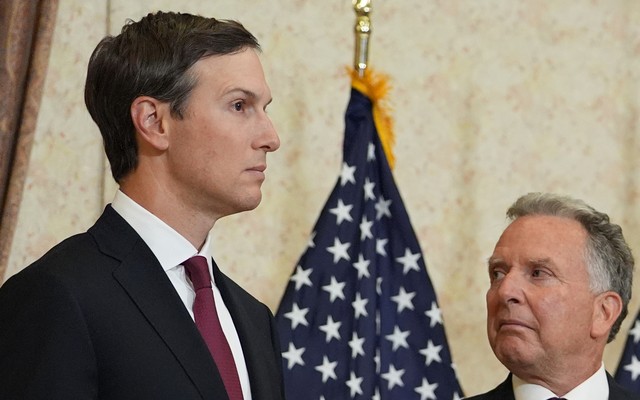
In 2021, shortly after he left his role as a senior White House adviser, Jared Kushner let it be known that he had loved his job but disliked the scrutiny and disclosure that came with being a top U.S. government official. He set up a private-equity firm and took a $2 billion investment from a Saudi fund led by Crown Prince Mohammed bin Salman. He proclaimed that he was embracing private life. “I’m an investor now,” Kushner said in a 2024 interview. If President Trump “calls you on November whatever and says, ‘I’d like you to come back to D.C.,’ you say, ‘Thanks, but I’m good’?” the interviewer, Dan Primack of Axios, pressed. “Yes,” Kushner responded.
But Kushner did come back. Two days before the United States and Israel attacked Iran this past February, he was in Geneva in a negotiation of the highest possible stakes. Over the weekend, he traveled with Vice President Vance to Islamabad to participate in failed peace talks with Iran. Without title or remit or any kind of official designation—only “presidential son-in-law”—Kushner has in the first 14 months of the second Trump administration sat down with world leaders including Vladimir Putin, Benjamin Netanyahu, and Volodymyr Zelensky, along with Saudis and multiple other actors from the Middle East.
The president’s attempts to interfere with the midterms demand vigilance, but a recent flimsy gambit is an argument against despair.
This is an edition of The Atlantic Daily, a newsletter that guides you through the biggest stories of the day, helps you discover new ideas, and recommends the best in culture. Sign up for it here.
Anxiety among election officials and experts had been building for months before Donald Trump issued his latest executive order purporting to ensure election integrity late last month. When the actual text emerged, the reaction wasn’t relief exactly—but a definite sense that things could have been much worse.
Americans have many reasons to be worried about whether the midterm elections will be free and fair. As I laid out in a cover story last fall, the president’s plan to subvert the 2026 election is multifaceted and already in swing. But last month’s order and the dismissive reaction it’s received from experts—along with this weekend’s decisive defeat of Hungarian Prime Minister Viktor Orbán, which shows how the competitive-authoritarian playbook that Trump has imitated can be beaten—also point to the reasons to resist doomerism.
A minimally speaking autistic man just wrote a best-selling book. Or did he?
On a recent morning at Rockefeller Center, NBC employees strolled through the crowd with copies of Upward Bound, the latest book-club pick from the Today show co-host Jenna Bush Hager. “It’s deeply heartfelt and moving,” Hager said, after holding up the debut novel from the 28-year-old Woody Brown, “and the reason it’s so authentic is that the author understands autism firsthand.”
That understanding is indeed profound. Brown’s autism is such that he can barely speak, and he communicates mostly by pointing to letters, one by one, on a laminated board. This is also how his novel, which is already a New York Times best seller, came to be. In the recorded interview that followed Hager’s introduction, Brown’s mother, Mary, sat beside him, holding the letter board and reading his tapped-out messages.
On many recent nights, Donald Trump has been posting obsessively on his Truth Social site into the wee hours. The president, of course, has never been one for a solid night’s sleep—or restrained and temperate commentary on social media—but his emotional state seems to be fraying: This weekend, he attacked Pope Leo XIV, presented himself as Jesus Christ, and then jabbed at his phone until dawn.
Judging from those posts, the commander in chief is in distress. No one can say for sure what is causing the president’s bizarre behavior. Perhaps Trump’s narcissistic insistence that he is always successful in everything he undertakes is feeling the sting and strain of multiple public failures, including the collapse of his campaign to dislodge the Iranian regime, plummeting approval ratings, the decline of the U.S. economy, and, on Sunday, the crushing defeat of one of his favorite fellow authoritarians, Hungary’s Viktor Orbán.
Former U.S. Deputy National Security Adviser Matt Pottinger on the U.S.-Iran cease-fire, Trump’s Hormuz blockade, and China’s reaction to the Iran war. Plus: A seismic election in Hungary, and Labyrinths, by Jorge Luis Borges.
In this week’s episode of The David Frum Show, The Atlantic’s David Frum opens with his reaction to the recent election in Hungary and the defeat of Viktor Orbán. David counters Orbán defenders who claim that this loss proves Orbán was never a threat. Antidemocratic leaders often face institutional constraints, and it was those institutional constraints that compelled Orbán to accept a defeat after years of abuse of power.
Then, David is joined by former U.S. Deputy National Security Adviser Matt Pottinger to discuss the current state of President Trump’s war in Iran. David and Pottinger talk about the recent failed negotiations between the two sides in Pakistan, the blockade of the Strait of Hormuz, and what could happen next. They also discuss how the Iran war is viewed in China and how it has been a financial gain for Russia.
Hungary offers lessons in defeating right-wing populists.
To the outside world, Hungarian Prime Minister Viktor Orbán began his rule as a pariah—an obstreperous, often lone dissenter from European Union policies, especially over migration. Then he became a prophet to new-style “national conservatives”—the anti-immigration, anti-elite right-wing movement that has reshaped the politics of the West. After resoundingly losing national elections held on April 12, Orbán has become a parable for how populism can be defeated.
His political demise was hardly inevitable. It had to be shrewdly engineered by politicians and voters who put aside their ideological differences to defeat him. In politics, there is no natural law of self-correction.
From 2010 until now, Orbán and his Fidesz party transformed Hungary into a new kind of state, which he proudly proclaimed as an “illiberal democracy.” He and his allies rewrote the constitution to entrench his power, centralizing control over civil society and countervailing institutions such as courts and universities. Péter Magyar, the presumptive next prime minister, triumphed against a tilted electoral system—gerrymandered districts, government influence over traditional media and even over the country’s billboards—designed to keep Fidesz in power. Magyar understood that such a regime does not simply collapse under the weight of its own contradictions and mismanagement.
If you are anything like me, you have spent a lot of time over the past few weeks opening letters, finding receipts, requesting PDFs, scanning documents, and going through your credit-card statements line by line. It’s tax season. And in the United States, taxes are a DIY affair.
This is the case even though Washington could probably do your taxes for you. If you earn a salary or an hourly wage, the Internal Revenue Service already knows how much money you make. It likely knows how much you owe or how big your refund should be too. Nine in 10 households take the standard deduction, making their liability easy to glean from payroll and banking data.
Yet Uncle Sam demands that Americans fire up TurboTax, head to a storefront preparer, hire an accountant, or sit down with a sharp pencil and a strong cup of coffee to get their taxes done each spring. The average filer spends 13 hours on their 1040—a time tax that many of our wealthy peer countries have reduced to a couple of minutes, if that. Prepopulated documents and return-free systems are common everywhere but here. Sweden lets residents file by text. Canada prefills paperwork. Japan sends households a document summarizing their tax contributions. If everything looks copacetic, many workers get to do a blissful nothing. Denmark, Estonia, Spain, and Norway have similarly simple processes.