—Leonard Cohen, the singer known for his deep voice and poetic lyrics, died Thursday. He was 82.
—Indians lined up at banks to trade in their 500-rupee and 1,000-rupee notes, the two largest denominations, after the government, in an unexpected move, scrapped them Tuesday.
—We’re live-blogging the news stories of the day below. All updates are in Eastern Standard Time (GMT -5).
Leonard Cohen, the singer known for his deep voice and poetic lyrics, died Thursday. He was 82.
It is unclear how the songwriter died. Announcing his death, Sony Music Canada said in a statement:
We have lost one of music's most revered and prolific visionaries.
Cohen, born in Quebec in 1934 and inducted into the Rock and Roll Hall of Fame in 2008, was remembered by Rolling Stone as “the songwriter’s songwriter,” adding:
Cohen was the dark eminence among a small pantheon of extremely influential singer-songwriters to emerge in the Sixties and early Seventies. Only Bob Dylan exerted a more profound influence upon his generation, and perhaps only Paul Simon and fellow Canadian Joni Mitchell equaled him as a song poet.
There will a memorial service in Los Angeles. The date will be announced later.
This Newly Discovered Dinosaur Fossil Was Almost Blown Up by Dynamite
An artistic reconstruction of Tongtianlong limosus’s possible final moments stuck in mud. (Zhao Chuang / nature.com)
Construction workers in China using dynamite to clear a rocky area almost blew up a well-preserved dinosaur fossil before realizing their discovery, according to a paper published in Scientific Reports on Thursday.
The fossil constitutes a newly discovered dinosaur species. Scientists speculate that the creature died while stuck in mud, which explains its awkward body position; the dinosaur’s limbs are splayed and its head and neck are raised. They estimate that it lived about 66 to 72 million years ago during the final era before dinosaurs became extinct.
Because of those qualities, scientists named the dinosaur species “Tongtianlong limosus,” a mix of Chinese and Latin that means “muddy dragon on the road to heaven.”
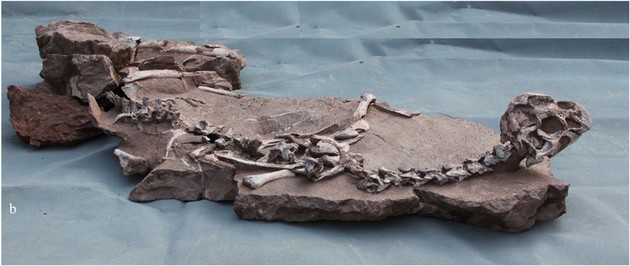
The skeleton of the Tongtianlong limosus (nature.com)
Tongtianlong limosus is part of a branch of dinosaurs called Oviraptorosaurs, or bird-like feathered theropods with toothless skulls found in the Ganzhou area of China. The Tongtianlong limosus is different from other Oviraptorosaurs because of its “unique dome-like skull roof” and “highly convex premaxilla,” referring to the cranial bone near the upper jaw, the scientists write.
The fossil was discovered during construction of a new high school. Workers nearly destroyed it, and parts of the fossil are missing due to dynamite. A drill hole where TNT was placed can be seen near the pelvic girdle of the fossil.
"It was found at a construction site by workmen when they were dynamiting, so they nearly blasted this thing off the hillside," University of Edinburgh paleontologist Stephen Brusatte, a co-author on the paper, told the BBC.
'Pharma Bro' Is Trolling Everyone But at Least They Get Wu-Tang Clan Out of It
Lucas Jackson / Reuters
Say what you will about Martin Shkreli, but the controversial pharmaceutical CEO kept his word.
Two weeks ago, the executive better known as “Pharma Bro” promised to release music from the $2 million Wu-Tang Clan album he bought at a secret auction last year—but only if Donald Trump won the election. Early Wednesday morning, he followed through on his promise and live-streamed the the album’s introduction in a video early Wednesday morning.
“I’ll be releasing this music over a long period of time, but let me play at least a little bit of it now,” he said. (The music begins at 7:00 in the video below.)
Shkreli became well-known last September after his drug company Turing Pharmaceuticals bought the drug Daraprim, which is typically used to treat infections in HIV patients. Shkreli raised the price of the drug from $13.50 per pill to $750, a dramatic example of price-gouging that drew widespread criticism. He was arrested in December on securities fraud charges and was released on $5 million bail.
During the controversy over the price hike, Shkreli bought the only known copy of the Wu-Tang Clan’s latest album “Once Upon A Time In Shaolin” at auction for $2 million. As part of that purchase, Shkreli was legally barred from releasing the music commercially for 88 years.
"I actually have a contract with the Wu-Tang Clan where I'm not allowed to do this,” he said in the video on Wednesday. “Obviously, I own the music and I bought it and paid a lot of money for it. In many ways, the contract shouldn't matter that much. But I am a man of my word; I had to play a little bit of it … but I've got to keep my word to them, too."
The Polish Army Is Teaching Women Self-Defense for Free
Rick Wilking / Reuters
Women in Poland will soon be eligible to enroll in free self-defense training, the country’s national defense ministry announced Thursday.
The training, offered in 30 cities, includes eight free courses led by Polish army instructors aimed at teaching women techniques to defend themselves “in various situations that threaten their life or health,” including hand-to-hand combat and self-defense. The course will be offered to Polish women over the age of 18 who are considered in good health. The program is expected to run beginning November 19 until June 3.
Antoni Macierewicz, the country’s defense minister, told the BBC the program seeks to equip women with “basic fighting techniques and improve overall physical fitness.”
Police departments in the United States and Canada have offered similar free classes to women.
A day after several states voted to relax their marijuana laws, the union that represents NFL players has announced it will research the use of the drug in pain management.
The NFL Players Association has created a committee to study the use of marijuana as a pain-management strategy for football players, as well as consider whether the league should change its rules on legal substances, The Washington Postreported Wednesday. The union didn’t provide information about the research process.
On Tuesday, residents in California, Massachusetts, and Nevada voted to legalize recreational marijuana, following similar measures in Colorado, Washington, Oregon, Alaska, and the District of Columbia in previous elections. Voters in Maine, Florida, Arkansas, and North Dakota approved ballots measures to legalize marijuana for medical use. Research has shown marijuana use is helpful in managing pain.
The drug policy negotiated between the NFL and the players’ union prohibits the use of marijuana for any reason. Players are tested throughout the season and can be fined or suspended for violating the drug policy.
NFL spokesman Brian McCarthy said on Wednesday the league would continue to listen to the advice of its medical experts, who haven’t recommended changing the league’s policy.
The increased interest in marijuana’s pain-management effects comes amid increased scrutiny on opioid painkillers like Vicodin. The use of team-administered opioids for pain management is relatively common in NFL locker rooms. In recent years, a number of football players, including former offensive lineman Eugene Monroe, have expressed support for medical marijuana to treat pain as a replacement for opioid painkillers.
According to a recent survey in ESPN magazine, 59 percent of NFL players said they worry about the long-term effects of painkillers, and 61 percent said they believed fewer players would use painkillers if marijuana were allowed.
Eastern Aleppo Faces Mass Starvation as Food Rations Run Out
Abdalrhman Ismail / Reuters
The last available food rations are being distributed by aid workers in rebel-held eastern Aleppo, the United Nations said Thursday, warning the 275,000 people remaining could face mass starvation without a resupply.
“I don’t think anyone wants a quarter of a million people to be starving in east Aleppo,” Jan Egeland, the UN’s humanitarian adviser for Syria, told journalists Thursday in Geneva.
The last time a humanitarian-relief delivery was permitted to eastern neighborhoods of the city was in July, Egeland said, noting that food prices had skyrocketed. Since then, the UN presented a proposal to all sides that would involve food- and medical-aid distribution, as well as medical evacuations and access to the city by medical personnel—a deal Egeland said he was optimistic the Syrian government and rebel forces would accept.
Access to the besieged city by humanitarian agencies has been limited since the Syrian government, backed by Russian forces, resumed its offensive to retake rebel-held parts of the city, which has been divided since 2011. Though Moscow and Damascus have declared unilateral “humanitarian pauses” to allow civilians and rebels remaining in the city to evacuate, few have left.
The U.S. Military Releases New Estimates of Civilian Deaths in Air Strikes
Reuters
U.S air strikes in Syria and Iraq killed 64 civilians between November 2015 and September 2016 during operations against the Islamic State, the U.S. military said in a statement Wednesday, a figure much lower than the one humanitarian groups have reported.
"In each of the cases released today, the assessment determined that although all feasible precautions were taken and strikes complied with laws of armed conflict, civilian casualties unfortunately did occur,” said Colonel John Thomas, a spokesman for U.S. Central Command.
The U.S. conducted 24 air strikes in the timeframe reported. The report brings the total number of civilians the Pentagon has acknowledged have died since the U.S.-led coalition started bombing ISIS in 2014 to 119. The numbers of people killed in a single strike ranged from one to 10. The most recent, publicly reported strike occurred September 10, near Raqqa, Syria, which killed five people.
Human-rights group Amnesty International said last month that in the battle against ISIS at least 300 people have died over the past two years in just 11 strikes.
The U.S. has conducted 12,354 air strikes against ISIS targets in Iraq and Syria as of this month, according to Reuters.
Television’s comedy late-night hosts largely delivered serious monologues with sprinkles of humor a day after the election of Donald Trump to the presidency.
“I guess ruining Brooklyn was just a dry run,” she said in her post-election segment. “The Caucasian nation showed up in droves to vote for Trump, so I don’t want to hear a goddamned word about black voter turnout. How many times do we expect black people to build our country for us?”
On TBS’s Conan, admitted history buff Conan O’Brien initially took a serious tone and praised the American system of democracy.
“Everybody should feel grateful that we get to vote, and if we don’t get our way, we have the chance to try again,” O’Brien said. “It is a beautiful thing.”
He then went for laughs with a “silly and completely pointless” diversion, “The Really Tall Dachshund.”
On The Tonight Show, Jimmy Fallon stuck to his routine of one-liners, riffing on Trump’s victory.
“Republicans hope he’ll keep his promise to build a wall, and Democrats hope he’ll keep his promise not to accept the election results,” he said, according toThe New York Times.
On Late Night with Seth Meyers, who famously lampooned Trump during the 2011 White House Correspondents Dinner, Myers re-upped his plan to give Trump a 13-episode TV show about a fake president if he would drop out of the race. Meyers pushed that offer up to 22 episodes on Wednesday night, and said he would even give it a prime slot right after The Voice.
“After last night’s results, I just want to say to Donald Trump: Our offer still stands,” Meyers said. “You didn’t think you were going to win this thing either, and I’m guessing that right now you are spinning out.”
Coast to coast, in more than a dozen major cities, protesters against the presidential election of Donald Trump shut down highways, burned effigies, burned cars, and also held calm candlelight vigils. The rallies all shared a common theme: that Trump’s comments during his campaign do not represent the U.S.
The rallies were held in Portland, Oregon; Dallas, Chicago, Atlanta, New York, Washington, D.C., and many others. Police arrested dozens of people. At the Oakland, California, protest, where about 7,000 people joined, two officers were injured and two patrol cars set afire. In Los Angeles, protesters chanted outside City Hall, where they lit a giant effigy of Trump’s head on fire. In both Oakland and Los Angeles, protesters shut down freeways until the early morning. Police in riot gear were called in to disperse the crowds.
Democratic nominee Hillary Clinton and President Obama asked their supporters on Wednesday to give Trump a chance, and to peacefully allow a transition of power. Everyone, Clinton said, is “rooting for his success.”
As much of the protesters expressed anger, though, they also were fearful. Some in New York, outside Trump Tower, where Trump lives, told The New York Timesthey feared their family members might be deported. Another protester told theLos Angeles Times he feared the anti-LGBT sentiments of some Trump supporters. In Washington, D.C., protesters at a candlelight vigil and some held a glowing banner that read: “Love Trumps Hate.”
Indians Line Up at Banks After Surprise Currency Announcement
(Rupak De Chowduri / Reuters)
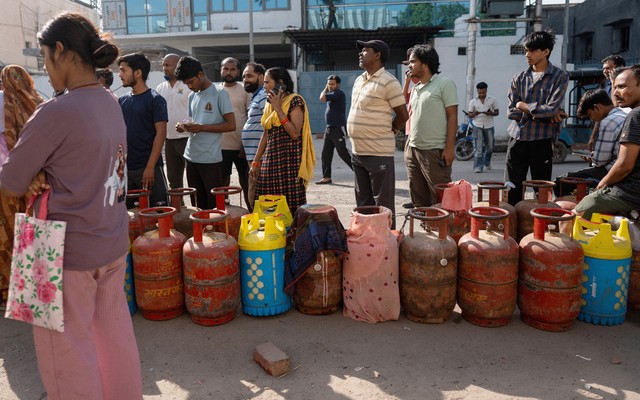
Indians lined up in banks across the country to trade their no-long-valid 500-rupee and 1,000-rupee notes, which were scrapped Tuesday by a government fiat.
Prime Minister Narendra Modi’s decision to scrap the two largest denominations is an attempt by the government to battle corruption, tax evasion, counterfeiting, and “black money,” the term used locally to describe a parallel economy that some estimates say accounts for as much as 20 percent of India’s $2 trillion gross domestic product. Cash use is ubiquitous in India, accounting for more than 90 percent of all transactions. Indians rely on rupee notes to buy everything from packets of salt, to street food, to multimillion-dollar apartments, and to finance elections. And no rupee notes are more heavily relied upon than the two scrapped—500 rupees (about $7.50) and 1,000 rupees ($15.05). Together they accounts for an estimated 85 percent of all cash transactions in India.
Indians have until December 30 to swap the old notes for new 2,000-rupee (about $30) and 500-rupee notes that have security features.
Patients are getting stuck in the emergency department for days while waiting for a spot in an inpatient ward.
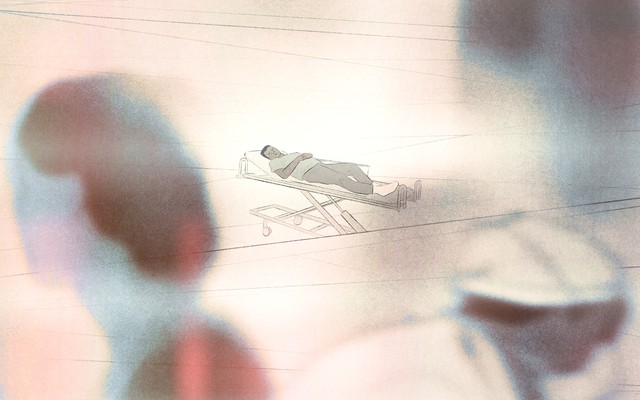
In the last months, weeks, and days of his life, “I will not go to the emergency room” became my husband’s mantra. Andrej had esophageal cancer that had spread throughout his body (but not to his ever-willful brain), and, having trained as a doctor, I had jury-rigged a hospital at home, aided by specialists who got me pills to boost blood pressure; to dampen the effects of liver failure; to stem his cough; to help him swallow, wake up, fall asleep.
“I will not go to the emergency room”—emphasis on not—were his first words after passing out, having a seizure, or regurgitating the protein smoothies I made to pass his narrowed esophagus. He said it again and again, even as fluid built up in his lungs, rendering him short of breath and prone to agonizing coughing spells. He had been a big, athletic guy, but now, in the ugly process of dying, he was looking gaunt. Ours was a precarious existence, but I understood his adamant rejection of the emergency department. Most prior visits had morphed into extended trips into a terrifying medical underworld—to a purgatory known as emergency-department boarding.
For the richest men on Earth, everything is free and nothing matters.
At the end of Paul Thomas Anderson’s 2007 movie, There Will Be Blood, Daniel Day-Lewis’s oil-baron character, old now and richer than Croesus, beats Paul Dano’s preacher to death with a bowling pin. Dano’s Eli Sunday, a nemesis of Day-Lewis’s Daniel Plainview during his seminal, wealth-building years, has come to sell Plainview the oil-rich land that he once coveted. But Plainview doesn’t need the land anymore, because—as he explains in one of the most famous monologues in modern cinema—he has sucked out all the oil hidden beneath it from an adjoining property, like a milkshake.
Desperate for money, Eli begs for a loan. Instead, Plainview chases him around a bowling alley and murders him with great enthusiasm. Once it’s over, a butler comes to see what all the noise was about. “I’m finished,” Plainview yells.
When President Trump last summer implored Republicans to launch a nationwide gerrymandering blitz to pad their narrow House majority, the fight he started did not seem fair. GOP lawmakers had both the will and the power to draw their party new seats, while Democrats were hamstrung by limits of their own making. The question was not whether Republicans could expand their edge in Congress, but by how much.
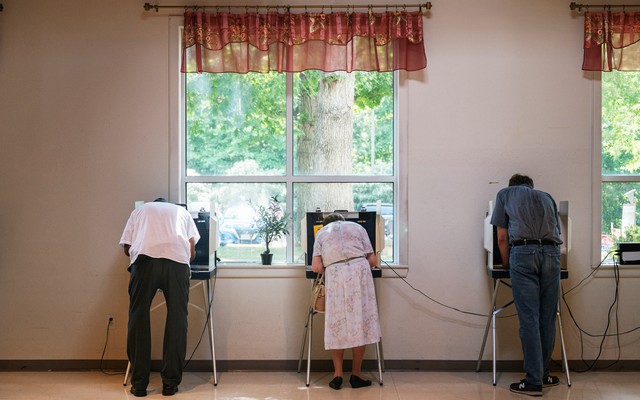
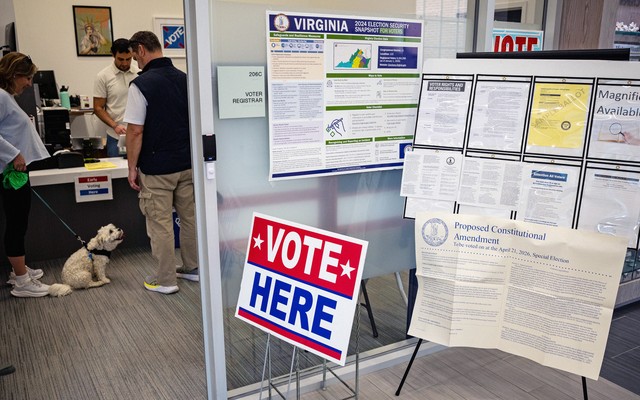
This morning the landscape looks a lot different, after Virginia voters yesterday approved a lopsided new House map that could hand Democrats an additional four seats that Republicans currently hold. The Democratic redistricting victory is the party’s second in a statewide referendum. When combined with new lines that California voters endorsed in November, Democrats have now succeeded in drawing districts that will likely yield them nine more seats this fall, at least matching what Republicans have been able to achieve in states that they control. By some measures, Democrats have jumped into the redistricting lead, bolstering their chances of winning back the House majority in the midterm elections.
The economist Adam Posen on the effect of the war in Iran on the world’s economy and the darkening economic outlook for the United States. Plus: A shifting partisan balance of power and Ask Not: The Kennedys and the Women They Destroyed, by Maureen Callahan.
In this episode of The David Frum Show, The Atlantic’s David Frum opens with a discussion of the likelihood that the partisan balance of power will shift from Republicans to Democrats at state-government level.
Then, David is joined by the president of the Peterson Institute for International Economics, Adam Posen, for a conversation about the state of the world’s economy. Frum and Posen discuss the economic effect of the war in Iran, the United States’ reputational hit caused by Trump’s tariffs, and the chance of global recession.
Finally, David ends the episode with a discussion of Ask Not: The Kennedys and the Women They Destroyed, by Maureen Callahan, and reflects on why reactions to the abuse of women by men in power seem to have become a partisan issue.
Kash Patel has alarmed colleagues with episodes of excessive drinking and unexplained absences.
This article was featured in the One Story to Read Today newsletter. Sign up for it here.
On Friday, April 10, as FBI Director Kash Patel was preparing to leave work for the weekend, he struggled to log on to an internal computer system. He quickly became convinced that he had been locked out, and he panicked, frantically calling aides and allies to announce that he had been fired by the White House, according to nine people familiar with his outreach. Two of these people described his behavior as a “freak-out.”
Patel oversees an agency that employs roughly 38,000 people, including many who are trained to investigate and verify information that can be presented under oath in a court of law. News of his emotional outburst ricocheted through the bureau, prompting chatter among officials and, in some corners of the building, expressions of relief. The White House fielded calls from the bureau and from members of Congress asking who was now in charge of the FBI.
This article was featured in the One Story to Read Today newsletter. Sign up for it here.
The mystery of the missing scientists began with a Silver Alert. In late February, a retired Air Force major general named Neil McCasland left his house in New Mexico for a walk and never returned. Rumors spread on social media that the elderly former astronautical engineer had been abducted or killed. Forget Nancy Guthrie, they said. Here was a guy who used to run a “UFO-linked” lab. Here was a guy with knowledge of “America’s deepest, darkest secrets.” So where was this guy?
McCasland’s wife did her best with a post on Facebook to address what she called the “misinformation circulating about Neil and his disappearance,” but wild notions only multiplied. Dots were added, then connected: Another scientist—an advanced-materials researcher at NASA’s Jet Propulsion Laboratory (JPL) named Monica Reza—had disappeared while hiking near Los Angeles in June 2025. A physicist at MIT had been murdered in December. “What is going on seems to be an enemy action,” Walter Kirn, the novelist and podcast contrarian, said last month.
Republicans seem to have expected that Democrats would continue to follow rules they had long since enthusiastically abandoned.
Voters in Virginia approved a lopsided congressional map on Tuesday, reducing the expected number of Republican-leaning districts in the Democratic-controlled state from five to one. Republicans have reacted by complaining that conservative-leaning voters in the state have been disenfranchised by gerrymandered maps that reduce the influence of their vote.
And they’re right. That is exactly what the new Virginia map does.
Gerrymandering is an attempt to thwart the will of the voters. It circumvents the vital process of democratic feedback by insulating politicians from political backlash. It should not happen, and yet this latest chapter of the redistricting wars did not begin in Virginia. It did not even begin last year, when Donald Trump openly urged red states to gerrymander their congressional maps so Republicans might retain possession of the House during the midterms. He did so despite the fact that the maps had been drawn after the 2020 census and would normally be expected to last until 2030.
The people we were died at the exact moment our child did.
This article was featured in the One Story to Read Today newsletter. Sign up for it here.
My husband, David, hates Valentine’s Day. He once called it “New Year’s Eve with nuclear weapons.” I pretend not to care. Still, when the day passes entirely unremarked on, a woman can’t help but feel overlooked.
On Valentine’s Day 2024, David found a way out. He booked a speech on February 14 that required traveling from our home in Washington, D.C., to Toronto. I couldn’t object—he was getting paid. Anyway, I had my own plans: an “anti–Valentine’s Day” dinner hosted by one of the foreign embassies.
As I got ready, I called our oldest daughter, Miranda. She answered from her Brooklyn bathroom, getting ready for her own party. She propped her phone up beside her sink and laughed when I told her about her father’s strategic Valentine’s Day escape.
Modi styled himself a global leader but can’t seem to get ahead of events in the Middle East.
Pakistan is having a diplomatic moment, and India’s political elites are not enjoying it.
Indian Prime Minister Narendra Modi has spent the past decade promoting the notion that India is the leader of the global South and, as such, is indispensable to world affairs. Now a conflict in the Middle East has thrown the global economy, and, with it, India’s, into crisis. On top of that, Islamabad, not New Delhi, has hosted at least one round of talks between the United States and Iran and is preparing to mediate others, leaving the Indian government to ponder its irrelevance.
Indian Foreign Minister Subrahmanyam Jaishankar first dismissed Pakistan’s role in the U.S.-Iran talks, using a pejorative Hindi word for a kind of unsavory middleman. But in Indian political circles, particularly after the April 8 cease-fire was announced, criticism has been trained on the Modi government. Jairam Ramesh, a spokesperson for the opposition Congress Party, wrote on X that Pakistan’s role was “a severe setback to both the substance and style of Mr. Modi’s highly personalised diplomacy.” Ramesh mocked the Indian prime minister for calling himself vishwaguru, meaning “teacher of the world.” Asaduddin Owaisi, the country’s most prominent Muslim politician, lamented that India would have been the natural venue for the U.S.-Iran talks, if not for the Modi government’s missteps.
Politicians who think health-conscious women could swing the midterms are fooling themselves.
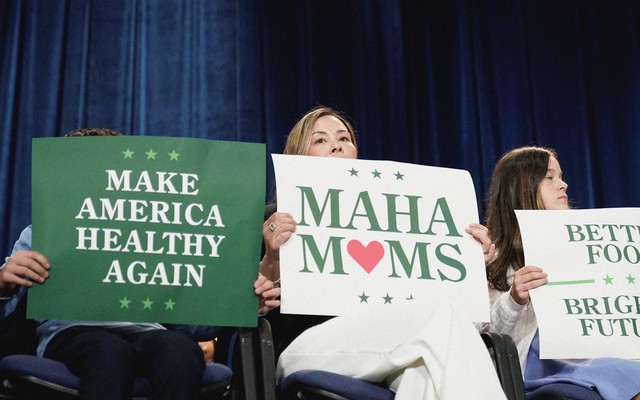
Earlier this month, MAHA moms went to the White House. Several key figures in the “Make America Healthy Again” movement gathered around a table in the Roosevelt Room to speak with Health Secretary Robert F. Kennedy Jr. and other top administration officials. The invitees—who included the health activist Kelly Ryerson, the wellness podcaster Alex Clark, and the nutritionist Courtney Swan—were all women. They’re influential among the loose coalition of Kennedy supporters known as MAHA moms, many of whom are worried about their children’s health. This was a chance for them to air their grievances with the Trump administration—which have grown in recent months. Afterward, they were ushered into the Oval Office to see President Trump, who, according to Ryerson, welcomed them as “my MAHA leaders.”