The Iran Talks Are Making India Feel Small
Modi styled himself a global leader but can’t seem to get ahead of events in the Middle East.

Pakistan is having a diplomatic moment, and India’s political elites are not enjoying it.
Indian Prime Minister Narendra Modi has spent the past decade promoting the notion that India is the leader of the global South and, as such, is indispensable to world affairs. Now a conflict in the Middle East has thrown the global economy, and, with it, India’s, into crisis. On top of that, Islamabad, not New Delhi, has hosted at least one round of talks between the United States and Iran and is preparing to mediate others, leaving the Indian government to ponder its irrelevance.
Indian Foreign Minister Subrahmanyam Jaishankar first dismissed Pakistan’s role in the U.S.-Iran talks, using a pejorative Hindi word for a kind of unsavory middleman. But in Indian political circles, particularly after the April 8 cease-fire was announced, criticism has been trained on the Modi government. Jairam Ramesh, a spokesperson for the opposition Congress Party, wrote on X that Pakistan’s role was “a severe setback to both the substance and style of Mr. Modi’s highly personalised diplomacy.” Ramesh mocked the Indian prime minister for calling himself vishwaguru, meaning “teacher of the world.” Asaduddin Owaisi, the country’s most prominent Muslim politician, lamented that India would have been the natural venue for the U.S.-Iran talks, if not for the Modi government’s missteps.
Modi’s troubles with the Trump administration began last spring. A terrorist attack in Indian-administered Kashmir sparked a four-day conflict between India and Pakistan. President Trump announced a cease-fire that ended the fighting. But this unilateral declaration embarrassed Modi, who likes to project a strongman image. The Indian prime minister could not bring himself to acknowledge the American role in brokering the cease-fire. After that, his relationship with Trump steadily worsened. The U.S. president slapped 50 percent tariffs on India, among the highest anywhere in the world.
Pakistan, meanwhile, saw a window to repair its relationship with the United States. The war on terror had driven a wedge between Islamabad and Washington, as the American government came to suspect Pakistan of evasions and double-dealing. Last year Islamabad profusely thanked Trump for his role in the cease-fire with India, and Prime Minister Shehbaz Sharif nominated the U.S. president for the Nobel Peace Prize. Embracing Trump’s transactional style, Pakistan signed a rare-earth-minerals deal with the U.S. and joined the president’s Board of Peace.
The first round of Islamabad talks ended without an agreement a little more than a week ago. No one was apparently happier than the members of New Delhi’s power circles. “To all those who were hailing the Pakistan mediation and calling it a diplomatic coup. Hope the cake on your face was tasty,” Priyanka Chaturvedi, a former member of Parliament, posted on X. But Pakistan has not abandoned the role, and a second round of talks in Islamabad is still possible this week.
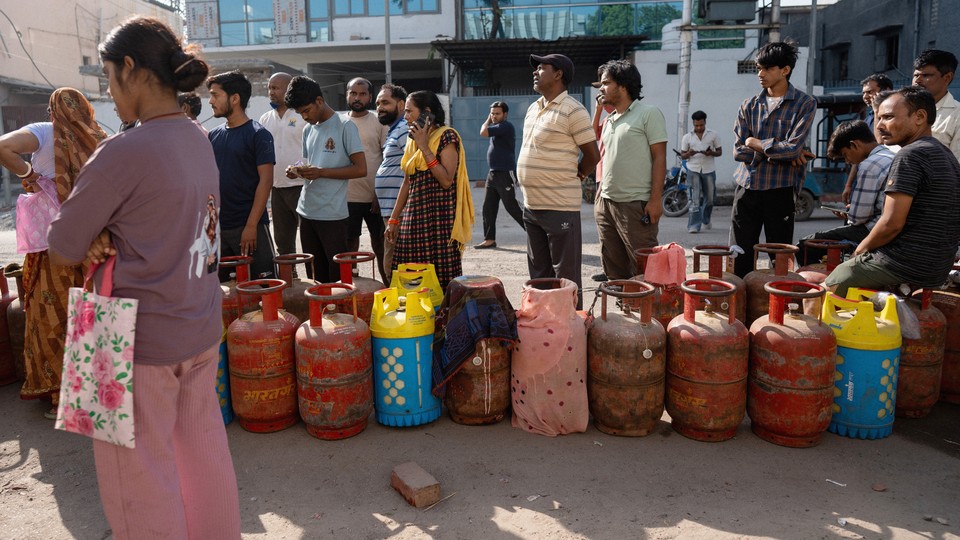
Ordinary Indians have reason to want to see the U.S.-Israel-Iran war resolved, regardless of who does the mediating. The country procures half of its oil and 60 percent of its liquid petroleum gas from the Middle East, and much of both transits the Strait of Hormuz. The war has caused an oil shock that has rattled India’s economy. Restaurants have been closing early, or closing altogether. Rural migrants who eke out a fragile existence in India’s cities now flock to railway stations to return to their villages, on the grounds that living on farms and cooking on wood fires may be a decent alternative to starving in the city. Factories have closed because of the uncertainty around energy supplies. A scarcity of fertilizers imperils the country’s food security. And the Indian rupee has been in free fall. A United Nations report warned that the Iran war could push up to 2.5 million Indians into poverty.
One humid afternoon early this month, I spoke with Irfan Ahmed, a 56-year-old electrical worker, as he emerged from a gas dealership in central Delhi with a bulky red cylinder of the sort that’s a fixture in most Indian homes. Piped gas is still restricted to elite neighborhoods; most Indians rely on portable cylinders that they hook up to stoves. Procuring this one had taken Ahmed more than five hours and cost him the day’s wages.
Before the Iran war, he would have placed a request online, and the cylinder would have been delivered to his home within three days. Since the war, the online process has been discontinued, and the government, ostensibly to stanch the black market, demands that people present identity documents when buying cylinders. Ahmed had spent the morning in a two-hour queue for bureaucrats to verify his documents before directing him to the gas dealership. Then he and his brother hoisted the container, which weighed more than 50 pounds, onto a scooter and drove home with the cumbersome vessel perilously perched between them. Many others around them were similarly trying to balance cylinders on their motorbikes.
At the start of the U.S.-Israel-Iran war, the Indian government apparently did not envision such far-reaching consequences. In fact, when a February 28 air strike killed Iranian Supreme Leader Ali Khamenei, the Indian government maintained a pointed silence for several days before sending a diplomat to sign the condolence book at the Iranian embassy in New Delhi. Many observers, including in the Congress Party, concluded that Modi approved of the strike. But if New Delhi had imagined that Iran’s regime would fall, and that no complications would arise for India, it was sorely mistaken. Instead the war escalated, and Iran blocked the Strait of Hormuz.
India managed to make some temporary arrangements for itself. On March 12, Modi spoke with Iranian President Masoud Pezeshkian and secured passage for a few Indian ships through the strait. The U.S. waived some sanctions on Iranian oil, and in April, India received its first such shipment in seven years. But shortly afterward, on April 18, Iran shot at two Indian-flagged vessels crossing the Strait of Hormuz, forcing them to turn back. The incident broke the fragile detente; India summoned the Iranian ambassador to convey New Delhi’s “deep concern.”
Before the Modi years, India’s policy in the Middle East had been one of strategic balance. It maintained strong, civilizational ties with Iran that went back more than a millennium; at the same time, it pursued a relationship with Israel. But Modi has tipped that balance by drawing closer than ever to his counterpart in Israel, Prime Minister Benjamin Netanyahu. The Indian leader paid a friendly visit to Israel in the days immediately preceding the war, and this likely destroyed any possibility of New Delhi emerging as a mediator in the conflict.
“India has been pretty irrelevant in the war,” Aakar Patel, a prominent writer and columnist, told me. “Except that we are taking the punishment quietly.”
India’s inability to influence global events has much to do with the way Modi has managed domestic ones. Modi has empowered a virulently anti-Muslim Hindu nationalism that has helped diminish his country’s standing in the Middle East. And the lack of a constructive and serious public reckoning with the government’s missteps during this crisis or any other largely owes to Modi’s suppression of the Indian media. For the past decade, Modi has preferred to rule by spectacle, forbidding the country’s problems to be acknowledged, let alone confronted and solved.
On April 18, the same evening that Iran attacked the Indian-flagged vessels, Modi gave a prime-time address to the nation. He might have used that speech to lay out the government’s response to India’s geopolitical and economic predicament. But he didn’t: He devoted its entirety to attacking his political opponents, in the hope of swaying an upcoming election in West Bengal that has become a particular fixation for him.
Meanwhile, the Hindu-nationalist propaganda machine has carried on creating an alternate universe. Shortly after the Iran war began, the film Dhurandhar, about an undercover Indian spy in Pakistan who metes out brutal punishment to his nation’s enemies, became one of the highest-grossing Bollywood movies in history. The hypernationalist blockbuster is typical of India’s current public discourse in its detachment from reality and profound unseriousness about the real challenges India faces.
A country that once imagined itself a great power in waiting—a regional hegemon, dwarfing Pakistan, and a counterweight to China—now struggles to project power even within south Asia, having fought Pakistan to a draw last summer. The Iran crisis further suggests that India remains stuck as a middle power, defined by events rather than shaping them.
“The ambition that India would be this global power is gone,” Patel told me. “It’s only the pageantry that remains.”