Bobbie Ann Mason: Poised for Possibility (September 19, 2001)
Bobbie Ann Mason, the author of Zigzagging Down a Wild Trail, talks about Springsteen, Joyce, and discovering her own writing voice.
Simon Winchester: The World Beneath Our Feet (August 29, 2001)
A conversation with Simon Winchester, whose new book,
The Map That Changed the World, rescues a pioneering geologist from obscurity.
Philip Gourevitch: A Tale of Two Murders (August 1, 2001)
In A Cold Case Philip Gourevitch tells the story of three men from three very different moral universes, linked by a decades-old crime.
Glyn Maxwell: Breath and Daylight (June 14, 2001)
John DeStefano talks with the poet and playwright Glyn Maxwell—author of Time's Fool and The Breakage—about Auden, Frost, and America's feud with form.
James Fallows: The Soul of a New Flying Machine (May 25, 2001)
James Fallows, the author of Free Flight, argues that the next generation of small planes could usher in a new age of travel.
Nicholson Baker: The Gutenberg Purge (May 10, 2001)
A conversation with the novelist Nicholson Baker, whose latest book, Double Fold: Libraries and the Assault on Paper, makes the case for old news and the long shelf life of the printed page.
Robert Sapolsky: Of Monkeys and Men (April 25, 2001)
The author of A Primate's Memoir talks about his years as a member of a troop of Serengeti baboons.
A. L. Kennedy: Spasms of Grace (March 29, 2001)
In On Bullfighting, A. L. Kennedy describes the "death, transcendence, immortality, joy, pain, isolation and fear" that is the Spanish corrida.
More on books in Atlantic Unbound and The Atlantic Monthly.
Atlantic Unbound | October 3, 2001
interviews
Jonathan Franzen, the author of The Corrections, discovers that, when it comes to fiction, "serious" doesn't have to mean "marginal" or "boring"
.....
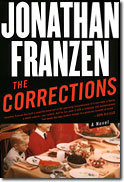
The Corrections
by Jonathan Franzen
Farrar Straus & Giroux
528 pages, $26.00
he institution of
writing and reading serious novels," wrote Jonathan Franzen in a
1996 Harper's cover story, "is like a grand old Middle American city
gutted and drained by superhighways. Ringing the depressed inner city of
serious work are prosperous clonal suburbs of mass entertainments: techno and
legal thrillers, novels of sex and vampires, of murder and mysticism." Franzen,
whose first two novels had received relatively little attention, argued that in an era
when computer-savvy readers were increasingly distracted by new forms of
technology and media, and readers had come to doubt the capacity of fiction to
address significant social issues, his dream of writing a serious novel that
could "matter to the mainstream" had become seemingly impossible.
Five years later, however, it seems that Franzen has overcome his despair over
both the state of fiction and his own prospects as a novelist. After
relinquishing his hope of writing the next Catch-22 and renewing his
faith in serious readers, he was able to start writing productively again, and
eventually to publish, last month, his third novel, The Corrections. If
we are to believe the nearly unanimous chorus of literary reviewers, Franzen
has at last achieved his goal: The Corrections has indeed tapped the
vein of the mainstream—movie rights and all—without sacrificing social
content.
The novel follows the neurotic interactions of the Lambert family—two
adults and three grown children—and chronicles the tumult that ensues when
the mother insists that she wants everyone home for Christmas. One son has to
escape Lithuania where he's been running an Internet scam, another must choose
between spending the holiday with his parents or with his own wife and children
(who refuse to go with him), and the daughter must own up to the destruction
her sexual confusion has wreaked upon her career. The resulting conversations
and miscommunications are sometimes painful, sometimes hilarious. Each
character, each relationship, and even the family's Midwestern hometown of St.
Jude, are clearly in need of some change—and perhaps correction.
Jonathan Franzen grew up in a suburb outside of St. Louis. After graduating
from Swarthmore in 1981 he won a Fulbright Scholarship and studied at the Free
University of Berlin. His first novel, The Twenty-Seventh City (1988),
received the Whiting Award. Strong Motion, his second novel, was
published in 1992. Franzen writes for The New Yorker and lives in New
York City.
We spoke over the telephone on September 6.
—Jessica Murphy
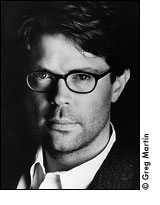
Jonathan Franzen
In your 1996
Harper's article, "Perchance to Dream," you wrote, "When I got out of
college in 1981, I hadn't heard the news about the death of the social novel."
How do you define the social novel? And how is it faring twenty years
later?
I think Philip Roth's declaration in 1961 of the death of the social novel was
accurate. There is no place anymore for social realism à la Germinal or
Frank Norris or Dreiser, whatever Tom Wolfe might say. Other media simply do
social realism much better. I was aware of that. I wasn't imagining the social
novel as muckraking fiction, or exposé fiction. What I had in mind in 1981, as
I said in the article, was a book like Catch-22, which cut deeply enough
into the country's consciousness to create its own dictionary entry. The book
was more than just a story—it was also about where we were as a country,
asking big questions about war and pacifism. The idea that you could actually
reach a large audience while engaging with questions that were interesting to
society seemed alive to me in 1981. I think that's what I meant by a social
novel—one that is engaged with society, both in its reception and in its
preoccupations.
Do you think it's possible for a novelist to reach a large audience today
with so much information and so many other types of media at our fingertips? In
your essay you said that "television has killed the novel of social reportage."
Is there a literary antidote to the television screen?
The idea that the novelist somehow has a responsibility to take on and combat
television is something I probably would have found much more attractive in my
twenties. My feeling is that the best way to combat TV is not by attacking it
head on—not by producing fiction that explicitly exposes TV's negative aspects
and causes the scales to fall from the viewer's eyes, producing a conversion to
fiction on the spot. It's really much more about—book by book—trying to
produce fiction that is so compelling that one would want to read fiction
rather than watch TV. If enough writers do that then I think the medium can
continue to exist as a plausible alternative to television, particularly as TV
continues to exhaust itself.
Didn't writing a manifesto that lamented the state of American fiction put
certain pressure on you to deliver?
I don't think it was a prescriptive article. It was not—if you compare it to
the obvious touchstone—Tom Wolfe's manifesto of ten years earlier. He was
really calling for a certain kind of fiction, which he then delivered in the
form of Bonfire of the Vanities. My article asks, Why bother to write at
all? And answers with some reasons.
I was saying, let's remember who really reads books and what they read for. The
serious readers aren't reading for instruction or for journalistic content. My
piece was about the scaling back of expectation.
It did put some pressure on me, although nothing like the pressure I already
felt simply because it was taking me so long to get a third book out. The piece
raised the question, Who is he to be speaking on behalf of all novelists in
this way? It had already been four full years since I'd last published a book,
and I had two novels to my name—neither of which had particularly made my
career. So, there was some pressure to show people that I really was the person
to be writing that piece.
Did you happen to read B. R. Myers's "A Reader's Manifesto" in the July/
August issue of The Atlantic in which he argued that contemporary
literary fiction is pretentious? What did you think of that piece?
Myers seems to think that things were different in the past. But I don't think
that's true. Look at the Pulitzer Prize winners in the fifties. A certain kind
of pretentious, heavy, pseudo-literary writing has been being rewarded for a
very long time. So my feeling is that there's some truth to his argument, but
it was ever thus.
Many critics are saying that The Corrections is the next social
novel. Would you agree?
No. I want to curl up and take a nap when I hear the phrase "social novel." So
I would never want to apply that term to my book, because I wouldn't want you
to think of it as a snore.
It's not.
Well, thank you. It's a novel and it does some of the things that a novel can
do. And one of the cool things that I think a novel can do is connect the
personal and the more broadly cultural and social. So it is social in that
sense.
What are the risks of writing about society and addressing social issues in
fiction?
In the head-on approach the risk is banality of observation. For instance,
Neill Postman is right about TV, but it's not a complicated rightness. He
basically makes the same point over and over. This is an infernal machine. This
is an infernal machine. That's one of the dangers I talk about in the
Harper's essay: making the same simple point. Any fiction that has a
simplistic or repetitive or—increasingly nowadays—banal point to make is not
going to be very interesting.
How could The Corrections be about "contemporary society" if it took
eight years to write? How can you write a novel that sustains itself in our
rapidly changing contemporary society?
It's easy, actually. It really wasn't until '96 that I could afford to devote
full time to it. Even then, what I was doing for several years was trying to
find the right set of characters and in particular the right tone and structure
for those characters. The three are inextricably linked.
I took forever to get the first chapter written. The chapter which introduces the youngest son, Chip, kept wanting to be more
complicated and it wanted to be a satire of academic manners and, God, do we
need one? So, I tried going again and again to the well, trying to find the
right tone, the right character, and the right situation that would allow me to
do what I really wanted to do and find stuff that was fresh enough to sustain
each of the five major chapters. The result was that I wrote almost all of the
book in the year 2000. If you watch an office building getting constructed,
workers spend nearly a year digging around in the dirt, and then the thing goes
up in about two weeks. It's just like that. If you do that, most of the
references and most of the spirit is stuff that really is fresh.
A recent article in The New York Times Magazine mentioned an
elaborate diagram that you used to map out the entire novel and its characters.
When during the process did you have the entire map with all of the characters
and the engine driving the novel—that the mother wants everyone to get home
for Christmas?
That came really late. As late as about three months before I turned the book
in, I was just in despair, saying, "I don't know what the book's about. I don't
know what the book's about. There's no story here." But that was partly because
I didn't know how I was going to end it.
As each chapter was finished, I would add it to the map. About two years before
I handed in the manuscript, I threw out everything I had been working on except
the chapter where Enid and Alfred are on a cruise, and decided that this
was going to be a five-part book. There were five main characters, and I
decided that there were going to be five novella-size sections with a beginning
and ending tacked on. That was the real map. That's what I knew. It wasn't
until the very end that I figured out exactly what was going to be in each of
those sections, particularly the last one. Those graphs didn't really do
anything except reassure me that I had a different structure for each chapter.
Also, the part of me that is somewhat formally obsessed and writes for
insiders—for other writers—wanted to be able to say that each of the sections
has its own distinctive, chronological structure.
Did your other two novels come together in the same way, character first,
plot later?
Yes. In every case. Also in every case, there has been a long gestation period
and then the writing happened relatively quickly.
The dysfunctional family seems to have been fertile imaginative ground in
all of your novels, but especially in The Corrections. In many ways the
Lamberts represent the typical generation gap between stoic parents stubbornly
holding on to social mores and their grown children who are looking for
something different. But there is a real sense of pain and struggle and
dissatisfaction to all of their lives. Why is family such a focus in your
work?
I find this phrase "dysfunctional family" very curious. It seems to imply that
there is such a thing as a functional family. Can we find some other phrase?
The "normal" family?
Yes, exactly. It is the normal family as I know it. The Lamberts'
experience—which is quite a bit stranger than mine—is really tame compared to
a lot of what I hear about from my friends. (I probably do tend to know people
who are somewhat weirder than average since I know writers and artists.)
We're in an era when it's very hard to be idealistic about anything. Even when
you do manage to achieve idealism for a few moments, you immediately start
examining it and becoming ironic. In a prosperous post great society era, when
the two major political parties resemble each other so closely, and the Cold
War is over, there aren't many places to find meaning. But family does remain
an enduring generator of meaning. Since the fiction writer is trying to tell
stories that have meaning, I think it's natural to be looking at family.
Chip has an illicit relationship with a student who gives him
libido-enhancing drugs, a cruise-line doctor convinces Enid to take a different form of the same drug (and she likes it!), and then there is the
whole Corektall phenomenon—the drug with the same name as a laxative that is
supposed to cure everything from Alzheimer's to Parkinson's to depression and
crime. What is your novel saying about our quick-fix, drug-loving
society?
The book gestated in a period of greatly exaggerated technological promise,
when worker productivity was going to increase by ten percent a year, and world
peace would ensue from our sharing our thoughts on the Internet, and we would
soon live forever because of the various improvements on the biological or
medical front. It's not a complicated insight to say that history does
not show that you can fix things. When you try to fix something, you
create a new problem. I don't think that's a lesson—I'm not teaching anything.
I'm having fun with some of that particularly American optimism. It's amusing
to me. The spirit of most of my treatment of it in the book is meant to be
funny.
How important is place to the characters and to you? This came to mind when
I was reading, "In the pageantry of weddings Enid reliably experienced the
paroxysmal love of place, as a mid-west in general and suburban St. Jude in
particular—that for her was the only true patriotism and the only viable
spirituality." Place is most certainly important to Enid.
That speaks again to the question of how you find meaning in your life. That's
certainly a way Enid finds meaning—by belonging to a place (and also by being
at the head of the family).
In the Harper's essay I talked about the dismay with which the fiction
writer views the increasing homogenization in this country—the elimination of
regionalism. That's just a fiction writer's petulant way of saying that there
used to be all these cool details that you could use to really to liven up the
page—the local manners, the local landscape. When every landscape is tract
housing and Wal-Marts, and every mannerism is derived from hours of viewing
MTV, you have to work harder to come up with an interesting page. But I believe
place does still exist. There are distinctions among regions and among cities.
There were many moments where I found myself laughing out loud while reading
your work, both at times when the characters find themselves in absurd
situations, having absurd conversations and also in their mundane, everyday
miscommunication. What role does humor play in your fiction? Is humor essential
to you as writer?
I would no sooner fall in love with a humorless book than with a humorless
woman. And there are a whole lot of humorless books out there, let me tell
you...
And humorless women?
Indeed, there are. They tend not to be too aware of it, but there are. Everyone
prides themselves on having a "sense of humor" but I know what the real thing
is. It's vital to me for a lot of reasons. When I read stuff aloud to
audiences, I always choose funny stuff because you get something back. It's
the key indicator that I've got something right, when it begins to get funny. I
spent a year trying to get the Chip chapter off the ground and what that
consisted of was repeated attempts to start writing, and fifteen
or twenty pages in, saying, this isn't funny, and it's no good. As a
reader, I find humor to be an indicator that I can trust the writer, because I
know the writer is not taking him or herself too seriously and has enough
distance on the characters that I don't feel that I'm being sold a character
whom the author is attached to in some unwholesome way. Mostly the funny pages
are the ones that are fun to write. It's vital. It's the center of what I'm
about.
Your books are all roughly the same length, just over 500 pages or so. Why
this length?
This just feels like the right size for a book to me. Once you get everything
rolling, why not have a world that you enjoy dwelling in for a while? If the
book has passages that are a chore to read, or that are humorless and earnest
... then the shorter the better. But if you're committed to really entertaining
the reader and having fun, then a longer novel seems right.
All of your novels pull in a very broad range of subject matter. In The
Corrections there is metallurgy, a Lithuanian dot-com scam, the strange
social interactions on a cruise ship, among other topics. In Strong
Motion you have seismology, anti-abortionists, and Red Sox mania. How do
such divergent topics make their way into the same novel?
One of the reasons I like a not-short book is that it gives me an opportunity
to use a lot of different tones and have a lot of different colors. To the
extent that a novel is like a painting, it's nice to have the expanse of
simple, blue, lightly-clouded sky; it's also nice to have a real knot of
compositional complexity in a different corner and a strong compelling figure
or two in the foreground. (Obviously I'm talking about representational art
here.) It makes for a richer reading experience if you can create different
areas of interest because it contributes to that illusion—which is an illusion
that I enjoy as a reader—of being bound up, caught up in a whole world.
How do I do it? I make a lot of stuff up and then I check afterwards to make
sure the facts are okay. For the pages about Gary's attempt to get in big on
the IPO, I talked to a stock broker friend of mine on how IPOs really work and
how the shares are allocated in advance among institutional investors and
private investors. There was work involved there, but the need to do that work
was generated by the broad outlines of the chapter.
In reviews you're almost universally grouped together with and compared to
Thomas Pynchon and Don Delillo, both of whom you've said that you admire. Have
you been influenced by them and if so, how?
Delillo has certainly been an influence—especially when I was learning how to
write. Even when I lose my way now he's an influence, just because his writing
is so strong. He has such clean and beautiful sentences and such rhythms. It is
so rarely self-indulgent that it's clarifying. He's a palate cleanser for me.
Both he and Pynchon are very good at getting at certain postwar
moods—capturing the age of crowds, nuclear weapons, and the denaturing effects
of the media and technology on language. So they're kindred spirits in that
way. But I don't know how to speak to their influence much beyond that. There
are many books that are important to me in terms of my pointing at them and
saying, that's the kind of book I want to do.
Is writing a private, insular activity for you, or do you find that more
material comes from being out in the world?
I think a little bit of experience goes a long way. It's relatively insular
because the worst thing I can do in setting out to write about something is
know too much about it. If I'd spent a month researching the way IPOs work, I
would've had all of this information and I would've wanted to do justice to it,
or I would know about some little snag that would have made the whole thing
impossible. So just doing the minimum of out-there information gathering as it
comes up, and as it's dictated by the exigencies of the story, is a better way
for me to work.
You've sold the movie rights to The Corrections and you've had
several publications trying to get interviews. How has that been? How are you
reacting to all of this press?
In a way that goes back to the much earlier question about whether I put
pressure on myself by writing that Harper's piece. I felt as if I'd
written two fine and interesting novels by the time I wrote that essay, and the
essay in part was a cry of pain for not having gotten what I considered
sufficient recognition for them. Of course that sense of being under-noticed
only got worse as the decade dragged on because I still hadn't published a
third book. So some of this is satisfying a hunger I've had for a long time.
I'm conscious of being very fortunate—not fortunate that I had a lucky break
for some reason and everyone is getting excited about this book. I feel
fortunate, rather, because I have great parents, great friends, a great
girlfriend, a wonderful agent, a wonderful editor, I have a great relationship
with The New Yorker—I have everything going for me, plus I don't know
what else I might be good at, but I do know I really feel as if I am somebody
who knows how to build a novel. I don't have a sense of getting something I
don't deserve. It's not like I'm a hundred times better than a lot of short story writers, but short story writers just won't get this attention. They're a hundred times more dedicated, but I make maybe a hundred times more money, and I get ten times more media coverage. That's a sorry situation, but not one that I can do anything about.
The Corrections ends on a hopeful note, particularly for Enid,
despite the habits and the fears that constrain the characters throughout the
novel. Is this sense of hope and redemption important to you?
I think Enid's the hero of the book. At the outset it's infuriating
how hopeful she is in the face of obvious grave troubles. It comes off as an
annoying inability to face reality, and yet, ultimately her hope is one of the
most beautiful things about her. I mean, hope is one of the primary Christian
virtues—faith, hope, and charity. Enid struggles very hard with charity, and
she has some little crises of faith, but she never loses hope. If you have a
literature that is built around the tragic recognition that there's always
going to be pain and suffering—no way to escape that—it sure helps if you can
introduce some note of hope as well. I think that's true to my experience of
life.
What do you think? Join the conversation in Post & Riposte.