Philip Gourevitch: A Tale of Two Murders (August 1, 2001)
In A Cold Case Philip Gourevitch tells the story of three men from three very different moral universes, linked by a decades-old crime.
Glyn Maxwell: Breath and Daylight (June 14, 2001)
John DeStefano talks with the poet and playwright Glyn Maxwell—author of Time's Fool and The Breakage—about Auden, Frost, and America's feud with form.
James Fallows: The Soul of a New Flying Machine (May 25, 2001)
James Fallows, the author of Free Flight, argues that the next generation of small planes could usher in a new age of travel.
Nicholson Baker: The Gutenberg Purge (May 10, 2001)
A conversation with the novelist Nicholson Baker, whose latest book, Double Fold: Libraries and the Assault on Paper, makes the case for old news and the long shelf life of the printed page.
Robert Sapolsky: Of Monkeys and Men (April 25, 2001)
The author of A Primate's Memoir talks about his years as a member of a troop of Serengeti baboons.
A. L. Kennedy: Spasms of Grace (March 29, 2001)
In On Bullfighting, A. L. Kennedy describes the "death, transcendence, immortality, joy, pain, isolation and fear" that is the Spanish corrida.
ong before the Industrial
Revolution, European scholars recognized that the earth was not flat.
Cartographers drew maps depicting the round earth as best they could on a flat
medium, but while these maps were highly accurate, they delineated only the
surface. In 1815, however, a richly color-coded map drawn by a man named
William Smith detailed the earth's subterranean features for the first time.
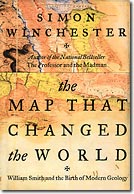
According to Simon Winchester, the author of The Map That Changed the
World, Smith's map would become a cornerstone of the study of geology—and
one of the most undeservedly overlooked works of science produced in the modern
era.
William Smith grew up in a time when few in his position could expect
significant upward mobility. An impoverished orphan from Oxfordshire, Smith
became interested in fossils at an early age and soon developed a passion for
rocks that earned him the nickname "Strata." His job as a surveyor enabled him
to travel the countryside noting various rock formations and puzzling out
relationships between them by studying fossil-distribution patterns. Smith came to realize two key things: first, that one can identify the relative age of a layer of rocks by comparing the fossils that are found in it to those found in other layers. And second, that these layers tend to be arranged in a consistent pattern. Using these concepts, and his knowledge of rock formations throughout the country, he was able to create a geological map of England, Wales, and a section of Scotland. With this new map, educated readers could easily grasp Smith's basic principles and use them not only to understand underlying rock formations, but also to predict, with uncanny accuracy, the location of untapped natural resources hidden within certain layers.
Though the map proved enormously beneficial to British industry, which was
eager for ever more coal and iron, recognition eluded Smith because much of the
scientific community dismissed him as a working-class upstart and publicly
ignored his map while privately appropriating its findings for use in their own
work. Winchester paints a picture of deceit and conspiracy that, when combined
with a few financial mistakes by Smith, led to the confiscation of his home, and his imprisonment for ten weeks in a debtor's prison in London.
Near the end of his life, when many of his antagonists held less sway in the scientific establishment, Smith did finally receive some recognition, and in 1831 he was awarded the Geological Society of London's first Wollaston Medal, geology's equivalent of the Nobel Prize. Since his death, however, public knowledge of William Smith has faded, and he has been reduced to a minor character mentioned briefly in history-of-science textbooks or in university-level geology courses.
This brings us back to Simon Winchester. A history writer with a degree in
geology from Oxford, Winchester is well-qualified to recount William Smith's
story and explain the significance of his revolutionary map. In the same way
that he shone a spotlight on the obscure lexicographer W. C. Minor and his
contribution to the Oxford English Dictionary in The Professor and the Madman (1998)—an international bestseller—so, too, does he now illuminate the life and work of a forgotten scientific pioneer.
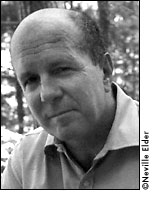
Simon Winchester is an author and journalist whose work has appeared in The
Atlantic Monthly, The New York Times, Harper's, and Condé Nast
Traveler. His books include The River at the Center of the World, about the Yangtze River, and The Fracture Zone: A Return to the Balkans. The Map that Changed the World is his nineteenth book.
Winchester recently spoke with me by telephone from the Berkshires.
—Jordi Weinstock
Simon Winchester
How did William
Smith's map change the world?
I think the two crucial words here are "predict" and "extrapolate." Once you
knew what was on the surface of the earth and you could identify different
rocks in different places as being the same rocks—because you knew what
fossils were in them—then you could follow the precepts Smith laid down and
begin to extrapolate the way those rocks disappeared under and curved and
wiggled about below the surface of the earth. And once you could do that you
could then predict, with great accuracy (obviously the accuracy increasing as
the sophistication of your mapping increased), what mineral resources you would
find under the surface of the earth; the coal, the gas, the oil, the uranium,
the gold, and whatever else. So in a heartbeat, really, nations were suddenly
able to realize and then to exploit what lay beneath them. Up to that point, up
to 1815, you really only managed to scratch the surface, almost literally, of
the earth. You saw coal outcropping; you saw gold glinting in the hills. You
went and got it, and maybe you followed the seam a little way underground. But
once you could predict what lay a thousand feet below the surface, or 2000 feet, then
suddenly you could make use of your natural resources. I think that was the way
that Smith's map changed the world. It made nations aware of and able to
exploit their natural mineral resources.
So did similar mapping projects arise in other countries?
Almost immediately. The French and the Germans had them going by 1816 or 1817.
Geological maps of America were being made as early as 1822. So all of a sudden
any country that used this technique realized that it was sitting on something
of enormous value.
The Map That Changed the World clearly shows that you think William
Smith was under-appreciated as a founding father of science. Why do you think
he has remained relatively unknown? Why should people know his name?
I think he is unknown because of his origins, quite honestly—because he was so
ordinary a person. In the geological industry, or, if you like, the whole
scientific industry, there was something of the cult of celebrity. I mean, look
at the cults of Darwin and Huxley and Sedgewick and Mercheson and Einstein.
Maybe it was the way they projected themselves, maybe they had friends who were
ecstatic about their achievements. Smith was alone, he was working class, and
he had, except for a short period of his life, very little by way of
influential friends. And then he was cheated. He was plagiarized, he was
ruined, he was shunned by society, as it were, and all of these things
happened, coincidentally, to conspire to leave his legacy very little known.
Not the least of these tribulations was that for years the map that was
publicly considered the map that changed the world was one done by the president of the Geological Society, which was almost an exact copy, a plagiarism, of Smith's map. So in
a way, the Geological Society of London got the credit for creating the map
when in fact they had stolen it from Smith—and Smith's achievement was
somewhat overlooked. So it's a combination of facts, but deep down I think it
was the fact of his extremely humble origins and his ordinary background.
When William Smith was growing up, it seemed that science was the realm of
the wealthy, but you point out in your book that by the end of his life that
was starting to change. What were some of the forces behind that change? Did
William Smith have any role?
Unwittingly I think he did have a role. I don't think he set out and said, "I
am going to change the social makeup of the science that I am studying," but I
think the sheer force of discovery swept away the pretenses of the aristocracy
that dabbled in the science. Suddenly people were making discoveries that
required real brain power, that required, in geology, real brawn. I mean,
people would have to go out from the drawing rooms of London and travel around
and actually tramp about in hobnail boots and hit rocks with hammers. This is
the kind of thing that perfumed dandies weren't terribly keen on doing. They
liked to sit back in their drawing rooms and look at these exquisite objects
from the earth. But going through the grime and the heat to actually get them
was something that practical men were much better at doing. So geology, like
many sciences, slowly and steadily became the realm of the practical man, of
the thinking man, rather than the dilettante and the aristocrat.
So before Smith what was the science of geology like?
Very primitive indeed. It was dominated, of course, by the religious beliefs
that either the earth had been created in seven days, and then was altered by a
Noachian flood—to use that rather ugly word—but essentially Noah's flood, or
that the world had come out of a series of volcanoes. These are the two
opposing views of neptunism and plutonism. Either way, the idea was that
fossils had been placed, as I mentioned in the book, by the vis
plastica, the divine force that had inserted fossils into the earth as a
manifestation of God's omnipotence and majesty. Things that we today would
think of as completely wacko were central to this rather primitive science. It
wasn't until a man called James Hutton came along in the middle of the
eighteenth century and said, "Wait a minute, the processes that we see
happening today—the erosion being caused by rocks chipping against each other
as they fall down a mountainside or animals dying and being buried by
sand—these processes have been going on for eons." If you can accept that the
earth is older than 4000 or 5000 years old—which is a churchly belief—if you
can accept that these ordinary processes that we see around us have been going
on for millions and millions, if not billions, of years, then maybe that is
what geology is all about. Maybe there's a rational side to the science. At
first the Church dismissed Hutton, but it was into this atmosphere that Smith was
born, when things were beginning to change.
When Smith published his map, was that still the view of the Church or had
it changed?
It hadn't changed at all, and I might say parenthetically that there are
something like a hundred million people in this country today who still
cling—not necessarily desperately, you've only got to watch certain television
channels—cling with great enthusiasm to the idea that the earth is young, that
fossils are artifices and that mankind descended from Adam and Eve. The Church
hadn't given it up in 1815, and a significant number of people haven't given it
up today.
Did Smith face any sort of criticism from the Church for his blasphemous
publication?
Oddly enough, no. He didn't because the atmosphere was beginning to change in
the circles in which his map was discussed. But remember that, in a way, going
to debtor's prison, being made to live as a homeless man for a decade, being
completely excluded from the chattering classes of London, were ways of being
shunned. The Church did not turn its back on him, but it didn't need to. I dare
say if he had published his map in 1815 and been lionized in London society,
there would have been churchmen who would have said that this kind of thing is
not on, and this man must be blackballed or argued with. Because he
disappeared, the Church didn't have to bother shunning him.
You dedicated The Map That Changed the World to Harold Redding, your
tutor at Oxford. How important was your university study in geology in
researching this book?
Enormously important, I think, though I was not a practicing geologist but for
one year after leaving Oxford. I went to Uganda and worked looking for copper
and then, for a variety of reasons, got into journalism and essentially had
nothing to do with geology for years and years and years. Except occasionally I
would write pieces that touched on geology. I was in the Far East for a long time, where we had a lot
of volcanoes and the occasional earthquake, and in those stories I remember my
news editor saying, "Gosh, Simon, you seem to know a reasonable amount about
this ... Wait a minute, weren't you a geologist?" So once in a while the
geological background was helpful, but I hadn't ever thought of actually doing
a book about geology. One day while I was looking for a character who might be
as historically interesting as W. C. Minor had been to me in that book about
the Oxford English Dictionary, I suddenly thought, I remember Harold Redding
telling me about William Smith. I rang him up—delighted, of course, to
find that he was still alive, an elderly man still working at Oxford—and said,
"Harold, do you remember me after all these years?" (It's been thirty-five),
and he said he did.
I said, "I'm vaguely thinking of writing a book about William Smith." There was
this wonderful pause, and he said, "I would be so delighted if you did, because
nobody has. I always thought of him as a great hero, and to have you writing
his story would be the greatest of delights."
Throughout this book and your other books that I've read you give rich
narrative detail that almost makes it seem as if you were there. I'll give an
example:
"On April 18, 1814, Smith was interested indeed when he passed Cary's shop in
the Strand, and saw that in the bow windows of the store were four of his
sheets completely finished, and fully coloured. Cary had chosen to surprise and
delight the forty-five-year-old mapmaker—he had placed the finished
sheets ... in the window without telling anyone. Smith, who became as excited as
a schoolboy, snatched up the sheets and immediately—his first reaction, and a
noble one—took them over to Somerset House to show Sir Joseph Banks."
Was it difficult finding the kind of detail necessary to write scenes like
this in a story whose events occurred two centuries ago?
Curiously, that particular event of Smith's being surprised by seeing the first
four sheets of the map is recorded in three places: Smith's own diaries, John
Cary's logs, and [Smiths' nephew John] Phillips's biography of his uncle. It
would have been a more difficult task if you had chosen another passage of the
book where maybe there was less factual evidence. That was a relatively easy
one to pin down. Easy, and, of course, delightful when you find this kind of
thing. It really, really does make history come alive. You can imagine—you can
almost taste the excitement that Smith was enjoying at that moment.
Were there any areas of Smith's life, such as his marriage, which you
referred to a couple of times, that you wish you could have had more
information on?
Yes. Smith himself was a pretty bad diarist, and Phillips, I think,
bowdlerized—he took away a lot of material that he didn't think succeeding
generations ought to read. Now, I would have loved Smith to have kept a diary
in prison, for instance. I'd like to know exactly what he was feeling when he
took the stagecoach up the road that August night to Yorkshire to begin a
self-imposed exile. I would have loved to have found out more about his wife,
about her as a widow. I'd like to find out what happened to the Wollaston medal
that was given to him by the Geological Society, which I've never managed to
track down. Most extraordinarily—and of course this is the kind of thing
that happens when you research a book—I could never find a living relative of
Smith's. But blow me down, I was giving a talk in Oxford four weeks ago, and an
old man who was having his book signed said, "Oh, by the way, my name is John
Taylor, and I am, as far as I know, the only living lineal relative of William
Smith." I said, "Why weren't you there when I was researching the book!" So
research is a terribly imperfect science, and you learn an awful lot more after
you've published a book, because people keep writing to you and saying, "Oh,
gosh, I was related to such and such a character and I have a letter in my
possession." So it's a never-ending process, and once you have actually
finished the book and sent it off to the publishers to be printed, you wait
with an enormous amount of anticipation and a slight amount of trepidation to
hear what untold parts of the story you've missed.
The Professor and the Madman raised public awareness and appreciation
of not only the men involved in the creation of the OED but also the dictionary
itself and lexicography as a field. Do you think The Map That Changed the
World can have a similar effect on public appreciation of Smith's map and
the field of geology?
Well, you know better than I that geology in this country is a bit like
fruitcake. It's one of those things that people affect not to like at all. I
now feel keenly—I would say almost passionately—devoted to it. I think it's a
wonderful and fascinating science, and it literally underlies everything.
That's not meant to be a pun; it's crucially important. I think it's also very
romantic and filled with romantic figures. So in the same way that lexicography
did seem dry as dust until I started researching it and now a lot of people
have come to believe that dictionaries and lexicons are fascinating, yes,
I do think—at least I hope—that people will become as intrigued by geology as
I have been.
Did your love of language develop as you researched both The Professor
and the Madman and "Word Imperfect" (on Roget and his thesaurus, in the
May, 2001, Atlantic)? Has your perception of your own writing changed as
a result of that?
I should say, first of all, that I think it was my father that really turned me
on to language. We were tremendously and competitively keen on doing crosswords
when I was a little boy. English crosswords, as you may well be aware, are very
different from American ones. They're not synonymous—they're sort of cryptic
clues. So he was always very interested in words and the sound of words and in
having a bigger vocabulary than I did, and I would compete with him. To fast
forward to what you're asking, yes, I think my own appreciation of the language
has increased hugely since writing those pieces. Now I do look at everything I
write much more critically to decide whether I really am using with great
precision what I think is the right word. I'm often wrong, but it gives me a
greater sensitivity, that's for sure. I should say that at the moment I'm
reading Decline and Fall by Evelyn Waugh, and I think that Evelyn Waugh
is the master of the absolutely exact use of words. I think he is a great,
great man, and few writers can match the exactitude of his linguistic choice.
Before writing The Professor and the Madman you worked primarily as
a travel writer. The Map That Changed the World seems to have elements
of both travel and historical writing. Are you going to try to continue writing
books that fit into both these genres?
I'm actually leaving on Sunday to go off to West Java, because I'm beginning
work on a book about Krakatoa. Not so much on the volcano itself—because I
think volcano books have a certain similarity to them—but on the fact that
this was the first great catastrophe after the invention of the submarine
telegraph cable and the world knew about it very quickly. So here is a subject
that involves a lot of historical research, because the eruption was in August,
1883, and takes me to exotic, distant places. The Krakatoa book and the book
I'm vaguely planning after it will both take me around the world and back in
time. Being able to travel in geography and history simultaneously seems
to me a pretty ideal way of writing books.
What do you think? Join the conversation in Post & Riposte.