I nominate Aretha Franklin’s cover of “The Weight” by The Band. Taking a song as moody and solemn as that and singing it the way she does transforms it in startling ways. Switching to a soul arrangement and foregoing the piano for horns creates an entirely new dynamic within the song, while the pure power and depth of her voice is almost overwhelming.
By the way, if you want to continue the Beatles covers, you could also use Franklin’s “Eleanor Rigby,” which is similarly incredible.
(Submit a cover via hello@. Track of the Day archive here. Pre-Notes archive here.)
Reader John Maschoff ends a despairing week of national news on an optimistic note:
This version of “We Can Work It Out” so wonderfully injects the groovy funk and soul that Stevie Wonder has been creating for decades. It’s a must-include on this list.
I love this song because it takes a classic synthpop song and turns it into a classic power pop song. When I listen to the original, it’s hard for me to imagine it as a power pop song; when I listen to the cover, it’s hard for me to imagine it as a synthpop song. The Nada Surf arrangement works on its own, without depending on knowledge of the original for its effect.
(Submit a cover via hello@. Track of the Day archive here. Pre-Notes archive here.)
The Carpenters’s “Ticket To Ride.” Brilliant. Period. End of sentence.
Here’s some trivia regarding that song title, relayed by Don Short, a Daily Mirror music journalist:
The girls who worked the streets in Hamburg had to have a clean bill of health and so the medical authorities would give them a card saying that they didn’t have a dose of anything. I was with The Beatles when they went back to Hamburg in June 1966 and it was then that John told me that he had coined the phrase ‘a ticket to ride’ to describe these cards. He could have been joking – you always had to be careful with John like that – but I certainly remember him telling me that.
(Submit a song via hello@. Track of the Day archive here. Pre-Notes archive here.)
A reader in NYC, David Leitner, has the perfect cover for the day:
Marvin Gaye’s “Star Spangled Banner” is the ultimate song transformation. What only he could sing, solo with a beat box …
If you have any Star-Spangled suggestions of your own, let us know and we’ll update. Update from Noam:
This version is my fave because Sufjan [Stevens] captures the menace of it. The song is fundamentally about a war, and although patriotism compels us to ignore the fact that war is hell, this cover doesn’t.
(Track of the Day archive here. Pre-Notes archive here.)
In response to my inquiry for the most genre-bending Beatles cover, Jay in Cincinnati remembers a truly unique, a cappella version of “Helter Skelter”:
Somewhere in the mid-1980s, I was working late ... really really late, after 3 A.M. late. Finally driving home, my brain competed with only two thoughts: staying conscious enough to survive the trip, and how good it would feel when I finally could collapse into bed.
The radio was on—nice and loud, to help me avoid nodding off, tuned to a small non-commercial station that played non-mainstream music. When this song came on, it must have been close to 30 seconds before I even realized it was a song I knew. It was so different—not just different from the original song, but from almost any kind of music I’d ever heard—that for my own safety I pulled off the road so I could listen. Nobody identified what I’d heard; they just kept playing more music. Sometimes on this station it could be 40 minutes before anyone came on to list what had been played.
There were no cell phones, there was no internet. When I got home, I did not go to bed. I had to get a phone book, look up the station’s number and call. I had to know. Unlike today, when hardly any radio station in America has a live person on the air overnight, someone answered.
I’ve since seen this group [The Bobs] in concert maybe ten times, occasionally planning family/friend visits to other cities based on when they would be performing there. They’ve done covers of other famous songs, sometimes as radically different as this, but also in versions more recognizable. Mostly they sing their own songs, which range from hilarious to weird to touching. Every time I see them do this song, it brings back that night.
When he burst into public recognition in 1968, people either regarded Tiny Tim as a lovable wacko, or simply a wacko; though Tim’s eccentricity seemed both charming and oddly appropriate in the wake of the Summer of Love, despite his long hair and beatific attitude, he was no hippie, but instead an amateur archivist of American popular song who made it his life’s crusade to remind people about the joys of the Tin Pan Alley era. In his own odd way, Tiny Tim was one of the first artists of the rock era to celebrate the notion of the Great American songbook, though his fondness for a warbling falsetto delivery, his thrift-store wardrobe, his slightly fey personality, and his championing of the ukulele as his favored means of accompaniment was every bit as anomalous in 1968 as it would be today. While Tiny Tim was (principally) marketed as a novelty act and treated as a joke by many who presented him to the public (one of his most frequent television platforms was on Rowan and Martin's Laugh-In), Tim wasn’t kidding -- he loved and lived for this music, and he performed it in a historically accurate manner, remaining true to his musical vision right up to the very end . . . .
This cover sounds both serious and wacky, and it bends the original song into such a bizarre vaudeville style that it is almost unrecognizable. Tiny’s vocal range is very wide, and gives the song a unique sound. I would guess that most people won’t like it, but here it is anyway.
(Track of the Day archive here. Pre-Notes archive here. Submit via hello@.)
One cover I still love to hear after 30-odd years is Jeff Beck’s cover of The Beatles’ “She’s A Woman.” It manages to be faithful to the original and, yet, so very different with a talk-box vocal—an early use of the effect—and a laid back, reggae-jazz vibe with amazing, complicated musicianship. (I still find it a bit hard to believe the drummer was 19-years-old at the time.) Widely considered one of the greatest rock guitarists, at the time Beck had tired of backing up singers like Rod Stewart, even though his albums were released as The Jeff Beck Group. Instead of another rock album, however, he came out of left field with an instrumental jazz-fusion effort produced by George Martin, The Beatles’ producer, which became a huge hit.
Here’s a thought: What’s the best, most genre-bending Beatles cover you know of? Drop us a note with your pick and why you love it.
(Track of the Day archive here. Pre-Notes archive here.)
Your cover song series is a such a great idea. I’d like to recommend Lake Street Dive’s cover of The Jackson 5’s “I Want You Back.” The original version—with its young Michael Jackson vocals, instantly funky baseline, and infectious riff—has been called “certainly the fastest man-made route to pure joy.” It’s almost impossible to hear it and not want to move, bop your head, and crack a smile.
Lake Street Dive takes the raw material and transforms it into an almost plaintive lament about lost love that fits the song’s lyrics much better. By slowing down the tempo, changing the harmonies and adding a meandering jazz trumpet that echoes and elaborates the joyous guitar riffs of the original, they completely change the song.
Nowhere is this more clear than in the third verse. Whereas the Jackson version features a joyous a-ba-ba-bum-bum under Michael’s soaring “all I want, all I need” lyric, the cover goes all in with an upright base solo. In their reading, it is a jazz/country ballad, not a pop anthem.
Although “I Want You Back” is by far my favorite of their covers, Lake Street Dive has a ton of compelling cover songs on YouTube. Hall and Oates’ “Rich Girl,” George Michael’s “Faith,” Annie Lennox’s “Walking Through Broken Glass,” and even “Bohemian Rhapsody” have all gone through their unique jazz/Nashville/’60s Atlantic Records filter with great results.
(Track of the Day archive here. Pre-Notes archive here. Submit via hello@.)
I saw your Miami Vice/“In the Air Tonight” note and immediately thought of this: The opening scene of the pilot of the NBC/TNT show Southland and its amazing use of “School" by Supertramp. (I grew up listening to Supertramp and their album Crime of the Century was always my favourite.) This scene is even further into the TV arena than Miami Vice, so it might fall outside your boundaries for the cinema series, but it’s something that has always stuck with me. It’s rookie cop Ben Sherman’s first day on the job, and he is doing crowd control at a homicide scene:
The show used the haunting harmonica opening from the first track “School,” played over top of low-frame-rate shaky cam footage with no sound, quick-cutting among the confused throng of people around the scene. The producers cut out the song’s lyrics, jumping right to the instrumental break in the middle of the first verse. As the music builds to the child’s playground scream, the music cuts out to show an onlooking woman screaming instead, which jolts Sherman awake to what’s going on around him. Thus, while Sherman has graduated from the academy, this homicide is his first day at school.
(Track of the Day archive here. Pre-Notes archive here. Submit via hello@.)
A gospel-tinged track for Sunday, sent by reader Keith Wells:
Before he became a superstar, Bob Seger released an album of almost exclusively covers, titled Smokin’ Ops, including his version of Tim Hardin’s “If I Were A Carpenter.” Of the hundreds, perhaps thousands, of versions released over the years, it’s my favorite. His passion comes across as authentic, and Skip Knape’s beautiful Hammond organ throughout gives it an almost gospel feel.
(Track of the Day archive here. Pre-Notes archive here. Submit via hello@.)
Gary in Saskatchewan, our serial contributor to the cinema series, delivers another solid track: Danny Elfman’s orchestral “Ice Dance” in Edward Scissorhands. (Full instrumental version here.) As Gary puts it, “This scene captures a brief moment of magic before everything falls apart.”
The official new Ghostbusters theme song was released today, and for everyone reading this who was in middle school in 2005 (and for those who decidedly weren’t), this might be confusing:
Fall Out Boy and Missy Elliott recorded the new theme song.
It’s a reworking of the original “Ghostbusters (I’m Not Afraid)” by Ray Parker Jr in 1984 that was nominated for Best Original Song at that year’s Academy Awards, won a Grammy, and followed the franchise for the past 30 years.
Not everyone’s a fan of the new version. Jezebel’s Julianne Escobedo Shepherd calls it “bad.” The Verge’s Kaitlin Tiffany says it’s “specifically designed to make you realize what could actually retroactively ruin a 30-year-old movie.” BuzzFeed’s Katherine Miller tweeted that it “sounds like something we would've had to pretend was good in 2006 because everything was bad.”
So was it worth it? Well, they reworked it, put their thing down, flipped it, and reversed it: The 1980s synthpop was replaced with 2000s pop punk, but that same altered reality version of the city vibe holds true. This is the Chris Cornell version of the Casino Royale theme song.
Noiseyloves it. Entertainment Weeklylikes it, but felt that they should’ve picked Carly Rae Jepsen. (I, for one, am a proponent of all new Carly Rae ventures.)
This soundtrack, like the film itself and any good remake, won’t sound exactly like the original. The new one is set to include Pentatonix, 5 Seconds of Summer, and Elle King. Future generations may look back and see 5 Seconds of Summer and Fall Out Boy as this generation’s BusBoys and Thompson Twins.
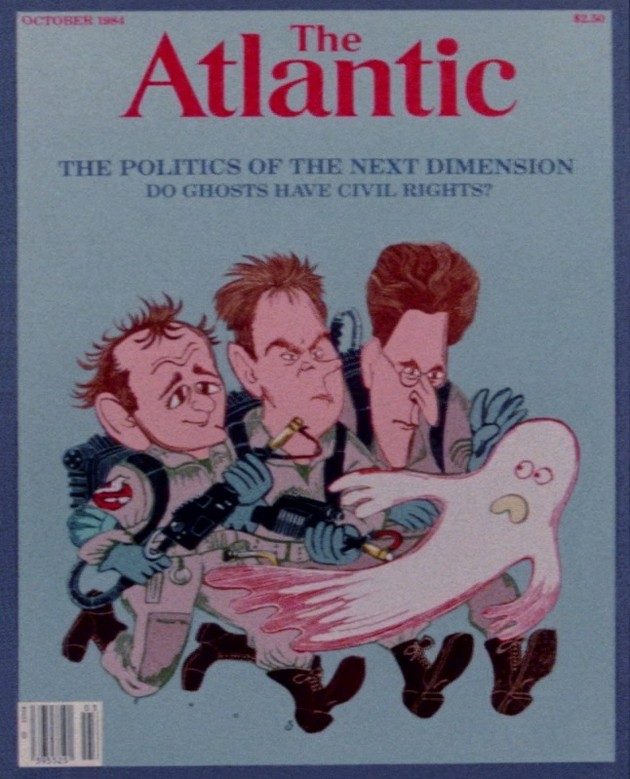
The film will be out in theaters on July 15th, and maybe we at The Atlantic will get another nice shout-out like this one in the original movie 30 years ago.
(Track of the Day archive here. Pre-Notes archive here. Submit via hello@.)