Where Did ‘Let Them’ Come From?
Years before Mel Robbins published her best-selling self-help book, a struggling writer posted a poem with a similar message.
The year 2020 was a bad one for Cassie Phillips. Her husband had recently returned from an overseas deployment, and while he was away, she told me, she’d rarely heard from him. The pandemic began, and the family moved to Savannah, Georgia, where they didn’t know many people. Phillips felt isolated in her new home, and her marriage was falling apart.
Late at night, on her computer, she started writing out some lines—“If they want to go weeks without talking to you, LET THEM”; “If they want to follow the crowd, LET THEM”—to remind herself that she couldn’t control her husband’s behavior. The writing was an attempt to “get through the day knowing I didn’t have anybody but myself,” Phillips said; she was “learning not to give up on other people, but understanding I had to trust myself.”
The phrase Let them wasn’t entirely Phillips’s own invention—she was inspired, in part, by a video clip in which Tyler Perry’s character Madea says, “If somebody wants to walk out of your life, let them go.” In 2022, Phillips left her husband and got the words let them tattooed on her arm, with the L in print and the rest in cursive. She posted a picture of the tattoo on Facebook, along with the lines she had been writing—she calls them a series of mantras, but many people refer to them as a poem. That post went viral, for a poem at least; currently, it has nearly 50,000 shares.
Phillips saw people reposting the poem on Facebook and Instagram, and even screen-printing it on T-shirts. She thought that was cool, but it didn’t occur to her to try to make money from the “Let them” idea. At the time, she was working at a nursing home and as a bartender, taking care of her kids, and trying to hold it together psychologically. “I was in survival mode,” Phillips said.
In May of the following year, Phillips saw an Instagram video from the popular podcaster and self-help author Mel Robbins in which Robbins said, “I just heard about this thing called the ‘Let Them Theory.’ I freaking love this. If your friends are not inviting you out to brunch this weekend, let them.” Initially, Phillips, who assumed the post was referring to her work, was flattered; she sent Robbins a message thanking her for sharing her words.
“I didn’t really care about credit,” Phillips said. She didn’t know what Robbins had planned for the theory. “I didn’t really think it was going to be”—she searched for the right word—“kept.”
A few weeks after Robbins posted her Instagram video, she talked about “Let Them” on her podcast, which has more than 37 million monthly downloads. “I shared something called the ‘Let Them Theory’ in an Instagram post less than a week ago, and I just looked it up; there are over 14 million views of this thing,” she said. The reason the post resonated, she added, is that “every single one of us struggles with controlling behavior, or we struggle with controlling thoughts, and the ‘Let Them Theory’ is a way that you can check yourself so that your controlling nature or your controlling or obsessive thoughts don’t control you.” The YouTube video for that episode now has more than 3 million views.
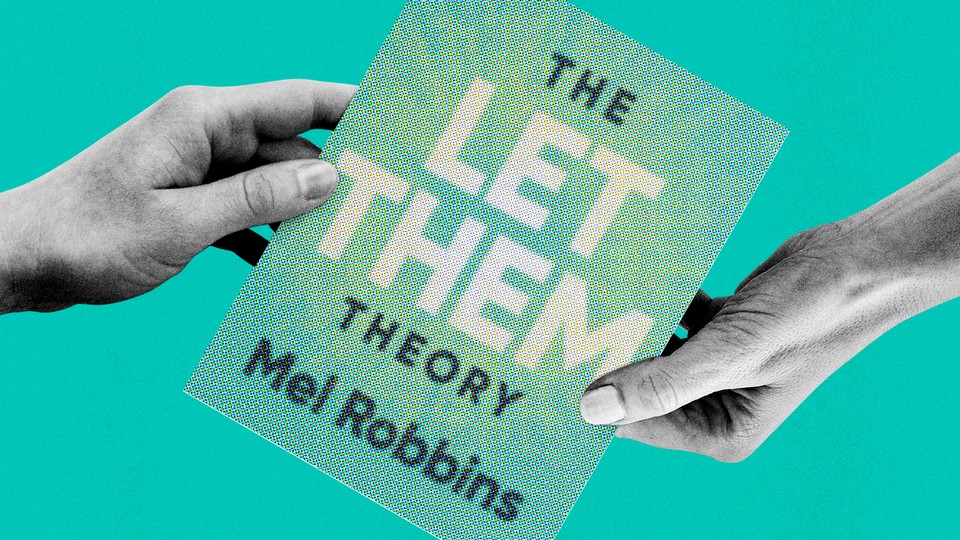
In late 2024, Robbins released a book called The Let Them Theory, which became the best-selling book of 2025 and has sold more than 9 million copies. As her publisher put it, “I’ve been working at Hay House for 37 years, and we’ve had lots of big-selling books, but nothing as big as this.” Robbins released the book into a marketplace where nonfiction sales—never especially robust—were particularly abysmal, down nearly 10 percent from the previous year.
The Let Them Theory advises readers to stop trying to control others and instead take responsibility for themselves. I found parts of it genuinely helpful. Robbins includes one of the best explanations of motivational interviewing—a technique in which a person tries to help a loved one come up with their own reasons for changing their behavior—that I’ve read in my 12 years of covering psychology. And I appreciated her advice to not force a friendship. Still, reading the book, I found some tonally jarring clunkers. A chapter arguing that people should accept that life isn’t fair includes the line “It’s not fair that your country is torn apart by war.” At times, she assumes that her audience has the worst possible habits and intentions: In assuring the reader that they can “create anything you want in life,” Robbins adds that they are unlikely to do so if they keep up “this stupid and toxic habit of comparing yourself to other people. Stop it.” The book is definitely motivating, in the way that getting yelled at by your mother can be motivating.
Robbins writes that the theory came to her when, on the night of her son’s prom, her daughter Kendall urged her to stop micromanaging his choice of pre-dance restaurant. “Mom, if Oakley and his friends want to go to a taco bar for pre-prom, LET THEM,” she recounts Kendall saying. Robbins also acknowledges that many people and groups, including the Stoics and the Buddhists, have previously lauded the virtues of detachment. Indeed, between Seneca and Mel Robbins came “Let It Be,” I’m OK—You’re OK, and “Shake It Off.”
Of all the book’s citations—203 in total, according to a representative for Robbins—none of them credits Phillips’s work. Robbins has denied reading the poem or being inspired by it. Her representative told me, “neither Mel, the fact checkers, the researchers nor the publishers saw the poem.”
Phillips doubts Robbins’s origin story. Her “Let Them” lines had been widely shared online by the time Robbins was writing her book, and she thinks that Robbins, or her team, would likely have encountered them. In her poem, Phillips writes, “If they are showing you who they are and not what you perceived them to be, LET THEM.” In the book, Robbins writes, “Let Them show you who they are.” Phillips writes, “If they want to judge or misunderstand you, LET THEM.” Robbins writes, “Let Them judge. Let Them disapprove.” Robbins also writes that people were inspired by her podcast to get Let Them tattoos, but several of the tattoos pictured in the book look like Phillips’s, with similar lettering. Phillips said that Robbins never responded to her message or later attempts to contact her.
Phillips is especially incensed that in July 2024, Robbins filed a trademark for “Let Them,” in an application that’s still ongoing. She worried that a trademark would mean that she and others who wanted to speak or write about the theory would have to pay Robbins a licensing fee. She also seemed to find the move generally unsavory. “Don’t take a mindset and say, Well, now I’ve declared this is mine,” Phillips said.
I don’t know if Robbins sees it that way—her representative declined interview requests for this article. But when I read her book, I did wonder. In a passage about starting your own business, Robbins tells her readers to follow the example of a business owner who is already successful, and to not be afraid about whether you’ll seem like you “copied them.” “Let Them think you copied them,” she writes. “Because you did.”
Phillips, with her southern drawl and working-class background, is an ideal David to Robbins’s rich, polished Goliath. Many people—mostly fellow writers—have come to her defense, urging Robbins to credit her. Phillips has become a symbol of sorts for authors who will never earn out their advances, become best sellers, or otherwise be like Mel Robbins.
A writer named Andy Mort has posted a series of videos on YouTube dissecting the stated timeline of Robbins’s discovery of “Let Them,” attempting to poke holes in the idea that she learned about it on the night of her kid’s prom. The videos now have more than 100,000 views. (I’ve watched several of these and don’t find them dispositive either way.)
Sage Justice, a writer with a name oddly appropriate for this controversy, has written several posts on her Substack accusing Robbins of cribbing from Phillips. “Mel Robbins made a mint off of someone who had a smaller audience but was building momentum,” she told me. “If we don’t say something, it’s just going to keep happening. Then how do writers like us ever get ahead? How do we get that big break?” Justice mentioned that she is dealing with housing insecurity and financial difficulties, and that she would like a lucrative publishing deal.
Jeff Guenther, a therapist and a social-media influencer known as Therapy Jeff, has also criticized Robbins on social media. He told me that he believes that “Let Them” is an oversimplified version of a real psychological strategy; he doesn’t like that Robbins, who is not a professional psychologist, “took a very specific therapy technique” and “made it fit on a tote bag.” He objects, for example, to Robbins’s advice for how to deal with political disagreements with family members. Guenther thinks that rather than simply letting loved ones hold potentially harmful beliefs, as Robbins has advocated, people with the opposing view should “speak the fuck up.”
As Guenther and I were winding down our conversation, he admitted, “There’s jealousy here.” Guenther has a book out, but it’s sold far fewer copies than The Let Them Theory. He appreciates that he’s “internet famous,” but Robbins is internet famous and “book famous”—and don’t all writers want to be book famous?
Beyond Guenther, many of Robbins’s detractors are likely motivated, at least in part, by envy. People tend to feel most envious of people who seem similar to them and who have achieved something impressive in an area that’s relevant to their own identity, Nicole Henniger, a professor at Tennessee Tech University who studies envy, told me. A bronze-medal-winning figure skater is more likely to envy a gold-medal-winning figure skater than they are a pole vaulter or a plumber. One explanation is that as our brain strains to tell us stories about our existence, we tend to look to comparable, successful people as proxies for other lives we could have lived. “I feel like I maybe should be able to do what they have done” is how Henniger explained the feeling. And of course, in a zero-sum contest, people who are similar to you but slightly ahead of you are your competition.
If I’m honest, professional jealousy is probably also part of why I spent a significant amount of time reporting a story about a self-help book, despite Everything That’s Going On. In a shrinking nonfiction-book market, one in which the victor has reaped an obscene amount of spoils, one person’s overwhelming success—especially if their core idea doesn’t seem very original—can be jealousy-inducing. No one would have made such a fuss over Robbins if she had sold fewer than 1,000 copies, as the majority of books do.
Jealousy isn’t the only reason that someone might take Phillips’s side. Many people have a tendency to root for underdogs out of a sense of justice, Nadav Goldschmied, a psychologist at the University of San Diego, told me. Despite what The Let Them Theory purports, people like to think that life is fair, and the possibility of a dark horse prevailing makes it seem more so, Goldschmied said. He has studied this phenomenon in situations such as Olympic matchups and the Israel-Palestine conflict. In the latter case, participants were shown a map, and he found that they tended to feel more sympathetic to whichever country was portrayed as smaller relative to other countries.
Part of the tension here can also be explained by the fact that influencers, podcasters, and other internet stars may not have the same commitment to attribution that journalists and academics do. An editor at a prominent publisher—who asked not to be named because he wasn’t authorized to speak to the press—told me, “Some of this is people placing an academic understanding of knowledge onto podcasters, for whom intellectual credibility is not a source of anxiety.”
Beyond trying to block the trademark, there isn’t much Phillips or her supporters can do at this point. A two-word poem title isn’t copyrightable. Publishers sometimes even put out books with the same exact title as a previous book, the editor told me. “That doesn’t really matter unless the title is, like, Gone With the Wind,” he said. And self-help books tend to be at least a little derivative. Many authors—myself included—frequently dip from the same well of time-worn psychological tricks. Atomic Habits, a book about habit change, heavily cites The Power of Habit, an earlier book about habit change; my book about personality change builds on several other books about the same topic.
The editor also said that the key to selling nonfiction books isn’t necessarily a title or an idea, but a person’s fan base—something that Robbins had already well established with her podcast and a previous best seller, The 5 Second Rule. (Podcasts are a particularly important engine behind nonfiction-book sales; some book-publicity firms now have publicists devoted exclusively to pitching podcasts.)
Taking a step back, one could argue that everyone in this drama is actually doing fine. Robbins certainly seems fine. Phillips has more than 20,000 followers on Instagram and is now working as a freelance writer. She isn’t sure she’d want to pursue a settlement with Robbins, if it came to that, because it might include a non-disparagement clause, and she’d want the freedom to discuss “Let Them” however she pleased.
The editor at the prominent publisher could also see the bright side of this saga: He said that at least it means “people still care about books.” In the age of AI-written novels, he said, “it’s kind of exciting that there are readers out there interested enough in policing the intellectual integrity of books that they bothered.”
Fervid discussion about books tends to be good for other books. If people want to argue over who truly created the “Let Them Theory,” maybe we should—well, you know.