Reporter's Notebook

Orbital View
Show Newer Notes

That’s one way to look at these spots of land in Bombetoka Bay, Madagascar:

Several commenters are noting how the shape of the water looks like a squid. For some less figurative observations, let’s go to NASA’s Earth Observatory:

On the northwestern coast of Madagascar, the salty waters of the Mozambique Channel penetrate inland to join with the freshwater outflow of the Betsiboka River, forming Bombetoka Bay. [...] Along coastlines and on the islands, the vegetation is predominantly mangrove forests. In fact, Bombetoka Bay is home to some of Madagascar’s largest remaining communities of mangroves, which provide shelter for diverse mollusk and crustacean communities, as well as habitat for sea turtles, birds, and dugongs.

What’s a dugong? Here are two, at Jakarta’s Sea World:

Reuters

Here are some basics about these adorable, dopey-looking dudes:

The dugong is a medium-sized marine mammal. It is one of four living species of the order Sirenia, which also includes three species of manatees. It is the only living representative of the once-diverse family Dugongidae; its closest modern relative, Steller’s sea cow (Hydrodamalis gigas), was hunted to extinction in the 18th century. The dugong is the only strictly marine herbivorous mammal. [...]

The dugong is easily distinguished from the manatees by its fluked, dolphin-like tail, but also possesses a unique skull and teeth. Its snout is sharply downturned, an adaptation for feeding in benthic seagrass communities.

(See all Orbital Views here)

Move over, Chicken Littlethis has to be one of the most bizarre satellite images I’ve ever seen:

A photo posted by DigitalGlobe (@digitalglobe) on

Yes, that’s the KFC logo. And no, it’s not Photoshopped. Apparently the whole thing was part of an advertising campaign on behalf of the fast food chain. Condé Nast Traveller reported in 2014:

A team of nearly fifty designers, scientists, and craftspeople spent three months putting Sanders’s face onto the desert of Rachel, Nevada, a tiny town in the desert near Area 51. [...] The giant Colonel Sanders image was assembled like a jigsaw puzzle out of 65,000 tiles, individually painted red, black, white, or beige. The finished “Face from Space” measured 87,500 square feet in area, a bigger footprint than St. Paul’s Cathedral in London. The Colonel’s face was so big that it could hold all four of those other great Americans carved onto Mount Rushmore. In fact, it was the biggest logo in the history of advertising.

Despite being seemingly out-of-this-world, the ad wasn’t the first of its kind. From NPR:

KFC claims in a press release that their giant portrait of Colonel Sanders, built in 2006, is “the world's first brand visible from outer space.” But, as Alex and James Turnbull of the blog Google Sightseeing point out, the oldest “astrovertisement” is actually a Readymix logo that was carved into the Australian desert in 1965.

Planet Earth is a very weird place to live.

(See all Orbital Views here)

Benjamin Grant refers to this scene as “leaf-like impressions on the shore of Musa Bay, near the Shadegan Wildlife Refuge in Iran”:

The stunning estuary has been a place of commerce for millennia:

Before draining into the Persian Gulf, several rivers and streams in southern Iran converge into Musa Bay, a shallow estuary with a long history as a port. As far back as 326 B.C.E., the Greek navigator Nearchos noted that the area was already a shipping center. Today, it supports Bandar Imam Khomeini, Iran’s busiest port city.

Here’s a bit of background on Shadegan, from The Guardian:

To drive out to Shadegan wetland 100km south of Ahvaz is to see Khuzestan change from farmlands and orchards, to barren desert, and suddenly to a marsh. Shadegan, one of the first international wetlands registered at the Ramsar Convention of February 1971, covers 300,000 hectares. All across Shadegan lie green palm trees bearing the sweetest dates. Sheep, cows and water buffalo fill the plain. Birds, in their plenty, fly across the horizon and one may land on the back of a water buffalo, which will casually remain relaxed in the water.

(See all Orbital Views here)

This lovely sun-like formation is actually a drained wetland, per Anthony Quigley’s caption:

The Étang de Montady (or the "pond of Montady") is a former freshwater wetland that was drained by monks during the second half of the 13th century. The Étang de Montady is near Colombiers, midway between Béziers and Narbonne, in the western department of Hérault, in southern France. The area was drained by making radial ditches from a single center point out to the extremities. The water flows to this center point and is then drained through an underground culvert and through the Malpas hill and under the Malpas Tunnel of the Canal du Midi.

Same plot, different angle:

Paul Wilkinson / Flickr

(See all Orbital Views here)

From Anthony Quigley’s great IG account of satellite images:

Baldwin Village is called “The Jungle” or “Jungles” by locals because of the tropical trees and foliage, such as palms, banana trees and begonias, that once thrived among the area’s tropical-style postwar apartment buildings. The Los Angeles City Council ostensibly changed the name in 1990, after residents complained that it reinforced the neighborhood’s image as a wild and menacing place. They renamed it Baldwin Village, hoping to reflect the affluent and peaceful Baldwin Hills neighborhood nearby, one of the most affluent African American neighborhoods in Los Angeles.

Here’s an excerpt from a 1988 Los Angeles Times piece on the renaming effort:

“It’s been bad, it’s not a good place for a senior citizen like me,” [resident Booker T.] Burgess said. “People shooting each other, selling drugs on the streets and then threatening to rob you if you go outside. Most of the time, I’m afraid to leave the house.” [...] Tom Reddy Bailey, who has been robbed in broad daylight in front of his home, said he had already stopped telling people he lived in The Jungle, even before the official name change. “As soon as you say that name, they say, ‘Oh, you live over there. We don’t go over there,’” he said. “I just say I live on Gibraltar Avenue, and I don’t say anything else. I never liked the name ‘The Jungle.’ Baldwin Village sounds a lot better. But we need more than just a new name."

City Councilwoman Ruth Galanter, whose district includes the neighborhood and who proposed the name change, agreed: “Of course it’s not enough. It was never intended to be enough. But it is a step to show city commitment toward helping the community get back on its feet.”

The neighborhood is the setting for the 2001 film Training Day, which probably set back the rebranding with ominous scenes like this one:

Baldwin Village is also the setting for the 1992 film White Men Can't Jump and the popular music video for Waka Flocka Flame’s “Hard in Da Paint” (2009).

(See all Orbital Views here)

With temperatures in D.C. set for the high 70s this week, this gorgeous view above Pesaro, Italy, is just right:

Update: So saith the Capital Weather Gang, “We declare winter over and spring here, effective today.” Hallelujah.

(See all Orbital Views here)

Just because it's interesting and beautiful, take a look at this visualization of shipping traffic around the world. It’s a promotional video for a commercial tracking service called FleetMon, but nonetheless worth checking out.

Thanks to reader AB for the tip.

(See all Orbital Views here)

NASA

Details from NASA’s Jet Propulsion Laboratory at Cal Tech:

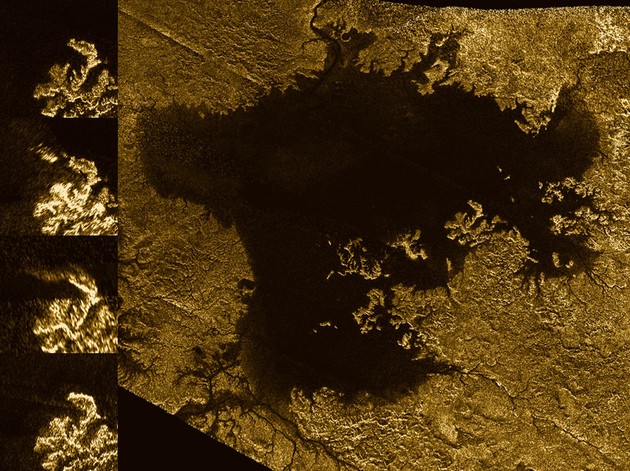
These images from the Radar instrument aboard NASA’s Cassini spacecraft show the evolution of a transient feature in the large hydrocarbon sea named Ligeia Mare on Saturn’s moon Titan.

Analysis by Cassini scientists indicates that the bright features, informally known as the “magic island,” are a phenomenon that changes over time. They conclude that the brightening is due to either waves, solids at or beneath the surface or bubbles, with waves thought to be the most likely explanation. They think tides, sea level and seafloor changes are unlikely to be responsible for the brightening.

The images in the column at left show the same region of Ligeia Mare as seen by Cassini's radar during flybys in (from top to bottom) 2007, 2013, 2014 and 2015. … These features are the first instances of active processes in Titan’s lakes and seas to be confirmed by multiple detections.

(See all Orbital Views here)

A metallic stripe over rippling blues:

From Benjamin Grant’s caption:

The Juscelino Kubitschek Bridge is a steel and concrete structure that crosses Lake Paranoá in Brasília, Brazil. The main span has four supporting pillars submerged underwater, while the deck weight is supported by three 200-foot-tall (61 m) asymmetrical steel arches that crisscross diagonally over the bridge.

For reference, here’s the same structure, from a different angle:

Reuters

The Juscelino Kubitschek Bridge, which opened in 2002, is nicknamed “JK Bridge” for short. No kidding.

(See all Orbital Views here)

NASA’s Earth Observatory released its “newest puzzler” last week and asked its Instagram followers the following questions:

What do you think is the cause of the grid pattern? How would you explain why there are different shades of green (and brown) present? What part of the world do you think this image shows? Your challenge is to use the comments section to tell us what part of the world we are looking at, when the image was acquired, what the image shows, and why the scene is interesting. Good luck!

A few days later, they revealed the answer with a zoomed-out image. Both are revealed after the jump, if you’d like to guess first:

The location: Argentina’s Chaco Forest, in the northern province of Salta. Further details from the caption:

Shrubs and hardwood forests thrive in the semi-arid region. For many years, puestos—small settlements centered around water sources—dotted the landscape. But in the past decade, large-scale farm and ranch operators have cleared broad swaths of the chaco to make way for livestock and crops raised on an industrial scale.

In fact, an analysis of data collected by several Landsat satellites suggests that Argentina’s chaco faces one of the fastest tropical deforestation rates in the world. On October 15, 2015, the Operational Land Imager (#OLI) on #Landsat 8 captured this false-color image of fields, forests, and puestos in the #Salta province of northern Argentina. The fields, most of which appear to be fenced, are arranged in a grid pattern. Fires are actively burning in a few sectors of the grid, likely lit by land managers trying to clear shrubs and trees to make room for livestock, timber, or crops. Fresh burn scars are dark brown; older burn scars are lighter brown.

Over time, burned areas become light green and eventually dark green. In the lower right of the image, several traditional puestos are visible as light green patches. These settlements usually consist of a few dwellings, farmhouses, and small-scale crops located near a well. Tree cover declines significantly at the center of a #puesto because of heavy grazing by cattle, goats, and other free-ranging livestock near the water source. Ecologists call the distinctive grazing patterns piospheres.

(See all Orbital Views here)

It’s hard not to have Malvina Reynolds’s famous ditty in my head after seeing this suburban view:

I actually spent four years in Killeen as a kid, when my parents were stationed at neighboring Fort Hood, the biggest military installation in the world (about 53,000 residents in 2010 and as high as 95,000 in the 1940s). When I went in college, my mother returned to Hood as the assistant chief nurse of its hospital, so my driver’s license for most of my 20s had a Killeen address. Bartenders, after checking my ID, would sometimes ask me about this notorious chapter in Killeen history:

The Luby’s shooting was a mass shooting that took place on October 16, 1991, at a restaurant in Killeen, Texas. The perpetrator, George Hennard, crashed his pickup truck through the front of a Luby’s Cafeteria, and immediately shot and killed 23 people, and wounded 27 others before shooting and killing himself. It is the third-deadliest mass shooting in U.S. history, behind only the Virginia Tech and the Sandy Hook Elementary School shootings. It remains the deadliest mass shooting in the U.S. that did not occur at a school.

My dad and I used to eat at Luby’s often, but fortunately we moved to Kansas a few years before the massacre. And then there was the Hasan shooting of 2009 that left 13 people dead and more than 30 injured on Fort Hood. Other than that, a great place to grow up!

(See all Orbital Views here)

When home is the International Space Station, human activities can feel pretty extraterrestrial. You sleep in a bag attached to a wall to keep from floating away. Your meals come from freeze-dried packets, your water from recycled urine and sweat. You can’t shower. It’s all very strange.

But you can still Instagram.  

In the 340 days he spent in space—a record for an American astronaut—Scott Kelly took a lot of photos, inviting earthlings to survey their planet from above. He returns to Earth tomorrow, bidding farewell to sunrises like this one:

Scores of fans are wishing him well, including this one:

Thank you for all the amazing pictures over the last year. Sad it’s coming to an end but hopeful your journey will open the door for us go further and see more than ever before. Have a safe trip home tomorrow.

Another one:

I can’t believe this will be your last night. I will certainly miss you very much and all your very informative posts. I feel somewhat sad that you are leaving the ISS and somewhat happy [that] you will be reunited with your family members again. Please keeping posting every day when on Earth! Station Commander Scott Kelly Rocks!!!

(See all Orbital Views here)
More Notes From The Atlantic
  • Notes Home