Pivot irrigation fields cover the landscape north of Copeland, Kansas, USA. Powered by electric motors, lines of sprinklers rotate 360 degrees to evenly water crops.
“Apparently Kansas is much cooler from above!” one commenter exclaims. The dotted nature of the photo reminds of the work of Japanese artist Yayoi Kusama:
Simon Kwong / Reuters
For more on Kusama, Steven Heller wrote a piece for us in 2012 covering an upcoming documentary about the “polka-dot-loving art legend I initially mistook for crazy.”
British astronaut Tim Peake, currently living on the International Space Station, shared the minimalist snap. “Granted - not the most exciting pic ever but this iceberg drifting off Antarctica is about the size of London,” Peake posted.
For reference, here’s London:
Stefan Wermuth / Reuters
If you read Peake’s caption and thought to yourself, “Wow, I wish I could hook that up to a boat and drag it thousands of miles” … well, you’re not alone. Back in 2011, Alexis Madrigal reported on the (surprisingly long) history of “zany iceberg towing schemes.”
Here’s Russian cosmonaut Oleg Artemyev’s description of what we’re looking at:
Santa Cruz River (Spanish: Rio Santa Cruz) is a river in the Argentine province of Santa Cruz [in the Patagonia region]. The Santa Cruz begins at the shore of the Viedma and Argentino Lakes.
It’s unclear what exactly these orange puffs are, but one commenter points to this spot in Algeria. If that’s right, that would put them just outside Hassi Messaoud, a town in the Ouargla Province. Do you have clue what, specifically, these features might be? Let us know.
More colors to come.
Update: Stephen Morris, a professor of geophysics at the University of Toronto, writes in:
I believe the puffy orange things are sand dunes. Lines of them. The orange is the color of the sand.
I do not know where in Africa they are, but there are similar lines of "barchan" dunes on the Arabian peninsula:
21°35'27.99"N 54°20'19.96"E
The lines of dunes form perpendicular to the direction of the prevailing winds.
Fifteen years ago today—on March 23, 2001—the Russian space station Mir descended from the heavens in a dramatic flourish. Here’s how NASA describes it:
After more than 86,000 total orbits, Mir re-entered Earth’s atmosphere on Friday, March 23, 2001, at 9 a.m. Moscow time. The 134-ton space structure broke up over the southern Pacific Ocean. Some of its larger pieces blazed harmlessly into the sea, about 1,800 miles east of New Zealand. Observers in Fiji reported spectacular gold- and white-streaming lights. An amazing saga and a highly successful program finally had come to a watery end.
Below are a few more stunning images captured before Mir’s demise, taken from a great new Instagram account I just found, TravellingThroughSpace:
The Russian Space Station Mir endured 15 years in orbit, three times its planned lifetime. It outlasted the Soviet Union, that launched it into space. It hosted scores of crewmembers and international visitors. It raised the first crop of wheat to be grown from seed to seed in outer space. It was the scene of joyous reunions, feats of courage, moments of panic, and months of grim determination. It suffered dangerous fires, a nearly catastrophic collision, and darkened periods of out-of-control tumbling.
Mir soared as a symbol of Russia’s past space glories and her potential future as a leader in space. And it served as the stage—history’s highest stage—for the first large-scale, technical partnership between Russia and the United States after a half-century of mutual antagonism. [...] For Russians, the very name “Mir” held meaning, feeling, and history. Mir translates into English as “world,” “peace,” and “village,” but a single-word translation misses its full significance.
A photo posted by The Jefferson Grid (@the.jefferson.grid) on
One commenter has a hunch: It’s Amboy, California. And a Google maps search confirms it:
There’s a lot less going on in the area than the picture suggests. Located over 100 miles from Las Vegas, Amboy is a ghost town—in more than once sense. The abandoned highway outpost, which reportedly boasts a population of four, has a history of alleged paranormal activity. According to Las Vegas news channel KSNV News3LV:
The town itself dates back to the mid-1800s. Settlers from a nearby mining claim developed it. A cemetery on the outskirts still has the grave sites of about 30 children who died from an unknown disease.
Then came the railroad, followed by Route 66. Amboy flourished, adding a school and a church. “At one time, we were told that Roy's employed over a hundred people," said Carol Aceves, Town Manager. [...]
Eventually, all of that progress came to a screeching halt. “In the 70s when that interstate opened up, everything just went dead around here,” said Aceves. And perhaps not just figuratively. According to Aceves, there have been many reports of ghosts and paranormal activity in town. Noises heard at the church, also the Amboy school. The classrooms today are still littered with books and notepads.
“We heard kids screaming and having fun, like a typical day in school. But it was in the middle of the night and we know there was nobody there,” he said. In one of the motel rooms, they say, blood suddenly appeared on one of the walls. Blood that had not been there the day before.
A photo posted by The Jefferson Grid (@the.jefferson.grid) on
Okay, they’re a lot bigger than your average puddle: These spring-colored plots are actually ponds of potash, a potassium-containing salt used in farm fertilizers. Suzy Strutner has more in the Huffington Post:
Workers pump the potash from way below the Earth’s surface into the ground-level ponds, where sun evaporates the pond water and leaves potash behind. The water is dyed an eye-catching blue so that it’ll absorb heat and evaporate more quickly, a process that typically takes about 300 days. Some passersby have found it jarring when, seemingly out of nowhere, the mine pools make a surreal stark contrast to the mostly unspoiled landscape.
A great milestone for one of the best things on Instagram:
Today we’re doing a PRINT GIVEAWAY because we just passed 250K followers! To enter the contest, simply TAG FOUR (4) FRIENDS in the comments of this post and we’ll randomly select a winner on Friday who will win a 16x16” print with this stunning Overview of Venice. To see more details of this print or to check out what else is available in our Printshop, just click [here]. Good luck and once again, our sincerest thanks to everyone for making Daily Overview what it is today!
And thanks to its creator and curator, Benjamin Grant, for providing so many amazing views for this feature.
Welcome to the #city of #Yuma in the United States, in southwestern #Arizona!
Yuma is home to some 90 000 people. Situated along the #Colorado River, the Mexican frontier lies just west of it and California lies to the north.
Yuma was founded in 1854, and is considered to be the winter vegetable capital of the US because it has some of the most fertile soil in the country.
The city’s official website offers a bizarre fun fact:
By 1949, with Yuma’s postwar economy looking a bit grim, the Yuma Jaycees decided to stage an elaborate publicity stunt to spotlight the area’s year-round perfect flying weather: an attempt to set a record for nonstop flying.
The plane was an Aeronca Sedan named the “City of Yuma” and emblazoned with the hopeful slogan “The City With A Future.” The small plane took off on August 24 and did not touch the ground again for nearly 47 days – until October 10, 1949.
The record-setting 1,124 hours aloft was made possible by a team of volunteers who passed food and fuel to pilots Woody Jongeward and Bob Woodhouse from the back of a Buick convertible as it sped along the runway at 80 miles an hour, with the plane flying just above it and matching speeds.
The caption identifies this whale-like formation as the Tendra Spit, located in the Black Sea. Speaking of whales, a new study suggests that the southern right whale population is still struggling to recover from the sins of generations past. From The Guardian:
A population of southern right whales that was hunted to the brink of extinction by the start of the 20th century has only recovered to 12% of its original population size and will take at least six decades to recover fully, new research suggests. By that time, the population is likely to be be impacted by climate change. [...] In the 19th century, armed with just hand-held harpoons and sailing ships, hunters killed almost every New Zealand southern right whale, leaving just 15 to 20 mature females and about 100 whales in total.
A photo posted by The Jefferson Grid (@the.jefferson.grid) on
Chris Iovenko provided some great background on the Salton Sea in a piece for us last November warning about the area’s toxic dust:
At 235 feet below sea level, the Salton Sea occupies what was once known as the Salton Sink, a forbidding sunken expanse of ancient dry lake bed with a black mud sub-surface that made crossings treacherous. The area was generally avoided until the end of the 19th century, when land developers realized that the area’s alluvial soil and the hot climate would, with irrigation from the nearby Colorado River, produce valuable farmland. A series of canals were built and water flowed in; soon, more than 10,000 farmers and farm workers relocated to the Salton Sink, now grandly rechristened the Imperial Valley, and quickly put 100,000 acres of land under cultivation.
In the spring of 1905, following extreme rains, the Colorado River flooded and blew out a weakly constructed irrigation canal. All efforts to seal the breach failed—for 18 months, the river continued to flood into the Salton Sink, filling it up with fresh water like an enormous shallow tub [covering nearly a thousand square miles of land. ...]
In the 1950’s, with the rising popularity of the nearby desert resort of Palm Springs, developers once again saw opportunity in the Salton Sea. Towns like Salton City and Bombay Beach cropped up along its shoreline, along with resorts catering to tourists interested in water sports, fishing, and swimming. Meanwhile, fish that had been introduced to the lake were flourishing, and by the late 1950’s the Salton Sea was the most productive fishery in California. At its peak, the Salton Sea was drawing 1.5 million visitors annually, more than Yosemite.
Unfortunately, little thought and few resources were devoted to the management of this accidental lake. As a terminal lake, the Salton Sea lacks any outflow, and in the late 1970s a series of heavy tropical storms caused the water level to rapidly rise and flood its banks. The surrounding towns and businesses were severely damaged, many beyond repair, and tourism began to shift away. In the 1990s the lake began to recede dramatically, stranding many of the remaining residences and businesses, as changing water-management priorities diverted more water from agricultural areas to cities. [...]
By the early 2000s, it had become clear that the lake was headed for disaster: The agricultural runoff that sustained the lake contained not only fertilizer and pesticides, but high quantities of salt. Over the years, the salinity rose enough to kill off the lake’s fish species, even salt-water fish.
Our video team posted this short documentary by Jim Lo Scalzo featuring some harrowing images of the area:
In response to the video, our own James Fallows shared a personal connection with the doomed Salton Sea:
It is particularly interesting/alarming for me, because I could well have been in one of those shots from the Leave it to Beaver era. Several times in the late Fifties and early Sixties my dad would dragoon the rest of us for the broiling drive down through the desert to Salton City and neighboring developments, with the fantasy that it could be a “good investment” for the family to buy a lakeshore lot there. Thank goodness he never followed through.
A video posted by NASA Climate Change (@nasaclimatechange) on
Wikimedia
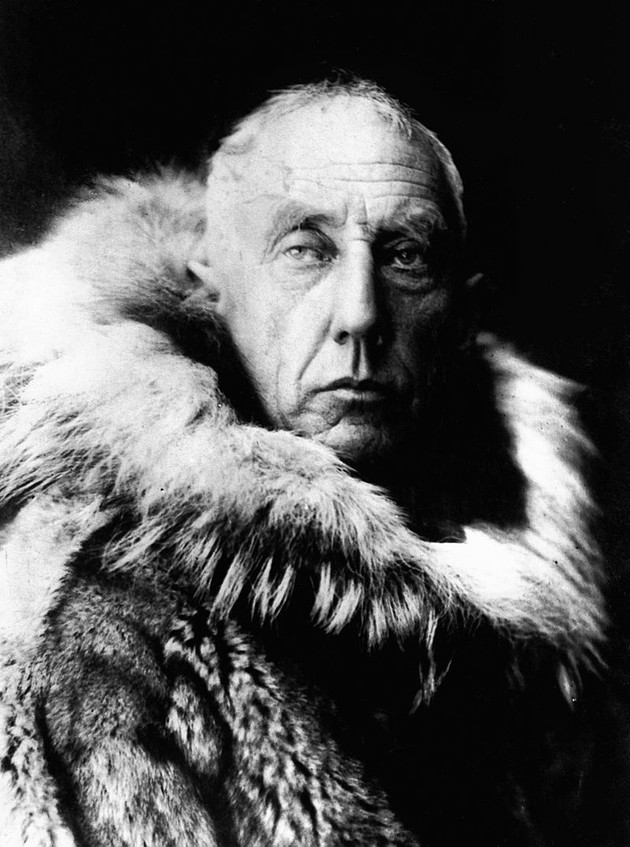
The ice coating in the Arctic Ocean grows and expands each year, thickening in winter and melting away in summer, when ships can start navigating the freezing waters. But when Amundsen, a Norwegian explorer, traversed the Northwest Passage in the early 1900s, it took three years in a tiny ship to make it through all the ice of the fabled sea route. Now, an increased rate of sea-ice melt in recent decades has created, in the warmest months, conditions for nearly smooth sailing.
Such smooth sailing, in fact, that in August, a Crystal cruise ship will coast through the Northwest Passage in 32 days. Plenty of vessels, mostly research expeditions, have sailed through the passage since 2007, when the route first became more navigable. But none carried an open bar, eight restaurants, and a gym.