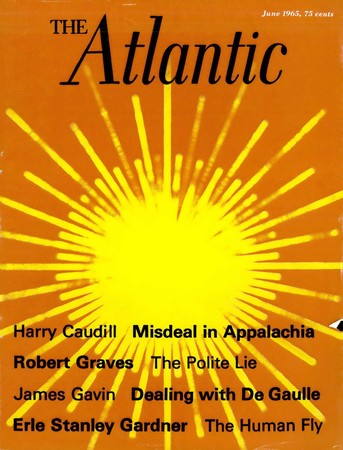
June 1965
In This Issue
Explore the June 1965 print edition below. Or to discover more writing from the pages of The Atlantic, browse the full archive.
Articles
The Corporation as a College
Neil W• Chamberlain The rapid obsolescence of the knowledge gained in college has become a matter of great concern to our universities as well as lo the industries that attract our most intelligent graduates. Mr. Chamberlain, professor of economics at Yale, here suggests a method of continuing education in the business world.
Working for the Government
A native of Omaha, Nebraska, Charles W. Morton came to the ATLANTIC to become the associate editor after valiant service as a reporter on the BOSTON EVENING TRANSCRIPT in the worst of the Depression, the pages which follow are part of an occupational memoir which we hope to see published in book form.
Malaysia
The Vacuum Hat
No Uncertain Terms
JEROME BEATTY, JR., who lives in Mashpee, Massachusetts, is the author of many light articles and books. This is his first appearance in the ATLANTIC.
The Eyelash: Fur or Hair?
Jo ANN SARGENT is a Californian recently transplanted to Athens, Ohio, where she keeps house for her husband and two young sons.
It Figures!
Italian Land Bargains
British and American Operas
The Peripatetic Reviewer
The Judge and the Trout
Reader's Choice
Potpourri
Chile
Rumania
Washington
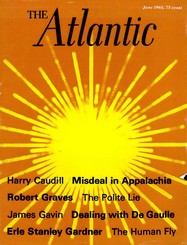
Misdeal in Appalachia
Appalachia is home to Harry M. Caudill, a Kentucky lawyer and former slide legislator whose sorrow for the fate of the area and passion for its renewal were movingly told in NIGHT COMES TO THE CUMBERLANDS. his biography of a depressed area, published in 1962 by Atlantie-Little. Brown. In this article, he tells why the Administrdion‘s Appalachian relief program promises to inject little light into that long night, and he explains what Appalachia really needs — all-out education, effect ire mining controls, and restoration of its natural beauty.
The Seven Houses: In Memory of John F. Kennedy
On Dealing With De Gaulle
“What can you do with a man like that?” President Kennedy would remark in quiet exasperation over some new maneuver by French President Charles de Gaulle. For eighteen months, General Gavin, as U.S. Ambassador to Paris, was most intimately engaged in trying to provide John Kennedy with some useful answers to the problems of doing business and meshing American interests with those of the enigmatic man who seeks the return of France’s grandeur.
Speed Dash
A young trial lawyer eager to escape from his rut in California, Erle Stanley Gardner in 1923 got the idea for his first successful series of short stories when he watched a human fly crawl up the face of his office building. That cliff-hanger was to turn, him into a writing man with results that are amusing to read about.
Harry W. A. Davis, Jr
A native of Cambridge. Massachusetts, who served in the Merchant Marine and in the Army. Ralph Maloney did a six-year stint on Madison Avenue before he quit to write. He then went into the saloon business as bartender. manager, and front man. ATLANTIC readers who remember his first saloon story, “Benny,” which appeared last August, will enjoy this one.
Stephanotis
The Canals of Copenhagen
When at home. Miss Adams is the literary editor of the ATLANTIC. When abroad, she travels with curiosity and a lively sense of pleasure. This is the third in her new series of articles about Scandinavia; readers who like the way she writes are recommended to her new hook, A ROUGH MAP OF GREECE.
Have the Undertakers Reformed?
The proffered honor of having a coffin named after her was but one of the many aftereffects of Jessica Milford’s brilliant vivisection of the burial business in THE WIHKICAN WAY OF DEATH. In this postmortem she tells of many other changes and reactions provoked by her 1963 exposé.
Four-Word Lines
The Polite Lie
Poet, novelist, and historian, Robert Graves is a classical scholar who is at home in many languages and whose reputation as a translator has been justly acclaimed. In the following essay, Mr. Graves tells of some of the pitfalls that beset a translator and provides us with some very helpful guide posts.
If One Green Bottle ..
The mother of two daughters, Audrey Callahan Thomas is married to a sculptor who is teaching art at the Kwame Nkrumah University in Ghana. A graduate of Smith, who took her M.A. at the University of British Columbia, she is now writing her Ph.D. thesis (on BEOWULF) and, one hopes, more stories.
The Tree Warden
Rebirth of the Shad
A free-lance writer, a former editor of TIME, and author of four books, John Stuart Martin is a longtime devotee of wildlife, bird dogs, gunning, fly-fishing, and golf. He here tells of the remarkable renaissance of shad in the Delaware River, beginning in 1961 and continuing this spring in full force and on schedule.
Günter Grass
With his third novel, HUNDEJAHRE, published in the United States under the title DOG YEARS by Harcourt,Brace & World, Günter Grass has established himself as the most controversial as well as the most versatile of the new generation of German writers.Michael Roloff, a young writer and critic who came to the United States from Germany in 1950‚ is the editor of the review METAMORPHOSIS and the translator,with Michael Lebeck,of three novels in the new American edition of Hermann Hesse’s work.