The Vacuum Hat
It seems only yesterday but it was really something like forty years ago that we were reading about “small-bubble lather” and how it propped up the whiskers and kept them from falling down and escaping the razor blade. There were pictures (greatly enlarged) to prove it: the whiskers uniformly erect among their small-bubble supports and bending every which way in the big-bubble stuff. Little did we dream that those same whisker pictures would one day come pelting into our living room in an ingenious arrangement of dots (as described in What Makes TV Work?, a new book by Scott Corbett), assembled by a TV camera, flung in our direction at the speed of light, and sorted out into the familiar image by our TV receiving set. So far, the dots are simply black or white, but this same bristle-propping shot will soon be reaching us in living color. Forty years it took, but it was worth waiting for.
Thanks to the miracle of electronics, we ought to be able to see in much greater detail today how other remedies and appliances of yesteryear really worked. The man in the advertisements of the “vacuum hat,” for instance, was not even photographed: his portrait was simply a crude drawing of him, sitting rather stiffly in a chair, wearing The Hat, from the top of which several tubes and wires trailed oil to various outlets. The device was guaranteed to cure baldness, which it did simply by creating a suction on the scalp, thus unplugging the follicles and allowing the hair to sprout anew.
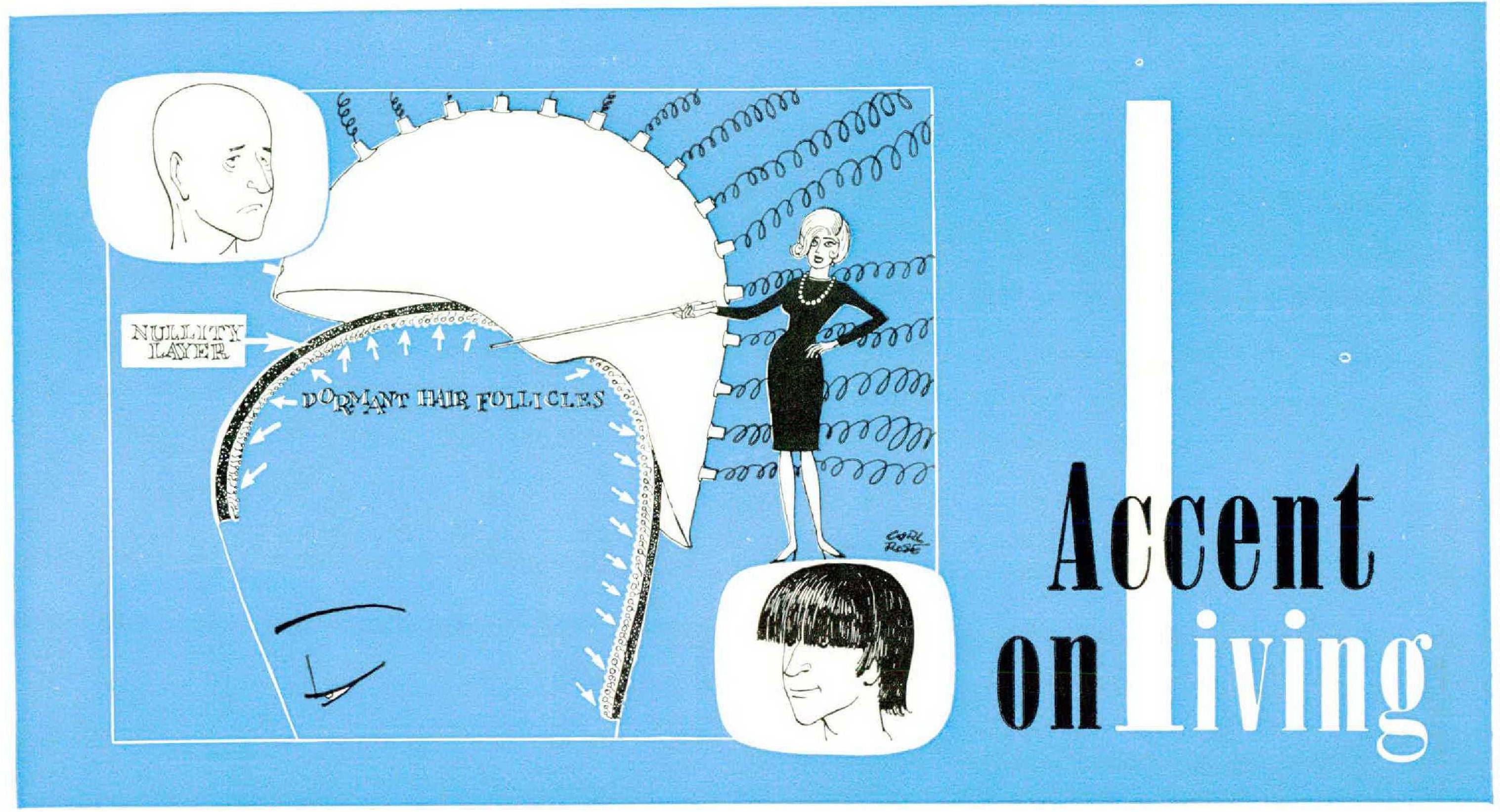
The workings of the vacuum hat — what goes on just below scalp level as a result of the wires and tubes - would make a showy demonstration for all of us who enjoy the science commercials. Any smart young agency anatomist could lay out the picture (to be greatly enlarged): the distressingly smooth outer epidermis; then, just beneath it, a thin layer of something or other, about one thirty-second of an inch thick, for which a new TV anatomical term would be invented. This would be the troublesome, the obstructing, layer, fairly dense, inert, and altogether useless. Like the Van Allen Belt in the outer atmosphere, the layer could be named after its discoverer — the Doakes Dimension, the Schmidt Encasement, or by some purely descriptive word, “what we call in our profession [copy writing] the nullity zone.”
The real drama would lie in the next layer down, the follicles: countless little cells, seemingly empty and with absolutely nothing at all goingon in any one of them. But stay — what is this gentle tugging from above that seems to be setting in? Are those pores that begin to crinkle that smooth exterior? And look at what’s happening to the nullity zone: tiny passageways, the pore-extension, as we call it in our profession [copy writing], taking form all along the line and allowing the vacuum to reach right down into the follicle itself. Hair, long dormant, begins its outward thrust. And after a few workouts with the vacuum hat the customer will be embarrassed by the unruliness of his abundant new thatching.
The actress slightly past her prime who explains how her employers’ headache pill gets to work in the bloodstream more quickly than other headache pills would be just right to talk it up on TV for the vacuum hat. She knows that we know she never went to medical school, so her manner is friendly rather than professional. and we can only wonder where she dug up so much information about the bloodstream. With the right pictures to support her story, she ought to be able to bring the vacuum hat back into the modern scene, right up there beside small-bubble lather.