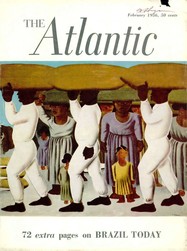
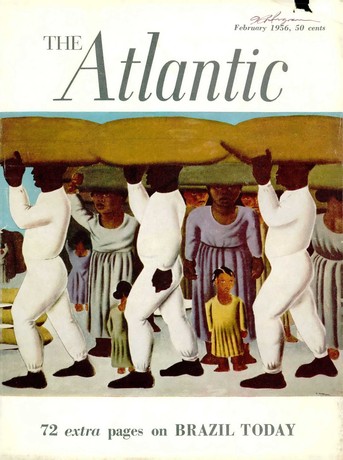
February 1956
In This Issue
Explore the February 1956 print edition below. Or to discover more writing from the pages of The Atlantic, browse the full archive.
Articles
Editor's Introduction
The Good Neighbor: A Half Century of Brazilian-American Friendship
Brazilian Melting Pot: The Meeting of Races in Portuguese America
Blue and White: (In Praise of the Ministry of Education Building)
Music: Key to the National Psyche
Fandango: The Life and Death of a Gaúcho
Men, Ideas, and Institutions: Humanism and the Temperament of the People
Turkey
The Beauty Contest: A Story
The Guardian Angels
The Art of the Tropics: Painting and Sculpture in Brazil
The Birth
Reproductions of Art & Architecture
Testimony of a Carioca Architect: Concrete, Sun, and Vegetation
The Cactus
Mozart in Heaven
Recollections of a Right Arm: A Story
Modern Writing in Brazil: The Growth of a National Literature
The Poem
Yemanjá, Mistress of the Sea: A Story
The Tide of Government: From Colony to Constitutional Democracy
Dramatic Renaissance: The Theater and Cinema Come to Life
Childhood
The Funnyman Who Repented: A Story
A Chronology of Brazilian History
A Glossary of Brazilian Words
Acknowledgments
Brazil
The Atlantic Report on the World Today: Washington
Toward a Generation of Safer Drivers
A unique classroom driver training device, developed as a public service by the Aetna Casualty and Surety Company, proves its effectiveness in carefully controlled research. By cutting costs and reducing the number of teachers needed to provide ”behind-the-wheel" training, the Aetna Drivotrainer will make it possible for more and more high schools to train their students to “drive and live.”
Can Men Live Without War?
“If war ends, we must still have outlets for our inherited energies; we need only attempt to render them dignified and worthy.”
Rhythm in My Blood
Dancer, choreographer, and writer AGNES DE MILLE has brought to the ballet an Americun idiom and impetus which were responsible for her first great successes, Rodeo and the dances she designed for Oklahoma! She is today recognized as one of our most original choreographers, and in this article she shows us the drives and aspirations which set a dance in motion. In its recent tour of South America, Ballet Theatre presented two of her most popular compositions, Rodeo and Fall River Legend, and both were received with enormous enthusiasm.
Red China
Asia's Needs and Western Policy
Wooing and bungling, the voluble Khrushchev and his silent partner, Bulganin, made their way through Southeast Asia fabricating for each occasion promises which again and again were greeted with acclaim. Their reception and their utterances force us to re-examine the real needs of Asia and to determine a more effective policy than we of the West have thus far achieved. BARBARA WARD,former Foreign Editor of the London Economist, has this to recommend.
Saybrook Point: At the Grave of Lady Alice Fenwick
The Atlantic receives on an average as many as 1500 poems a month. They come as frequently from men as from women, and are evidence of an interest in poetry which never slackens. As an incentive for those writers yet unestablished, we shall from time to time devote a number of pages to the work of young poets.
Nightcoach From Salzburg
A Winter's Song
A Ballad of Holy Week: (After a German Folk Poem)
Medal in the Sky
LEO RoSTEN writes under two signatures — his own and Leonard Q. Ross, under which he wrote the ever-popular, The Education of H*y*m*a*n K*a*p*l*a*n. Mr. Rosten has taught at Yale, is faculty associate at Columbia University, and was deputy director of the Office of War Information. In 1945 he was sent to Europe on a special mission for the Secretary of War. He has written Hollywood: The Movie Colony; The Movie Makers; The Washington Correspondents; and many movies, notably Walk East on Beacon; Sleep, My Love; and The Dark Corner. He recently won the George Polk Memorial Award for his article, ” Is Fear Destroying Our Freedom?” and is editor of A Guide to the Religions of America.
Mozart and Nancy Storace
Pianist, conductor, and writer, BORIS GOLDOVSKY was born in Moscow in 1908, studied extensively in Europe, and came to this country in 1930 following his graduation from the Franz Liszt Academy of Music in Budapest. At Tanglewood and in Boston he has produced a number of Mozart’s works, some of them American premieres; he has achieved national prominence as master of ceremonies of the Metropolitan Opera broadcasts, and for ten years has been the artistic director of the New England Opera Theater. This year, the 200th Anniversary of Mozart’s birth, he is participating in a nation-wide tour playing and conducting Mozart’s piano concertos.