Toward a Generation of Safer Drivers
A unique classroom driver training device, developed as a public service by the Aetna Casualty and Surety Company, proves its effectiveness in carefully controlled research. By cutting costs and reducing the number of teachers needed to provide ”behind-the-wheel" training, the Aetna Drivotrainer will make it possible for more and more high schools to train their students to “drive and live.”

One day last winter, a fast-moving car overtook a driver training car from Hollywood High School which was slowly making its way down Laurel Canyon towards the movie capital. The student driver had had only two hours of actual on-the-road experience and therefore was cautiously descending the steep and winding highway, no faster than 25 miles an hour.
The driver of the speeding car, disregarding a double white line which warned of a curve ahead, and with no thought of the danger he was creating, attempted to pass. Just as he overtook the student’s car, a truck suddenly appeared, coming around the bend.
Panic stricken, the impatient driver cut in to the right, heedless of everything save his blind desire to avoid the oncoming truck. That he had the space to get back into his own lane without a collision which might have overturned his own car and hurled the school car down a steep bank was due to the correct and trigger-quick response of the student driver.
The student had spotted the truck the moment it appeared. Instantly he braked and veered to the right, foreseeing the other driver’s desperate swerve back into line. The cars cleared each other by a matter of inches.
Dr. Walter G. Patterson, the instructor, who was riding in the front seat with his pupil, breathed a sigh of relief, and so did the other members of the class who were sitting behind him in their official role of back seat “observers.” Dr. Patterson had gone into action himself with his dualcontrol clutch and brake when he spotted the truck, but there had been no need for his intervention. On the way back to the school, Dr. Patterson pondered. For a beginning student to be able to react so quickly and correctly was something new in his experience. Might the explanation lie in the training the boy had received on an experimental device, the Ætna Drivotrainer, recently installed at Hollywood High? The boy had met several emergency situations on the Drivotrainer paralleling the one he had just experienced in real life. He had been drilled in the correct response. When confronted with the real thing, he had made a split-second response, and a correct one!
Dr. Patterson, one member of a special team of Los Angeles educators who were evaluating the new device, thought a lot more about the near tragedy in the ensuing days. The boy might have reacted that way without Ætna Drivotrainer instruction — but then again, he might not have!
Dr. Patterson had observed that the students in the Drivotrainer class appeared to have more confidence, and to be better at simple manipulative skills and at complex tasks like parallel parking. What if these things were connected? Maybe they were really on the right track in this unique method of driver training.
A Grim Prediction
The automobile death and injury toll has been called “the greatest uncontrolled social problem facing the country today.” In 1954 approximately 38,000 men, women, and children were killed in traffic accidents. Two million more were maimed or injured.
In the last 50 years, one million Americans have died in traffic accidents, a greater number than all the American soldiers killed in combat from the start of the Revolutionary War up through the present day. A grim prediction from the Association of Casualty and Surety Companies warns that one out of every two Americans today faces the statistical likelihood of being killed or injured in a traffic accident!
According to the Association of Casualty Companies, only 15 per cent of all accidents come from mechanical or roadway defects. The remaining 85 per cent come from one source only: the man behind the wheel. Human frailties — including lack of knowledge, lack of skill and, in particular, improper mental attitudes-lie at the root of most accidents. An accident report may list the cause of an accident as “passing on a curve,” but the real cause of that accident is much more likely to be found in the mind or the emotions of one of the drivers — the lack of forethought, the impatience, or the irritation which made him ignore the dangers of passing at such a spot.
Education is needed for drivers in all age groups. But those who have studied the matter — the President’s Highway Safety Conference, the National Safety Council, the National Education Association, the American Automobile Association, the Association of Casualty Companies, and many others— have agreed it is needed in particular for the boys and girls who come of driving age each year in our schools. In these young people, many educators believe, lies the best longrange answer to the problem of traffic safety. If all our secondary schools — public, parochial, and private—offered both classroom and “behind-the-wheel” driver-education we could, in a generation, put on our highways about 40 million drivers who had been trained for safety.
Although driver education is making some headway, it is a regrettable fact that of the 20,000 high schools in the country, only half offered driver education courses during the last school year. Only about 37 per cent of the schools offered both the classroom course and the “behind-the-wheel” instruction which educators agree is necessary to develop a really safe driver. Of the 1.6 million public high school students eligible for driver education last year, only 468,000 — or about three out of ten — received both classroom and “behind-the-wheel” instruction.
Costs and Teacher Shortage
There are two reasons why more students are not receiving behind-the-wheel instruction: high cost and the current teacher shortage. In a typical high school classroom today, a teacher instructs 25 to 35 students at a time in subjects such as English, mathematics, and history. But in the driver-training car, the teacher can handle only three or four students at a time — the one who is driving, and the two or three observers.
This teacher-pupil ratio (the teacher is virtually a tutor) sends the cost of driver training skyrocketing compared with normal classroom subjects. Even when the training cars are loaned free of charge to the school district by public-spirited automobile dealers, driver training costs $35 per pupil, on the average, and in some cases as much as $50 or $55 per pupil.
As a corollary to its high cost in dollars and cents, driver training has proved to be expensive in teacher time. With the current teacher shortage, many a school administrator has been reluctant to “spend” the manpower necessary to offer all his students “on-the-road” training. One of the best ways to make sure that driver training will be available to more students each year is to cut the cost of the training (in both money and teacher time) without reducing its quality.
With this aim in mind, the Ætna Casualty and Surety Company decided to lend a helping hand. Ætna Casualty has long believed that it is the function of an insurance company to endeavor to prevent as well as to pay for losses, not just among its own policy-holders but among people at large.
Because of its philosophy, which recognized a proper concern with public safety, and because of its experience as a pioneer in the field of driving tests, Ætna Casualty brought not only desire but a certain backlog of experience to bear on the problem. As its initial step, the Company several years ago began a series of discussions with educators to determine whether a classroom driver-training device, especially designed for school use, might make an important contribution. In these discussions, the concept which became the Ætna Drivotrainer began to take form:
1. The device would apply to the training of automobile drivers the same principle found successful in pilot training devices like the Link Trainer and the Dehmel Flight Simulator.
2. The trainer would be a multi-place device so as to enable one teacher to instruct 10 to 15 students or more at a time.
3. The aim of the trainer would be to reduce, not eliminate, expensive “on-the-road” time.
4. The Ætna would produce especially for use with this trainer a series of motion pictures stressing: (a) judgment development in traffic situations; (b) handling the car in certain common emergency situations; and (c) the display of good driving attitudes at all times. In the films, educators agreed, students could be exposed to especially staged situations which could not be duplicated in real life due to the expense or hazard involved.
To find out whether such a training device would be both economical and effective, Ætna Casualty financed the development of the Drivotrainer and, working closely with a special committee from the New York City Board of Education, began the production of 19 teaching films for use with the new trainer.
Drivotrainer in Action
In order to get accurate, impartial appraisals of the Drivotrainer under differing circumstances, Ætna Casualty made several installations for research and evaluation. A 13-place Ætna Drivotrainer classroom was established in New York City, first at Brooklyn High School of Automotive Trades, and subsequently at Bryant High School. A five-place unit was installed at Iowa State Teachers College, a natural choice because of its research facilities and its outstanding record of training driver-education teachers. An eight-place unit was set up in Hollywood High School, under the control of the Los Angeles Board of Education. Los Angeles gives driver training to more students each year than any other city in the country.
All equipment at these three “study” installations was loaned by Ætna Casualty to the school or college without cost. Facilities to house the Drivotrainer and the services of researchers, administrators, and teachers were provided by the two school systems and by the college as their share of the project. Full findings from all of these installations are not yet available but the shape of the final picture is becoming clearer. New York City expects to arrive at a definitive conclusion by the end of the current school year and is hopeful that the Ætna Drivotrainer may be one means of making driver training available to more of its students. Officials have already found that the Drivotrainer can make important contributions in sharpening driver judgment in traffic, making possible safe training in emergencies, and inculcating important attitudes for expert driving. Group instruction in these areas may be given more economically and effectively on the Ætna Drivotrainer than in a regular training car, New York observes in a preliminary report of its research.
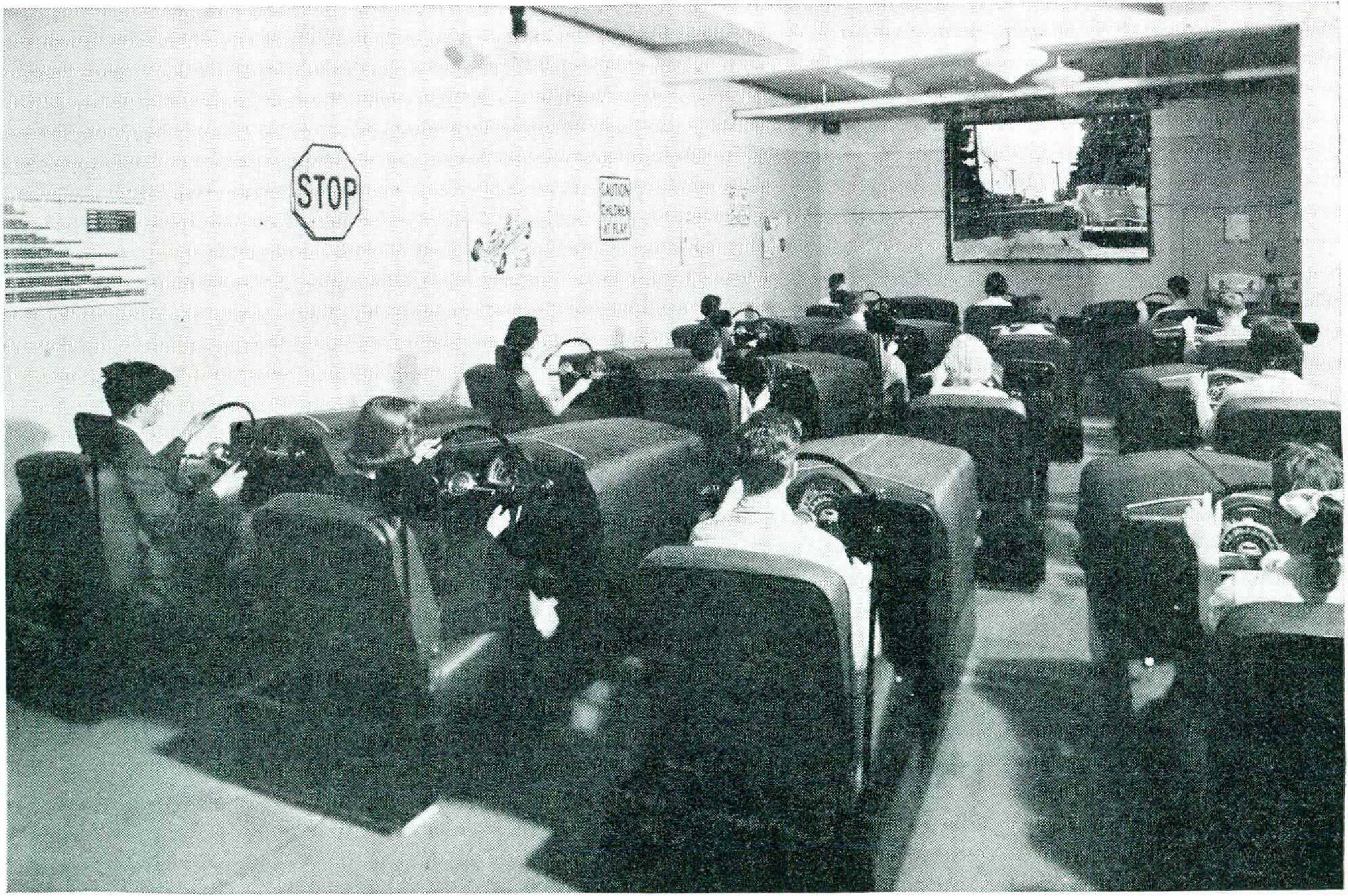
Iowa State Teachers College will continue its research, but has already made an optimistic interim report. Research has been completed in Los Angeles and a formal report issued.
The Los Angeles Experiment
In the Los Angeles study, 240 students were divided into two equal groups. The “control” group received the regular California State Prescribed Course, namely six class hours of actual on-the-road driving. The “experimental” group received 15 class hours in the Ætna Drivotrainer, but only three class hours of on-the-road driving, just half that received by the control group.
The two groups were carefully equated at the beginning of the course on such factors as age, sex, IQ, previous driving experience. Before the course started they were given four tests: an attitude test, a driving test on the Ætna Drivotrainer, and two paper-and-pencil knowledge tests. These tests, says the Los Angeles report, “indicated no significant difference between the groups with regard to initial driving ability.”
The same four tests were given at the end of the course to both groups in order to compare the effectiveness of the two methods of instruction. The Los Angeles report states that while both groups showed positive progress on all test scores, there was “a consistency in the direction of difference between the two groups and these differences were in favor of the experimental (Drivotrainer) group.”
A searching, 20-minute road test was also given to both groups at the end of the course. Prepared by the safety section of the Los Angeles schools, the test was given by driver-training teachers who did not know whether the students they were examining were from the control or experimental group. No significant differences were found between the two groups on this road test.
The Siebrecht Attitude Test given at the end of the course showed significant change for the better in the Drivotrainer group. No significant change could be found in the attitudes shown by the control group.
Recognizing the paramount importance of developing good attitudes in a driver training course, the Los Angeles report underlines this attitude gain by the experimental group by observing: “Educationally, this may have import for teaching methodology and for the Ætna Drivotrainer course.”
On the driving test given on the Drivotrainer at the end of the course, the experimental group showed significantly greater improvement.
Summing up, the Los Angeles report states: “Results indicate that practically the same progress in driving skill and knowledge will be experienced by the student trained by either the experimental method, using the Ætna Drivotrainer plus three hours of on-the-road training, or the California State Prescribed Course.” The report also says that, as a result of the study there is “greater awareness of the infinite scope of the contribution which the Ætna Drivotrainer may make to the field of driver education.”
Substantial savings in per pupil instruction costs were possible with the eight-place Drivotrainer unit used in the study, Los Angeles reported, and these per pupil savings would increase sharply with a 15-place unit such as would be used under normal operating conditions.
Fully as important as cost savings are the contributions which the Drivotrainer can make toward solving the teacher shortage. Whereas five teachers could give behind-the-wheel instruction to 700 students in Los Angeles by the conventional, car-only method, these same five teachers could instruct 1080 students by using the Drivotrainer and giving three hours of on-the-road training — a 54 per cent gain in the number of students reached.
Confirmation that the Drivotrainer makes possible substantial reductions in on-the-road time came in the interim report released recently by Iowa State Teachers College. This report said: “The research staff has formulated one major preliminary conclusion: A combination of approximately 14 hours of Drivotrainer instruction and three and 1/3 to four hours of practice driving is equivalent in instructional effectiveness to six hours of practice driving. . . . Project personnel not involved in the design of research plans or the analysis of results have come to a similar conclusion as a result of their personal observation of the program thus far.”
Of the 19 Drivotrainer motion pictures — ranging from instruction in elementary skills up through driving in heavy traffic and meeting emergency situations — the Iowa report observes: “The teaching value of these films is unsurpassed in driver education.”
The Aetna Drivotrainer Spreads
Important though formal research is to the new training device, enthusiasm for the Drivotrainer method of instruction has not awaited the completion of statistical analyses. The Oak ParkRiver Forest High School, just outside of Chicago, became the first in the nation to purchase a Drivotrainer, and is now well into its second year of instruction with a 15-place classroom. “The students like it; the parents like it; and, best of all, it works,” Ray C. Soliday, the instructor, observed in a recently published article.
Out on Long Island, a mobile “classroom” consisting of an eight-place Drivotrainer installed in a specially designed trailer circulates among several schools. The Freeport High School reports that the Drivotrainer makes it possible to cut on-the-road time in half, to reach twice as many students, and to get results equally as good as those with the regular six-hour program.
In Oklahoma City, Oklahoma, and in Dearborn, Michigan, the local associations of insurance agents as a public service have given Ætna Drivotrainer classrooms to their school systems, and have thus established a continuing method of combining accident prevention and good community relations which several other agents’ associations are currently considering very seriously.
Two commercial driving schools — one in Springfield, Massachusetts, and the other in Upper Darby, Pennsylvania-now offer Ætna Drivotrainer instruction: and a 15-place Drivotrainer has been purchased by an adult education association in Sweden for use in that country.
Though perhaps the most far-reaching in its implications, the Ætna Drivotrainer is just one of the means by which Ætna Casualty shows its belief in the importance of public service. The Company believes that important measures of public goodwill, so necessary for the health and continued growth of any business, can be earned by taking a broad view of the responsibilities of good corporate citizenship. The primary function of a casualty insurance company is to provide financial reimbursement in case of loss. Its most natural opportunities to go beyond this function, to provide extra service to the public, lie in the field of trying to prevent those losses from occurring.
In addition to the safety engineering service offered to commercial policyholders, Ætna Casualty has maintained for a number of years a complete educational service designed to prevent or reduce accidents, crimes, fires, and other forms of loss. Included in this educational service have been booklets, folders, and posters; motion pictures, several of which have won the top safety “Oscars"; attention-arresting action displays; and a whole series of testing devices designed to teach drivers to compensate for physical limitations. All these aids are offered to the public without charge.
In addition to maintaining these general public safety activities, Ætna Casualty realizes that further progress is possible with the Drivotrainer. Consequently the Company is doing its utmost to ensure that this new and most promising teaching tool may be brought to maximum effectiveness. Testing of teaching techniques, working out the most effective blending of Drivotrainer and onthe-road instruction, study of existing films for effectiveness, production of additional films, experimenting with new “wide screen" techniques for the Drivotrainer — these are a few of the items on the agenda, now and for the future.
The Ætna Drivotrainer has reached its present stage of development through the “working partnership” which has existed between the Ætna Casualty and Surety Company and educators. The Company deeply appreciates the confidence implied by this relationship and looks forward to advancing with the schools, during the years to come, toward the common goal of training a generation of safer drivers.
Additional copies of “ Toward a Generation of Safer Drivers" are available on request. Address: Public Education Department, Ætna Casualty and Surety Company, Hartford 15, Connecticut.