March 1954
In This Issue
Explore the March 1954 print edition below. Or to discover more writing from the pages of The Atlantic, browse the full archive.
Articles
Japan
Red China
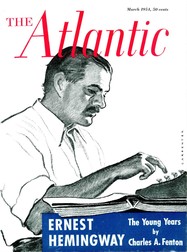
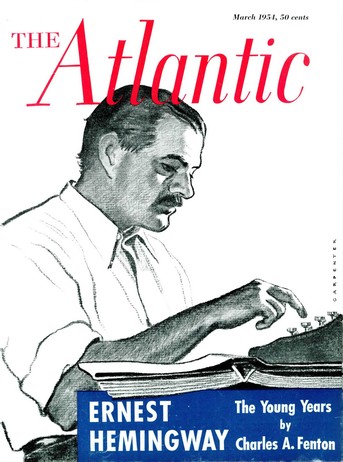
Ernest Hemingway: The Young Years
Ernest Hemingway’s apprenticeship as a writer begins in the high school of Oak Park, Illinois, where his two dedicated teachers of English encouraged, even prodded, him into print. After Oak Park came his journalistic training on the Kansas City Star; then his war experiences in Italy; then the stimulating friendships in Paris. CHARLES A. FENTON, Instructor of English at Yale University, has traced Hemingway’s development in the formative years 1916-1923, and from his book, The Apprenticeship of Ernest Hemingway, which will be published this spring by Farrar, Straus & Young, the Atlantic has selected three installments. Mr. Fenton served in the Royal Canadian Air Force, received his Ph.D. from Yale in 1953, and has recently been awarded a Morse Fellowship to work on a biography of the late Stephen Vincent Benét.
Schoolboy Racketeers
In her speaking and writing, in her testimony before Congressional committees, and in her unflagging zeal for public education, better medical care, and civil rights, AGNES E. MEYER HAS come to be recognized as one of the most forceful defenders of the family. In this paper, she traces one glaring case of juvenile delinquency to its source, and the recommendations she makes to counteract the spreading lawlessness are at once practical and sympathetic. Mrs. Meyer’s autobiography, Out of These Roots, published under the Atlantic - Little, Brown imprint last autumn, is being widely read and discussed.
The Atlantic Report on the World Today: Washington
The Everlasting Plateau: Basutoland
ENID BAGNOLD’S books have non her many admirers in this country. National Velvet (1935), The Door of Life (1937), and The Loved and the Envied (1951) —these three novels, each so different and so versatile, have established her as a most welcome author in any season. On her husband’s retirement from Reuter’s News Agency, of which he was director for many years, she had the opportunity to visit again that high plateau in South Africa which she writes about so discerningly in the paper that follows.
What's Poetry?
LEONARD BACON, friend and contributor, died on January l. He graduated from Yale with his ambition,as he once said, ”crystal clear. I knew I wanted to write poetry and nothing but poetry.”Thirty years later, after he had published several volumes and after his Sunderland Capture had been awarded the Pulitzer Prize. he was still of the same mind. “Poetry,” he said, “continues to be my blessing and my curse.”Readers will miss his exuberance. his staheart defense of the classics, his generosity, and his wit.
College Athletics: Education or Sltotv Business?
Big-time college athletics is now a major part of the entertainment business. Why then do educators pretend that the athlete must go through the motions of meeting, like other students, the usual academic requirements? The proposals in the article that follows are startling, but HAROLD W. STOKE writes with the authority of an experienced college administrator; former President of the University of New Hampshire and of Louisiana State University, he is today Dean of the Graduate School at the University of Washington.
A Buffalo Named Woodrow
A native Texan, DILLON ANDERSON established himself as one of the ablest young lawyers in Houston before he took time off for his fiction. In 1951, we published his first book, I and Claudie, a salty Texas narrative of two happy wanderers who fortunately do not take themselves or their victims too seriously. Clint Hightower and his oxlike companion have adventured their way in and out of the oil country, Texas politics, hurricanes, revivals, and state fairs — and now they are off again.
To Live Without Certitude: Dialogues of Whitehead
Philosopher, author, and mathematician, Alfred North Whitehead was born in England in 1861, taught long, full years at Cambridge University and at the University of London, and brought his career to a golden sunset at Harvard. He was one of the most illuminating conversationalists of our time. After his retirement, his talk was confined to a few intimates, of whom LUCIEN PRICE was one. Mr. Price, the author of We Northmen and Winged Sandals, has recorded with the discipline and accuracy of a trained journalist the audacity and the probing of the philosopher’s mind in his new book, Dialogues of Whitehead, which is shortly to be published. His record of the conversations was read and authorized by Whitehead. The Atlantic is proud to present three characteristic excerpts from this book, which has been more than a decade in preparation.
Chemicals for Cancer
That the struggle for the control of cancer has been slow, persistent, and at the same time hopeful, no one knows better than DR. C. P. RHOADS,who since 1945 has been Director of the Sloan-Kettering Institute for Cancer Research in New York City, In the paper which follows, he gives a progress report on the chemical agents which have been used with promise of success. A graduate of Bowdoin College and of the Harvard Medical School (1924), Dr. Rhoads served from 1940 to 1952 as Director of the Memorial Hospital for the Treatment of Cancer and Allied Diseases in New York. Since 1952 he has been Scientific Director of the Memorial Cancer Center.
Back to the Islands
Brünnhilde Goes West
After some years as a metallurgist, first in steel, next in the Admiralty, and then in the Ministry of Aircraft Production, R. P. LISTER left the Civil Service for a research association in London; but, he writes us, “ I found that writing books in the spare time from being a scientist made me ill; so I gave up this job early in 1919 and have done nothing but write ever since.” The Atlantic, which began publishing Mr. Lister’s poems in 1947, was the first American periodical to celebrate his comic genius.
The Western Influence on India
A native of Bengal, whose courage in controversy parallels that of Elmer Davis in this country, NIRAD C. CHAUDHURIwas a commentator on world affairs for All India Radio in Delhi. Mr. Chaudhuri ‘s Autobiography of an Unknown Indian, published by Macmillan in 1951, interprets the evolution of modern India through the story of his own life; now, in the article that follows, he seeks to evaluate the various pressures which the West has brought upon India and the rival faiths which are struggling for the control of that country today.
The Peripatetic Reviewer
Books: The Editors Like
Reader's Choice
Ambassador's Report
She Came to Stay
Seeing and Knowing and Caravaggio
Accent on Living
The Child-Watchers
PAUL H. ROHMANN is on Ihe staff of Ihe Antioch Press in Yellow Springs, Ohio, He is the author of “Father of the Twins,”which appeared in the August, 1951, Atlantic
Ghosts Do
Prelude to Travel
LOUISE ROE in the maiden name of an author who lives in Bethlehem,Pennsylvania, and has spent much of her life abroad and in leisurely travel on ships of all sizes. This is her first appearance in the Atlantic.
Our Toothless Old Saws
SCOTT CORBETT is a natire Missourian now living in East Dennis art Cope Cod. Readers of these pages will recall his fishing story, “ The Perfect Bait” (August Atlantic)
Of Advice (Alittle) Helpful
Record Reviews
Starting a Holiday
A London newspaperman and foreign correspondent, RENE MACCOEL is equally at home in Washington, Paris, and many other capitals in both hemispheres. He is the author of Assignment Stuffed Shirt, an irreverent novel published in 1952 by Atlantic-Little, Brown.
Gold-Rimmed Glasses
About 14 years ago, Alvertie K. Gray, now G8, of Bald Mountain Rd., Dedham, lost a pair of glasses while chopping wood in North Orland. They were found recently by his son Foster. 32, while walking through the woods. Strangely enough, the spectacles were undamaged despite the fact they had lain all that time in a cart road over w hich horses and men had hauled lumber through the years. — Bucksport tree Press