Starting a Holiday
A London newspaperman and foreign correspondent, RENE MACCOEL is equally at home in Washington, Paris, and many other capitals in both hemispheres. He is the author of Assignment Stuffed Shirt, an irreverent novel published in 1952 by Atlantic-Little, Brown.
by RENÉ MACCOLL
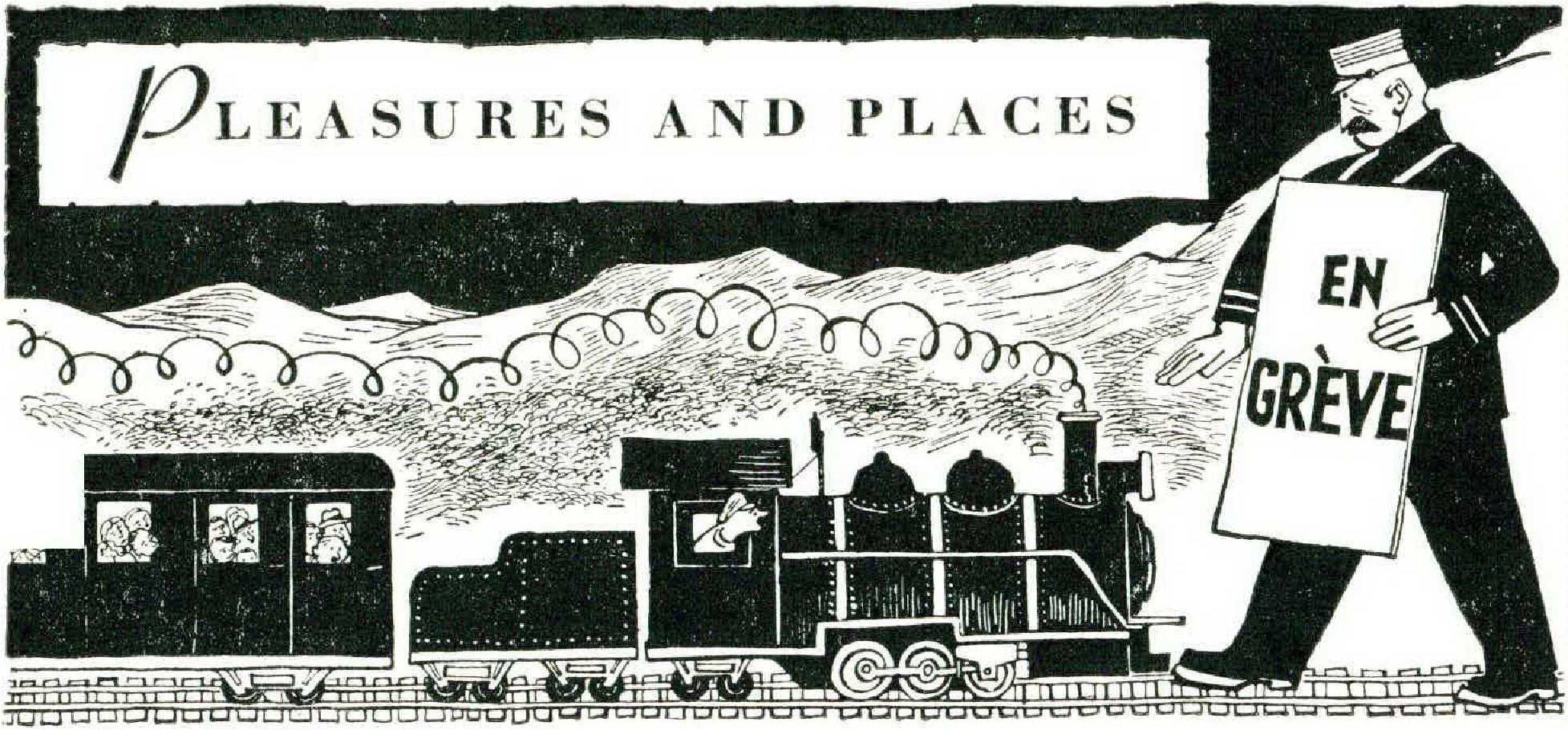
IT was not until I reached Paris on the evening of Thursday, the 6th of August, on my way to spend a holiday in the Balearic Islands, that I heard that a strike of all French railways was to begin at midnight. This was ominous, since my wife, my stepson, and I planned to catch an express train leaving Paris at 8.15 P.M. and due at Cerbère, on the Spanish border, about breakfast time the next morning.
But at the Gare d’Austerlitz the chief conductor of our train brushed aside my fears. Monsieur, he said, could enjoy his dinner in tranquillity. Even if some stoppages were to take place, it was inconceivable that a long-distance train of our magnitude would be affected. “Once launched,” said the conductor, striking a slight attitude, “we shall not arrest ourselves until the destination has been achieved.” Thus reassured, we dined well and retired to our couchettes, three of a carriageful of six, the remaining ones being occupied by three elderly French ladies who were off, so they said, to the Canary Islands.
The strike caught up with us at 4.30 the following morning, when our train ground to a stop in the station of Montauban, a medium-sized town northwest of Toulouse. Since there seemed little to be done about it at that hour, I was all for staying in my couchette and getting some more sleep. ‘This proved impracticable. ‘Idle strike was taken as a personal affront by every passenger on the crowded train, and amid a mounting swirl of cries and lamentations the dressed, stampeded up and down the corridors, and finally jumped off onto the platform to continue the debate. The ladies in our compartment were weeping and murmuring “Courage — one must keep calm” to one another between sobs. But the thought of their steamer sailing inexorably from Barcelona the next afternoon without them was a bitter blow for it seemed that they had been saving up for the Canaries for over a year.
Our own situation was none too encouraging. British Treasury regulations for the holiday-maker abroad are still strict. Our traveler’s checks were cashable in Spain only. We had vouchers for our railway meals while traveling in France (but the first thing the strikers had done was to remove the dining car) and only a handful of French francs. Any notion of hiring a car to get to the Spanish frontier was thus out of the question. And the problem of where we were going to spend that night, if we were to continue to be marooned in Montauban, was considerable. There was, we supposed, always the derelict train (there were four express trains stalled side by side in the station), but it is astonishing how quickly an abandoned train tends to become insanitary and generally unattractive as a place of abode.
Most of the passengers, hungry for breakfast, made a mass onslaught on the station buffet, but the staff there was ill-equipped, either technically or psychologically, to handle so unlooked-for a boom in business. A single waitress, whose demeanor seemed to suggest resentfulness at our presence in such numbers, tried to cope with the stream of orders for coffee and brioches, but her performance was badly slowed up by her evident suspicion that the man at the cash register — an elderly, gloomy fellow — was incapable of ringing up the score correctly. After each cup of coffee and plate of rolls had been handed over, the waitress would shout the amount over her shoulder, pause, then mutter something to herself, trot down to the other end of the counter, and review the efforts of this man. An argument would ensue even when he got it right.
The hours dragged past. A blazing sun mounted the sky. Most of us stood about outside the station in uneasy, fidgety groups, querying the local police about the strike (they knew nothing) and watching desultory efforts by the authorities to organize an emergency bus service to Toulouse. Suddenly, when we had been there for nearly seven hours, a gray-haired man wearing a green shirt rushed from nowhere and shouted: “The autobus bearing the Algerian party to Port Vendres is leaving instantaneously. Are there any more Algerians?”
It was not so much deceit as a sort of reflex action which caused me to answer, “Yes — three here.”
The man was in a hurry but even so he paused with raised eyebrows and said, politely enough, “Monsieur and family are veritable Algerians?”
I tried to look burt — and nationalistic too. “Certainly,” I averred.
“ Bon— this way, please.”
We snatched our bags and rushed in his wake. Round the corner there stood waiting, its engine already turning over, not the battered old veteran of the highways which I had expected, but a brand-new bus of enormous proportions. The veritable Algerians were already aboard, a smiling group of men and women. They were not at all exotically garbed, but their skins were, undeniably, darker than ours. We nipped in to join them and almost immediately set off. (Why should these Algerians have received such providentially preferential treatment? I never found out, since I thought it impolitic to ask too many questions. Presumably they had been visiting France on some kind of sponsored tour and the authorities felt it advisable not to spoil the effect by having them miss their ship. Port Vendres suited us fine. It is only a few miles from Spain.)
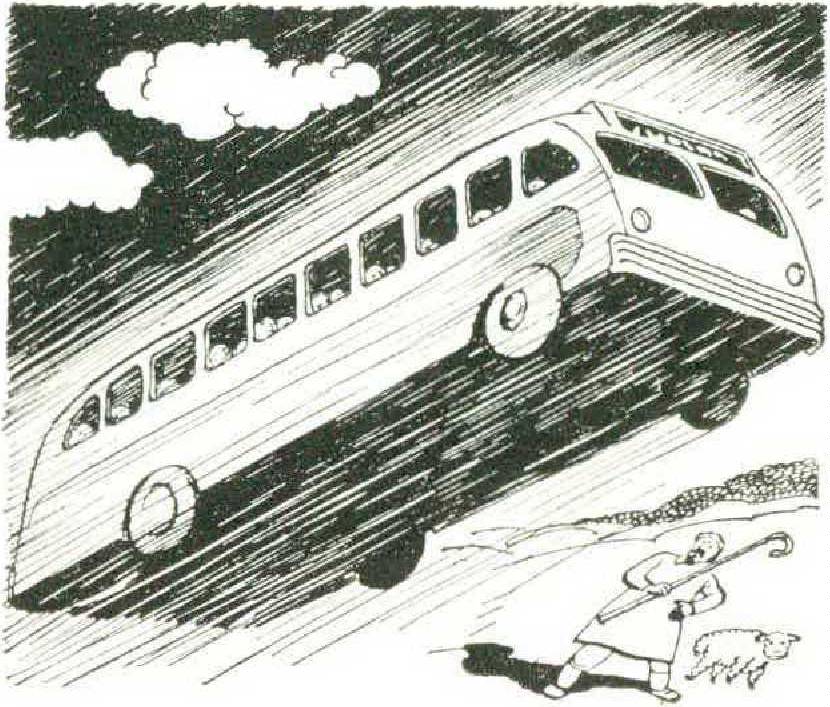
This part of the trip took about eight hours — and it was throughout a demonstration of the art of Gallic driving at its most insouciant. Above the chauffeur’s head there hung a small notice which stated that the vehicle must in no circumstances be driven at a speed exceeding 50 kilometers an hour (just over 30 m.p.h.). The only times we touched this speed were when we were starting up or slowing to a stop. The chauffeur was a likable young man in a beret who really enjoyed his work. His bus was equipped with three different hooters. The one in the topmost register was about in the same league with the Queen Mary’s siren. We screamed and howled our way across southern France in the sunshine, traveling at mad speeds, and when an occasional policeman balked us momentarily in one of the towns (Toulouse, Carcassonne, Perpignan) the chauffeur would scream “Á bas la police! Conspuez la police!” and lead us all in a round of enthusiastic booing.
Towards sunset we reached Port Vendres, and there, sure enough, was the Algerians’ ship, steam already up, witing in the neat little harbor. Off went the Algerians, with gay cries, and now it became necessary to explain that we wished to continue a little further. The chauffeur, admirable fellow, took it in stride. On to Spain.'' Hut certainly. Monsieur had only a few francs to offer? Ah, but he realized the difficulties with which the contemporary British traveler was besot. The eternally accursed fiscal authorities! Nevermind. . . .
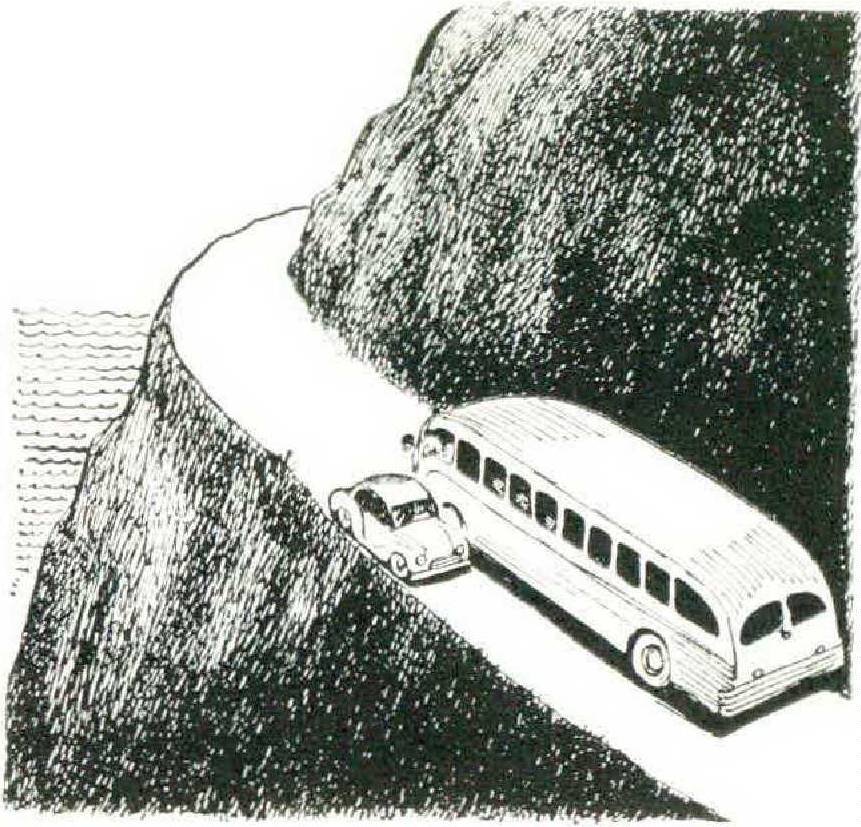
The next hour and a half had us on the edges of our seats. The distance between Port Vendres and Port Bou (the first town inside Spain) is not great, but the terrain across which the coastal road fights its way is the far from placid eastern end of the Pyrenees. We tried to dissuade the driver from looking round to talk to us, feeling that he ought to keep his eyes firmly on the road, but he explained that “this route was not imagined for modern autobuses — we are evidently making history.” A good deal of traffic was going the other way, small cars such as Simcas and Renaults; and whenever we encountered one of these at some crisis point in the twirling road — a huge drop into the sea on our left, a scowling mountainside at our right—our driver would halt, lean out of the window, and simply taunt the other driver until he was finally goaded into creeping past us with his outside wheels barely clinging to the last inch of cliff. “Why all the fuss?" would roar our man as the white-faced, shaken tourist finally nosed past us to safety. “Is Monsieur conceivably not insured?”
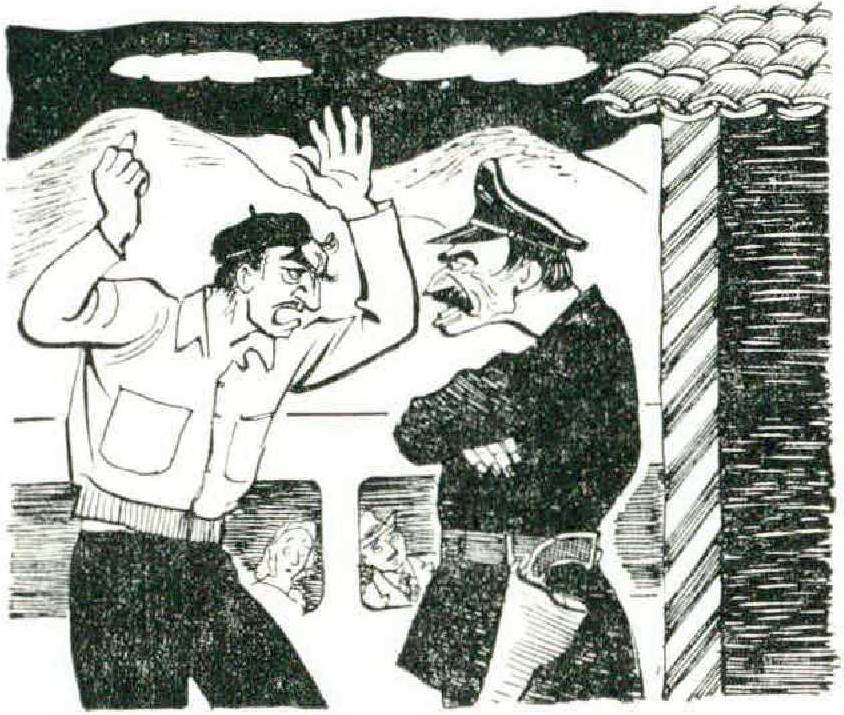
The Spanish Customs House, which stands on a hillside far above the town of Port Bou, provided the setting for one of the day’s noisiest scenes. The jefe of the Aduana, a glum-looking chap with a rusty revolver at his belt, gave it as his opinion that our autobus could go no further. He pointed out, correctly, that our Montauban man was without the triptyque with which drivers wishing to cross borders must be provided, and that to allow him to proceed one meter inside Spain would be to break a great many regulations. The alternative? Ah, too bad; but it appeared inescapable that the Englishman, his lady, and the small boy would undoubtedly have to trudge the remaining two miles into Port Bou, carrying their bags.
I had grown to admire our driver already, but I had not realized until then the full rich depths of this man’s nature. As easily as though changing gears in his autobus, he flew into a rage of monumental violence. The jefe, no slouch himself, tried to match him, and for several minutes their combined efforts entirely halted the routine work of the frontier post as the other customs men and the various travelers, lining up in their dusty cars, listened agape. Our man won, the jefe only saving face by stipulating that one of his underlings would have to accompany the bus into Port Bou to ensure that it duly left Spain again that night.
At Port Bou railway station we found that the first train to Barcelona would not leave until four o’clock the next morning—a further wait of seven hours. It was now over forty hours since we had left London; we were hungry, unwashed, hollow-eyed, irritable, deafened by the clamorous horn of the autobus, and I badly needed a shave. Nothing for it but to sit it out in the station waiting room; and this, supported by an occasional glass, we did. When the train finally appeared it turned out to be sleeperless, and the seats had been designed, apparently, to ensure that travelers would remain bolt upright while occupying them. By way of Gerona we slowly dragged our way southwards to Barcelona. Our Spanish fellow-passengers on this dawn patrol were bright, eager, and full of chatter. They mounted the train on their way to work, not at all sleepy or grouchy as would be the normal Anglo-Saxon at that hour. For them the uproarious anecdote, the constant Imrsle of laughter. I sat there snatching a few moments’ sleep, my head bouncing off the window, and wondering why I hadn’t gone to Coruwall. Only one prospect seemed to diminish the generally gray outlook; at Barcelona we would be able to repair to a good hotel at which we had made reservations (for the night before) and there have a bath, a change, and some breakfast. Our plane for Minorca did not leave, so we had been told in London, until the afternoon, and thus we would have plenty of time to repair the ravages of this ill-starred journey.
Barcelona at last. And yes, the hotel proved first-class. Eagerly we signed the register, ordered a vast breakfast, went up to our rooms. I had just unpacked my razor, and was staring into the mirror at the sprouting bristles while the boiling water gushed into the spotless basin, when there came a hammering on the door. It was the hotel porter to say that the airplane schedule to Minorca had recently been changed and that if we meant to catch our plane there was only time to make it out to the airport if we left immediately (breakfastless) and paid a staggering sum to rent a private car. Nothing for it. The plane went only three times a week, and if we missed that day’s it would mean kicking our heels in Barcelona for a long weekend. Off, then, groaningly to the airport. . . .
It was in fairly somber mood, but with a faint lift of the spirits, that, we got off our plane at Mahon, the modest capital of Minorca. Journey’s end at last! Sunshine. Blue skies. Swimming. Relaxation. . . .
But instead of a boisterous greeting from the manageress of the hotel, there to meet us at the little airport, we found only the lugubrious mien, the strained smile. “ Not liing but misfortune has befallen us, she said. “We have had to sack the chef, and he is being very difficult. And then, only the other day, a charming woman, who gave Hnglish lessons locally — we all knew her and liked her — fell over the cliff while on a picnic and was killed. The authorities have placed certain difficulties in the way of burying her. Twice the corpse had to be taken back to the mortician because the papers were not in order. A very long walk in this warm weather. . . . '
Suddenly she seemed to remember the professional niceties. She pulled herself together with an obvious effort and said: “I hope you had a pleasant journey?”