Full of Foolish Song: New Recordings of Guys and Dolls and Other Musicals
by Francis Davis
ON HIS FIRST visit to London, in the late 1950s, Miles Davis supposedly remarked that he wasn’t much enjoying himself, because it pained him to hear English spoken that way. It sometimes pains me, on listening to a show album, to hear the songs of Jerome Kern, Cole Porter, George and Ira Gershwin, Irving Berlin, or Richard Rodgers and Lorenz Hart performed “that way”—by which I mean as show tunes rather than as jazz. I feel this even though I realize that the fusty sopranos and rhythmless baritones making me cringe were usually the very singers for whom these songs were crafted. Insofar as Broadway musical scores were the point of origin for most of the songs now regarded as standards, they are American popular music’s mother tongue. But Broadway’s most recognizable dialects are those of vaudeville and Viennese operetta, turn-of-the-century idioms that sound stilted to ears used to the relaxed pulsation of a Frank Sinatra or an Ella Fitzgerald.
By virtue of removing songs from their theatrical context, these and other superior jazz and pop singers gain the further advantage of needing to project only themselves, not scripted characters. The fact that in practically every instance I happened to hear their interpretations first probably explains my preference for them. But another possible explanation is my having reached adolescence in the early 1960s, as part of the first rock-and-roll generation—a generation convinced (and not unreasonably so, on the basis of My Fair Lady, The Music Man, and The Sound of Music) that Lerner and Loewe, Meredith Willson, and Rodgers and Hammerstein were synonyms for “square.” A decade or so later Broadway attempted to woo us by turning up the decibels on such frizzy monstrosities as Godspell and Hair, but this only succeeded in widening the breach.
Things have changed since then. Broadway musicals are no longer dismissed by arbiters of hip as bourgeois self-indulgence. Last year, in an edition of his Village Voice Consumer Guide, Robert Christgau—the rock critic most closely read by others in the field—wrote that only his preference for the original Guys and Dolls prevented him from choosing the CD Guys and Dolls: The New Broadway Cast Recording (RCA Victor 09026-61317) as one of his Pick Hits. Studio restorations of George and Ira Gershwin’s shows of the 1920s, such as the recent Lady, Be Good! (Elektra Nonesuch 79308), are accorded the same respect as new recordings of Beethoven or Stravinsky, and greeted with only slightly less curiosity than greets collections of previously unissued Bob Dylan. And people who see George C. Wolfe’s Jelly’s Last Jam, about the life of Jelly Roll Morton, leave the theater debating the show’s racial politics, just as they do after seeing a movie by Spike Lee.
My generation’s belated embrace of musicals past and present is generally taken to be evidence that we now require a roomier fit in our music as well as in our jeans. Maybe so, although as someone who has always held Elvis and Sinatra in more or less equal esteem and who enjoys much of the rap and alternative rock that is supposed to baffle or enrage people my age, I can hardly offer myself as living proof. My own experience is no doubt atypical, but one aspect of it is probably typical enough. Until persuaded otherwise by massive doses of albums of Kurt Weill songs, the original-cast album of West Side Story, and productions of Sweeney Todd and a revival of Oklahoma! that somebody dragged me to in the late seventies, I had no use for Broadway. At around the time I discovered that there were musicals I enjoyed as complete scores, I also realized that what had spoiled Broadway for me—along with rock-and-roll’s frank adrenal pitch—were those awful film adaptations of the hit shows of the fifties and sixties.
Those movies, which amounted to the only exposure to Broadway many of us had, tended to be implausibly cast (Oklahoma!, with Rod Steiger as an ethnicized Jud who had apparently read An Actor Prepares, is one example among many) and to overextend the big production numbers to the point of tedium. Much worse, in order to “open up” a show for the screen and thus prevent it from being perceived as uncinematic, its producer or director would often change into matter-of-fact dialogue talk that was originally intended as a way to telegraph songs.
The point lost on these filmmakers was that musicals are inherently stylized, not naturalistic. The musical-theater scene that most persuasively sums up the medium’s reason for being—and best reveals its capacity for magic— might be the one in Frank Loesser’s Guys and Dolls in which Sky Masterson and Sister Sarah, just back from Havana and strolling through a quiet and nearly empty Times Square a few hours before dawn, serenade each other (and us) with “I’ve Never Been in Love Before,” as luminous a song as any written for the stage. The crapshooter and the Salvation Army worker, tipsy with ardor and unembarrassed to be “full of foolish song,” could be singing this duet for all of Broadway’s brimming-over couples, all the Curlys and Lauries and Tonys and Marias. In drama as in life, crapshooters and Salvation Army workers and street-gang members don’t celebrate falling in love by bursting into song. In musicals they do, and when the songs are as seductive as the best of those in Guys and Dolls, we happily buy into the make-believe—an opportunity not offered us by even the greatest recorded performances of Sinatra and Fitzgerald, who always are exactly who they arc.
NATURALLY, “I’ve Never Been in Love Before” was omitted from Joseph L. Mankiewicz’s 1955 movie of Guys and Dolls. So was “My Time of Day,” the ode to nightlife that in Loesser’s original score amounted to the introductory verse of “I’ve Never Been in Love Before,” and whose wide intervals were presumably too great a stretch for Marlon Brando, Mankiewicz’s improbable Sky. But although hardly equal to the numbers he actually does warble, including “Luck Be a Lady” and the rapturous “I’ll Know,” Brando manages to use his shy whisper of a singing voice to externalize the flamboyant Sky’s hidden softness and decency, the qualities that prevent him from taking advantage of Sister Sarah after getting her soused on rum in Havana. Legend has it that Brando, once he found himself in a position to demand script approval, would insist on being shot or beaten up at least once in every movie, in order to enlist sympathy for his character. You can’t help feeling sympathy for his Sky, whose wavering intonation and puzzled relationship to the beat are the aural equivalents of a bloodied nose or an arm in a sling.
There has never been an entirely satisfying stage production of Guys and Dolls either—at least not in terms of the singers chosen to interpret Loesser’s songs. In saying this, I realize that many will think me guilty of heresy. T he album of the original 1950 production (now available on an MCA compact disc, MCAD-10301) is one of the most cherished artifacts of the early originalcast-album era. Robert Alda and Isabel Bigley as the romantic leads, and Sam Levene and Vivian Blaine as their comic counterparts, the floating-craps-game operator Nathan Detroit and the showgirl Miss Adelaide, are generally believed to have set a standard to which the cast of the current Broadway revival can only aspire. But this lofty reputation strikes me as borrowed magic, a side effect of the realization that the unapologetic contemporary-American accent of Loesser’s melodies and lyrics represented a real breakthrough for Broadway.
From the vantage point of four decades later, Bigley is nondescript, Blaine a little brassier than her role calls for, Alda close to tone-deaf, and Levene phlegmatic in the laryngological as well as the dispositional sense. The only performer from the original cast who gives a performance that you sense in your bones couldn’t possibly be bettered is the inimitable Stubby Kaye, as Nicely-Nicely Johnson, the tinhorn so good at conning himself that his nag can’t lose that he also cons himself into believing his dream about changing his wicked ways.
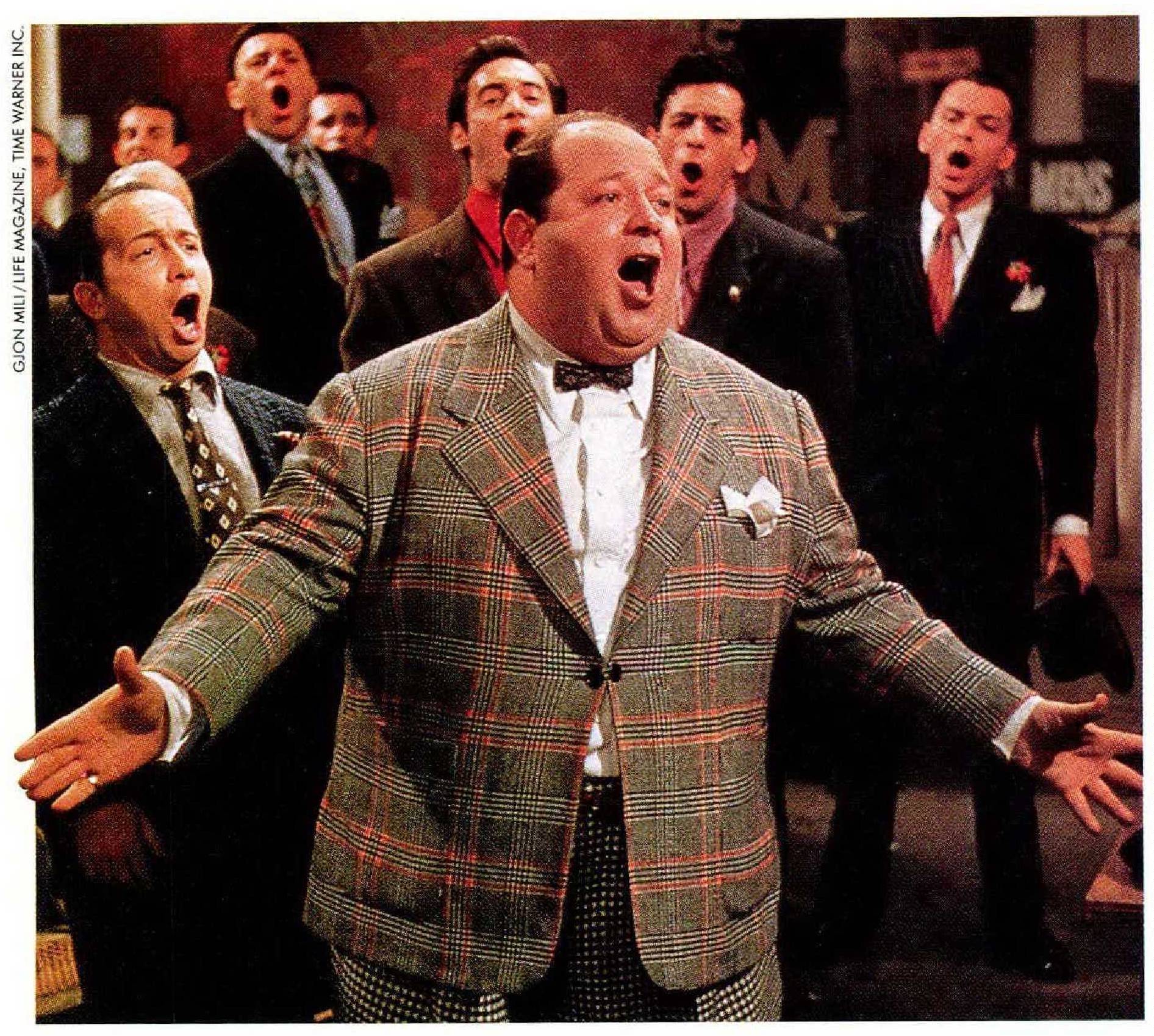
This, of course, is in “Sit Down, You’re Rockin’ the Boat,” the biggest of the show’s production numbers, delivered by Kaye in a voice as stout and unmannered as Jimmy Rushing’s and preserved in the film version. (Seemingly wider than he is tall and just made for Cinemascope, Kaye steals the movie; you can see the look of preternatural bliss on his face.) There’s never going to be a comparable Nicely-Nicely, but on the cast album of the new Guys and Dolls, Walter Bobbie sets the nerves on edge by whining “Sit Down, You’re Rockin’ the Boat” instead of singing it. I wish that the role had been given to J. K. Simmons, who joins Bobbie on “Fugue for Tinhorns” and the title song, and whose voice is similar to Kaye’s in amplitude and timbre.
In the new cast Faith Prince and Josie de Guzman score especially high marks as Adelaide and Sarah, and Edward Strauss’s orchestrations bring out a jazzy shimmer in Loesser’s melodies that wasn’t always apparent on the first cast album. Prince’s skills as both singer and actress are such that in “Adelaide’s Lament” what comes across is the wit of Loesser’s lyrics about the perils of a girl’s remaining single, instead of just the character’s Brooklynese. The challenge in singing the role of Sarah is that it demands two completely different voices—a prim and yearning soprano for “I’ll Know,” and a horny, openly amazed-at-itself slur for “If I Were a Bell.” De Guzman is believable at both, perhaps because she has the wisdom not to overdo either.
As his gambler namesake, Nathan Lane relies more on comic timing than on vocal prowess, which is okay, because no role originated by Sam Levene requires much in the way of vocal prowess. The role of Sky does, and Peter Gallagher isn’t always up to the task, although his voice does curve handsomely under De Guzman’s on their two love duets. A studious actor for whom singing is an acquired skill, much as it was for Alda and Brando, Gallagher isn’t bad, just unsure of himself. He’s a Sky lacking in self-confidence, and this cannot be. The RCA CD includes a few of the spoken interludes leading up to the songs, and Gallagher frequently seems reluctant to speak in his natural voice, much less to sing in it. Just when he seems to be doing fine, he becomes the dreaded Gordon MacRae.
ACTORS WHO sing on Broadway are seldom cast for their singing abilities alone. They also have to look the part, and it helps if they’re able to move and to deliver their spoken lines with some amount of grace. In a way, cast albums are no more than one-dimensional souvenirs of the shows they allegedly preserve. The exceptions are those albums on which a cast was assembled for the sole purpose of recording. These are usually not just revivals but archaeological digs that place shows in status quo ante by restoring songs discarded at one point or another during a show’s early run. The masterpiece of the genre is John McGlinn’s 1988 restoration of Jerome Kern and Oscar Hammerstein II’s Show Boat—a more “theatrical” experience than most stage productions of the show, largely owing to the chill provided by Teresa Stratus as the mulatto Julie and McGlinn’s retrieval of an ominous, quasi-gospel number called “Mis’ry’s Comin’ Aroun’.”
Not every vintage show benefits from, or even justifies, this archival approach. A case in point is Lady, Be Good! (Elektra Nonesuch 79308), the latest in Tommy Krasker’s series of Gershwin restorations, following Strike Up the Band and Girl Crazy. As presented on Broadway in 1924, Lady, Be Good! —the Gershwins’ first smash—was less an organic whole than a series of star turns for a variety of the period’s top performers, including Fred and Adele Astaire and the vaudevillian Ukulele Ike. In addition to the title song, the score introduced “Fascinating Rhythm” and “The Half of It, Dearie, Blues.” It also included a number of period novelties there seems little point in recording now, especially with performers lacking the charisma of the Astaires. (An actual stage revival, with the songs complementing the action and vice versa, might be another matter.) On “Fascinating Rhythm” and “Little Jazz Bird” the singer and guitarist John Pizzarelli, this production’s Ukulele Ike, exudes a carefree swing that six decades of jazz interpretations of the Gershwin brothers have conditioned us to expect from all performers of their songs. But Lara Teeter and Ann Morrison, though faithful to the composer’s intentions, sound hopelessly dated in the roles originated by the Astaires.
There have been studio recordings of Guys and Dolls, but nothing like today’s meticulous, carefully cast restorations. My own dream cast recording of Guys and Dolls, featuring singers past and present, would include Stubby Kaye and Faith Prince. My choice for Nathan would be none other than Frank Loesser, whose singing voice resembled Gene Kelly’s in its regular-guy-ness, although his phrasing was far more relaxed than Kelly’s—like a jazz instrumentalist singing a few choruses for his own enjoyment. I base this judgment on An Evening With Frank Loesser (a CD, DRG 5169), a collection of recently discovered “demonstration” versions of songs from Guys and Dolls, The Most Happy Fella, and How to Succeed in Business Without Really Trying. No one has delivered Nathan’s lines (from “Sue Me”) “All right already, I’m just a nogoodnik . . . it’s true / So nu?” with as much charm as the composer himself.
Frank Sinatra as he was in 1955 is the only man fit to play Sky, his credibility as a high roller enhanced by his long-alleged links to organized crime. Wasted in the role of Nathan in the movie of that year, presumably because Hollywood still considered him too much of a toothpick to woo a leading lady, Sinatra got his revenge eight years later as first among equals on an album of songs from Guys and Dolls by the Reprise Repertory Theatre (actually an ad hoc gathering of Rat Packers and their fellow travelers). This Guys and Dolls— reissued last year on CD (Reprise 45014)—is truly a crapshoot. Sinatra sings “I’ve Never Been in Love Before" so beautifully that you’re willing to forget that the song is supposed to be a duet, and his bravura “Luck Be a Lady" (with Billy May’s punchy high brass taking the place of a chorus of crapshooters urging Sky to “Roll the dice!”) has since become one of his trademark numbers. It’s such a definitive performance that many of us now think of the song as Sinatra’s, not Broadway’s. Sammy Davis jr.’s “Sit Down, You’re Rockin’ the Boat” is brash fun, and Jo Stafford’s “I’ll Know” is just about perfect (harmonizing with the orchestra where Sarah usually does with Sky, she interpolates the male response into the bridge). On the other hand, the McGuire Sisters’ “A Bushel and a Peck” is sheer torture, as are Debbie Reynolds and Allan Sherman as Adelaide and Nathan.
If the excesses of the Reprise album teach us anything, it’s that Loesser’s songs are so closely keyed to the tumult surrounding them on stage (and are so revealing of the eccentricities of the characters who sing them) that a studioonly Guys and Dolls featuring singers who have never tried on those Salvation Army bonnets and flowered ties inevitably leaves us feeling cheated.
BROADWAY HAS changed so much in the past two decades that the name most people under the age of thirty associate with it is probably that of Andrew Lloyd Webber, whose vulgar spectacles at least kept Broadway alive through some lean times (that’s about all that can be said in their favor). Along with British imports, the other new trend on Broadway in the past twenty years has been the “jazz” musical, usually featuring an all-black cast and built around the songs of an iconic performer of another era: Fats Waller in the case of Ain’t Misbehavin’, and Duke Ellington in that of Sophisticated Ladies.
Two such shows had their Broadway premieres in 1992, and there is a cast album for each. Essentially a revue, Five Guys Named Moe (Columbia CK52999) celebrates—or lamely attempts to—the influence of Louis Jordan, a singer and alto saxophonist whose hit records of the 1940s, which included “Is You Is or Is You Ain’t (Ma’ Baby)” and “Choo Choo Ch’ Boogie,” hilariously translated country homilies into urban jive and established the ground rules for rhythm-and-blues in the process. Jordan’s songs are as evocative of their period as the zoot suit, but they also represent superior musicianship of a kind that is timeless. You’d never guess this from Five Guys Named Moe. The title song was written for Jordan by Larry Wynn, who explains in the liner notes that the phrase “five guys named Moe” popped into his head one day as he was trying to remember the names of the lesser-known musicians on a recording date with Billie Holiday, Roy Eldridge, Teddy Wilson, Don Redman, and Georgie Auld. The five nonentities in this Broadway revue might as well all be named Moe, so indistinguishable are they in their cheery oversell of two dozen of Jordan’s slyest numbers.
Jelly’s Last Jam (Mercury 314 510 846) is something else altogether: more ambitious and more effective as theater, but meanspirited and manipulative in its portrayal of its subject. Written and directed by George C. Wolfe and starring Gregory Hines, the show tells the story of Jelly Roll Morton, the New Orleans “Creole of color” who claimed to have invented jazz—and whose tangos, stomps, and variations on ragtime and the blues really did originate jazz composition.
Unfolding mostly in flashbacks after having deposited Morton and his immortal soul in the Jungle Inn, “a lowdown club somewheres ‘tween Heaven and Hell,” Jelly’s Last Jam is simultaneously the most lavish of Broadway’s black musicals and a critique of the genre. It breaks new ground in acknowledging the social disorder its subject’s music evolved from, and in incorporating lighting and staging techniques associated with the shoestring avant-garde into what is essentially a mainstream, big-bucks extravaganza. But it puts Morton on trial for being a light-skinned opportunist who formulated his music from the joys and misfortunes of people darker and lower on the social ladder than himself, whom he persisted in thinking of himself as superior to. Some of the charges might be true; but you get the feeling that Wolfe, by changing the rules on Morton and questioning whether he was “black” enough by today’s standards, is using Morton to work out his own conflicts regarding color and class. The most unforgivable part of it is that Jelly’s Last Jam stacks the cards against Morton by never letting us hear his music in anything resembling its original form. The titles of his pieces have been changed to conform to Susan Birkenhead’s ill-fitting lyrics, and Luther Henderson’s unsympathetic arrangements reduce Morton’s idiosyncratic rhythms to generic 1920s doowacka-doo.
JAZZ ONCE derived much of its repertoire from Broadway, but, owing as much to changes within jazz as to a decline in the quality of Broadway songwriting, the process has been reversed, with such shows as Jelly’s Last Jam and Five Guys Named Moe the unhappy result. In addition to the pleasures it affords in its own right, the current revival of Guys and Dolls is a reminder of a time when Broadway was not only more robust but also more autonomous.
The alto and soprano saxophonist Michael Hashim’s album Guys and Dolls (Stash ST-CD 558) is likewise a reminder of a time, this one approximately three decades past, when “jazz version of” LPs used to follow on the heels of the original-cast recordings of most hit shows. Albums like Hashim’s used to be plentiful: in the jazz section of any good used-record store you’re likely to find Teddy Wilson’s Gypsy, Cannonball Adderley’s Fiddler on the Roof, even (with some luck) Eddie Costa’s Guys and Dolls Like Vibes. The target audience for such albums was only marginally interested in jazz but was willing to make an effort if the musicians obliged by playing familiar songs of recent vintage. This secondary market for jazz no longer exists, and such albums have disappeared along with it.
All of which might make Hashim’s Guys and Dolls merely an irresistible anachronism. But it’s also vital contemporary jazz. Thanks to their challenging harmonic structures, Loesser’s songs lend themselves as readily to chordal improvisation as they do to singing. Hashim and his sidemen—the drummer Kenny Washington, the bassist Peter Washington, and the pianist Michael LeDonne, who worked out most of the arrangements—do justice to the melodies even while taking such liberties with them as voicing “I’ll Know” slightly sharp, slowing “Fugue for Tinhorns” to a saunter, and putting the drummer’s brushstrokes up front on “If I Were a Bell.” “My Time of Day” becomes a lonely blues wail, and “Marry the Man Today” is transformed into a semi-exotic march, replete with Phil Woods-like puckers at the end of Hashim’s lengthier and more excited phrases. In exercising their own improvisational flair, these four musicians also demonstrate the amenability of Loesser’s songs to such novel approaches. An improviser could hardly ask for better material.
They don’t make albums like this anymore, in part because they don’t stage shows like Guys and Dolls anymore. But did they ever? Guys and Dolls isn’t just a Broadway musical. It’s a down-to-earth platonic ideal of what a Broadway musical should be.