Culture Watch
Dear Ms. Bovary . . .
The other night, tired of swotting for a Madame Bovary lecture, I picked up a magazine and learned that times, they’re still a-changing, A Survey Shows. After studying 100,000 replies to a questionnaire titled “How Do You Really Feel About Sex?" the editors of Redbook conclude that:
Close to 95 percent of all women married after 1973 “say they have had pre-marital intercourse.”
Nine out of ten women under twenty-five “say they have had premarital intercourse.”
Among wage-earning wives between thirty-five and thirty-nine years of age, “almost half say they have had intercourse with men other than their husbands” since they were married.
As a way of underlining the scope of the change, the magazine goes on to compare its data with that released by Kinsey twenty-one years ago:
Among 25-year-old women, Kinsey found, 9 percent had had extramarital intercourse: in the Redbook survey, among 20-to-24-year-old wives, extramarital sex was reported by 25 percent. Among 40vear-old women Kinsey found that 26 percent had had extramarital sex; among Redbook’s 35-to-39year-old wives—the group with the highest percentage of extramarital activity—it is 38 percent.
No word in this article about how many questionnaires were printed and mailed; no observations, either, from the house psychologist, about probable personality traits of people who answer questionnaires on how they really feel about sex. Take it or leave it, is the line. One reason for taking it is that the figures make those hard-nosed Sixty Minutes reporters who grilled the First Lady about her daughter’s sex life look even more like prurient creeps than they did before. One reason for skepticism is the hint, elsewhere, that Red-book’s 100.000 may be a step behind advanced thought at this hour. Ms. Erica Jong, for instance, came out firmly for fidelity in a recent Playboy interview. (Another truant evening.) The author of Fear of Flying remains a salty lass, full of— excuse the phrase—zip:
PLAYBOY; There’s a lot of licking in your poems, isn’t there? JONG: Yes. Well, I’m a very oral person. I like licking a lot. PLAYBOY: Licking or being licked? JONG: Both. I also like barking. PLAYBOY: Barking? JONG: Arf! Arf! What I mean by barking is a certain kind of playfulness . . .
But Ms. Jong displays several traces of ennui with the world of sexual liberation. ("One night I sat down with some friends in an apartment to watch some . . . porn films and we got so bored with running them forward that we decided to run them backward. . . .”) And she’s downright uncooperative when Playboy, piping its customary one note, pushes for a new. all-out endorsement of the “excitement of being unfaithful”:
[Adultery is] very superficial. It really turns out you’re not getting the best of either man. . . . Infidelity seems like a tremendous turn-on at times, but you really don’t get much out of it. It’s much better to have one really rewarding relationship than to have several fragmentary ones.
Nor are Ms. Jong’s hesitations the only leading indicator, as they say, suggesting that zest for ceaseless multiplicity has peaked. While Vogue continues to run nudie photo layouts, shots of bra groping by males, and the like, the copy testifies that the audience isn’t as wild for experiment as it was once presumed to be. (The strongest argument for having an affair set forth in recent issues of Vogue is that it tends to improve the complexion.) And, for that matter, in commenting on The Survey, Redbook itself was a bit mystified-in the absence of exact time frames—by the tendency of a majority of sex-experimenting wives to describe themselves as “happily married.”
Ah, but enough dawdling . . . I’ve a job of work to finish. Returning to my lecture text, I read Flaubert’s extraordinary words about the excitement for Emma Bovary of her infidelity, the glory for her of turning her existence into “one long tissue of lies.” of transforming herself into a person for whom duplicity has become such “a need, obsession. delight” that, “if she claimed to have walked on the right side of the street the previous day, one could be sure she had walked on the left.” Maybe the only pertinent reflection is that, when every second person you meet is into the same sport, the thrill of the thing is gone. Maddened by Rudolphe. by Léon, maddened for lying, Emma opens the post and finds a questionnaire. one of a million copies. Her correspondents inform her they’re curious—a clinical but nevertheless caring tone—about what it’s like making out behind Charles’s back. They’re coming at this, they explain, from a public service and social research point of view, and would she take a moment to look over these sixty questions, using an ordinary lead pencil, please, not ink, to facilitate info retrieval, stamped, addressed envelope inside.
Woe. woe! What a dim day for the heroines of our past would that have been, risky love obliged to see itself packaged in multiples of millions, dwindling into data as it dies.
Turnabout
“What happens to women of the kibbutz? . . . The founders of the kibbutzim wanted to develop a new kind of human being, motivated by communal commitment . . . Men and women would do the same work . . . would equally be politicians and cooks, equally have the freedom to make love with whomever they wished unbound by the old association of sex, marriage, and procreation. Indeed, they would be free not to marry at all; they could live together, and could separate as easily as they had united . . . [But) our data show . . . the overwhelming majority [of kibbutz women acting] against the principles of their socialization and ideology, against the wishes of men of their communities, against the economic interest of the kibbutzim, in order to be able to devote more time and energy to private maternal activities . . . Obviously these women . . . are trying to accomplish what women elsewhere have been periodically urged to reject by critics of traditional female roles.” Women in the Kibbutz by Lionel Tiger and Joseph Shepher (Harcourt Brace Jovanovich. $10.95).
Personal politics
Lina Wertmuller isn’t a name on every lip, despite the media commotion stirred by her most recent movie. Swept Away by an Unusual Destiny in the Blue Sea of August. And since I’ve now seen three of this director’s films (Swept Away is her eleventh, and the fourth to be shown here), and have read a fair amount about her, I’m in danger of taking a proprietorial tone—putting myself forward as one of those upon whom, cinematically speaking, nothing is lost. The opposite is the case. I don’t know all the Italian masterworks, I could easily have missed Ms. Wertmüller’s current entry, and the chief reason I didn’t is that the young Sicilian named Caspar in the barbershop saw Swept Away last summer in Italy, and, one recent afternoon as he was leaving me short on top and full on the sides, he laid out the story amusingly and pointedly, making its possibilities vivid.
The tale is about a rich woman. Raffaella, and a poor man, Gennarino, whom circumstance thrusts together on a desert island. (Circumstance is a dead outboard on a rubber raft belonging to Raffaella’s husband’s yacht.) Raffaella is the sort of rich woman who is led by personal arrogance and scorn of the clichés of well-heeled radicals into shrill denunciation of the poor and the helpless; Gennarino, deckhand and assistant steward on the husband’s yacht, is the sort of working-class/family man/communist whose self-scorn (for his own political impotence) and hatred of the mighty conjoin in such fashion as to banish from his being, seemingly, all capacity for nonideological response. Raffaella taunts and mocks this man, as well as the prating rad-lib intellectual guests who’ve joined her and her husband for a Mediterranean cruise; Gennarino’s somber fury is effortfully suppressed until Raffaella’s impulse and the dead outboard bring on the desert island and a comic and provocative reversal of roles. Swept into power by his survival skills. Gennarino refashions his employer into his slave, teaching her to wheedle and fawn like the poor. But lyric intervenes: slowly the two begin to transcend power relationships, the new and old hierarchies of sex; they are to be purified by passionate love. At the end comes, not astonishingly. a fall, a return to the world as it is, bitter reacceptance of the social structures east and west of Eden.
Mediterranean buffs will leave this movie drunk with azure seas and diamond dawns (much talk of pollution in the film, but no sign of it on Raffaella’s and Gennarino’s island). Literary types will ruminate on various witty updatings of fantasies past. (Gennarino is a militant Crichton-Crusoe-Prospero, a magician whose arts of provisioning have a hard, articulated, political edge: Raffaella is a Friday-Miranda for whom the goal of the “learning experience” is recovery, not loss, of innocence.) And, whatever one’s special interests, admiration is bound to flow for the players
themselves. Mariangela Melato and Giancarlo Giannini are marvelously spirited throughout, so that the movement of their feeling—from brutal hatred to mutual exploitation to the discovery. in love, of each other’s true dignity, beauty, and worth-gives forth no sense of a decline of energy or descent into sentimental weakness. (The same two actors are paired in Ms. Wertmüller’s Love and Anarchy and TheSeduction of Mimi, and in both movies the characterizations are sufficiently rich and particularized in voice, tone, appearance, and gesture to enable the “stars” to disappear into them. Only after a while does it come to mind that that Chaplinlike fellow in Anarchy—can it be? Is that Giannini again? Splendid!)
But most striking in Swept Away is the complication of the director’s mind, her alertness to the interpenetration of emotion and ideology, and to the force of personal motive in those dramas that piety reads as “exclusively political.” Gennarino catches some rock lobster barehanded, lights a fire, cooks it as the famished Raffaella watches, eats it voluptuously before her imploring eyes. He tells her, licking his fingers in the firelight, that he is her instructor, he is showing her what it is like to beg from the rich and to learn there’s no hope. A moral lesson. But the moralist’s level eyes express other satisfactions than that of the pursuit of truth —the eternal smugness of the lucky, the bliss of having when one’s neighbor has not . . . As the scene moves, develops, the watching mind scans a rapid succession of complementary qualifying truths . . . accustomed to authority. the rich are harder to teach than others . . . the oppressed can’t be expected to behave better than their oppressors . . . next to the love of power, the love of justice is a flea . . . love is born in sharing, but what a lot can greedy power teach!
The hero and heroine of this film progress to an elevated politics, a uto-
pian politics, as they approach their purification—and then, to repeat, they’re “saved” by a passing craft, restored to habitual life. But the current of thought, of good-humored but intricate evaluation, isn’t checked. The film shows no shame at the island fantasy of perfect human accord, all savagery spent, but neither does it sink into conventional mockery of homely life. Gennarino’s real-world wife is plump, silly, graceless, but also self-respecting and alive. The camera angle is wide and distant yet oddly reconciled in the final frames wherein, paradise lost, Gennarino heads home to is-ness, shaking off his fantasy. Can’t win in this life, but at least, my friend . . . we can do what we have to do. A lively, funny, continuously ponderable film.
S/he
Two years ago the annual meeting of the American Anthropological Association passed a motion urging writers to stop using “he” and “man” as “generic for the species” and to use more comprehensive terms, “such as ‘people’ and ‘human beings’ which . . . include both sexes.” The least boring effort in this line I’ve so far seen is a convention followed throughout Urban Higher Education in the United States, a volume by George Fischer that began life as a report to the chancellor of the City University of New York and was published by that university’s press. Wherever in the book Fischer has occasion to write a gender-troubled sentence—say. “A student has two options, he can. or she can, or he or she can . . ."—he simply writes: “A student has two options, s/he can . . .” Will this fly?
Gone coed
Recently and belatedly the college I teach at went coed and, because of this, the term has thus far produced, for me, one moving moment, occasional evening surprises, and several patches of student newspaper writing of the kind I like best. The surprises are simply female voices where you don’t expect them. . . . My walk home at night takes me past the gym where in fall and winter, at about this hour, the football-basketball-hockey men are sloping up from practice and showers for chow. Local convention dictates an exchange of greetings, and it’s disorienting to hear, coming out of the darkness now and then in answer to my hi! a sound not heavy and hard but fluting, a softvoiced kindness . . . girls’ voices saying good evening.
The writing I speak of is done by older chaps, seniors, trying to sort out their responses to life in “a college for men and women.” I was standing in the dining hall, in my white worker’s jacket, wrote a senior named Mark J. Magyar last month in our paper, eyeing the line for Saturday supper,
. . . when they came marching in. Eight rugby players, including several freshmen, led in song by a senior. One of the veterans would rasp a traditional verse, then all eight would belt out the chorus:
Ass against the wall,
If you never get laid on a
Saturday night.
You’ll never get laid at all.
They paraded . . . into the medium length line and continued singing until they reached the checker’s stand. The three women in the dining hall got their meals uncomfortably, never meeting the eyes of the ruggers, while the ruggers only stole a glance, then looked away lest the women catch their eye.
Magyar proceeded to acknowledge that the ruggers had no right to behave as though they owned the place any longer. (Out of fairness he noted they didn’t seem to be singing as loudly as they would have last year, and he predicted that next year they wouldn’t be singing at all.) Next he produced some disavowals. (“Before I applied to Amherst, I viewed its all-maleness as a demerit . . . this isn’t an . . . anti-coed editorial. . . . There is a certain perverseness at an all-male college . . .”) But he was still wrestling with something inside:
It’s one thing to rationally deal with this kind of sexism because there are no justifications for it to be found. But it’s quite another thing to try to talk about how it feels to be one guy among a group of guys, singing those songs at a rugby tap, and to realize that this sort of thing is probably just about over at this place. I write this piece not in hope of conveying an understanding of that feeling to the women transfers or even to the new freshmen. I am under no illusion as to the limits of my skill. I write this for those who felt the way I felt when the ruggers marched into East on Saturday afternoon.
What’s likable here, I’d argue, isn’t the “position”—there is none, really but the embarrassment, the awareness that now and then something awkwardly substantive inside a person can’t find its way into socially or even personally approved words. The usual voice in a student newspaper is somebody trying {and succeeding) to sound, at twenty, like the blowhard authoritative fakes who write the editorials in the grownup paper of your choice.
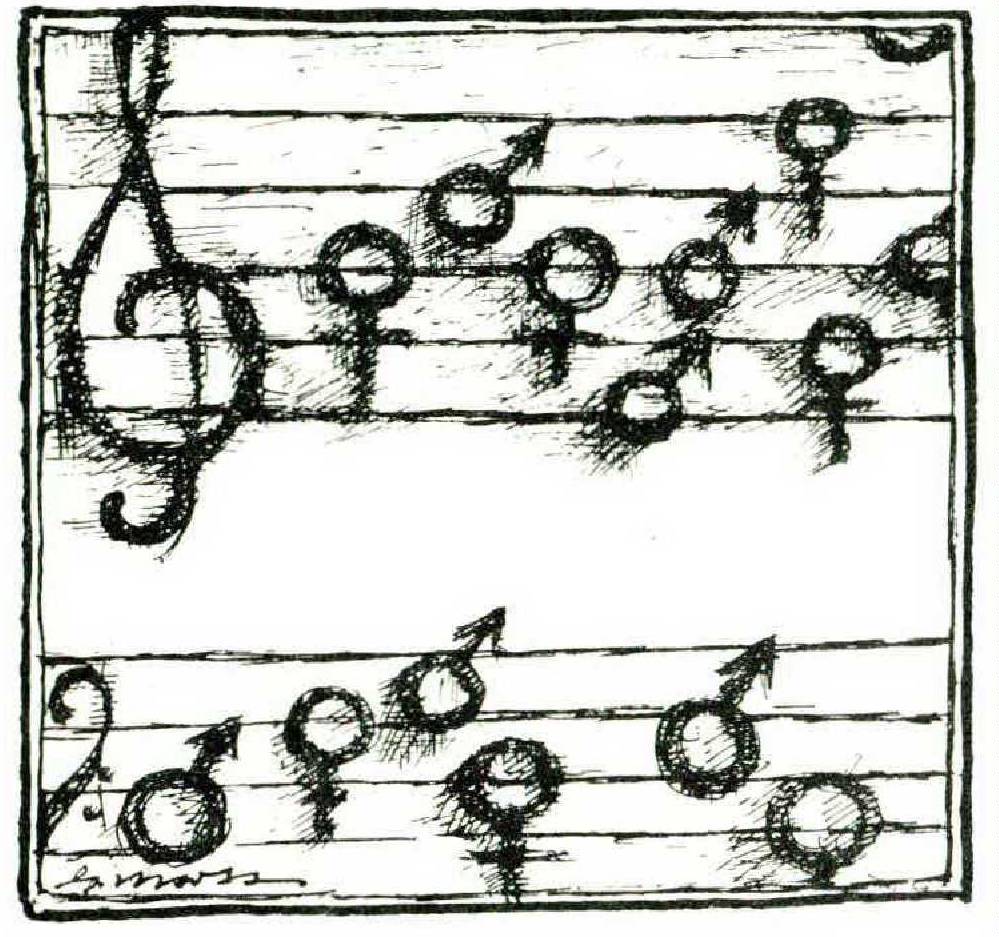
As for the moving moment, it occurred about two bars into the first hymn at opening chapel. I’ve been attending these ceremonies in the same building on roughly the same day for twenty-five years, hence I don’t follow events and rhetoric intensely—sometimes don’t, in truth, even focus undistractedly on the remarkable performances of our college’s well-regarded male choir. But this time, a few bars in. as I say, I awoke ... I looked down at my program, which told me the hymn in progress was composed by an eighteenth-century American, a sensation in his day. and even as I read about him I knew. Turning round to the choir loft in the upper balcony . . . there they were, answering choirs, male and female, voices pouring it forth, superbly blended, now separate, now superbly blended again. Praise! Praise! Soaring shouts of sound. Praise Him! Praise Her! Very beautiful it was. mysteriously poignant. Eyes brimmed. And we moved on.