English as Spoken in Scandinavia
THEODORE PRATT has written thirty-four novels, the latest of which is THE MONEY. He lives in Delray Beach, Florida.
Anyone contemplating a trip to the Scandinavian countries worried about the people’s speaking English can continue to worry a little, even though most of the guidebooks blithely keep on saying: “Don’t worry, everybody speaks English,” as one of them comes right out with, flatly and unequivocally.
That guidebook writer should have been along with me last summer in Scandinavia. He should also read the little booklet “We Danes and You,” put out by the National Travel Association of Denmark, selling for one krone and well worth it. If there is one thing the Danes have, it is a delicious sense of humor, plus the ability to laugh at themselves. In this booklet the following statements about their speaking English and other languages are made:
“Just after midnight it is general for Danes to break into English whether they can or not.”
“Every Dane speaks at least one foreign language. It may not always be easy to be sure which it is.”
“It staggers the Danes to think visitors can speak languages like English, French, Swedish, Norwegian, not to mention Spanish and Portuguese, even better than we can.”
“Most Danes speak foreign languages more or less.”
The Swedes and Norwegians may not kid themselves as readily as this about speaking English, but dealing with them in their languages is much the same as with the Danes. Quite a few in all Scandinavian countries do speak English well. But as for that “everybody” of the guidebooks, please listen:
In Oslo, when I asked a man on the street how long it would take me to walk up to the old castle on the hill above the city, he told me without hesitation, “Five minutes, no more.” Three quarters of an hour later, on wobbly legs, I came into sight of the castle.
Obviously, my guide must have missed a zero in his English computation, meaning fifty instead of five.
Sometimes such misinformation can lead to near-serious consequences. On a Swedish train from Stockholm to Copenhagen I decided to have a late lunch and asked my Scandinavian compartment companions if I would have time before the train was split up (part was to go to Malmö, in another direction). Oh, yes, they informed me, plenty of time, a lot of time. Off I went to the restaurant car. No one there said anything to me about trainsplitting or inquired where I might be going. I was in the middle of my lunch when the train stopped and began to lurch back and forth in that unmistakable manner which means cars are being shunted. At that point I made hasty inquiry, and learned that the diner was being jockeyed to go with the cars to Malmo, where in a moment I would be heading.
Leaving half my lunch behind, I just managed to get back to my car. My English-speaking friends had gotten off, lucky fellows.
The following scenes with the Danes were repeated in the other countries. On the street you ask a Danish man, “Do you speak a little English?”
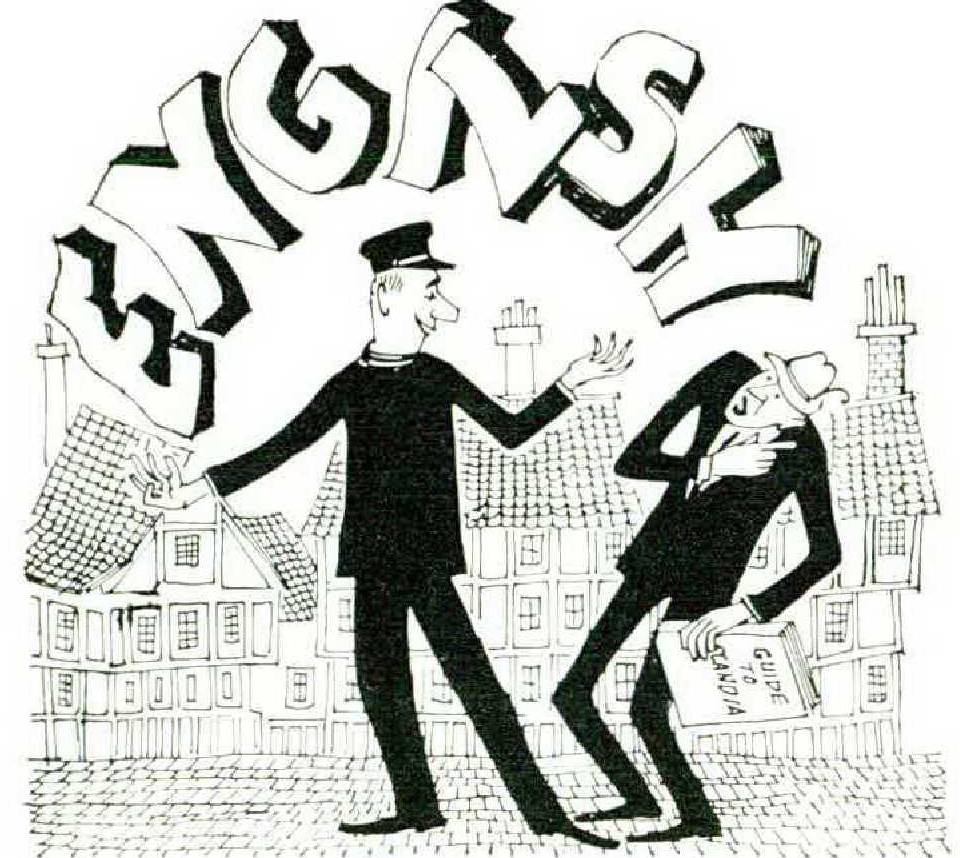
“Yes, yes,” he replies agreeably, and then with a twinkle in his eye, “I also speak a good Danish.”
Delightful, except for what follows. I point down the street and ask, “Is the Glyptotek Museum down that way?”
“Yes, yes,” he agrees, “down that way.”
I thank him and start off down that way. But there is no Glyptotek Museum down there or any other museum. Belatedly I realize the English of my man on the street consisted mainly of “Yes. yes” and perhaps his joke about speaking Danish, and that he had just been agreeable and had gone along with my own wrong direction, which I was following.
There lies the great danger, the agreeableness of the people. Often they are so charming that you simply can’t believe they don’t know what they are talking about. In my hotel room when I first moved in, there was a table I liked for my portable typewriter. One day they took that away and brought another, smaller, which I did not like. I asked the desk clerk for the return of the first, to replace the new one, all in English.
“Of course,” he replied in that language.
When later in the day I went back to my room, I found that the first table had been brought back all right, but the second one had also been left; I now had two tables, which crowded the room considerably.
Most of the help around the wonderful Tivoli Gardens speak English quite well, but there is one tall, magnificent guard who is usually on duty outside the main entrance who doesn’t know the difference, in English, between Tuesday and Thursday, which, after all, do sound somewhat alike. Alter he had told me a certain weekly event would be on Thursday and I missed it because it was on Tuesday, I tried to point out to him the difference between the two days. “Yes, yes,” he agreed, nodding and thanking me.
I hung around to listen to how he got on with the days. A young American couple approached him and asked about the same event I wanted, which came on Tuesday. Beaming, he told them, “That is on Thursday.”
I set the young couple straight, but I gave up on the guard. I picture him standing there in his splendid uniform still most pleasantly confusing Thursday with Tuesday.
One just can’t get mad with the Danes even when they make such bloopers. I will never forget the middle-aged couple I asked, in the rain, for directions to get to a certain place. In what passed for English, and with many gestures and a few charades and consultation of the map I carried, they assured me they could put me on the way to the place. They walked two blocks in the rain with me to a tram stop, waited while I got on what they assured me was the right car, and smiling in the most friendly fashion, waved after me while I smiled and waved back.
The only trouble was that the trolley didn’t go anywhere near the place I wanted to go. But I could only think fondly of them.
The same thing happened with a Swedish couple on a tram in Stockholm. I was with another American that day, and we asked directions from this couple. As soon as they realized we were foreigners, they gave up their seats on the crowded tram, even the woman. I felt decidedly foolish taking her seat, but they insisted. And they, too, gave fulsome and enthusiastic directions to get to a place by the wrong route that never got there.
Scandinavians are always so pleasant and helpful that eventually you find yourself quite happy at being given wrong directions, and accept it as a kind of game.
“Do you speak a little English?”
“Yes, yes.”
“Is that the way to Birger Christensen?”
“Yes, yes.”
“I’ll bet that’s the wrong way to go.”
“Yes, yes.”
In any case, it’s a lot more than I could tell any Scandinavian if he came to my country and asked directions. I might want to, but I couldn’t even say “No, no” in Finnish.