Those Crazy Americans
ELINOR GOULDING SMITH has written many books and light articles and has been a contributor to the ATLANTCsince 1943.
Americans (including me) are always going through agonies of self-abasement and self-analysis in an effort to understand why we are so distrusted, scorned, envied, and (well, it’s true, isn’t it?) hated by the people of the rest of the world.
I don’t know all the answers (actually, I know hardly any answers if it comes to anything much past two plus two), but I do knowone answer. It’s so simple. The people of the rest of the world can’t understand us because they don’t understand our climate. I don’t mean something vague about political climate or social climate; I mean climate — ordinary, old-fashioned meteorological climate. How hot or cold it is, how much it rains or snows — that kind of climate.
People in Europe think that because on a map we appear to live in the temperate zone, just like them, our climate must be roughly like theirs. They might even come over for a short visit in April or October and go home again still not understanding. If they came anytime and stayed for a year, they might begin to comprehend what it is that makes us different.
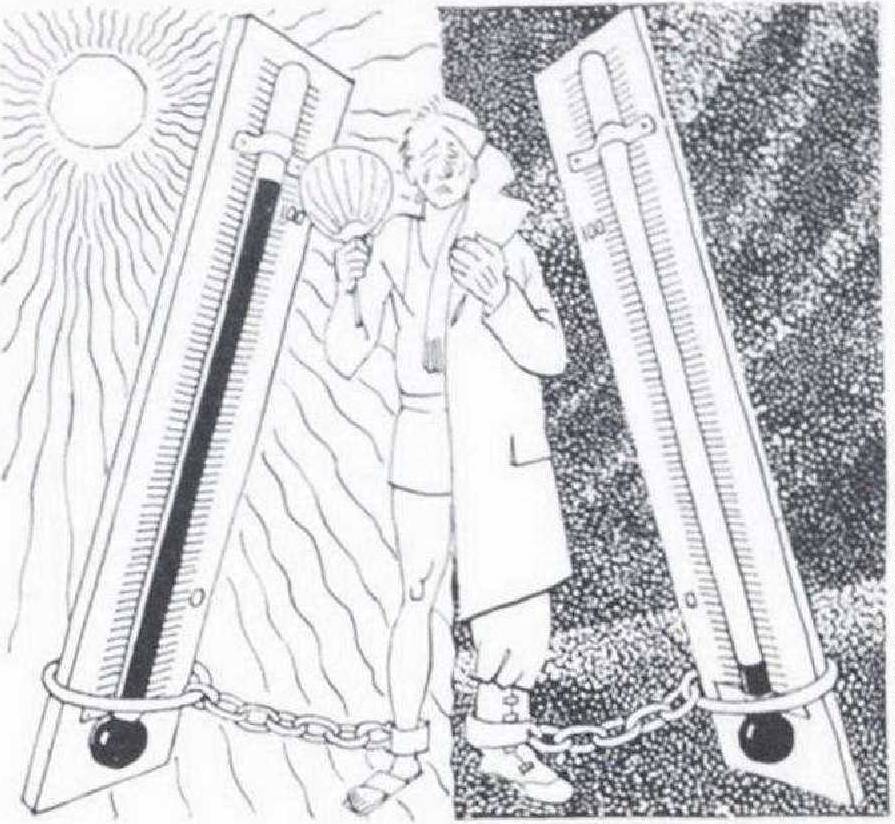
Now, there are lots of cold countries, and there are tots of hot countries. But North America is the only place I know that is thickly populated and is, by turns, violently cold and violently hot, and regularly has hurricanes, floods, tornadoes, and droughts.
A European who reads about how many refrigerators we have, to take one small example, simply does not understand that in our summer heat food spoils while you blink. I’ve seen a meat pie stand on a larder shelf for three days in England in July and still be perfectly all right; but I’d hate to eat anything here that had been standing on a shelf for three minutes.
I think most Europeans feel we buy air conditioners to show the rest of the world how rich we are. They’ve never tried to sleep during one of our spectacular three-week heat waves, tossing and turning in sweat-soaked, rumpled sheets, and fighting nausea and despair. They don’t know about putting small children in the bathtub at three o’clock in the morning to try to cool them off enough so they can fall asleep again. They don’t know about taking a bath and then standing around to let the water evaporate in a hopeless effort to keep the cool With you for just a few minutes longer. They don’t know about the soles of your feet getting burned if you walk on a city pavement in thin-soled sandals on a summer day. They don’t know about sitting up all night in an air-conditioned cafeteria or an all-night movie house because your apartment is too hot to go back to.
People from other parts of the world don’t understand about the Arctic gales that come howling down through the central plains of Canada and the United States, They have their water pipes on the outsides of their houses. I hey think all Americans are central-heating mad; they don’t realize that without central heating we would have to hole up in the kitchen for the winter, like our early colonists. In a modern house, we would quite literally not survive without a furnace comfortingly whirring away. Only a couple of winters ago, when the temperature got stuck at ten degrees for nearly a week, my oil burner was not able to keep up with it. Though every window had its storm window and every door its storm door, the house was cold. We wore sweaters all day, our hands were blue, and wc had to go to bed early. How long would we have had water with our pipes on the outside? And I live in the mild part of the country.
One winter, long ago, when I was at college in Ithaca. New York, the temperature fell to forty degrees below zero and stayed there for seven days, if my memory can be relied on. It might have been ten days. It is not one of my happiest memories. All the water pipes, buried well underground, froze and burst. The infirmary was full of frostbite cases and one bronchial pneumonia case (me), and I can remember crying — really crying, real tears that froze instantly — from the pain in my hands, feet, eyes, and lungs when that weather hit me. Europeans don’t understand about winters like that.
Right here, in the nice temperate New York suburbs, same latitude as Rome, Italy, it can start to snow, and the next time you look out the window you can’t find the fourfoot-high stone wall that separates! your place from your neighbor’s.
One ghastly winter when the snow and ice and cold were normally worse than normal, I read in the newspaper that some visiting Norwegians were in a state of shock. They said they had never experienced cold like ours before. The following summer, a usual unusually hot one. some visiting Iranians made the same comment about our heat. Their heat is hotter, of course, but it’s dry. They were having their first experience with a combination of heat and humidity, and it knocked them out. Well, of course it knocks us out, too. Only we have no place to go home to. We live here. So either we drop dead with a snow shovel in our hand or we drop dead with a lawn mower in our hand: or we survive somehow, and the minute we can afford an air conditioner, we buy it because we need it, not because we’re spoiled rotten.
A few years ago, during an ordinary extraordinary winter, we were having some electrical work done (to give us enough power for our air conditioners, oil burner, and so forth), and the electrician was a Frenchman. He had come, in his total ignorance, to America with his wife and daughter, and they had settled, in their ignorance, in Montreal. After five Montreal winters, they had moved, blue, shivering, and stunned, south, to the New York suburbs. There was something like forty inches of snow that winter, and the thermometer stuck for weeks on end at ten degrees. I’ve often wondered if they moved again, perhaps on down to Atlanta or Miami.
In England they call it a heat wave if the sun comes out for half an hour. They frolic around on their beaches in a drizzle at sixty degrees and call it summer. And in the winter, if there’s more than six inches of snow, the whole place goes to pieces, a state of emergency is declared, and food is dropped from planes to besieged towns.
All societies and cultures are affected by their climates, and we, like all the others, are strongly affected by ours. The problem is merely that other people fail to realize how different our climate is from theirs, I can see that if you didn’t know, it would be pretty hard to believe that one country could have the bitter extremes that ours manages to provide in just twelve months. We live in a rugged country, with rawcraggy mountains, raw new rivers that don’t stay put. perishing Arctic winds, brutal, blazing summer heat. That our ancestors managed to survive at all is a pure miracle. That we survive at all is a small miracle.
One evening I met an English couple who had been here only six months, and the young wife was in a state of perpetual terror. “Everything here is so big.”she said. I thought she meant ostentatious, as in cars and buildings. “Oh, no,”she said. “It’s things like your rivers. I shall never forget the first day I saw the Hudson River and the George Washington Bridge. It was quite frightening.” I knew what she meant because I had had the same feeling, in reverse, when I was in her country, with its (to me) doll-sized rivers and tiny bridges and red toy trains. I felt cramped all the time. Everything was neatly to scale, and I never felt as though there were room for my legs anywhere.
Living in this wild climate among these giant mountains and rivers takes a sort of energy that is not needed in most other places. It is a climate so raw and unfriendly that if you don’t move fast you die. People do move fast here. They move with a kind of energy that comes merely from keeping alive in a country that hits a hundred in the summer and forty below in the winter and has everything there is in the way of weather in between.
Like most things in life, it is useless to try to explain it. Try telling a Frenchman that we really need our refrigerators. He doesn’t understand. You have to experience it for yourself. So I sec no hope for it but to go on with our air conditioning and central heating and refrigerators and freezers, and be misunderstood. “Oh, those crazy Americans. Have you heard? They’re putting air conditioners in their cars, now, and heating their garages.”