On Paul Goodman
If Paul Goodman is the aging lion of American radicalism, Michael Harrington, at thirty-seven, is the most risible of his likely successors. THE OTHER AMERICA. Harrington’s derastating examination of America’s poor, is mandatory for field workers in the war on poverty; his new book, THE ACCIDENTAL CENTURY,will be published this month.
by MICHAEL HARRINGTON
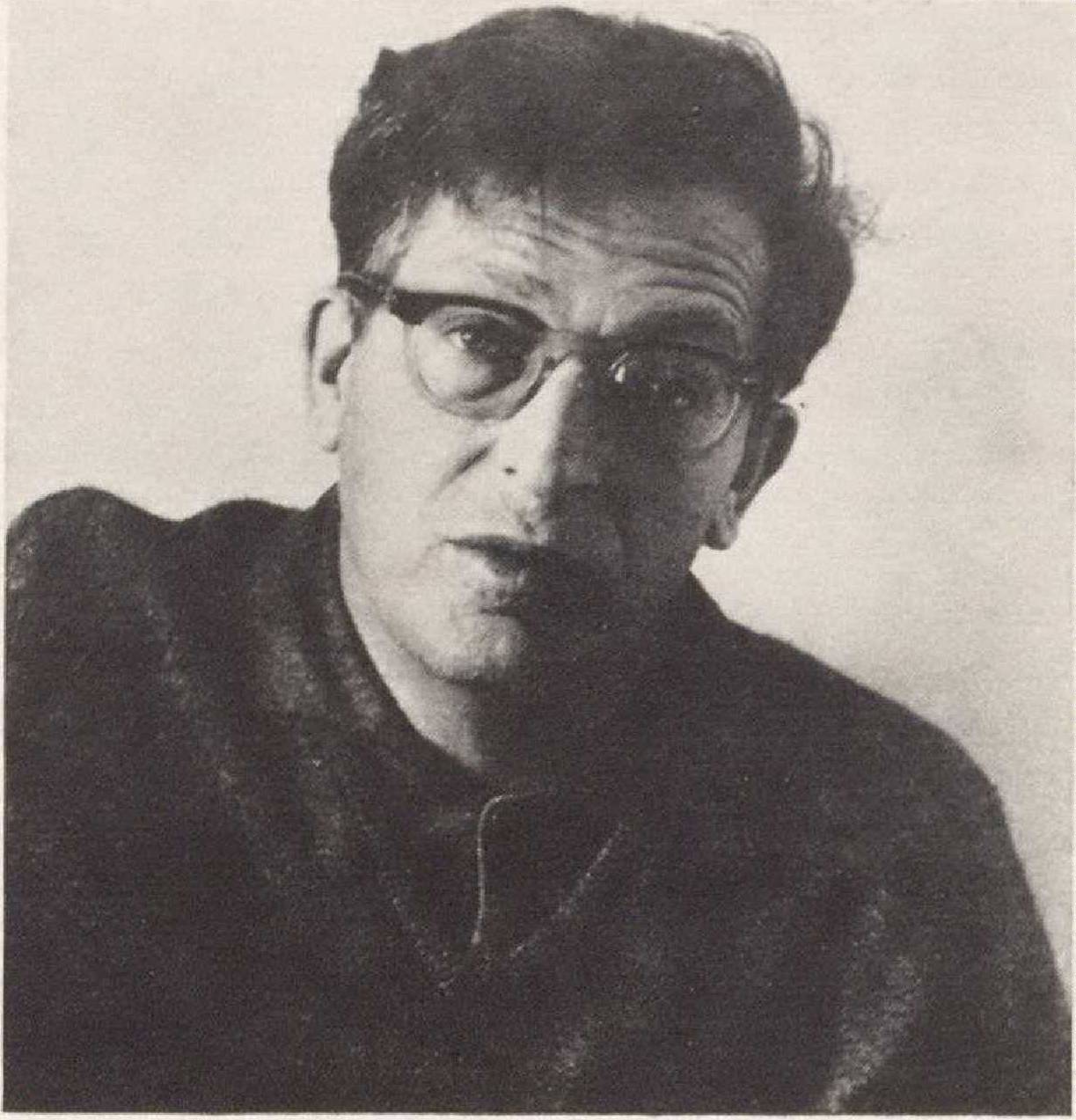
DURING one of the recent student uprisings at Berkeley, an activist told a reporter that his rebellious generation distrusted everyone over thirty. There is, however, a fifty-four-year-old exception to tins rule: Paul Goodman, utopian agent provocateur and perhaps the only honorary angry young man on the American campus today. A few years ago, Goodman said that he was trying to integrate the existentialism of Zen, Tao, and Albert damns with the pragmatism of William James and John Dewey. Why should such a mix, which at first glance seems fairly exotic, enable its author to engage in dialogue with a bitter, discontented, and oedipal generation half his age?
American literature, Philip Rahv once said, is divided between the paleskins like Henry James and the redskins like Whitman. Goodman is, of course, a redskin. He is a devotee of that genuinely American cult of experience in which the natural man refuses to obey, or rather, seeks to destroy, conventional society. In recent times, this cult has produced Hemingway, E. E. Cummings, Henry Miller, and the entire Beat Generation. When Paul Goodman, in his Compulsory Miseducation, prposed that young people be encouraged to drop out from the impossible schools we force them into, he argued that they would be better off hanging around on a street corner than sitting in a classroom. That is the voice of an American redskin.
The main issue of his new book, People or Personnel, is the oppressiveness of bureaucracy and routine. Modern society, Goodman says, is everywhere centralizing. As a result, “the function to be performed is the goal of the organization rather than of persons. . . . The persons are personnel.” The answer to this situation is radical decentralist change which creates a society in which “people are engaged in a function and the organization is how they cooperate. . . . Each person becomes increasingly aware of the whole operation and works at it in his own way according to his capacities.”
These words were written before the first student demonstrations at Berkeley in the fall of 1964, yet they summarized and anticipated much of the spirit on that campus and others across the nation. In a recent essay on Berkeley, Goodman tried to explain why undergraduates might accept this view: “ The thoughts and feelings of the young have been more relevant [than those of the older generation] to the underlying realities of modern times, the drive to rationalization, the abuse of high tec hnology, and the hardware GNP, statism and the Bomb.” The students, Goodman is saying, arc a new proletariat, whose experiences with academic” bureaucracy make them sensitive to, and rebellious against, the centralizing impulses of the nonuniversity world. This thesis is certainly overstated, and just as certainly describes a spirit which has captivated some of the best of American youth.
It is in this context that one can understand what Goodman and his readers mean by “existentialism” (if Zen and Tao are not explicit heroes of the current student movement, Albert Camus verymuch is). The post-World War II European existentialists responded to the violent breakdown of the old order climaxed in the death and destruction wrought by the war itself. Their notions of commitment, of being engaged, were, of course, a generalization of their experience in the Resistance movement. The setting for Goodmanesque existentialism among American youth today is hardly so somber. By and large, Goodman and his youthful audience define their existentialism as a revolt against the success, _rather than the collapse, of the system. For them, a corporation is a concentration-camp universe.
This angst of affluence is hardly new. The Beats of the fifties were existentialists, too, American redskins singing the joys of the road, of sex, and of pot. The new existentialists have retained many of the bohemian, épater les bourgeois styles of their immediate predecessors. Yet and this is an enormous difference - they are political, and for all the talk of hip, their concern with social morality makes them square in Beat terms. For they seek, as Goodman has said, to marry their existentialism to pragmatism.
IN People or Personnel, then, American society is not only charged with being immoral and aesthetically., ugly. Goodman alsoclafms that it is “ineffective, economically wasteful, humanly stultifying and ruinous to democracy.” Consequently, decentralism is proposed not as a panacea but as a practical way of performing certain important functions and doing them better than the centralizers. Goodman makes out an ingenious argument on behalf of this proposition.
In a good many cases, Goodman says, centralized technology and organization are terribly wasteful. Because of its bureaucratic structure, the New York City school system still specifies that its builders use a type of hardware so old-fashioned that it is kept in production only for these schools. At a 1964 meeting of highway planners, Washington was urged to expedite its housing program so that it would not interfere with highway construction. The road was thus proclaimed more important than the place to which it leads. Mass agricultural production and marketing makes a whole range of frozen foods available but often deprives one of the opportunity to get fresh fruits and vegetables.
As a result, Goodman continues, the centralizers do more altering of the human environment and condition that any utopian has ever proposed. (In his Utopian Essays a few years ago, Goodman pointed out that Robert Moses had restructured New York City beyond the dreaming of the most radical reformer.) The corporations themselves become more and more automatons and less and less “free” enterprises. And all this is justified in the name of efficiency and the unproved hypothesis that centralization always yields the greatest volume of goods and services.
Goodman in his new book does not challenge all the arguments in favor of centralism as a necessary development of the technological society. He freely concedes that certain economic and social functions require large-scale organization. But that, he says, does not mean that the centralist mode is everywhere applicable. There are situations where the enormous cost of centralization far outweighs any advantages gained. And conversely, there are human resources which can be used most effectively on a face-to-face basis and without the need for calling some huge administrative structure into being.
The Broadway theater, he notes, is run on a sound commercial basis. It is also a risky and expensive place to do business. Off-Broadway, particularly in its formative years, was creative, exciting, and cheap. Its competitive advantage, so to speak, was access to the personal and individual enthusiasm of the participants and their resultant willingness to work for next to nothing. Goodman cites television as another case in point. A network hour on NBC costs an advertiser $143,000 and represents a tremendous investment of money. But one educational television station produces an hour for $600, and a more independent, less institutionalized station provides the same hour for $225. Goodman applies a similar sliding scale to New York City education: a good traditional private school spends $850 per child per year, the public schools $700, and a private Summerhilltype school, which involves parents, faculty, and children in a sometimes unruly democracy, $450.
Goodman overstates his case, I think. Mast of his examples depend on the resources of an experimental intellectual community which is both resourceful and on the fringe of a conventional community. Such a group can make only a limited contribution to meaningful efforts at reform. Nonetheless, People or Personne lmakes its basic point, and even government administrators are getting the message. One of the most important innovations in the war against poverty has been the appearance of the “indigenous” neighborhood worker that is, the slum dweller who lacks formal education in social work, or even a high school diploma, but whose understanding of poverty and whose personal contact with a neighborhood can become an essential part of a community-action project. But this application of Goodman’s thesis involves the integration of uniquely individual capacities into the centralist mechanism of a poverty program. Goodman would go a step beyond this. He would look for the possibility of spontaneous voluntary social work outside our institutional structures.
From this vantage point Goodman advocates that society guarantee a minimum income as the right of the citizen. Were this done, he believes, it would liberate the idealism and humanism of many who must limit what they do because they lack the necessary time or financial resources. Since society is now materially able to provide a guaranteed income indeed, automation may eventually transform the traditional definitions of work and income it is possible to lay the groundwork for a vast expansion of the voluntary and face-to-face principle. Freed from financial dependence, people could voluntarily choose social work and give it a personal, rather than simply a vocational, social commitment; or they could engage in far-out aesthetic experimentation, such as the Living Theatre, and enrich our culture.
All this has the ring of science fiction to the American generation which grew up in the Depression. Hut to many contemporary campus rebels it amounts to hardheaded realism.
I have spent some fourteen years lecturing at American colleges and universities. At first, as a sort of itinerant radical preacher, I was not always exactly welcome. Then, as the social mood changed, criticism of our society became such a fad that college presidents sometimes showed up for the talk. During this period, one of the most striking developments was the increasing brightness of the students. This was bound to happen with the fierce competition for the status schools and the emphasis, sometimes almost hysterical, on the value of an education.
Hut along with the intellectual sophistication of students there came a new discontent. Every spring, it seems to me, more and more of the best seniors were less and less satisfied with the occupational choices society offered them. They had been analyzing and criticizing American values from a distance. Now they had to confront those values in a practical way. A good many of them finessed the decision by going on to graduate school, sometimes with vague intentions of becoming academies. And in recent years, with the growth of rebel consciousness on campus, an even more drastic solution to the problem lias emerged.
Like the Narodniki, those Russian intellectuals of the nineteenth century who “went to the peasants.”American student volunteers are to be found in practically every slum in the nation and in a good many abroad. Some are college dropouts, others come from graduate schools, some are part-time students and part-time tutors or community organizers in tenement ghettoes. And what they share with Goodman is the conviction that work in American society is morally empty, aesthetically ugly, and, under conditions of automation, economically unnecessary. So it is that, according to the Wall Street journal, more students at Harvard last year were thinking about the Peace Corps than about a career in business.
The enthusiasm for voluntary action, which has led some students to face death in Mississippi and Alabama, is the main resource of Goodmancsque economics. Many of these students can afford spontaneous and voluntary actions for a few years because they are the children of affluence and can work for the Student Nonviolent Coordinating Committee or the Students for a Democratic Society at a wage of less than ten dollars a week. But what then? Are they to be forced back into the rat race? That would be an enormous waste — from their point of view and from society’s as well. I think Goodman is right to argue that an investment in these young people might well create more positive social change than all the boards and bureaucracies taken together.
But achieving a guaranteed income and changing the definition of work for an entire society require a new kind of politics. At this point, Goodman, the anarchist, cannot sustain his analysis. And even his young disciples part company with him.
For all his previous tough-minded ness and existential pragmatism, Goodman makes a political assumption which comes out of the American tradition of innocence and optimism: that since his proposals are more moral and efficient than the prevailing methods, the executives and wieldcrs of power will surrender to the force of his argument. What this ignores is that a great deal of centralist enterprise is highly profitable, and therefore, from the profit taker’s point of view, quite rational.
Goodman’s discussion of the industrial psychologists is a classic instance of his naivete in this crucial regard. The industrial psychologists, he writes, are “decentralist by disposition and have taught a wisdom opposite to the time-motion studies of ‘scientific business management.’ ” The original scientific business managers regarded the worker as an object to be calculated like a machine. Then Elton Mayo came along, and in his famous experiments demonstrated that the people on the assembly line responded to human attention and concern, and what was more important, responded in terms of increased productivity. He thus defined nonmaterial incentives which could be used to forward the basic aim of the scientific business managers: maximum production.
In a society dominated by Paul Goodman’s values, Mayo’s revelations could have been put to humane and exciting use. But that is hardly what the corporations have done. They have simply hired psychologists and sociologists to make their control of the production line even more scientific. One of the most ingenious companies in this process has been General Electric. It has a community philosophy, communicates with workers about marriages and the weather, is determined to destroy, or at least emasculate, the union by speaking over the heads of the elected leaders, and has a penchant for rightist political and economic ideas.
In short, so long as concentrated economic power determines how change is to proceed, the most radical and rational ideas can be assimilated to the most irrational purposes. And even at this moment, a shrewd centralist executive may be studying his Goodman, trying to find out how he can extract a decentralist technique and put it to work for his own centralist ends. The basic peed, therefore, is a political movement which can offset concentrated economic power and a social setting in which Goodmancsque ideas can be placed in the service of Goodmancsque ideals. In People or Personnel, Goodman docs not face up to this point.
But then, his problem is related to the broader crisis of Western radicalism. As the technical possibility of utopia has increased, its political fortunes have declined. There is today no movement in the lanted States which will incorporate People or Personnel into a political program.
Here Goodman’s disciples have been wiser than their master. The activists of SNCC and SDS have gone into the slums and fields, not simply to live out a new way of social work but to initiate a new political movement among the black and white poor. Some of their theories about their prospects are much too optimistic, and their strategies are often inflexible. But they are asking the right question: how can their ends be achieved? The main defect of People or Personnel is that it does not.
It would he wrong to close this analysis of Goodman’s text and its readers on a sour note. The analyses in People or Personnel are rewarding in their own right. More than that, they provide some clues about why the generation which revolted at Berkeley, which marched in Washington, and which challenged the sovereign stateof Mississippi is responsive to the marriage of Zen, Tao, and Camus with William James and John Dewey. Goodman and his audience are the first existentialists of affluence.