One Spring Morning
After his graduation from the University of Notre Dame, EDWIN O’CONNOR worked as a radio announcer for the Yankee Network. In 1946 he sold his first magazine piece, a satire on radio, to the ATLANTIC.Since then he has written four novels: THE ORACLE,published in 1951; THE LAST HURRAH,which won the Atlantic prize in 1956; THE EDGE OF SADNESS, which received the Pulitzer Prize for Fiction in 1961; and I WAS DANCING, published last spring. The story which follows is the opening episode in Mr. O’ Connor’s new novel, as yet untitled.
ONE year, when I was a boy — eleven, going on twelve — my father took me to Ireland. We went because of a tragedy, a family tragedy which was really my first experience with sadness of any kind. We arrived there early in April and stayed the rest of the spring and all of the summer. It was the first trip we had ever taken together, for although my father was a great traveler, before this he had always gone off alone with my mother, leaving me at home with my younger brother, Tom, a nurse named Ellen, and a small, neat, red-faced man who could do anything — fix a car, fly a plane, shoot a rifle, build a tree house, whistle through his teeth, and walk like an Indian. His name was Arthur, and he had been with my father for years.
He was a man of unusual appearance: his face, which was the color of a bright cherry the year round, was also strangely smooth, looking always as if it had been freshly waxed, and his hands, I remember, were astonishing. They were freckled and very large — for someone of his size they were enormous. Enormous, and powerful: one night, one great night, when I was about eight, I had their power demonstrated for me in the most dramatic way imaginable. I had been asleep; I was awakened by a series of loud noises coming from somewhere in the house. I listened, frightened; Tom was in bed beside me, still asleep, and in any case too small to help. The noises continued, and finally— and fearfully — I got out of bed, crossed the room, and opened the door the smallest possible crack. Through this opening nothing much was visible to either side, but straight ahead I could see down the stairs leading into the front hall, and there, at the bottom of the stairs, just at this moment and as if for my exclusive benefit, Arthur and a man I had never seen before came bursting into view, moving swiftly but oddly across the dark parqueted floor, and all at once I realized that they were fighting!
It was a thrilling sight, but an alarming one, too, for the other man was much bigger than Arthur — to me he seemed at least twice his size. Suddenly, however, Arthur stepped back, very quickly, and his right foot shot out, kicking the other man savagely just below the knee. The other man’s arms dropped and he doubled over; at this, Arthur moved in and with a forward sweep of one arm brought the flat edge of his huge hand smashing high and hard against the other man’s face. From where I crouched I could hear as well as see the blow: the sound was not loud — a thin, sharp splat — but the man instantly collapsed and fell to the floor, one leg jerking up and turning as he fell, so that his toe caught and was held in the neck of a large Persian vase. For a moment he lay there, motionless and silent on his stomach, one leg up in the air behind him, and then, amazingly, he began to cry! I was terrified, but also astounded: I had never seen a grown man cry before; I had never seen Arthur like this before. The ferocious kick, the slashing smash to the face did not belong to the Arthur I saw every day; moreover, they were not at all like the squared-off stance and the manly closed-fist attack which, I knew, was the only fair way men and boys fought each other.
This troubled me, and later, when Ellen had telephoned the police and they had come and taken away the intruder — whom, to my surprise, they seemed to know quite well: they even laughed and made jokes with him, in which he did not join — I asked Arthur about it. To my relief he agreed with me at once. “Don’t you go by what I done, Jackie,” he said. “That’s no way for nice people to fight. It’s more what you could call a shortcut, like. A little joke 1 play sometimes on people that’s bigger than me.”
When my father and mother came back a week or so later and learned what had happened, my mother, who had been an actress before she married my lather — she was tall and very pretty and smelled like flowers, and she had soft pale-gold hair and extraordinary eyes that sometimes looked gray and sometimes very green — wept and hugged us hard, first Tom, then me. After we were out of the room and, supposedly, out of hearing, she began to talk excitedly of kidnappers and ransom and declared that she would never again go off and leave us without what she called “adequate protection.” My father, who had disappointed me by receiving our great news with his usual calm, laughed and said that of course she was right. He added that this was why we were so fortunate in having Arthur.
“He’s as good as a regiment,” he said, and when my mother protested that this was not at all what she had meant, he simply nodded and said, “I know. But what would you rather have? Two state cops in the living room? Burning holes in the rug and shooting the mailman by mistake? No, we’ll stick with Arthur. He’s small, but he’s tidy. And he’s very, very tough.”
The thrill of this night was never repeated. My mother and father continued to travel, just as before, and we continued to be left with Ellen and Arthur, just as before. There were no more breaks, no more fights, no more summoned police; as my father had predicted, we could not have been safer.
NOR HAPPIER, either. Ellen and Arthur, who then must have been in their early forties, had no children of their own — Ellen was a widow, Arthur had never married — and possibly because of this they gave us great affection as well as excellent care. We responded, naturally, inevitably. Tom, who was five years younger than I and still not much more than a baby, preferred to stay close to Ellen, but I had some time ago begun to slip away from such placid company and now spent every possible moment with Arthur. This kept me busy, for Arthur was never idle. We lived in a large old-fashioned house, always painted freshly white, with big round pleasant tower rooms and, up above, a steep crowning cupola with a golden rooster weathervane. We had space to spare, inside and out: there were wide lawns and maple trees and, in the back, some distance from the house, a combination stable-garage which also, at one point, had served as a hangar. My father had owned a small singleengined plane silver, with a red, jagged streak of lightning painted on each side — but my mother, who had always objected to his flying, had finally persuaded him to sell it a year or so ago, and now the building housed two cars, my father’s horse, Sinbad —a powerful, inky, restless animal I feared and avoided — and my own version of a horse: a docile and nearly motionless pony named Theodore. All of this was Arthur’s territory: he made his rounds every day, walking briskly and sometimes almost running, but always looking all around at everything, his sharp blue eyes searching for soft spots, for the first signs of damage or decay.
“You got to hop on it before it hops on you, Jackie,” he said to me one morning. There had been a thunderstorm during the night, and a cellar window had cracked; sprawled out on the warm summer grass I watched him as he worked swiftly and expertly with his glass cutter and his putty knife. “You let it get a head start on you, and you know what happens? You wind up livin’ like them Lynches!”
I grew up with all the Lynches and never saw One. I met them only in Arthur’s stories: a large and very dirty family who had only to move into a house — a good house, Arthur emphasized, a new house — and that house died, simply crumbling to pieces in no time at all around its awful tenants. Arthur never told me exactly what the Lynches looked like, but I thought I knew: they were huge and smudged and covered with hair; they threw bones on the floor and circled each room slowly all day long, rubbing against the walls like cattle, their massive shoulders slowly erasing the house away. The Lynches must have been very much on Arthur’s mind, for he talked about them a great deal, and whenever he set out on his daily tour of inspection, with me at his side, I felt satisfaction and pride in knowing that I was helping him to preserve us all from similar disasters.
I followed him everywhere. If he left the house for so much as an hour — to drive in to the center of the city on an errand, say — I was on the front seat beside him, pelting him with questions, listening to every word as he answered in his high and rather solemn voice. It was the same voice he used to everyone, to my father as well as to me, and it was for me — at least in my father’s absence — the voice of authority and adventure, everything it said being one more link to the fascinating world which Arthur knew so well and which I was burning to know:
“Arthur, did you ever shoot a tiger?”
“Only the one I told you about, Jackie. When I was with your dad out in India, there.”
“Was that the Man-eater?”
“The Man-eater, that’s right, Jackie.”
“Did you ever shoot an elephant?”
“Your dad wouldn’t shoot elephants, Jackie. Still, there was one he did. On account of it was crazy. What they call a rogue. They’re bad actors, them rogues.”
“Are they man-eaters, too?”
“No, elephants don’t eat anybody. Not even rogues. What they’d do, they’d spear you with the tusks and then jump on you till you was jelly. . . .”
“Arthur, are you rich?”
“I wouldn’t say that, Jackie.”
“Is Dad rich?”
“Some people of got more money than other people, Jackie. That’s what it all comes down to.”
“Buster Mahoney says Dad has millions of dollars. He says my Uncle Jimmy is the richest man that is.”
“There’s people in this town of got nothin’ to do but talk about this family. I wouldn’t pay them no mind, Jackie. Mostly they don’t know what they’re talkin’ about. You listen to your dad on that one. . . .”
“Arthur, did you fight in the war?”
“That’s right, Jackie.”
“Did you kill lots of people?”
“Not many, Jackie. Not many at all. And they was Germans, mostly, they call them Huns.”
“How did you kill them? With your rifle?”
“Different ways, Jackie. Different ways. . . .”
I HAD a marvelous time with Arthur. If I wasn’t with him all day long it was only because by now, unlike Tom, I was old enough to go to school. There was a public school about a mile from our house, and I went there from the first grade on. I liked this school, I liked the teachers — or most of them — and I made good friends and had a fine time, but it always seemed to me that I had a far better time when, at the end of the day, I got home and ran to find Arthur and talk to him and listen to him and join him in whatever fresh and exciting project he had found to do that day.
He could make anything, even painting a wall, seem exciting to me, and the only people I knew who could make all parts of life even more exciting were my father and mother. When they came home, everything and everyone else, even Arthur, slipped into the background—not forgotten, but diminished temporarily — for once at home our parents filled our lives. We never talked or wondered about this; it was simply taken for granted that when they came back, they came back to us. They seemed to do nothing without us, and yet, of course, this could not have been so — they were young, they were popular, they had a great many friends here in the city. They must have had a thousand things to do which had no connection with us at all, and I suppose they did them, but I have no memory of this. All I remember is that they seemed to be with us, not just at odd hours or in their free moments, but literally all the time. And they arranged this so easily, so naturally, that each time they came home we slid without awkwardness or hesitation into the family routine which had been suspended from the moment they went away.
Exactly what we did depended on the time of year. In the summer we often drove into the country for long, all-day picnics, or else we went to the ocean — not far away there was a broad, gently sloping beach which stretched straight as a string for miles in both directions, and which by some miracle was nearly always deserted — and here we swam and played in the surf, and when the tide went out, built our moist, doomed castles in the sand. In the fall and spring—and in the winter, too, if the weather was clear and the roads were open — we went on weekend camping trips to a cabin my father owned, only two hours from our house in the city, but so cleverly isolated in a dark pinewoods that whenever we were there, I felt as if we had been dropped mysteriously into the middle of a distant northern wilderness, to which there were no maps and which no one but ourselves had ever seen.
I loved this cabin. My mother, who always enjoyed herself up here, but probably found life a good deal more comfortable in our house in the city, never called it anything but “your father’s log cabin,” although actually there were no logs at all. The building was long, low, shingled, and because of the pines all around it, rather dark even in the brightest daylight. It had one central room with a huge stone fireplace, and two small bedrooms; it was situated on the end of a point of land which reached out between small twin lakes. These lakes were blue-black and very clear; except for some weeks in the late spring and early fall they were too cold for leisurely swimming. A weird, chilling cry sometimes came floating across these lakes at night, and it was my father who told us that this was a loon. And often around sunset we would see two large domed shells appear suddenly and side by side, to ride sedately and heavily on the surface of the water; they belonged to a pair of enormous turtles who apparently always swam together. My father said that they were very old.
“How old?” I asked.
“Older than anybody,” he said. “Anybody you know, that is,”
“Older than Grampa?” I mentioned my grandfather — who was always being mentioned by other people — not because I thought about him a lot, or because he was a favorite relation, but only because he was certainly the oldest person I had ever met. I barely knew him: he was my father’s father, but he was not a great visitor — I had seen him in our house only a very few times—and my mother told me that he was now almost never in the city and lived mostly abroad.
“Older than Grampa, even,” my father said. “If that’s conceivable, and I guess it is. Although maybe not to him. Look, give me a hand with this rope, will you? I want to rig a hammock for your mother.”
SINCE so few people came up here during the year, the country all around us was pretty much let alone — particularly the lakes, which were said to be bursting with fish. This would have delighted me if I had been more of a fisherman, but I was not. I hated fishing, and I hated it from the first. One spring, when I was still quite small, my father took me out on the east lake in a large flatbottomed rowboat he had shipped tip to the camp for just this purpose. It was ugly and clumsy, but it was also just about untippable, and this was a condition my mother had insisted on. We rowed slowly out to what my father said was a likelylooking spot, near a patch of lily pads; I had with me the shiny black fishing rod which my Uncle jimmy, of all people, had sent me a birthday or so ago and which until now I had never used. We anchored, and my father showed me how to bait my hook, how to cast, how to reel in after a strike; then, in silence, we began to fish. And I remember that, sitting there, hunched down in the bow of the boat, a bottle of rapidly warming ginger ale beside me, with the smooth blue monotony of the sky doubling itself in the still water, and the faintest drowsy breeze bringing the first smells of summer through the piny air, and the gentle tugging at the line informing me that soon now one more small perch would either be brought into the boat or else would get away — I did not in the least care which — I decided that fishing was the greatest waste of time I had ever known, and I began to fall asleep. I opened my eyes to find my father looking at me; he nodded encouragingly and said, “This is the life.”
“It’s swell,” I said politely. “Really swell.”
“I’m glad you like it,” he said. “I had an idea you might not, but some of my friends told me I was missing a real bet, having a place like this and not taking my boy out to fish with me. They said that’s all a real boy wants: to be taken out in a boat with his dad, with his fish pole in his hand. As I say, I had my doubts, but now that I know you like it so much we shouldn’t have any trouble catching ourselves a couple of hours this way every morning. And maybe in the afternoon, too. How about it?”
I said cautiously, “I might not like it all that much.”
“No? Well, that’s all right. The problem would be if you didn’t like it at all. Then we’d really be up a tree. I suppose then we might just have to try the other way.”
He paused thoughtfully. After a moment I said, “The other way?”
“The emergency way,” he said. “It’s what you do if you find that one of the people in the boat really can’t stand fishing. There’s only one thing you’re allowed to do in that ease. You have to row into shore, bore a few holes in the bottom of the boat — not too big — and then row out again and sit there while it sinks under you. Boat, bait, fish poles, and all. Then you swim back to shore and never bother with anything like it again. But of course that’s an extreme measure; you do it only if someone doesn’t like fishing at all. I wouldn’t think of doing it to you. Why, do you know what it would mean? It would mean no more fishing for the rest of the summer !”
I stared at him, not really believing that I had heard what I had heard, and then I saw that he was smiling, and I felt like yelling because I knew that he not only realized how much I hated it, he hated it just as much himself. And later, after we had sunk the boat — in just the way my father had said
— and were swimming back to the shore, with my mother standing on the little dock, just looking at us, he said to me, “You never know till you try. Later on, there’s a kind of fishing you could enjoy. But this is for sleepy old men with pipes. You might just as well be knitting.”
I said, panting as I swam, “I just remembered: the fish pole. It was a present from Uncle Jimmy.”
“I’ve been wondering what to do about Uncle Jimmy’s presents for years,” my father said. “I guess we’ve just discovered the ideal solution. Come on, over on your back: float a little, Keep on with that dog paddle and you won’t last another ten seconds.”
So the fishing stopped for good, and we passed the time in far better ways. We swam whenever we could; we shot across the lakes in a long darkgreen canoe which, strangely enough, my mother (who was always worried about boats collapsing or turning over) loved, and handled expertly; we skated in the winter; we trooped after my father on expeditions through the woods, over narrow trails which had been broken long ago, by whom we did not know. Pine needles had been dropping on these trails for years and had not been disturbed; they formed a thick dry cushion on which we could walk in silence, frequently surprising birds, snakes, rabbits, squirrels, and even deer. Once my father stopped abruptly and simply pointed to the sky; there, taking off from the top of a tall dead tree, his wings moving up and down with a powerful lazy majesty, was an eagle! To me it was like seeing a dinosaur or a roc. I had read all about eagles, but I had never seen one before, and I have never seen one since.
There was a cave at the end of one of these trails; we entered it through a small opening in the side of a hill. It was gloomy and damp and just large enough for my father to stand up in it, but people had lived here — maybe, I thought, Indians. The roof had been darkened with smoke, there were rough scratchings on the walls, and when I began to dig around in the dirt floor, I found an arrowhead. We dug some more: we found another arrowhead, a piece of colored glass, and an old and very large bone. We wondered excitedly about this bone. To what had it belonged? Or to whom?
“A bear or a buffalo, I imagine,” my mother said. “It’s certainly too big for a man.”
“Too big for a man, yes,” my father said, looking significantly at Tom and me, “but ask yourselves this: is it too big for a giant? Think about that for a minute !”
I thought about it for much more than a minute; I thought about it for days. It seemed to me that as usual my lather was completely right.
Often, when we came back to the cabin after one of these expeditions, tired, not talking much, and thinking of many things but most of all of supper, it was quite late and sometimes it was dark. Then there was a different, quieter kind of excitement, for after dark the cabin was a mysterious and even a romantic place. We had no electricity up here: the cooking was done on an oilstove, and the only light came from kerosene lamps and the big fireplace. The fire was seldom allowed to go completely out, but every once in a while it did, and then, if we begged him hard enough, my father would restart it Indian style, using no matches but twirling a bow with a leather thong rapidly back and forth across a wooden spindle, while we watched breathlessly for the first thin curl of smoke from the little pile of shavings he used for tinder.
After supper we usually went right to bed, and as the final treat of the day my father came into our room to tell us a story. He always waited until we had washed up and said our prayers, and then, as we lay in bed waiting, with the blankets pulled up hard around our necks, he would come in, sit on the bed, and begin. He must have had hundreds of stories; I don’t remember ever hearing him repeat one. A few were familiar — I had read them in books or heard them in school — but only a few; the rest he made up himself, and these, for me, were by far the best. My mother always came in with him and sat on the bed, too, and I think he must have told the stories to her as well as to us, for although she did not listen in the same way we did — she might suddenly laugh where I could see nothing funny at all, or else she might ask a question just as he came to the most exciting part — still, most of the time she listened with great attention, and if the story was an especially long one, and if in spite of everything we could do we sometimes fell asleep before it was over, the last thing I always saw was my father looking down at us, still talking, and my mother, seated beside him with her arm around him, still listening.
THIS was the cabin, with my father in charge. At home, in the city, he was still in charge, but here it was more my mother’s world, and here more time was given to the things she really liked. The theater was one of these. Although she had left the stage for good when she married my father, she was still very fond of anything connected with it, and she kept in close touch with all her old friends. Whenever a new play came to the city, some of the people who were in it were quite likely to come out to our house for dinner, and one who did so very often was an English actor they called Dickie. He was a great friend of both my mother’s and father’s. He was small and bald, with large horn-rimmed glasses and funny teeth; when I saw him he usually had a cold, and he ate very little because of what he called the Old Intestine. I liked him because he was always nice to me and brought me a present whenever he came, and also because he could pop his eyes and play the banjo and sing sailor songs.
One night, shortly after one of his visits to us, my mother and father gave me a surprise treat by taking me to the theater with them, and as I sat between them, not really enjoying or very much understanding what was happening on the stage, suddenly, in one corner of that stage, there appeared a tall man in a long black robe that reached to the floor. His face was dark and evil; he had long black hair and a small pointed black beard. As soon as he took a step forward there was an absolute silence in the theater, a silence which was broken only when his voice screamed out: a malignant, paralyzing howl that seemed to shake the building, then dropped away to the thinnest of whispers that was somehow more frightening than the howl. I sank back against my seat, petrified, and it was a moment or so before I realized that my mother was patting my hand and murmuring that it was all right, that this terrifying figure was really only Dickie. I did not believe this simply because I could not believe that such a thing was possible, and it was not until later, in Dickie’s dressing room after the performance, that I was at last persuaded. And it was not until many years later that I learned something which would in any case have meant nothing to me as a child: that our friend Dickie, with his popping eyes and his Old Intestine and his sailor songs, was usually spoken of as one of the few really great actors of that day.
But the theater I liked best was the theater we had all to ourselves. My mother enjoyed family theatricals, and we were always rehearsing and presenting special versions of plays she had selected for us. Whatever these plays may have been in the beginning, by the time they reached us they had been considerably changed to fit our talents. There was always an infant and often nonspeaking part for Tom, and always an older and more heroic role for me. My mother and father doubled in brass, each of them always playing at least two parts, and sometimes three or four, and my father, who was very good at doing magic tricks, found that more often than not a magician was an important figure in our plays. Then he, with my mother as his confederate—he in white tie and tails, she in a long white evening gown — would miraculously change one card into another before our eyes, pull colored flags out of the air, make tennis balls appear and disappear, and he once produced from an obviously empty hat a small white rabbit for me!
If there was music in the play, as there sometimes was, we all took turns at singing, but it was really only my mother who sang well. She had a pretty voice, light and sweet and true, and I loved to listen to her sing. For years, whenever I thought of my mother, I thought of her as standing on the small improvised stage in the music room, holding Tom by the hand on one side of her and holding me by the hand on the other, trying to keep us swaying back and forth together in rhythm while she sang to my father a song which went, in part:
We’ll sail off together
To the golden dreaming sands
Of Zanzibar ....
The rest of this song, or even the show in which it was sung, I cannot remember at all.
We were never entirely alone at these family productions. Since my mother firmly believed that no play should ever be done without an audience, no matter how small that audience might be, Ellen and Arthur were invariably called in to watch us. They always applauded loudly, and on several occasions Arthur told me in confidence that I was a very good boy actor, and that if I ever decided to go on the stage to earn my living, he would be enormously surprised if I did not get famous and make a huge fortune.
We had an interesting, a happy, and a wonderful childhood. More than most children, I think, we had a family childhood, and in a way this was strange because our parents were away so much more than other parents. But this seemed to me to make no difference. We knew that whenever they went away they would soon come back; we knew that we were loved; I think we may have been surer of our parents than most children. And in the meantime, of course, we had Ellen and Arthur. So that when I look back upon my childhood — or at least upon this part of it — in spite of school and the good times there and all my friends, I’m always tempted to think of it as exclusively a family time, a time in which there was my father and mother and Ellen and Arthur and Tom and me and no one else, a time in which I was as happy as a boy could ever be, a time which was so marvelous that day after day I hoped with all my heart that it would never end.
It did, of course. It came to an end on a morning in March, when I was eleven years old. It came to an end most sadly and most unexpectedly; it came to an end in an instant.
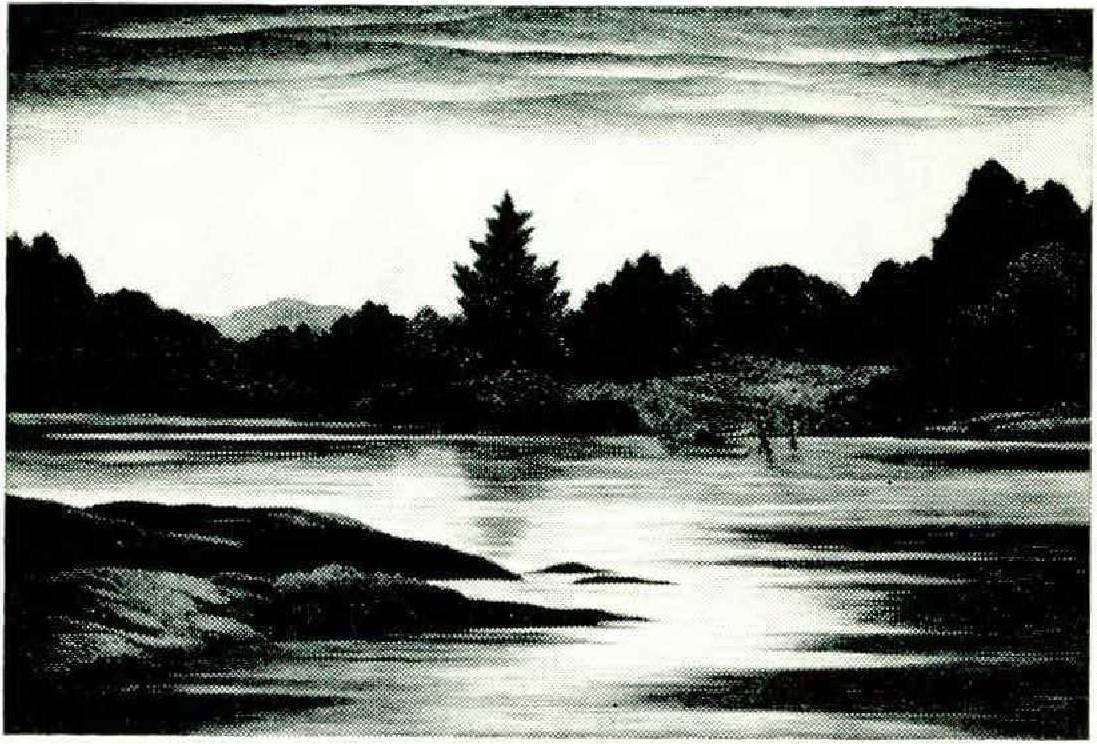
WE HAD gone up to the cabin for the weekend. March was always unreliable, and the winter had been bad, but for more than a week there had been a warm spell, and when we reached the cabin, late on a Friday afternoon, the ice which had edged the lakes on our last visit was gone, the sharp, wet smell of winter had left the air, the ground was soft, birds we had not heard in months were chirping away somewhere in the trees, and out on the water a fish jumped. Spring had not really and firmly begun, but winter was over, and when we woke the next morning the air was very warm and slow and slightly hazy, as though we had skipped a season overnight and were now in mid-July.
After breakfast, wearing only our shorts on this extraordinary March morning, my father and I went outside and began to work around the cabin, doing the little things that always needed to be done at the end of every winter — there were screens to be replaced, shingles had blown off, paint had flaked away in spots, and a squirrel had started a hole in the back wall near the fireplace. My mother, who always cleaned the cabin each time we came up as it no one had been here for years, stayed inside, and with Tom as an unreliable and occasionally disappearing helper, opened windows, aired bedding, and swept dirt that I could not even see off the floor. When she began her cleaning she usually stayed with it until she finished, but this morning she surprised us by suddenly joining us in the yard. More surprising still, she was wearing her bathing suit.
“Ha!” my father said. “Who’s rushing the season? Don’t let that sun fool you: the last thing in those lakes was an iceberg.”
“I’m having spring fever,” my mother said, “for the first time in years. It’s all so beautiful I’m taking time off. No swimming; just the canoe.
The first ride of the year. Want to come?”
“All right,” my father said. He began to get up — he had been plugging the squirrel hole — but then he stopped and said, “On second thought, no. I’d better wait for this stuff to dry. Otherwise I’ll have to start all over again. Take Jackie with you: he’s a good man in a canoe.”
But I was my father’s helper; loyally I said, “I want to see this stuff dry, too.”
I can go,” Tom said. He was now six years old, a round-headed little boy who came up to my shoulder, with blond hair so light it was almost white, and gray-green eyes just like my mother’s. for a long time now I had been making bets—sometimes with Arthur, but mostly with myself
— that whenever people would come to our house and meet Tom and me for the first time, they would always say that Tom was the image of my mother, just as they would say that I was the image of my father. Tom had been wandering in the woods on the other side of the cabin, and when he came walking toward us now he held in his hand a very small box turtle. “Look what I found,” he said. “I could take it in the canoe.”
He went over to my mother, who put her hand lightly on his head and mussed his hair a bit. “Good for you, Tommy,” she said. “That gives me one customer. That’s all, is it? Just the one?”
And a turtle,” my father said. “Don’t forget that. And look: don’t be too long, will you? I’d like to drive in to the village sometime before noon.”
My mother had already started for the lake, with Tom at her side. As they went around the corner of the cabin Tom turned and held up his turtle to show me once more, and my mother, with a little wave of her hand, called back, “We may surprise you: we may never come back!”
And as she called this out to us, her voice was light and very gay. It was almost as if she were singing.
We were working away about ten minutes later when my father paused and said, “Wait: listen. Did you hear anything?”
We both listened; we both heard a shout. My father jumped up and ran down to the point; I followed as fast as I could. We looked out on the east lake, which was the one my mother liked best, and there, some distance out and closer to the far shore than to us, we saw the dark-green canoe. We could see it very clearly. It was floating upright, and it was empty. Of my mother and Tom there was no sight at all. My father called my mother’s name three times, very loudly; there was no answer. There was no sound of any kind: I don’t think that at that moment we even heard a bird. We simply stood there in the complete stillness of the beautiful morning: I, not yet realizing just what had happened, and my father, who must have realized it from the very first shout.
Suddenly my father went “Aaaggghh!” It wasn’t a call, it wasn’t a shout to my mother, it wasn’t anything, just a loud and terrible sound. Then without even looking at me or asking me to follow him — but I did anyway — he spun around and ran for the little boathouse, about fifty yards away on the shore of the lake. Here there was a small rowboat and a blue canoe, neither of which had been used since last year; my father began to tug at the rowboat and pulled it into the water. Still without looking at me, with his eyes out on the lake, he said, “Hurry up, get in. Take this can: you’ll have to bail. This thing can’t be tight. Hurry up, hurry up, come on!”
So I jumped in, and by now I was frightened.
I had never heard my father like this before, I had never seen him look like this before, and now at last I knew what must have happened. My father began to row very fast, and water began to seep into the boat through the seams — not much, but I had to bail. We moved out over the water, the spray from the oars sometimes hitting me in the face, and as I felt the icy drops I knew how cold the water really was. I thought of my mother and Tom in that water, and suddenly I began to cry. At first my father paid no attention to this, merely keeping on with his rowing and looking constantly over his shoulder at our target: the dark-green canoe, which continued to float and swing gently about, not moving much in the still morning air.
I continued to bail and also to cry, and my father continued to pay no attention, but at one point he looked up from his rowing and stared at me with such a strange expression that for a moment I was sure he was terribly angry with me. But he was not, it must have been something else, for he closed his eyes tight, then opened them and said in a quiet voice, “Don’t cry, Jackie. Don’t cry. It’ll be all right. You’ll see. We’ll both see. It’ll be all right.” After this he seemed to row faster than before, breathing quite hard now, and still looking back over his shoulder at the canoe as if he were afraid it would go away before we reached it.
I DON’T know how long it took us to get there: probably no more than a few minutes, but it seemed a very long time. We came alongside, and my father reached over and grabbed the canoe, pulling it right up against us, and there, on its floor, we saw the pale blue kerchief that my mother had worn around her head, and we saw also, carefully crawling its way across the varnished ribs, Tom’s turtle. So the canoe had not turned over; we knew that much. My father stood up in the boat; I started to do the same, but he said, quickly and harshly, “Sit down! And stay down! Don’t move until I tell you to!” I sat at once and began to look over the side of the boat, more frightened than ever by the thought of what we were looking for and what I might have to see. The water was dark but quite clear, and although it must have been several feet over my head, I could see to the bottom, but I could see nothing except sand and dark patches of leaves and weeds and a couple of large smooth shapes which I knew were rocks.
My father now knelt in the bow, his head bent forward as if he were trying to reach down through the water with his eyes. Straining to see, he was so close to the water that he seemed to be mostly out of the boat, and suddenly I had the terrible feeling that at any moment he might topple overboard and get lost, like my mother and Tom, and in that case what would become of me? It was a thought that filled me with panic, but I didn’t dare to say a word, and after no more than a few seconds my father straightened up, and without taking his eyes from the water, reached around behind him and grabbed one of the oars. Using it as a paddle, he began to send us forward quickly but not too quickly, dipping the oar each time very carefully so that it made no ripples to interfere with our seeing. We went in straight toward the shore, then came back out; we zigzagged; we swung around in a big circle, then came back to the center in smaller circles. We covered all the nearby water, with my father kneeling in the bow and with me seated on a thwart in the stern; we saw nothing. Once I asked my father a question, but he gave no sign of having heard me. He continued to paddle, never missing a stroke, and as I sat there behind him, seeing only the blank and silent surface of his slim, strong, freshly sunburned back, my own hope died away, I knew at last that my mother and Tom were gone for good, and I began to cry again, but this time to myself.
My father was paddling faster now, taking less care not to disturb the water, but this did not matter much anymore, for while we had been looking a wind had come up out of the north. It was a cold wind, the kind of wind that brings clouds, and these were scattered all over the sky, huge and gray, all rushing together to block out the sun. The still lake was now fairly rough, the boat began to bump along, and while we continued to search, I realized all at once that with the choppy water and the loss of sunlight I could no longer see the bottom — I could barely see to any depth at all. My father could have been no better off, for suddenly he jumped to his feet, threw the oar down on the floor of the boat, and stood looking all around him, out over all the lake, and back into the boat and right at me, but looking at me in such a different way that I wasn’t even sure he saw me. Then, without a word, he dived over the side and disappeared in the cold dark tossing water!
I screamed at him, but I don’t think he heard me. I stood up, still screaming and at the same time crying, for I was terrified now: too much had happened that I did not understand, and I had no idea what was going to happen next. Then, just as suddenly as he had gone, my father was back, pulling himself over the side, standing, breathing deeply, and diving over the side again. I looked over after him, saw him swim down and out of sight, and knew now that he was not leaving me or swimming away: he was going down to the bottom himself to try to find my mother and Tom.
This knowledge was of no help, however, because for the first time it had occurred to me that I was going to drown. The wind had become stronger and the water rougher; the boat was rocking badly, and except for my father’s frantic reappearances, I was alone: I was certain that within the next few minutes the boat would capsize and I would be dumped into the freezing water and would never come up again. Meanwhile, my father kept on diving from the boat and a minute or so later scrambling back in —clearly not in answer to my screams, for each time he came back he said nothing to me and didn’t even seem to know I was there. The pattern was always the same: my father throwing himself over the side, the splash as he entered the water, my screams, my father bobbing up on the other side and then pulling himself in, waving me away, almost pushing me away if I tried to help. Each time he climbed in, the boat tipped more dangerously than before, and twice I slipped and fell to the floor, sprawling out on my back in water which had leaked through the seams or come in over the sides, while my father stood over me, ignoring me, and breathing in and out noisily, filling his lungs before he hurled himself into the water again. It got worse and worse, and I remember screaming and crying and yelling “Dad! Dad!” whenever he came back in the boat, and thinking that at any moment now we would both go over and that would be the end of me. I was so frightened by my own danger that I could think of absolutely nothing else, and from the beginning to the end of this awful interval I completely forgot the reason, the terrible reason, for our being out on the lake in the first place. I did not once think of my mother or of Tom.
Then, at last, my father climbed into the boat once more, but slowly this time, and very carefully, as if it had only now occurred to him that he might tip the boat over. I had slipped and fallen again and was lying on the floor; my arm hurt where I had cracked it against one of the oars, and I was cold. My father stood over me, dripping water on me, just as before, but now he seemed more like himself, and instead of looking all around him in a wild way and breathing in and out in great harsh gasps, he just stood still, breathing deeply but quietly, his shorts soaking wet and torn by something — a nail in an underwater board, maybe, or a branch. All at once he said loudly, but mainly to himself, “Nothing. Nothing nothing nothing.”
At this I sniffled, and he looked down at me with a funny expression on his face; he said, “Jackie.”
“I’m cold,” I sobbed. “I’m freezing.”
“You’re freezing?” he said. And he said it almost with surprise, as if he didn’t even know that it was cold. Yet the wind was very strong now, there was no sun at all, the temperature must have been dropping all the time; like me he had on only his shorts, and he had been in the icy water. When I looked up at him for comfort I saw that he was shaking and that his skin was pinched and blue. I was shaking too, trembling all over: my teeth had started to chatter and I couldn’t stop them. My father looked down at me, and all at once he bent over and lifted me up and held me very close to him, hugging me against his cold, wet chest. He held me there for a few seconds, and I could feel him shivering. Then, very gently, he put me down in the stern, propping me up against a wet cushion.
“All right, Jackie,” he said. “We’re going in now.”
AND SO we went in, with my father rowing as hard as he could, and being helped by the wind which was blowing strong behind us. It must have been a fast trip; it seemed very slow. There were little whitecaps on the water now, the sky was completely covered with low thick dull-gray clouds, and it had begun to feel like snow. The beautiful March morning had gone in an hour, and I was so cold I ached. I was still shaking, I kept rubbing my arms and legs, and every second the cold seemed to get worse: great layers of it that passed right through me, freezing the inside of my bones. I could think of nothing but this cold, the warm cabin seemed a very long distance away, and I wondered miserably whether I would be frozen to death in the boat before we reached the shore.
My father spoke only once, and that was when he stopped rowing for a moment and looked across at me as if he had just hurt me. “Jackie,” he said. “Jackie, I . . . good God forgive me, I don’t know what to say to you!”
I said, lying bravely, “It’s all right. I’m not so cold anymore.”
But he just looked at me with the same look and said nothing to this; he went on with his rowing. It didn’t dawn on me that he hadn’t been talking about the cold at all.
When we got to the shore my father leaped from the boat, picked me up, and carried me to the cabin, running all the way. He ripped my shorts off and with a heavy, rough bath towel began to rub me dry. He rubbed so hard it hurt, and then he dried off, too, and we both put on heavy winter clothes. All this time he was silent; finally he looked at me and said, “You ought to be in bed, but I . . . come on,” and we ran out and got into the car and drove to the village.
Here, while I sat in the car, warm and safe now, my father hurried about, gathering people together, pulling them along with him: the priest, the doctor, the man with no jaw who ran the gas station. I watched all this, and as I watched, the odd and awful thing was that I couldn’t feel what I should have felt at all. By now I understood everything that had happened, I knew just what my father was doing and what he was going to do, but it was as if a part of me — an important part of me — had not been able to catch up with what the rest of me knew. What I felt was mainly suspense, a kind of excitement: I was like a spectator at some game which was interesting but with which I had no great personal connection. As yet I had not begun to feel anything more than the faintest trembling beginnings of what I was to feel so devastatingly, and for the first time in my life, later in the day.
My father jumped into the car, bringing some of the men with him, and we drove back to the cabin, more men following us in two trucks loaded with some kind of equipment. When we reached the cabin my father took me inside; he built up the fire and told me to stay in front of it until he came back. 1 hen he went off to the lake with the other men.
I STAYED in the cabin all afternoon. Most of the time I was alone, and most of the time, as my father had directed, I stayed in the main room near the fireplace. Obedience was easy; there was really no place else to go. Once I went outside, into the clearing in front of the cabin, but the weather was worse now, a cold drizzle had begun to fall, and when I peered through the mist across the lake all I could see was men in boats over near the far shore where my father and I had been. And inside, beyond the main room, there were only the two bedrooms. I went into mine briefly. It was just as it had been when we got up that morning: Tom’s pajamas were still on the bed, and his lopsided fort, which he had made out of pillows and blankets, was still standing. I left the room quickly and did not go back. Later, reluctantly, but somehow feeling that I ought to, maybe even that I had to, I went into the other bedroom. The first thing I saw, directly opposite the door and hanging over the back of a chair in front of my mother’s dressing table, was a bathing suit — one she must have taken out, then decided not to wear; in that moment it looked to me exactly like the one she had worn. On the table was a scattering of her things — combs, brushes, little white jars of face cream, a slim gold bottle of the perfume which she liked best and which my father, for some reason, always called “One Night in the Alps” — and on the edge of the mirror, stuck in under the frame, was the birthday card from me. It was the first card I had ever sent her, long ago, before Tom was born, and I remember that my father had guided my hand while underneath the printed greeting I wrote a message of my own: “Dear Mom I love you and hope you have a very good birthday. Your son Jackie.”
And so I left this room quickly too. I sat by the fireplace and wished my father would come back.
I started to read a book, I pushed around the pieces of a huge family jigsaw puzzle called “Big Game of North America,” I picked up a pack of cards and began to scale them, one by one, across the room. I did all these things halfheartedly, in fact without any interest at all, because by now I had begun to feel quite different: uneasy, very strange.
Here by myself in the silent cabin where I had never been alone before, where nothing I touched or even looked at was all mine but was a part of my father and mother and Tom as well, where into my head now came not vague and passing thoughts but a sudden succession of hard and marvelously clear pictures of things we had all done together and could never do again — here, now, I felt as if something had begun a slow incessant twisting inside me, like a key which was winding me up, turning and turning and turning, tightening me more every second, and this was all so real that all at once the tension shot me out of my chair and I sprang to my feet, stiff and trembling a little and waiting apprehensively for the one final twist that would surely be unbearable. But suddenly it stopped, the tautness let go completely, and when it did it seemed that everything that was in me, even my breath, left me in a single great gushing rush, and I stood there boneless and helpless and absolutely empty. And it was in this desperate, desolate, total way that the death of my mother and my brother came home to me at last, and in this awful, cataclysmic misery I thought my heart would really break.
Strangely, I did not cry. I sat back in the chair once more, very lonely, and full of a great dull swelling ache. After a while — it might have been minutes, it might have been an hour — my father came back. He came into the cabin alone, he came over to me and hugged me hard again, and then, quietly but very quickly, he told me that a few minutes ago they had found my mother and Tom. And when I heard this it was just as if I had been expecting to hear it, and it made no difference: it just landed in the empty ache, and I didn’t feel any worse because, I suppose, I couldn’t feel at all. Then the priest came in and took my hand and patted it a few times.
“A brave li’l boys like you,” he said, “he don’ wan’ to cry, eh? You know what for? Because dat brave li’l boys, he know his mama and his brudder, dey’re wit’ de angels now!”
His name was Father LaPlante; he was a FrenchCanadian priest who sometimes in the pulpit on Sunday talked English, but most often did not. Everybody else came in then, and some of them said things to me and some of them just looked, but in a little while everyone went away, and they took my mother and Tom with them. I asked my father if I could see them before they went, but he said it would be better a little later.
And so my father and I were alone in the cabin again, but not for long. He went into his bedroom, and I heard him moving about; when I looked in I saw him putting some of my mother’s things into a suitcase. After this he came out and took me by the hand, just as if I were a baby, and led me out to the car. It was dark, and the cold drizzle had changed to a light and lazy snow. We drove off, and as we took the first turn on the dirt road I looked back through the slow flakes at the cabin, and I saw that my father had not even closed the door.
I never saw the cabin again.
WE DROVE toward the city: a long, silent, immensely sad drive. To my surprise we did not go home; instead, about twenty miles from the city, we left the main road and turned into a small seaside town and stopped in front of an old hotel. My father said simply, “We’re going to stay here. Just for tonight.”
I had never been in a hotel before, but I knew that this was not a very good one. At the desk downstairs a thin tired-looking man with watery eyes watched my father sign a big book; over his head was a card which said “PEOPLE may come and PEOPLE may go, but the BULL in this place goes on forever!” Upstairs, our room was big and dark and smelled of the sea. There was a wide brass bed, everything was old but looked clean, and on the floor, underneath one of the windows and attached to the foot of the radiator, was a coil of thick rope with big knots in it. Above the rope was a sign in big red letters reading “IN CASE OF FIRE.”
It was late, I hadn’t eaten since morning, but I wasn’t hungry at all; my father said it was time to go to bed. I undressed and knelt by the bed and said my prayers, and I think that this was the worst part of all. For the prayers for the dead were familiar to me, I had said them every night since I had begun to pray, but they had never been in any sense personal prayers: no one I knew had ever died. Suddenly I was saying them for my own mother and for Tom, and even now I found this impossible to believe, though I knew it was agonizingly, shatteringly true.
Finally I got into bed, and after a minute my father got in too. We lay there in the dark and the silence. There were no night noises from the streets of the town; the only outside sound was from the sea: a dull and regular thudding as the surf broke down on the hard shore. There was a thud, then silence, then another thud, then more silence, and in between I could hear only the beating of my heart, which seemed to me very loud and very fast. My father said nothing. He was lying on his back, looking straight up at the ceiling. Suddenly I felt his hand touch mine, then take it and hold it, very lightly and tenderly, and when this happened something seemed to turn completely over inside me, and I twisted around in bed and flung myself up against my father, clinging to him desperately, and as he quickly put his arms around me and held me, I cried for the first time since my father had told me that my mother and Tom had been found.
I cried and kept crying: very hard, and for a very long time. My father just held me, not saying anything, not trying to comfort me with words, and when at last I stopped — or at least gave signs of stopping — he still held me, but he began to talk, and to talk only about my mother. He went back to the beginning: he told me about how he had met her, how she had looked on the stage, where they had been married, and who had married them — the bishop had been at the reception, my mother had been thrilled by the telegram of congratulations from the President, my mother had been terrified when my Uncle Jimmy (at the time, my father explained, a drinking man) had first threatened to punch the governor of the state in the nose, and then in fact had done so. My father told me about their life together before I was born and afterward, of their trips and travels, of the wonders they had seen and the love they had shared. He talked and talked about my mother, and he seemed not to be able to stop talking, and I listened, hanging on every word, just as I had always listened to his stories at night in the cabin, and then, imperceptibly, I began to grow drowsy, and finally — again, just as I had done so often in the cabin — I simply collapsed into sleep with his words still sounding in my ears.
At one point during the night I woke and realized with sudden fright that my father was no longer in bed with me. But then I saw him: he was on the far side of the room, but I could see him clearly. The weather must have broken, for there was a moon, and in its pale light I could see that my father had thrown open the window wide and was in front of it, not standing but kneeling, motionless, his hands joined, and looking out into the still, dark, windless night. I watched him for a moment, and then I must have fallen asleep again, for the next time I saw him he was back in bed and it was morning.
We left the hotel and went home. Ellen and Arthur were waiting for us: Ellen was weeping, Arthur was pale and very quiet. Later in the day my mother and Tom were brought home, and I saw them at last. During the next two days, until the morning of the funeral, I saw them often. Sometimes I was by myself with them, sometimes I was with a crowd of people who came to the wake. On the third morning we all went to the church and from there to the cemetery, and at last it was over, and I knew that from now on I would see them only in my memory.
One week later, my father took me to Ireland.