The Night at Longjumeau
We really saw very little of Longjumeau. It was late dusk on a raw November afternoon when we arrived. We left in haste at dawn the next morning amid fog and rain. It was neither the community nor the season for the sightseer, and I am not quite sure today whether the place was— back in 1925 — an industrial suburb of Paris or simply a residential slum area. My wife and I reached Longjumeau after some months of viewing France by motorcycle and sidecar. I had been careful when I bought the outfit to specify magneto ignition, and our muscular red seventy-four-cubic-inch Indian used its battery and generator only for lights. All had gone dependably, if noisily, until about the halfway mark in our travels, when the lights suddenly conked out just as we were rolling, northbound, into the town of Digne. The potholes of the French roads had caused the battery, neatly cased in front of the unsprung rear wheel, to develop a fatal split. No new battery was to be had, so that we were obliged to be off the road thereafter before darkness, until we were back in New York again.
So it was that we had to stop at the first inn we came upon in Longjumeau, instead of at Versailles as we had hoped. Some hundreds of inns and restaurants had rewarded us so agreeably, and with so much variety, that we were accustomed to sitting down fearlessly at any dinner table. We never made reservations; we used the Guide on occasion or experimented freehand, and our travels had instilled in us only one rule: the best meals arc not to the latecomer. There seemed no reason why Longjumeau, in the dark, would not serve us well.
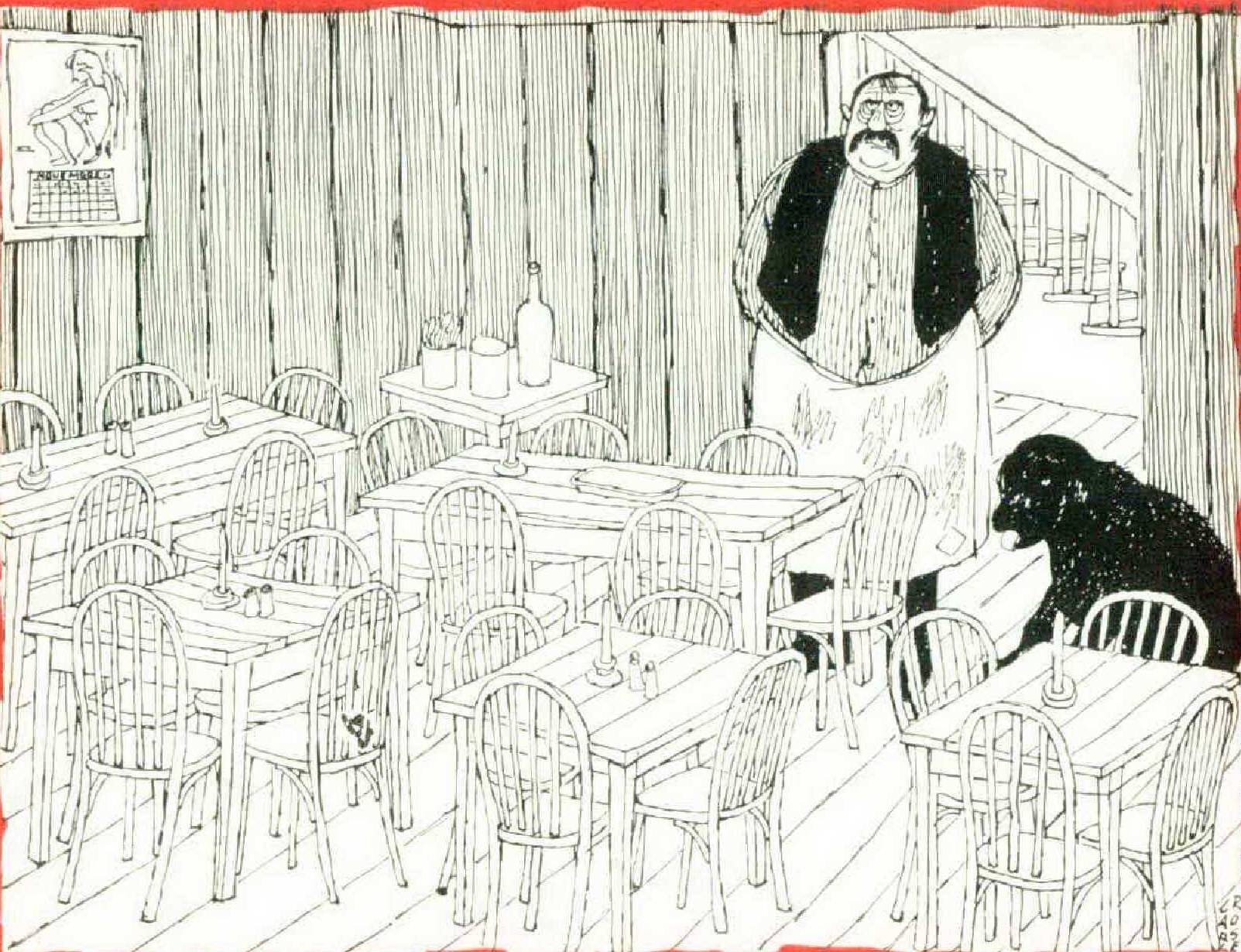
The proprietor of the inn showed us to a kind of abandoned stall with a door that locked, at the rear of the building, where we left the moto. In the rather sepulchrally dim light of the inn’s large public room, he proved to be a vast, paunchy figure, a grudging host, and not at all eager for our custom. He was wearing a neckband shirt with a collar button and no collar or tie, and a much dirtier apron. The inn itself, we realized, was just as dirty as he was, but it was good to be off the road on this chilly day.
Our bedroom, lighted by a single unshaded bulb, had an air of long disuse. It was damp and musty. We would wash up and descend quickly we agreed, for even the room downstairs was less gloomy than this.
I picked up the big china water pitcher and began to tip its contents into the bowl. Contents in the plural is perhaps the right term; what poured forth, in addition to the fluid, was an astonishing set of festoons of a spaghettilike substance, unidentifiable lumps, and bits of greenery. With it all came an overpowering odor, an odor so weighty that it had lain snugly with its sources in the pitcher and responded only to the pull of gravity in the tipping, like one of those heavier-than-air gases that goes down, amazingly, instead of up in elementary chemistry experiments.
The ingredients of a Nobel Prize in biology must have been multiplying themselves for years in the pitcher. I set pitcher and bowl in the corridor outside, opened the bedroom window, and we went down to the main room of the inn. It was about 5:30 P.M. If we had not washed, at least we were no grimier than the proprietor, who was slicing celery root into a large bowl. No one else was in the room.
By this time we had concluded that the inn did not ordinarily offer lodging and that it was more likely the meeting place of criminals. If we could get something to eat and back to the bedroom unscathed, I could wedge a chair under the doorknob for the rest of the night.
Over the next half hour we ate some of the celery root, disinfected, we hoped, by the fiery ordinaire which the proprietor set before us in a cloudy-looking carafe. We were ravenous, as always after a day of overcoming the French roads and weather. The bread and watery soup, which eventually came along, we tucked away so earnestly as to gain, with our intimations of approval, the first civil response from the proprietor.
By the table where the proprietor had been slicing the celery root lay his dog, a large black mongrel who might have had a fraction of Newfoundland somewhere in his lineage. Asleep and obviously not accustomed to expect anything from the inn’s diners, the dog was giving no heed to us or our meal, when his master removed our soup plates and set down the meat course.
I must digress briefly. Of all the dismal shops to be seen in France, the boucherie chevaline seemed to us outstanding. It was required by law so to identify itself, and a gilt horse’s head was usually conspicuous on its facade. Even the aggressively dead little birds, with their eyes so firmly closed, in big glass bowls of brine or whatever, that awaited the shopper in San Francisco’s Grant Avenue groceries, were no less capable of dulling the appetite. A scrutiny of any boucherie chevaline was unforgettable: alarming-looking wares hung outside, and the merchandise inside, separated from flies and the dust ol the street only by iron bars — all fully unrefrigerated.
We return to Longjumeau. The meat course was plainly horse: for each of us a thick, black slab, coarsegrained, tough and defying the knife, but yielding just enough to disclose a purplish and virtually uncooked interior.
We busied ourselves with the fried potatoes as the proprietor went back to the kitchen. My wife tapped the meat with her fork, whispered the question, “Horse?” I gave one of those peut-être shrugs and grimaces. She managed to attract the attention of the dog by throwing a crust at him.
The dog sat up, lazily, just as my wife tossed her portion of meat to him. It landed about two feet from the dog. His reaction was electric. He thrust forward his neck with the speed of a heron nailing a frog, and the meat vanished in a gulp. I tossed him my own meat, with the same result.
The proprietor, bringing us cheese and more bread a moment later, was pleased to find our plates empty. He became positively sunny, taking the circumstance, somehow, as a tribute to his cooking. We ordered more wine. When we left for our bedroom a short time later, the proprietor was treating us with real respect. We made no mention of washing water.
Our conclusion, on the road again, the next day, was that the inn at Longjumeau was not at all a den of thieves, for even thieves could fare more comfortably elsewhere, but rather that its proprietor was simply a loutish old ninny, who should have been in some other line of work. But I still wonder what would have happened had he kept a cat instead of that big, capacious dog.