The Ghastly Blank: The First Exploration of Australia
Author and war correspondent , ALAN MQOREHEAD was born in Australia , left for Europe at the age of twenty-tire , and has been traveling ever since. Of his war hooks he is best known for GALLTPOLI and his life of Montgomery, and of his travel books , THE WHITE NILE and THE BLUE NILE. The following excerpt is from his new volume , COOPER’S CREEK, to be published by Harper & Row.
HERE in Australia, perhaps more than anywhere else, humanity had had a chance to make a fresh start. The land was absolutely untouched and unknown, and except for the blacks, the most retarded people on earth, there was no sign of any previous civilization whatever: not a scrap of pottery, not a Chinese coin, not even the vestige of a Portuguese fort. Nothing in this strange country seemed to bear the slightest resemblance to the outside world; it was so primitive, so lacking in greenness, so silent, so old. This was not a measurable man-made antiquity, but an appearance of exhaustion and weariness in the land itself. The very leaves of the trees hung down dejectedly, and they were not so much evergreen as ever-gray, never entirely renewing themselves in the spring, never altogether falling in winter. It was the bark that fell; it dried up and cracked on the tree trunks and then peeled off, like the skin of a snake.
Everything was the wrong way about. Midwinter fell in July, and in January summer was at its height; in the bush there were giant birds that never flew and queer, antediluvian animals that hopped instead of walked or sal munching mutely in the trees. Even the constellations in the sky were upside down and seemed to belong to another system of the sun. As for the naked aborigines, they were caught in a timeless apathy in which nothing ever changed or progressed; they built no villages, they planted no crops, and except for a few fleabitten dogs, possessed no domestic animals of any kind. They hunted, they slept, just occasionally they decked themselves out for a tribal ceremony, but all the rest was a listless dreaming.
A kind of trance was in the air, a sense of awakening infinitely delayed. In the midsummer heat the land scarcely breathed, but the alien white man, walking among the gray and silent trees, would have the feeling that someone or something was waiting and listening. The smaller birds did not fly away as they did in Europe. The kookaburra approached, uttered its raucous guffaw, then cocked its head, waiting for a response. The kangaroo stood poised and watching. The earth itself had this same air of expectancy, as though it were willing the rain to fall, as though it were waiting for fertilization so that it could come to life again.
And in fact an awakening did occur in the southeastern corner of the continent when the first white settlers arrived in 1788. Somehow European crops were made to grow in land that had never been tilled before, and imported cattle, horses, and sheep managed to survive in a country where the farmer had no precedents to guide him. Every man was a Robinson Crusoe. A flood could and did wipe out a year’s labor in a single day, and when a drought began there was no knowing when it would ever end. Everything was new and had to be begun from the beginning.
But it was a healthy country. Along the coast at least there was a sparkle in the air, a sense of vigor, of light and space, that the colonists had never known in Europe. On the whole it was a mild climate by the sea — they had about as much rain as England, and the sun had no more than a Mediterranean warmth — and by 1860 places like Sydney, Melbourne, and Adelaide were flourishing settlements.
MELBOURNE, the capital of Victoria, was by some way the most important of these places; and this had happened with bewildering suddenness. Barely ten years earlier Victoria had been a remote pastoral backwater, an appendage of the older settlement of New South Wales, a place only known vaguely as the Port Phillip district. Most of the little colony’s affairs were managed from Sydney. No made roads or railways led off to the other Australian colonies, no telegraph existed, and twelve thousand miles of empty ocean divided the settlers from Europe. Apart from Melbourne and Geelong, there was not another township worth the name, and it is doubtful if the population of the whole region, which was about the size of England, exceeded eighty thousand.
But then in 1850 Queen Victoria had agreed that a new colony should be created south of the Murray River and that it should bear her name; and in the following year gold was found at Ballarat. Gold could create a mass frenzy anywhere — it had just done so in California — but in this little frontier community, where the struggle for existence had been so hard, people lost their wits. Bank clerks and civil servants left their jobs overnight to go off to the diggings, and not even the offer of double wages could hold them back. Ships putting into Port Melbourne were abandoned by their crews, and in the town itself women were left to carry on the shops and businesses. “Cottages,” Latrobe, the lieutenant governor, wrote, “are deserted, houses to let, business is at a standstill, and even schools are closed. In some suburbs not a man is left.” Prices shot up to impossible heights; an immigrant was obliged to pay £2 or more to get his luggage ashore and as much again for a corner of a hotel room to sleep in.
And the gold was actually there, at first near Ballarat, then in Castlemaine and Bendigo and in a dozen other new strikes along the inland rivers. Prospectors with nothing but a pick and shovel, a bag of flour and a little tea, spread out through the northeast, penetrating into hills and valleys that had never been explored; and it was enough for the word to go out that someone had “struck it lucky on the Ovens River” for a new rush to begin. The gold quite often was lying there on the surface of the ground waiting to be picked up; there were nuggets in the roots of trees, in upturned grass, in the sands of shallow rivers. The Welcome Stranger nugget, weighing 2284 ounces and worth £9534, was covered by only two incites of soil.
By 1853 a thousand ships were arriving in Melbourne every year, and money had begun to lose all value in a welter of speculation. Land in the city went for £200 a foot — five times the cost of land in London — and men made money only to spend it again as quickly as possible. After months of grinding work at the diggings it was a wonderful thing for a man to light his cigar with a five-pound note, to play skittles with bottles of French wine, or even in some cases to shoe his horse with golden horseshoes.
There had always been a shortage of women in Australia; at one stage of the early convict days a few hundred workhouse girls known as Green Linnets (so-called after a man named Green, who shipped them out) had been brought from England to provide wives for the settlers. Now prostitutes swarmed in the back-street hovels of Melbourne, and it was the delight of the newly rich miner to cock a snook at the respectable bourgeoisie by going through a mock marriage with one of the girls, dressing her up in the best brocades, and parading her in a carriage along Collins Street.
At first there had been prohibition in the colony, but now it was abandoned as a farce; illicit grogshops flourished everywhere, and when the miner had money, he drank himself into a stupor. Then, too, with the difficulty of recruiting police, and with so many government departments understaffed, the outburst of crime became a sinister and a menacing thing, and it was not merely the derringdo escapades of the bushrangers waylaying the gold coaches on their way down to the coast; it was the thieving, knifing, and murder in the Melbourne streets.
To the old guard of settlers — the woolgrowing squatters who had first taken up the land — all this seemed very like the mob taking over, a return in a small but depressing way to the lawless and egalitarian ideas of the French Revolution. It was, Dean Macartney wrote, “a time when the bonds of society were loosened, when most people had gone mad, and the rest paralysed by fear.”
Mr. D. Puseley, an itinerant author of strong respectability, speaks with horror of the Melbourne he found when he first arrived, and his experiences seem to be fairly typical. The city was, he says, “a modern Babel — a little hell on earth — a city of rioters, gamblers and drunkards. ... In 185253 speculation, crime, excitement and disorder in Victoria had probably attained their greatest height; the yield in gold and the price of land had touched their highest points up to that period; robbers and murderers commanded extensive trades which they prosecuted with impunity, and mostly without detection; land jobbers, many of whom were magistrates and the millionaires of the colony, made their thousands per diem, and were too much engaged on their profitable traffic to attend to the arrest or punishment of law-breakers; merchants and shopkeepers had too many additions to make on the profit side of their ledgers either to think of, or to care about anything else; swindlers and gamblers were reaping an abundant harvest.”
IT IS, of course, all too easy to make much of these lurid episodes and to forget that beneath the excitement a more normal, natural life was gradually growing up in the colony; farms were being quietly cultivated, houses were being built, and tradesmen who were strong enough to resist the gold fever were getting on with their business. In any case the lawlessness of the gold rush soon subsided, and the boom burst. It was not that the gold had failed; it was simply that all the surface alluvial had been picked up, and now gold had to be mined by machinery and in deep shafts. The individual prospector was replaced by the mining company employing hundreds or even thousands of workers at a fixed wage. Wool, and later wheat, were important industries, and many of the new immigrants were craftsmen with families, who found they could make a living without going as far as the goldfields. All this tended to stabilize prices.
By the late fifties a railway to Ballarat was being constructed and the more settled parts of the colony were being connected by a system of horse-drawn coaches organized by a young American called Cobb. Cobb’s coaches were soon to become familiar all over Australia, and his twenty-two-horse Leviathan on the goldfields run was a mammoth contraption capable of carrying nearly one hundred passengers. Soon, too, Melbourne was linked to both Adelaide and Sydney by telegraph, and fast clippers were making the voyage around the Cape from England in a little more than two months; the new canal at Suez would make the journey even shorter. Now rapidly the old isolation was melting away.
By 1860 Melbourne had a settled air. The city had been sensibly laid out on the banks of the Yarra River, with wide, straight streets lit by gaslight, and already there was a university, a public library, a Parliament House, a chain of trading banks, and public gardens filled with imported trees. At the Royal Theatre, which seated four thousand, one paid twelve guineas for a box when Catherine Hayes, the reigning prima donna, was singing, and there were half a dozen other theaters presenting Shakespeare, Sheridan, and vaudeville — a great change from the days when the theater was merely an annex to the pub and no respectable woman could go there. The Cremorne Gardens (a model of Vauxhall in London) provided another theater, waxworks, a dance hall, a menagerie, and such entertainments as brass bands, balloon ascents, and displays of fireworks. Horse racing had a mass following, and the Melbourne Cup was about to be run for the first time. When an important game of cricket was being played at the Melbourne Cricket Ground, Parliament suspended its sittings until the evening.
There was a craze for dancing the quadrille, the polka, and the waltz, and thousands of guests attended the balls in the newly built Exhibition Building. These were the well-to-do people, who came in their own carriages, the women in crinolines, the men wearing top hats and muttonchop whiskers. By day, we are told — and it is confirmed by many charming prints and watercolors — the central streets were filled with a constant passage of private gigs, carriages, and horse-drawn omnibuses; and there was a railway to St. Kilda, where one could put up at a good hotel and visit the seabathing establishments (one for men and another for women). In the fashionable suburbs many large, square Victorian mansions and pleasant villas had been built with their gardens running down to boathouses and gazebos on the river.
Life for the rich then was a good deal more expansive than it is now. A normal household would expect to have its three Irish maids, a cook, a coachman, and a gardener; silver, furniture, and hangings were all brought from abroad (to add to the kangaroo mats on the floor and the ornamental fans made of lyrebird tails); and Australian refinements were added to the lavish Victorian cuisine: black swan roasted and served with a port-wine sauce was a favorite dish. Picnics known as bushing-parties were very popular, and on a hot summer afternoon people would set off in boats up the Yarra to see the wallabies and the birds, to eat a meal of cold collations, and then sing glees as they drifted downstream in the evening.
The squatters in the bush were hardly less welloff. Their homesteads were comfortable places with wide verandas, mosquito nets in the bedrooms, and even bathrooms with hot water. There was an abundance of food for all comers, and a man’s normal breakfast was a pound of steak, perhaps with an egg on top. When Anthony Trollope came out to visit his sheep-farming son in the seventies, he fixed the social status of the squatters thus: “A hundred thousand sheep and upwards require a professional man-cook and a butler to look after them; twenty thousand is the lowest number that renders napkins at dinner imperative. Ten thousand require absolute plenty, plenty in meat, tea in plenty, brandy and water, colonial dishes in plenty, but do not expect champagne, sherry or made dishes.”
Among the rich and the middle classes, who were now arriving in increasing numbers, the standard of literacy was very high, probably higher than it was in England. Approximately one third of Britain’s book exports were sent to Australia, and every incoming mail brought large quantities of English newspapers and periodicals. By now, too, the colony had its own publications: the Age, the Argus, the Herald, and the Melbourne Punch.
It was true that the more squalid aspects of life were painfully apparent. There were at least one hundred brothels and five hundred prostitutes in Melbourne, and drunkenness was as prevalent as the common cold. Beggars had begun to appear on the streets, and the workingman was still a long way from the achievement of the eight-hour day. For a man to lose his job was a disastrous thing. But this was not poverty as it was known in Britain, where there were still a million paupers. Food, especially meat, was cheap, and in this mild climate there was no great struggle to keep warm through the winter months. Moreover, the change from poverty to security or even wealth could be very rapid, and the immigrant had much better prospects than he could ever have hoped for at home. Even the Chinese immigrants drifting down from the goldfields found that they could make a living by cultivating vegetable gardens, by opening laundries, and by catching and salting fish on St. Kilda beach.
And so by 1860 the Victorians felt that they had good reason to be confident. In ten years they had risen from being the newest and smallest colony on the mainland to a position of wealth and importance that far eclipsed that of all the others. In wool the colony supplied one sixth of Britain’s imports, and in gold one third of the world’s production: indeed, it had been so great a flood of gold that all the world’s economy was affected, and Marx and Engels, who had predicted a disastrous slump in Europe, found their program seriously delayed.
THE state’s population had increased to half a million — about half the white population of the whole continent — and Melbourne with its 140,000 inhabitants was a much more substantial place than the older settlement of Sydney. Moreover, in these tumultuous ten years a new kind of man had emerged. Apart from the minorities — 34,000 Chinese, 10,000 Germans, and 2500 Americans — the Victorians were overwhelmingly of English, Irish, and Scottish extraction, and although they were still intensely influenced by British customs and traditions, their new life had altered them both physically and mentally. They no longer thought of themselves as English. Irish, or Scots, but simply as Australians. Class distinctions were breaking down, and a self-reliant, slightly truculent attitude was beginning to appear.
This new man was a materialist, a speculator, a mocker of authority, and very often a sentimentalist. He had a certain volonté, an instinct to “give it a go,” to take a risk; but despite, or perhaps because of his professed contempt for tradition, he was deeply conscious of being a provincial, and he tried to conceal this inner feeling of cultural inferiority by an outward show of aggression. The harshness of existence in a new country, with its sudden drastic setbacks and failures, convinced him that life was an implacable struggle: he felt himself very much in competition both with the land and with his contemporaries. It was every man for himself. Consequently, when he did find a mate, a “cobber,” a man he could trust, he romanticized the attachment and trusted him absolutely. Victoria had never been a penal colony as New South Wales and Tasmania had been; nevertheless, some of these attitudes may have been a survival from the convict days when the prisoner, the underdog, the outcast, naturally sought allies from among the other outcasts in his war against the warders and against the society that had shut him in. One of the fascinating things about Australia is this sense of claustrophobia in the midst of such an infinity of space.
There was, too, the question of what this new man was doing to the country he had seized and adopted. For the blacks he had a mixture of fear and contempt. He was not interested in their way of life or their tribal customs; he did not particularly care what became of them; he did not grant them any rights in their own country; he treated them almost as animals. By 1860 the blacks had all but been driven away from the vicinity of Melbourne and the larger towns, and not more than a few thousand of them were left in the whole state. They had little resistance to smallpox and other imported diseases.
In the same way, Australian wildlife was being banished and exterminated. Already in a day’s outing from Melbourne it was becoming a rare thing to see a kangaroo, and of the many thousands of koala bears living along the banks of the Murray River soon not a single specimen would be left alive. Charles Darwin, returning home from the voyage of the Beagle, wrote of Australia: “A few years since this country abounded in wild animals; now the Emu is banished to a long distance and the Kangaroo is become scarce; to both the English Greyhound is utterly destructive; it may be long before these animals are altogether exterminated, but their doom is fixed.”
In short, the land was wanted for agriculture and that ominous inflationary thing, development; this was the era of sheep, the imported rabbit, and the mason and the miner. After countless millions of years of utter isolation the sudden fate of Australia and its aborigines was now to be used, to be exploited, to be forced to conform to an alien civilization.
THERE was nothing particularly new in all this: it had already happened or was about to happen in America, in Africa, and in every other primitive country into which white men were penetrating all over the globe. But what was new in Australia in 1860 was the fact that the settlers had as yet failed to take possession of or even explore the land they were so confidently governing. They perched on the extreme southern and eastern edges of it. The settlements of Sydney, Melbourne, Adelaide, and Brisbane, with their satellite townships, were no more than tiny specks on a continent the size of the United States, two thirds the size of Europe. For all the broughams bowling down Collins Street, the ladies in crinolines, and the champagne being drunk at the balls in the Exhibition Hall, the settlers were living in a little capsule, encompassed by a huge unknown wilderness; they were suspended, as it were, in space. If they stepped outside the capsule they were lost.
The coastline of the continent had been charted from the sea, but as yet very few adventurers had penetrated far into the interior. All that was known was that the further one advanced into that vast, empty space the hotter and drier it became, and it was perhaps because of this aridity that the colonists dreamed that one day they would discover an inland sea, a “new Mediterranean.” in the center of the continent. It was like the legendary Atlantis or the land of Prester John; the more serious geographers scouted the idea, yet it had the persistence of a mystery. After all, no one had actually been in the center, no one could say with finality exactly what there was to be found there, and the fact that half a dozen expeditions had already set out to resolve the matter and had returned defeated seemed, irrationally, to suggest that some great prize was awaiting the first explorer who succeeded in breaking through.
There is a good deal about these early journeys that reminds one of the rediscovery of the Sahara in the nineteenth century. Here in Australia, as in Africa, the travelers speak of the dry, antiseptic air, the cold nights, the incredibly high temperatures by day, the dreadful thirst, the mirages, the impression of empty land stretching away silently into infinity. Human beings are reduced to tiny atoms in these desolate wastes; cyclonic thunderstorms burst upon them out of a clear sky, and there is no shade or shelter anywhere.
And yet, the explorers profess to love the desert: they find a kind of exhilaration there, a sense of freedom, of physical cleanliness, perhaps even a spiritual regeneration, and no matter how they are reduced by their hardships, they return again and again. Every traveler likes to relate his misfortunes, but these men elevate their trials almost into a mystique, a cult of barrenness and asceticism. Warburton, the Australian explorer who penetrated into the flat depression around Lake Eyre to the north of Adelaide, might easily have been describing the Sahara when he wrote: “Take Eyre was dry — terrible in its death-like stillness and sterility. The weary wanderer who. when in want of water, should unexpectedly reach its shores, might turn away with a shudder from the scene which shut out all hope — he could hide his head in the sandhills, and meet his fate with calmness and resignation, but to set his foot on Lake Eyre would be like cutting himself off from the common lot of human beings. I had a cheerful companion, a good horse, and some tea and damper [bread made of flour, salt, and water and baked in the ashes of a fire]; but I felt a dismal satisfaction in looking on this lake, hardly knowing whether I saw before me earth, water or sky; and I could not help thinking what might have been my feelings had my circumstances been less happy than they were.”
Griffith Taylor, the Australian geographer who quotes this passage, was struck by the similarity of the Sahara to the interior of Australia. He makes the point that just as the Sahara blocked emigration from Europe into Central Africa, so this wilderness protected Australia from penetration by the peoples of Southeast Asia. He goes on to speak of the resemblance between the Murray, Australia’s largest river, and the Nile, pointing out that the Murray rises in a well-watered region with many tributaries on its upper course and then gradually enters a barren area where it receives only one tributary — the Darling — in a distance of eight hundred miles.
The notion of an inland sea arose from the fact that the mountains so far discovered lay on the eastern seaboard, and all the principal rivers — the Murray, the Darling, and the Murrumbidgee — flowed inland from these mountains toward the west; and in the west lay the tremendous unexplored tract, a region some sixteen hundred miles long by eight hundred miles wide, bounded by 20 and 32 degrees latitude and 115 and 140 degrees longitude — an area more than half the size of Europe. This was “the ghastly blank.”
A good deal was already known about the interior, of course, through the travels of the early explorers, and one man in particular had shown the way ahead. Charles Sturt is something of a giant in Australian exploration — and, indeed, of exploration anywhere — and it is strange that his name is not better known, since he was the most literate of travelers, the most persistent, and the most adventurous. Like so many other remarkable Englishmen of the nineteenth century, Sturt was born in India and at an early age sent back to England to be educated, first at Harrow and then in the Army. By 1814, when he was nineteen, he had already served with Wellington against the French in the Peninsular War, and with the British in Canada against the Americans. After Waterloo he returned to garrison duty in France, and when his regiment was transferred to Ireland he was involved in the famine riots of 1821 and 1822. In 1823 he was gazetted a lieutenant, and two years later a captain. He was then sent out to New South Wales in charge of a convict guard.
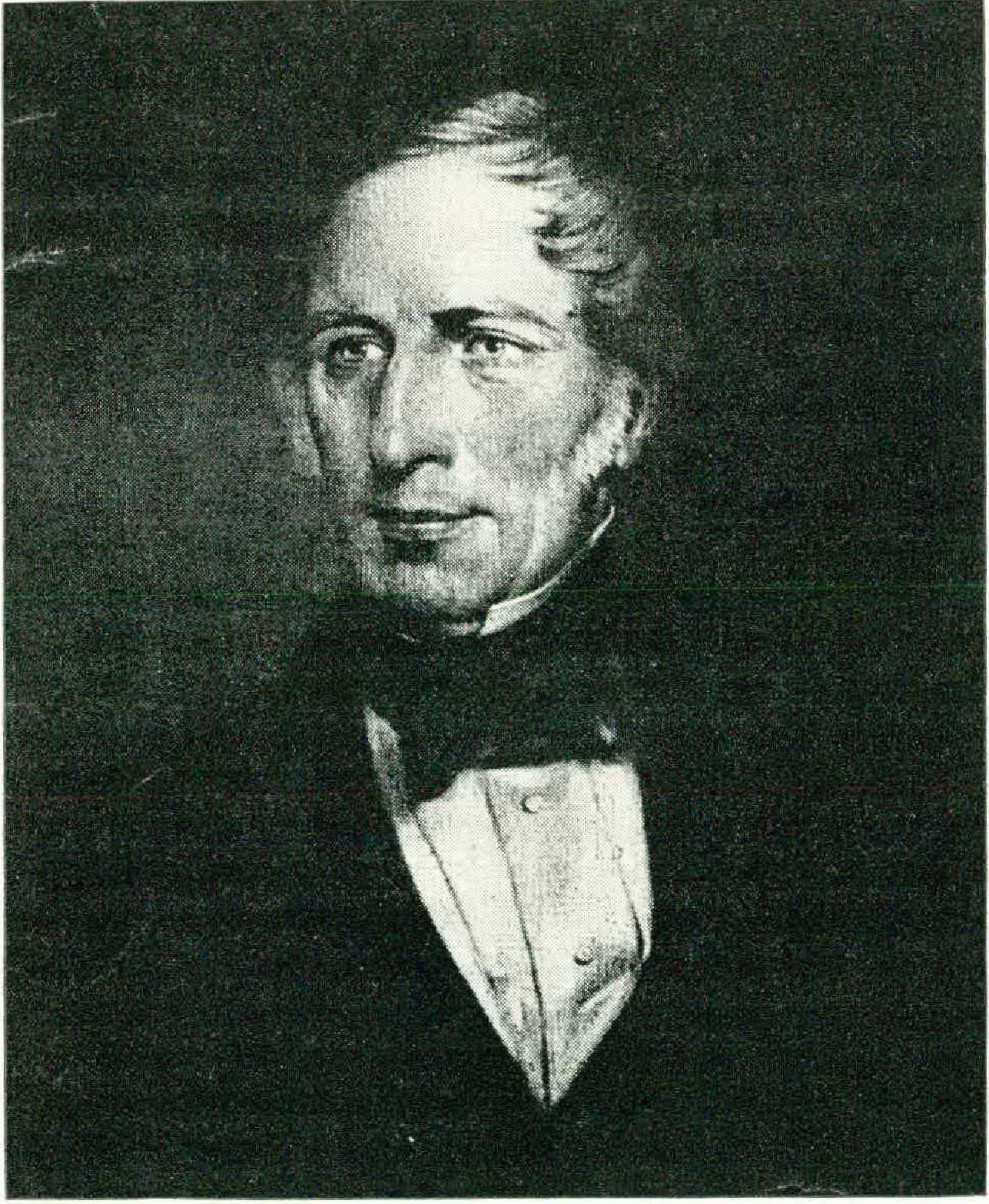
These brief details conjure up a recognizable military figure of the early nineteenth century: a bully-boy young officer, ignorant of politics, eager only to advance his own career, and ready to deal with any defier of authority, whether he be an American rebel, an Irish peasant, or an English criminal; more of a policeman, you might say, than a soldier. In point of fact he was nothing of the kind. At the age of thirty, when he sailed for Australia, Sturt was a spare, tall man with a sensitive and distinguished face; he had a talent for both sketching and writing; he was an enthusiastic botanist; and far from being a typical garrison officer in a penal colony, he loathed the whole idea. But a penniless professional soldier in the eighteen twenties had very little control over his comings and goings, and so, after a six months’ voyage, he arrived at Sydney, where his destiny was awaiting him. Governor Darling met the quiet, intelligent young man and made him his private secretary.
Already in 1827 Sydney was an established settlement, with cornfields and orchards running down to the sea, and it was not unusual to see forty or fifty sailing ships in the harbor. But in 1828 a drought set in, and with the failure of the crops the settlers began to look toward the regions behind the coastal mountains, where they hoped they would find more fertile land. Sturt got in with a group of young men whose names were soon to become famous as explorers—Mitchell, Hume, and others — all eager to find the “new Australian Caspian Sea,” and in 1828 he led his own party inland. With six convicts to carry the baggage he followed the Macquarie River to the point where, among swamps, it entered a large westward-flowing stream, which he named, after his patron, the Darling. Three years later he set out again, turning southward this time to the Murrumbidgee, and with a boat he had carried overland he sailed downstream until he reached a still more important river, the Murray, and this he followed to its junction with the Darling and then to its outlet at Lake Alexandrina on the southern ocean.
This prodigious journey of over two thousand miles illuminated the whole river system of the south, and earned for Sturt much praise in Sydney and a grant of land. It also undermined his health and, for the time being, ruined his eyesight. For the next ten years he was obliged to stick to his farm and administrative duties in Norfolk Island and New South Wales, and in 1839 he was appointed surveyor general in Adelaide. But he did not like a sedentary life and repeatedly offered himself for new expeditions. He was still dreaming of an inland sea. “I have a strange idea,” he wrote, “that there may be a central sea not far from the Darling in latitude 29° and I should go prepared for a voyage.” He had also observed the parrots and the cockatoos flying north, and he hoped that beyond the arid land to the north of Adelaide there would be “rich valleys and hills.”
In 1840 his friend Edward John Eyre left Adelaide in an attempt to reach the center, and Sturt, still troubled by his eyes and unable to leave his desk, regretfully watched him go. Eyre soon came back with a report that he could get no further than Mount Hopeless and the salt-lake country around Lake Torrens, some four hundred miles to the north of Adelaide. Mount Hopeless was nothing more than a low flat-topped hill among many others, but it was typical of that dreadful country. “We ascended Mount Hopeless,” Eyre wrote, “and cheerless and hopeless was the prospect before us"; nothing but an endless waste of barren rock and sand. He gave the place its despondent name to mark his decision “to waste no more time on so desolate and forbidding a region” and turned back to civilization. Sturt was not discouraged. “Let any man,” he declared in an address to the colonists, “lay the map of Australia before him, and regard the blank upon its surface, and then let me ask him if it would not be an honourable achievement to be the first to place foot in its centre.”
IN 1844 at last the authorities let him go. He was now forty-nine, but his eyesight had improved, and he was still physically robust. The party that assembled in Adelaide that winter was exceptionally strong: sixteen men, eleven horses, thirty bullocks, two hundred sheep (to be eaten on the way), a boat, a couple of heavy carts, and a year’s provisions. The expedition’s draftsman was a wiry little Scots officer, five feet six inches high and under nine stone in weight, named John McDouall Stuart; and among those who came to see them off was a particular friend of Sturt’s, Charles Cooper, a lawyer who was subsequently to become the first chief justice of South Australia. A farewell breakfast was given for the expedition by the colonists, and then Sturt, with a straw hat on his head and mounted on Duncan, his old gray horse, led the way out of town.
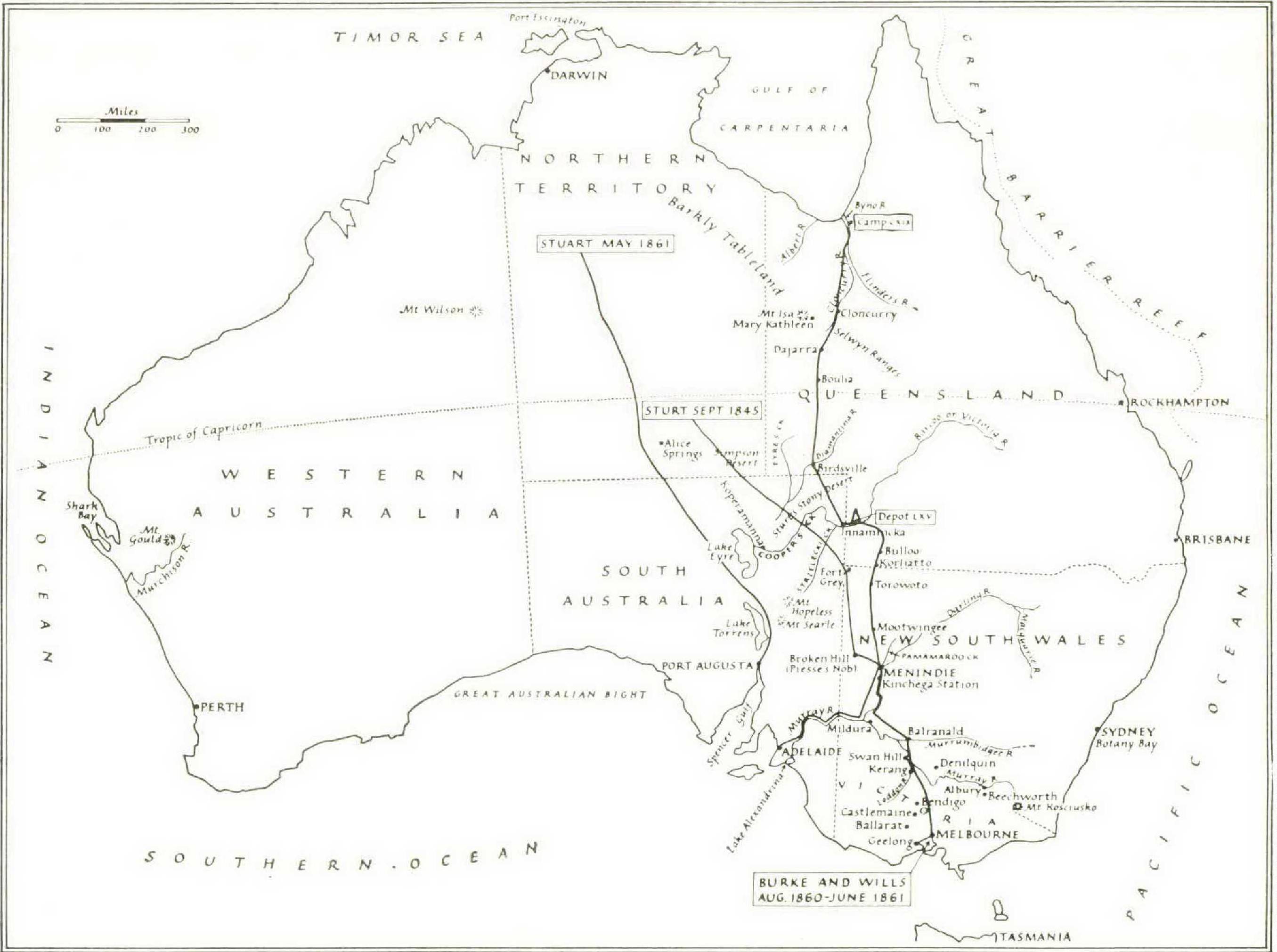
They marched first to the Murray River, and followed it upstream to the confluence with the Darling, About 180 miles up the Darling they reached the little outpost of Menindie, and here, having built a stockade, they turned northwestward into the unknown. It was mid-October, and although the summer was approaching there was still water about, and all the party were healthy. To cheer his friends, and perhaps himself as well, Sturt wrote back to Adelaide: “We seem on the high road to success with mountains and seas before us. . . . We have strange birds of beautiful plumage and new plants. . . . It will be a joyous day for us to launch on an unknown sea and run away towards the tropics.”
For the moment, however, the land was uncompromisingly dry and flat, and it was an event when presently they came on a line of low hills that stretched across the plain. The most prominent of these they named Piesse’s Nob, since it so much resembled the conical hat worn by Louis Piesse, the storekeeper of the expedition. Highly magnetic iron ore was found lying about, and in the years ahead mining engineers were to examine that hill with interest.
THE center of Australia is a place of violent extremes. “It is either a desert or a deluge,” one of the early geographers wrote; “the rainfall can vary from 30 inches in one year to three inches the next. Watercourses that have lain dry for a decade can suddenly turn into a flood, and land that is as hard and dry as concrete will overnight become carpeted with wildflowers and fresh young grass.”
Had they known it, Sturt and his men were marching into one of the most appalling summers ever recorded. The end of 1844 found them still toiling slowly northward — a biblical-looking group with their oxcarts and their flock of sheep — and early in 1845 they reached the twenty-ninth latitude. Here they stuck on a waterhole for six months while the land dried up around them, unable either to go forward or to go back until rain fell.
The extreme temperatures of the center are very bearable because of the dryness of the air, but even so the heat that year was unbelievable. It rose to 132 degrees in the shade and 157 degrees in the sun. It penetrated to a depth of three or four feet into the ground, it forced the screws out of wooden boxes, and horn combs split into fine laminae. The men’s hair ceased to grow, and their fingernails became as brittle as glass. Sturt found it almost impossible to write his diary; the lead dropped out of his pencils when he picked them up, and when he used a pen the ink dried as it touched the paper. Scurvy broke out in the camp, and one man died, but there was nothing to be done; they were alone in the wilderness; even the birds had deserted this inferno, and nothing moved on the cracked earth except the lizards and the ants. The blacks whom they had encountered on the way up had long since made off, saying that there was no water anywhere — “the sun had taken it.”
“The sky generally speaking,” Sturt wrote, “was without a speck, and the dazzling brightness of the moon was one of the most distressing things we had to endure. It was impossible indeed to shut out its light whichever way one turned, and its irritating effects were remarkable.”
By April it was a little cooler, and thunderclouds began to bank up on the horizon. At last on July 12 a gentle but persistent rain started to fall, and after a few days it developed into a downpour. Now they had floods to contend with, cold nights, and even frost, but at least they could move; and as a guarantee that life was returning to the parched earth, swans and ducks and other migrating birds began to reappear. Sturt sent some of his men back to the base at Menindie and with the remainder pushed on to the northwest. At a place which he named Fort Grey, close to the extreme northwestern corner of New South Wales, he formed another base where he dropped off more of his men, while he himself and a young companion named John Harris-Browne pushed on again, taking fifteen weeks’ provisions with them. They reached and named the Strzelecki Creek, and then followed it northward until they entered a region where the horses’ hooves were cut by flintlike stones and left no track. Here on every side there were “stupendous and almost insurmountable sand-ridges of a fiery red.” These ridges, Sturt went on, “like headlands projecting into the sea, abutted upon an immense plain where, but for a line of low trees far to the north-east, and one bright red sandhill shining in the sunlight, not a feature broke the dead level, the gloomy purple hue.” He named this region the Stony Desert. Beyond it there were glimpses ol the “better country” for which he was searching, but presently he was again among sand dunes, and at the end of August, on latitude 25 and longitude 139, he gave up all hope of finding his inland sea in that direction. The ground was drying up again, great chasms had appeared, and they heard explosions as of a distant gun. These they put down to “gaseous influences,” but no doubt they were caused by masses of rock being split off the sides of distant hills by the extremes of temperature during the day and the night. On September 8 they turned back. “Depend upon it,” Sturt wrote, “I would not have retreated from such a position for a trifle. But you can form no idea of that region.”
They found their way back through the red sand ridges, with white clay pans lying in between and the cloudless sky overhead — a country of red, white, and blue. If they had not quite reached the center, at least they had been almost halfway across the continent, and they had gone further than any other man. Both horses and men looked like skeletons when they got back to Fort Grey at the end of seven weeks. They had ridden nearly nine hundred miles.
IT WAS now October, 1845, and they had heard nothing from the outside world since they had left Adelaide fourteen months before, but still Sturt would not go back. Indeed, a kind of fixation seems to govern the actions of all these Australian explorers; they struggle on, not so much to get to a declared objective as to reach the extreme limit of their endurance, and then, and only then, will they turn for home.
After the briefest of rests Sturt set out for the north once more, taking with him this time McDouall Stuart and two men named Mack and Morgan. They had four riding horses and four packhorses, and once again they expected to be out for several months. Harris-Browne was left in charge at Fort Grey, and before setting out, Sturt gave him instructions that he was to retire from the place only if his supply of water failed or his men fell ill. In that event he was to leave a message saying where he had gone, and this message was to be placed in a bottle and buried under a tree which they chose together. Harris-Browne was devoted to Sturt and hated being left behind, but Sturt was adamant; and so, on October 9, with a promise of rain in the air, the little party rode off into the scrub. They headed cast of Sturt’s old track, making over thirty miles a day, and they soon crossed the Strzelecki Creek and came within sight of another creek which had been dry on Sturt’s previous journey. Climbing a sand hill early one morning they saw three miles away in an immense sandy plain a thick line of gum trees with hills in the distance, and they rode eagerly forward through parklike country until they came to the banks of “a magnificent channel covered with wildfowl.” they killed three ducks for breakfast. Riding on again to the north for half a mile they found still another creek, “broader and finer than the first . . . with splendid sheets of water.” It was a full two hundred yards from side to side, and the banks rose up some eighteen feet among groves of flooded gum trees. The blacks had recently been burning off the grass, and now the ground was covered with bright young shoots. The water in the stream was vivid green. Sturt would have paused to investigate this important discovery, but a thunderstorm burst upon them, and he decided to take advantage of the wet weather and go on again to the north.
His hopes for an inland sea had revived, and it was a bitter disappointment when once again they struck the Stony Desert. “Coming suddenly on it,” Sturt recorded, “I almost lost my breath. If anything it looked more forbidding than before. Herbless and treeless it filled more than half the horizon. Not an object was visible on which to steer, yet we held to our course by compass like a ship at sea.” But this was futile; the further they went the drearier the land became. Toward the end of October they were becoming dangerously short of water, and there was no alternative but to retrace their steps.
The desert now assumed its most menacing aspect. Most ol the water holes they had dug on the outward journey had dried up. “At the first waterless halt,” Sturt wrote, “the horses would not eat, but collected round me, my favourite grey pulling the hat off my head to claim attention.” It was only by catching sight of a pigeon darting down to a little muddy depression that they managed to replenish their supplies. When they were still ninetytwo miles from the splendid creek they had discovered on their way north, their water gave out entirely, and they continued on all night by lamplight. flalf dead with thirst, they reached the creek and the shade of the trees on October 28.
The Hies and the mosquitoes here were so bad that the men wore veils on their faces; but this mattered nothing at all: they could drink, they could bathe, and they could shoot ducks to eat. When they had recovered a little, Sturt led the way upstream, thinking that now perhaps at last they were on the true path to some really broad expanse of water. There were many encouraging signs. The blacks, for instance, were very numerous; their tracks and crude shelters were everywhere, and within five miles Sturt met no fewer than eight different tribes.
Sturt in his dealings with the blacks is something of a rarity among Australian explorers. He did not despise them or reject them. He treated them with kindness and tried to understand them, and in return found them to be a gentle, friendly people — embarrassingly friendly, in fact, since they invited the explorers to sleep with their grubby wives. They were, he said, an undernourished but merry people who sat up laughing and talking all night long. Being naked they suffered very much from the cold at night, and at this point he split his blanket so that he could give half to a shivering old man. He notes that they were adept at foretelling the weather from the position of the stars, and that in sight and smell they were keener than a dog.
The tribes they had first encountered on their way up from Menindie were rather a scrawny lot and very primitive; on seeing a horseman for the first time they had thought that man and beast were one creature, like the mythical centaur, and they had run off in astonishment when the man had dismounted. But here, on this green watercourse, they were a much more vigorous breed, the men six feet tall, and although by tribal law their front teeth had been knocked out, many of them were handsome. They netted fish and dived for mussels in the water holes; they brought down birds with their spears; and from the seed of a plant they called nardoo, they made a rough kind of flour that was baked into cakes.
Sturt questioned the tribesmen whenever he could, and now, by signs and by moving their arms in the manner of paddling a canoe, they indicated that there were indeed great stretches of water further to the east. With renewed hope the party went on and Found that the watercourse continued to divide itself into many different channels and water holes. With its grass and heavy timber the country was much more promising than anything they had previously seen. On November tthey arrived at a lake with seagulls flving above it, and still further east they came on other great pools, indigo blue in color and very salty. Here in this wilderness they interrupted a strange scene: a group of seven men crying bitterly. Nothing could make them explain the occasion of their grief; they cried and cried and would not stop, and in the end Sturt was obliged to go on his way, having left them a present of his greatcoat.
A few days later, when Sturt and his party were 120 miles upstream from their original starting point, they came on a crowd of some 400 blacks, more than they had ever seen before. The men were very fine, no tribal scars on their bodies, no bulging stomachs among them, and no missing teeth. They were very friendly once they had got over their fear of the horses. They came forward with gifts of ducks and flour cakes and held up troughs of water for the horses to drink. But they also blasted Sturt’s hopes for the last time; from this point on, they said, the stream diminished, and nothing lay further to the east but the desert. Riding out in that direction Sturt came on a swamp, and beyond this he was confronted by an endless plain.
Now, finally, he had had enough, and the party turned homeward. They retraced their steps down the creek to the point where they had first reached it, and then struck out for Fort Grey and the south. Sturt wrote: “Before we finally left the neighborhood where our hopes had been so often raised and depressed, I gave the name of Cooper’s Creek to the fine watercourse we had so anxiously traced, as a proof of my respect for Mr. Cooper, the judge of South Australia.” And he added, “I would gladly have laid this creek down as a river, but as it had no current I did not feel myself justified in doing so.”
THE march to Fort Grey was worse than anything they had endured before. A fearful hot wind sprang up; the thermometer rose to 127 degrees and burst; the horses stood with their noses to the ground; “the birds were mute; the leaves of the trees fell around like a snow-shower. I wondered the very grass did not take fire.” When finally the weaker animals began to stagger and fall Sturt and Stuart decided to go on ahead of the other two men to Fort Grey so that they could get help. On their last stage into camp they traveled for fifteen hours without dismounting.
Sturt half thought as he rode along that HarrisBrowne might have been forced through lack of water to retreat from Fort Grey, but he could not really bring himself to believe it. And so, when the two exhausted men at last reached the camp, a sickening feeling overcame them: all was silent. Stores, animals, and men—everything had vanished. “With my bitter feelings of disappointment,”Sturt says, “I could calmly have laid my head on that desert never to raise it again.”
They got off their horses and went to the tree which had been selected as a site for a cache, and there dug up a bottle with a message from HarrisBrowne in it. He had been obliged to retreat to another water hole sixty-five miles away, he said, because the water at Fort Grey had become putrid and was causing his men to have dysentery. This was all too painfully evident; when Stuart went to the little pool he found that the slime there was green on top and red below.
Without eating or drinking, the two men laid themselves down on the ground to sleep. Next day Mack and Morgan struggled into camp, having abandoned all their supplies on the way, but Mack after a short rest went back on the best horse to recover the provisions and a kettle. Now at last they were able to make a damper and boil a little of the slime. It was the first time they had eaten or drunk for two days.
The sixty-seven-mile journey that still lay between them and the new depot was, as Sturt says, a privation “of no ordinary character,” but somehow they managed it, riding for twenty hours without a stop, and on arrival Sturt collapsed. He fell to the ground as he dismounted, and next day his muscles contracted and his skin went black. It was nearly three weeks before they could move him, and then the whole party began their final retreat to the Darling, 270 miles away. It was now approaching midsummer — their second in the wilderness — and once again an incredible heat overwhelmed them: “The hot wind filled the air with an impalpable dust, through which the sun looked bloodred; and all vegetation seemed dead. So heated was the ground that our matches falling on it ignited . . . the silence oF the grave reigned around.” They traveled by night, Sturt lying helpless in one of the carts, and on December 20 they reached their depot at Menindie. The Darling had ceased to flow, but at least there were water holes in the dry bed, and in the middle of January, 1846, they struggled into Adelaide. When Sturt reached his home at midnight his wife collapsed.
Quite apart from the hardships they had endured — and one is forced to conclude that men in Victorian times were tougher than they are now — a good deal had been accomplished here. The expedition had failed in its main objects, but they had come within 150 miles of the center, and they had actually lived there for a year or more, isolated from the rest of the world like men on another planet, and they had valuable information to impart. From now on any future expedition knew that it must expect impossible conditions during the summer months, with the great dangers of thirst and hunger and, in the absence of green vegetables, of scurvy. On the other hand, it was proved that the blacks were not dangerous if properly handled; in fact, they could be very helpful.
STURT had brought back with him over a hundred species of plants, and many geological specimens which were to lead on to the great mining discoveries in the center. He had taken careful note of the strange wild animals he had found, and his description of the fantastic bird life around the water holes has never been improved upon.
He observes how the raptors, the hawks and the eagles, follow the migratory routes across the interior, terrorizing the smaller birds, dropping on them like arrows from the sky when they pause to drink, and carrying them off in their talons. He speaks of species like the crested wedgebill, ‘"which is heard in the heat of the day when all other birds are silent”; and of the galahs, which were also known as rose cockatoos; of black swans, which tended to be on the wing when the moon was shining bright; of the plover, with “its peculiar and melancholy cry ringing through the silence of the desert”; of sulphur-crested cockatoos that posted a sentinel while feeding on the ground; and of sea gulls on Cooper’s Creek, over five hundred miles from the sea. There were half a dozen varieties of duck and a “ventriloquist dove,” which, with the very slightest movement of its throat, made a sound that appeared to come from far out across the plain. Then there were the tawny-shouldered podargues, with mouths that reached from ear to ear and eyes half shut, that sat on the branches in a sort of conclave with their heads together; and the cracticus destructor, an ugly bird with dull feathers that could imitate any sound it heard — indeed, one of them used to come to Sturt’s camp every morning to learn a tune his men used to whistle to it. There were times when the birds were their salvation: of the amadina castanotus Sturt writes, “Never did its note fall on our ears but as the harbinger of good, for never did we hear this little bird but we were sure to find water close at hand, and many a time has it raised my drooping spirits and those of my companions. . . . The hawks made sad havoc amongst these harmless little birds, generally carrying off two at a time.”
And he says this of the gray falcon: “A pair, male and female, were observed by Mr. Piesse one Sunday in May, whilst the men were at prayers, hovering very high in the air, soon after which he succeeded in killing both. They came down from a great height and pitched into the trees on the banks of the creek, and on Mr. Piesse firing at and killing one the other flew away; but returning to look for its lost companion, shared its fate. Nothing could exceed the delicate beauty of these birds when first procured. Their large, full eyes, the vivid yellow of the ceres and legs, together with their slatecoloured plumage, every feather lightly marked at the end, was quite dazzling, but all soon faded from the living brightness they had at first.”
He writes equally well of the animals, of the dingoes, for instance, whose “emaciated bodies standing between us and the moon, were the most wretched objects in the brute creation.”
For Sturt’s leadership there could be nothing but praise. None of the usual jealousies or dissensions had occurred among his party, and he had lost only one man and a few horses. The expedition had cost just under £4000, which was very little more than he had originally estimated, and on the whole his system of base camps and small reconnaissance parties had been successful. There had been the interesting business of the message buried in the bottle, and in other ways — especially in the use of bullocks, horses, and sheep — he had been able to provide a useful guide for future explorers. In a general way they would know what fauna and flora they could expect to meet, the routine of the seasons and the contours of the land. Places like Menindie, Cooper’s Creek, and the Stony Desert were pinpointed on the map.
Sturt never managed to return to the center. His eyes began to trouble him again, and in 1853 he returned to England, and he died there sixteen years later. But his discoveries had opened a vast new field for exploration. From every side men began to push into the interior. Thomas Livingstone Mitchell, the New South Wales surveyor general, struck inland from Sydney on a series of journeys and discovered the Victoria River. Later, his assistant, Kennedy, traced the Victoria downstream and found that it linked up with Cooper’s Creek. Meanwhile Ludwig Leichhardt, a German botanist, traveled across the tropical north of the continent as far as Port Essington. In 1848 he set out once more from the eastern coast with the idea of crossing the continent to Perth, and was never heard of again.
Leichhardt’s disappearance caused a great stir at the time (for years afterward there were stories of a wild white man roaming in the interior), and Augustus Charles Gregory, the Queensland surveyor general, made two separate expeditions to find him. In the course of these journeys Gregory also followed the Cooper, and he eventually succeeded in reaching Mount Hopeless in South Australia, thus linking up his own researches with those of Sturt and Eyre some twenty years earlier. Then in 1853 a resourceful character named Captain Francis Cadell got a small steamer over the bar at the mouth of the Murray and sailed upstream as far as Swan Hill and back. Later he started a ferry on the Darling with regular sailings to Menindie.
Finally there was Sturt’s draftsman. John McDouall Stuart, and he was proving himself to be the most persistent traveler of them all. After the 1844 expedition he made several journeys to the north of Adelaide, and in March. 1860, he was preparing to set out again for the center of the continent.
Yet the basic objects still eluded them all. North of Sturt’s furthest expedition, on latitude 25. there was still terra incognita. Was it possible for a party to cross the continent from south to north? It was not merely curiosity that was involved in this, the persistent urge for men to go where no one else had ever been before. In 1860 the settlements in the south were still divided from Britain and Europe by a two months’ sea voyage, and the introduction of steam had not materially speeded up communications. What if a telegraph line could be built from Adelaide to the northern coast and there linked up with the cable that already extended through India to Southeast Asia? That was a compelling idea. If realized, it would mean that instead of waiting four months one could communicate with London in a few hours. There was also the possibility of opening up trade with Southeast Asia through a port on the northern coast. Then there was the hunger for land itself: all of it free, unused, waiting for the firstcomers to take possession.
One would have thought that Sturt s hardships were enough to disabuse anyone of such optimistic dreams as these, but here, as in the Sahara, mirages floated on the horizon, and oases such as Cooper’s Creek were a promise that they could be real.
AND SO in 1860 the people of Melbourne, the richest of the Australian cities, decided to try again. They fitted out an expedition that was far more lavish than anything that had gone before: £9000 was raised for the venture, and twenty-five camels were specially imported from India to carry a vast store of supplies and provisions into the interior. Among the fifteen men chosen for the expedition there was a botanist and a geologist. The post of leader went to an Irish policeman, John O’Hara Burke, and his surveyor and second in command was William John Wills, a young Englishman who had recently emigrated to Australia. By August 20, 1860, all was ready, and half the population of Melbourne came out to see them off.
Now, in the past one hundred years, the Burke and Wills expedition has become something of a legend in Australia; its adventures are much more widelv known than those of Sturt, and, indeed, it would be hard to imagine a more horrific tragedy of errors and miscalculations. One feels that an implacable destiny was working here; the ghastly blank was demanding its last quota of victims before it finally gave up its secrets. Yet, in fact, they got through; they accomplished what even Sturt had been unable to do. They reached Cooper’s Creek from Melbourne in November, and here they left a base depot in charge of four men while four others — Burke. Wills, and two “assistants,” King and Gray — struck off along Sturt’s old route to the north. Before he left. Burke assured the men in base camp that he would be back in three months.
The story of this march — and it continued for fifteen hundred miles — is almost too agonizing to bear.
Anyone who has been in the center of Australia will bear witness to those sharp, ankle-twisting stones, the clay as hard as concrete and full of cracks, the peculiar stickiness of the mud in the swamps. After the first few steps the sweat starts out, and one has to keep a hand free and swing it across one’s face to deal with the pestilential, neverending flies. One sees and hears and smells far more, of course, when on foot, but the mechanical monotony of this tremendous walk is something not easily to be understood by a twentieth-century mind: hour after hour, mile after mile, and always the same plain ahead; never to arrive at anywhere really significant; always to get up in the morning with the prospect of doing the same thing all over again. The world narrows in these conditions; one’s boots have the disembodied fascination of a clockwork pendulum; weariness is subdued by the dull compulsion of the rhythm; and ground is not ground but simply distance to be put behind one. In this apathy of movement, this concentration merely upon keeping going, this coma of walking. any intrusion is resented, and any call upon the mind is an effort. And so the imagination that held these men to their objective and the skill with which they overcame a thousand intrusions are things to be very much admired.
After two months they reached the tropical northern coast on the Gulf of Carpentaria, and then turned back again. They had proved that nothing lay in the center except a semidesert — the inland sea was a myth — but they were tired and desperately short of food, and their one hope lay in getting back to the depot on Cooper’s Creek, seven hundred miles away. They had with them six camels and Burke’s horse, Billy; most of these animals were killed and eaten, but the meat rapidly went bad in the heat, and by April 17, 1861, they were starving. And on that day Gray, the oldest of the party, collapsed and died. The others struggled on, and by April 20 they were within thirty miles of Cooper’s Creek, though so bemused with exhaustion they hardly knew what they were doing anymore. Yet on the following day they managed to cover the whole thirty miles. As they approached the depot in the dusk of the evening they shouted and hallooed and called to the men they had left there. There was no answer from the silent bush, no sign of movement anywhere, and they stumbled into the camp to find it deserted. An inscription had been cut with an ax into a large coolibah tree beside the creek:
DIG
3 FT. N.W.
APR. 21 1861
The most agonizing thing about this was the date: it was the same day. The depot party had left that morning. After four and a half months Burke and his men had missed them by a matter of nine hours.
By the bright light of the moon they dug as they were directed, and unearthed a wooden box which contained a small quantity of provisions and a note from the depot party saying that they were abandoning the place because one of their men had fallen seriously ill.
Burke and his companions were far too weak to try to catch up with them. They made a meal from the stores left in the cache, rested for a day or two, and then decided to strike down Cooper’s Creek on the shortest route to civilization — a further 150 miles — which, they hoped, would bring them out at Mount Hopeless, not far from the settled districts of South Australia. In fact they were blocked by the desert and never left the creek.
In September — five months later a search party coming up from Melbourne reached the depot, and the blacks, by signs, led them to a halfcrazed white man who was living with them. This was King. Being younger than the others — he was only twenty-one — he had just managed to keep alive. Burke and Wills had died months before, and their bones had been scattered over the sand by wild dogs. As for the rest of the expedition, they had been dispersed over the dried-up land between Cooper’s Creek and the Darling, and four of them were dead from scurvy. It was in some ways the greatest disaster in Australian exploration either before or since. All that one could say in favor of the whole mismanaged affair was that the ghastly blank had been conquered at last.
IT IS still quite possible today to retrace Burke’s march to the gulf, to camp where he camped, and to see more or less the same things he saw.
In Victoria the land has been fairly heavily settled, but Burke’s old route (now a highway) still leads out from Melbourne to Castlemaine and Bendigo; and at Swan Hill one can drive along the Murray riverbank to the junction with the Darling. In the fruit-growing district of Mildura one sees the skeletons of Captain Cadell’s old paddle steamers breaking up on the bank, but some of them are still prodded into action.
The Darling is a narrow, muddy stream, with dun-colored earthen banks shaded by eucalypts, but it has managed to keep some of the wildness and remoteness it had a hundred years ago. Here at last one catches a glimpse of the kangaroo bounding away through the scrub, and the flocks of parrots are almost as plentiful as they ever were. Menindie is now a railway junction and the center of a water-conservation scheme. Bulldozers roar by, throwing up new earthworks between the lakes, and there is not a camel to be seen. But the outpost atmosphere persists, and the local people will show you “Burke’s room” in an old pub on the riverbank. On the lake nearby, regattas of black swans and pelicans sail about, and in the evening the slender gray herons arrive. They stand motionless on the banks of the creek and stab for fish, and they are closely overlooked by flocks of cormorants that perch like black bobbins in the trees above. When the fishing is good these cormorants swoop together onto the water and drive the herons away — a scene the explorers must have watched a hundred times. By day the flies are troublesome and it is very hot, but in this clean, dry air the traveler is filled with energy, and he wants to go on across the great desolate plains stretching away to the north — to go on and on until he reaches the Cooper, four hundred miles away.
If he goes up in the late spring, as Burke did, he will see the wild flowers in bloom on the red soil, and especially great fields of Paterson’s Curse (which is a weed presumably imported by a Mr. Paterson), which Burke did not see. All this country is so flat that the Barrier Range (minus Piesse’s Knob, which has been demolished by the Broken Hill miners) is seen from a very long way off, and even the sparse lines of trees in the dry creeks look like forests on the horizon. But at a place called Mootwingee the plain really does break up, and it is a delight to go into these gullies and to slither down the flaking rock into the still water of the pools. In these rough hills the kangaroos and emus seem to be larger and tamer than they were on the open plain, and the parrots have a brighter color in the soft light. Tourists have been here, and with their guns have taken pot shots at the native carvings on the rocks and have cut their initials among the stenciled hands in the overhanging caves — those hands that probably signified a meeting place, the fingers representing tracks leading into a central junction. However, the damage is not yet complete, and although there are no longer any blacks to hold corroborees now, the somewhat eerie spirit of the place persists.
BEYOND Mootwingee the country is very deserty, but cattle manage to survive even where there is no grass, only bushes, and the water holes have become the sites of station homesteads. Some of these places have tennis courts lit by electric light fit is too hot to play by day), swimming pools and lawns and lemon groves (no danger of scurvy today), and the cattle are rounded up by cowboys in Volkswagens. The station owner in his aircraft will make the journey from Cooper’s Creek to the Darling in a single afternoon.
A new kind of fauna lives on these great fenced plains, the domestic animals gone wild: a lone white cat lopes across the track, miles from anywhere, and homestead dogs that have mated with dingoes bound away at the approach of a car. They keep glancing backward as they run, since they are sheepkillers and are always shot at. Then there are scrub cattle, so lean and bony nobody bothers to brand them anymore, and the brumbies, the wild horses which are rounded up from time to time to be slaughtered and sold in the cities as cat meat.
Near Torowoto (a name now forgotten), a plaque has been set up on a cairn, and it indicates the place where Sturt spent that long furnacelike summer in 1845, unable to go forward or to go back. Following on along the track, one comes next to an eightfoot netted dog fence, which marks the border of New South Wales and Queensland (neither state wants the other’s dogs), and one passes through at Warri Gate, which is somewhat to the west of Burke’s route. Then the plain again disintegrates into hard, stony ravines and gullies; this was the place where the expeditions had to make their last long waterless march to the Cooper. It is fearful country to walk on or even ride over; the ground is covered with sharp dark-brown stones known as gibbers, which are as hard as iron and brutal to the feet.
And now the desert takes a stronger hold. The trees grow spines instead of leaves, their bark peels away like paper, and except for a few desiccated bushes, every green thing on the ground has been defeated by the sun. The first approach to the Cooper is through a series of low ridges which in the distance look like long flat-topped hills; then there is another gibber plain, and finally the blessed shade of the creek itself. On that muddy, graygreen water (and sometimes the billabongs are half a mile long and as much as sixty feet deep) life begins again — the incessant passage of the birds, the little turtle thrusting up his doubting snout, the scamper of rabbits on the bank.
The site of Burke’s depot lies a few miles downstream from the Napper Merrie homestead, and it is a moving thing to see there the original tree with the word “DIG” still discernible, to build a campfire under its branches, and to spread a bedroll on the ground where the stockade of the depot used to stand before it was carried away by floods. Except that a cairn with a plaque has been erected on the bank, nothing has changed. The boomerang shape of the water hole that curves around the site is the same as it always was, and Burke and his men must have gazed a thousand times (with what boredom) at a great eucalypt on the opposite bank, which is a favorite roost for the corellas. Apart from the people at the Napper Merrie homestead there are no human beings for many miles around, and in the midday heat and again at night the silence is complete. The nights are remarkable. Once the evening commotion of birds is over and the theatrical light of the sunset has faded, the dark sky, studded with enormous stars, descends from the great height it had by day. and there is a kind of joy in just lying there on one’s campbed, cool and relaxed and safe in the midst of so much unvisited space. As a rule, the night is very still, and thus seems timeless while it lasts; and perhaps — one dreams a good deal on the Cooper — there might be something in all this to reconcile the mind with death. But then the dawn comes up with a sunburst of colored searchlights, the first fly settles on the sleeper’s nose, and he struggles back to life again.
One fancies one might be prepared to wait patiently for a long time in this solitary and beautiful place. Little by little, as the days pass, a rhythm takes command, and one can tell the time without looking at a watch by many different signs: the seven o’clock breeze ruffling the water hole, the midday flight of lilac kingfishers coming down the creek, the evening appearance of the rabbits. The light is so clear that every passing bird makes a precise moving shadow on the ground, and the smallest ants arrest the eye as though seen through a microscope. Soon it becomes apparent that the chief effects here are not of harmony but of contrast: the cool night succeeding the overpowering day, the scarlet dragonfly that is made doubly brilliant by the drab background of the bush, the cacophony of parrots in silence. One’s thirst is so great that a cool drink of water really does taste like sparkling wine.
And yet there is a certain menace on the Cooper. It remains basically inimical to man; it rejects him; the climate is too arid and too hard. The cattlemen here contract sores and swollen gums which they call Barcoo rot (Barcoo being the other name for the Cooper), and it is that same vitamin deficiency that killed the explorers. Sometimes, too, the men shake violently in a spasm of nerves, a condition known as the dry horrors, but this usually only besets those who spend their vacations in prolonged bouts of drunkenness and whose craving in these dry wastes becomes ungovernable. A week or two in the pubs in the south generally puts them right, and they can continue for another six months or so without a drink.
But perhaps the really undermining thing about the Cooper is the inertia that overtakes one there. It is not the soporific torpor of the tropics, but rather a feeling of deep physical exhaustion, a fatalistic passivity in the mind; one longs to take refuge in a slow, safe, uneventful routine, and soon the demands of civilization drop away. One lives upon the bare minimum of effort, one accepts discomforts, and to do nothing, to say nothing, to succumb to solitariness, becomes at last the only bearable existence. This is a condition which is admirable for hermits but may have done as much as anything else to destroy the explorers.
This part of the Cooper is embraced by the Innarnincka station, some 10,000 square miles in extent, and there is a homestead on the creek close to the spot where King was found. But the little township that sprang up after Burke’s time has collapsed through want of trade, and all that remains of it now are a few ruined buildings and a thousand empty beer bottles glittering in the sun. Nearly all the blacks who once lived here have long since died — mainly through diseases imported by the white man. Northward on the expedition’s route lies Sturt’s Stony Desert, and here, at a place called King’s Lookout, one can survey that unearthly prismatic landscape, which is really closer to an abstract pattern than to anything recognizable in nature. According to the time of day, the sandhills that stretch away on every side are vermilion, scarlet, rose-red, or orange, but always the color is of a startling intensity. Sometimes the ridges are dotted with gray and green bushes, and a bare rock breaks through to the surface, and so the general appearance is of a formal Japanese garden, always with the bright pale-blue sky beyond. One finds a track through this gay maze by keeping to the salt pans that lie between the ridges, and at the end of the day one finally comes out into the open plain again. Here a number of homesteads have been abandoned in the last half-century — the droughts were too long and the loneliness too abrasive — but still the artesian bores gush out onto the dry ground. The water comes up through an Lshaped metal pipe, hissing and steaming, and it is hot enough to boil an egg, hot enough to make one’s billy of tea. It cools off as it runs away, and in a sandstorm one will see the strange wraiths of cattle looming through the gloom at the places where they know they can drink. The bones of dead animals lie everywhere.
There is only one township in this desolation, Birdsville, and since it lies between Sturt’s Stony Desert and the Simpson Desert, where virtually nothing grows, it is perfectly placed to take the full brunt of these sandstorms no matter from what quarter the wind blows — and it may blow for days on end, until the grit lines one’s very stomach and red-rimmed eyes can stand no more. But invariably the “blow” subsides at last into a dead calm, and one wakes to a morning of such sparkling freshness and clarity that the explorers, in these latitudes, must have been much encouraged to go on.
Beyond Birdsville the country gradually improves as the rainfall increases: grass finds a hold on the blown sand, the creeks are more frequent, and now once again there are flights of birds and groups of kangaroos. One does well to watch the kangaroos, since they will not survive much longer except in the remote parts of Australia. Like the wild horses, they are being shot for pet food, and something like a million of them are destroyed every year.
The invasion of civilization here is, indeed, very strange, very ruthless, and very haphazard. Some of the new towns, with their banks and shops and gasoline pumps, have a bright suburban look, but at their outskirts there is sure to be a collection of iron shanties of appalling squalor, to which the few remaining blacks have been banished. These places swarm with rats; broken bottles and rusting cans are strewn about among the wreckage of old trucks and cars. But then in a few minutes one is out on the wide plain again, and the half-caste driver, who yesterday was seen sprawling, drunken in the pub, now rides by with his mob of cattle, graceful, handsome, and erect, absolutely in command of his world.
Despite its hardness, its hostility, and its tragedy, there is still great beauty and a sense of freedom in the ghastly blank. Take Mount Everest, “it was there.” It had to be conquered. And in conquering it these tough, determined, and unpretentious men found a certain greatness in themselves.