The Woman Across the Street
A Vassar graduate and the mother of three children, MAY DIKEMANmade her first appearance in the ATLANTIC in 1961 with her short story “ The Tender Mercies,” which won an Atlantic “First” prize. Her second story in our pages, “ The Sound of Young Laughter,” has been selected for the Martha Foley collection, THE BEST AMERICAN SHORT STORIES.
SOMEBODY is trying to get me” sounded too wild for Rachel to say even to herself, much less tell anyone, least of all write home to her panicky, all-female family who lived on the outskirts of Boston.
But this was the third night it had happened. Someone was standing in the hall outside the door to her apartment. She knew he was there by the slight creak on the tile as he shifted his weight, a swallowed cough, and the blotting of the crack of light that showed along the side of her door. Three times now since she had come to New York he had stood there, with just enough time lapse in between for her almost to put it out of her mind.
She looked at the clock. It was twenty minutes to eleven. She had just washed her hair, which she did every other night for her job as a collegeshop floor model. She had been sitting rubbing it with a towel. Now a drop ran down her spine inside her terry robe, but she caught the shiver it gave her in order to hold herself motionless, as if she could defeat the purpose of the man outside by getting rid of herself.
She always felt less vulnerable close to the door, even with the man on the other side of it, and she drew herself together to get up and slip barefoot into the foyer. But just as she put her foot to the floor, she saw the doorknob slowly turn. It was an old, oval brass knob outlined with a wreath of hammered protuberances like beads, and its normal position was horizontal. As Rachel watched, without moving, the blade of light on the knob turned clockwise till nearly vertical, as if aimed. For the first time, the man was trying her door.
The turning knob made no sound, but the quiet became pulsatile like a metronome. The thought of the things that other people, strident, righteously deadpan New York people, would do — call the police, demand through the door, “Who’s there?” — seemed as jeeringly remote as the drone of the bus down on Third Avenue, only sealing her isolation. She looked at the telephone, she imagined her voice calling “Who’s there?” But what good would it do? She could not get a man locked up for life on her charge that he had tried her door. Once challenged, he would be her enemy. She felt safer as long as he didn’t know she knew, as long as he stayed unidentified. “I’m afraid of vengeance!” her elderly mother always said of any neighborhood trouble, as she might have said she was afraid of infection, and this phobia about vengeance seemed to thicken the air with another element, more noxious because it was unspecified and humanly motivated.
At a quarter to eleven, the man went away. His step was so easy that Rachel could not be certain whether he went down or up the stairs.
She felt it had to be the superintendent. Rachel was contentiously tolerant, and her letters home suggested that all her New York acquaintances were Puerto Ricans with Ph.D.’s. But actually she was afraid of opaque skin, tapered, high-instepped male feet in counterless shoes, and the risqué music of Spanish. Once, as he brought her up in the tarnished-gilt manual elevator, which, like the rest of the building, had been ornate and showed stages of decline through paint parings and detached egg and dart, the superintendent touched her elbow, shrugged invitingly, and said, “My wife says she wants a divorce.” And in her fright, Rachel almost said, “But I’m terribly pro Puerto Rican!”
Still, just because the case against the superintendent seemed strong, Rachel knew it might be someone else. Growing up seemed to her to have been chiefly learning that inevitability meant the loopholes in it — mystery gifts never came from the right person, and betrayals came not from the suspect but from the friend.
She thought of the other men tenants in the building, about whom she had written home very literarily funny letters. She thought of Good Joe, so-called, although he was a lawyer named Maurice Fischer, because he liked to be called Joe and because of his continual petty good works in the neighborhood. If it suddenly rained, Joe was seen helping the newsstand man hoist his tarpaulin. When a driver parked, Joe stood in the street shouting, “Cut your wheel! You’re OK. Cut your wheel!”
She thought of bald Mr. Einstein, upstairs, who composed scores for juvenile productions. Banging on his piano, he would sing in a hoarse, terrible bass, “I don’t want to play today, I don’t want to play; I take my dolls and go away,” or “Raumschlager, raumschlager, scared to come out!”
Only by improbability itself could it be one of these people. But the possibility now blighted Rachel’s jokes about them in her letters home, and peopling letters with mad characters was the only real company she had.
As for the store where she modeled, there was Bill, the photographer, a sullen clown in a Tyrolean hat, who seldom uttered anything but onomatopoeic comments like “Whoosh!” when she or another model swept past him. And there were the two window dressers, Harold and Schuyler, who were queer.
It seemed to leave only the superintendent. But by its contraction, the shadow of a doubt saturated to a pall over each of the others. The embarrassment, if it were one of the unlikely ones, seemed more terrible than real danger. What if it were Good Joe? “Good evening, how do you do, I was trying to fix your doorknob for you, it’s a fire violation.” Or Mr. Einstein? Would he sing, “Raumschlager, raumschlager, scared to come out”? In reaction from the fright, Rachel felt light-headedly gay and started to giggle to herself. Then the very fact that, like many lonely people, she often made up things to laugh at reminded her that when she was a gangling, solidly redhaired child, everyone had let her alone for a waif. Now that undulations in her height and hair color had transformed her into a flintily delicate beauty, photographing as shell chips of cheekbones and shoulder blades, they still let her alone for a snob, except when they did worse. Even her name had not been the result of the modern caprice by which girls were named Rebecca, Melissa, and Jennifer. She was named Rachel in naïve good faith, for her grandmother and the Bible. You’re a real Rachel, she thought, not a piquant Rachel, and it would be easier if everybody still thought so and thought you were too weird instead of too “stunning.”
SHE started to cry to herself in outrage as she brushed her hair in front of the mirror, and the electricity of the hair and the tears in her gray eyes reminded her of how Harold the window dresser had hugged his chest, shuddering, as he exclaimed, “But, darling, only the absurdity of such beauty saves one from its terror.” She thought, only queers dare to say things to me. She threw down her brush and went over to the window.
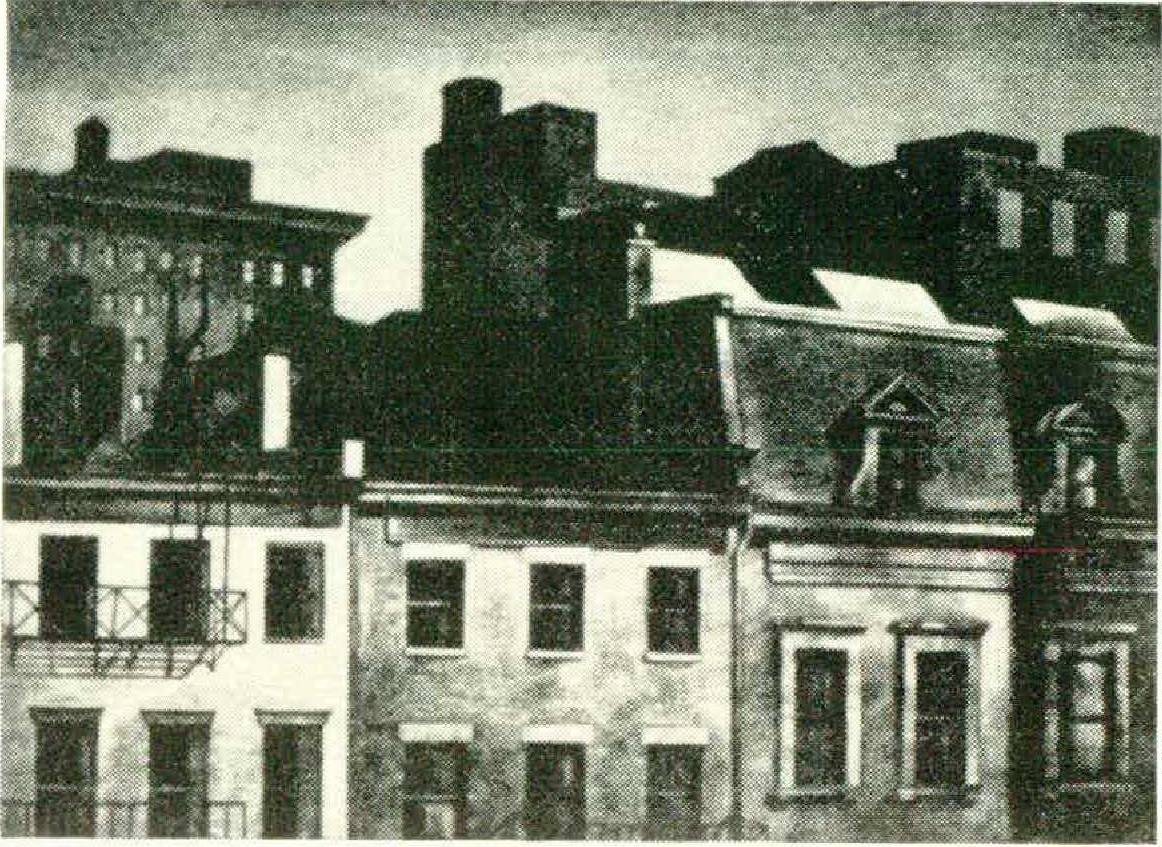
Brought very close by the stereoptican effect, the lit-up window across the street showed the young couple whom Rachel often saw this way. Weeknights, they were sloppy. Husband-and-wife jeans, thought Rachel. The boy was lounging on the bed, with one ankle crossed on his knee. He was in sock feet. By the precision of surmise with which one divines details in a stained-glass picture, Rachel knew the socks were Argyles. His wife would have knitted them. She was sitting upright, fondling his foot as they talked. Give his foot one more twist, thought Rachel, and it’ll come unscrewed. Then you can unscrew his head. They would be discussing what to name their planned, spaced children when they had them: Rebecca, Melissa, and, of course, Rachel.
Both of them had a lot of black hair. This made the boy seem a poet. On the woman, the fluffed effect looked as if a beautician had told her it would shorten her nose. Rachel saw her as a little thick in the middle, with too-tapering legs, a girl who would sign “Save Bleecker Street” petitions, cook with basil, study folk dancing at the New School, and have read an editorial apropos of anything said to her.
Why should you have an Argyle ankle to hold? thought Rachel. Why should it be candles on the table for you, and somebody always breathing next to you?
Jealousy restored Rachel. Her hands were warm and steady as she set her clock and laid out her things for the morning. She checked the lock and chain on her door again, set a chair under the knob as an extra precaution, and screwed the bolt on her fire-escape window a little deeper into the sash. Actually, she was perfectly safe. Nobody could get in as long as she was all locked up, and of course she would always be sure she was.
When she lay back in her bed, the lit-up window of the young couple was out of her sight. But she still thought about them. Tomorrow night would be Friday, so the woman would suddenly be in black and pearls, holding a glass and pressing the fiat of her hand to her scoop neck in protesting social hilarity (“Oh, no!”), and there would be too many people to distinguish the husband at all. The next night, Saturday, the window would stay dark. Saturdays they went out themselves. On Sunday they would give a party again, a cocktail party. Monday, and through the work week, they would be back in jeans, talking. I suppose it’s my New England conscience, Rachel said to the imaginary husband she conjured up to talk about other people to, but where does this lead? Her imaginary husband agreed that it seemed a meaningless life.
And having made their happiness seem their delusion, Rachel forgave them and got to sleep.
A FEW weeks later, Rachel went to a movie by herself and got home later than she expected. It was a paint-water pink night, threatening rain, with tree shapes of mist cowering in the street. Rachel’s building had a porte-cochere effect in front, casting a pit of darkness of which every gradation was a lurking man. The entrance looked like a trap no one could get through. Then Rachel saw the superintendent, with his back to her, rolling the cans into their formation at the area railing. He went down the steps into the basement. This was her chance. She dashed into the house and ran up the stairs, taking out her apartment key as she went.
On her own landing, just as she started to put her key into her door, she became aware that someone was waiting on the landing above her. She turned to run back down the stairs. But before she could take a step, the lights in the hall were blotted out momentarily by something like a flying monster bird. She screamed wildly. The man had jumped down the whole flight of stairs onto her. Pain shot through her like electric shock as her kneecap hit the tile floor. She thought he had stabbed her, and she felt hot and oozing in the middle as if she were bleeding. She screamed the name of a woman neighbor whom she hardly knew. “Mrs. Hoffman!” she screamed. “Mrs. Hoffman, Mrs. Hoffman!”
Doors crashed and echoing voices filled the stairwell. Terrible apparitions like gigantic mechanical baby dolls or bunnies, with big springs come loose from their heads, the women tenants in nightclothes and hair rollers, armed with pop bottles, all lunged for the man.
Rachel caught one flash of his face before he escaped. He was young. He had a lot of black hair, like a poet. As he dived for the stairs, she looked down and saw, as she knew she would, the Argyle socks of the husband across the street.
“Stop him!” yelled the women, thunderingdown the stairs after the man. Rachel was put on someone’s red-painted kitchen chair underneath an ivy-planter wall clock. A woman wet her forehead and started braiding her hair tightly. More to avoid having her hair braided than anything else, Rachel said she wanted to join the chase. “I’ll need to identify him,” she said. “I’m all right, I’m all right.”
The tenants, all eager to go, were easy to persuade. The hall was full of broken bottles. On every third step, Rachel saw a big drop of blood.
The superintendent came out of his apartment with no shirt on, his tragic eye-whites suppliant for any news he could deplore. Why, he’s a sweet little man, thought Rachel. He has a crucifix on.
The evening had come to life in a drizzle that ignited the streets, with Christmas balls and stars shining in the macadam. Rachel was swept along by two sturdy women in toggle coats over their flannel pajamas, who told her repeatedly, “Just so he didn’t harm you.” Sirens rose like a serenade, and the rain fused the lights of Second Avenue to a beacon. Rachel had never seen New York so beautiful.
Three women neighbors came out of the big hospital at the corner, hauling Rachel’s attacker, the young husband who lived in the apartment across the street. They had caught up with him as he tried to hide in a phone booth of the hospital lobby.
Standing at a safe distance on the far side of the Avenue, Good Joe, neatly dressed, with his checked wool scarf and fedora on, called, “Have you got him, girls?” The officers getting out of the police cars and the women howled with laughter.
Just before the police put him in the car, the man turned to Rachel. Thickened blood like paint was coming out of his black hair where the bottles had cracked his head. “I didn’t do anything to you, did I?” he said to her, in an entreating, boyish voice.
An hour after she had signed at the hospital that she refused treatment, Rachel’s body started to throb all over. Besides the bruises that showed, she had a pain in one breast and she found that when she flexed her knees or lowered her head, a sharp pain paralyzed her spine. The neighbors had stayed with her, vying with each other in offerings of tea, sherry, and soup, laughing at Good Joe, who had gone promptly to the prisoner’s wife to offer his legal services and returned home to report to them, “I can’t make out why that fellow should want to do it. He’s got a wife who’s a good-looking girl. Not strikingly gorgeous like yourself, but she’s not bad!” “He’s sick!” Mrs. Hoffman explained to the lawyer.
The neighbors now insisted on taking Rachel back to the hospital. “Anything with the breast I don’t like,” said one. They went and got a cab, and two of the women, still in pajamas and toggle coats, rode with her. Mrs. Hoffman promised to call the store for Rachel in the morning.
In the emergency ward, a doctor fingered Rachel’s breast and spine at great length, then said, “I can’t tell anything by manual examination.” Rachel said, “Well, Doctor, it was a terribly good try.” She had never said anything like that before, and never heard such applauding laughter.
Rachel was admitted to the hospital for observation and had the best time she had ever had in her life. When she was in bed, nobody could tell how tall she was, five-ten. They could only see her face. Everybody said over and over that it was good he hadn’t “harmed” her, and she realized that having just escaped “harm” made her more desirable than anything else that could possibly have happened to her. The doctors grouped around her bed and said to each other, “You know, I don’t blame that guy!” Rachel giggled chidingly in a way she never had before and told them to wait till she was back on her feet and they found out she was six-foot-three. The house doctor said if she were his girl, he’d never let her get on her feet. One doctor added musingly, “I love the name Rachel.”
The store sent flowers. A buyer, wearing what appeared to be a fresh pineapple in her hat, came and told her, “Usually they only do it for a death !” Her floorwalker and her section manager came with gifts from the store, expressing thankfulness that she hadn’t been “harmed,” and Snookie, the junior-sizes model, brought her a black velvet halter hostess gown she had admired, bought with the 40 percent discount, but still expensive. “I knew you liked it,” Snookie repeated, contentedly. “So I figured, what the hell.”
Bill the photographer came in, saying “Wheee!”, with his wife, Billie, who brought a mason jar of her bean and barley soup, which she said was “binding,” and a kit packed with a week’s supply of every possible cosmetic, including dry shampoo.
Best of all, Harold and Schuyler, the queer window dressers, came bearing a replica of the store, complete with awning and customers going in (one recognizable as an eccentric rich old lady who wore sneakers and prodded the models in the stomach with her umbrella), made entirely of flowers. While the patients on the floor flashed their lights frantically, the whole hospital staff congregated in Rachel’s room to admire Harold and Schuyler’s flower department store. “Schuy never stopped wiring mums all night,” Harold boasted fondly, hiccuping with pride. “I spoonfed him vodka till dawn.”
The neighbors also visited and reported that Rachel’s attacker had been committed to someplace upstate, while Good Joe remained nonplussed that the attacker had had a wife who was “not bad” right in his own home.
Rachel’s X rays didn’t show anything, and she was discharged. But even when she was back on her feet, taller in heels than many of the men, nobody seemed afraid of her and she was not afraid of them. She joked with Good Joe, and when she heard Mr. Einstein howling his children’s songs, she laughed and laughed. The superintendent still told her, shrugging seductively, that his wife wanted a divorce, but she told him firmly that he must preserve his marriage for the sake of the children, and he subsided with a disappointed air.
But in the apartment across the street, everything was changed. The first night Rachel glanced from her window, she thought the wife was getting ready to move, which seemed natural enough. Everything seemed dumped out over everything. A heap of clothes or bedding or curtains was over the big chair, with a big green thing, possibly a cotton shag rug, draped on top. The ironing board, with another mountain of things on it, stayed up in the middle of the room. What had been walnut cantilever bookshelves had become catchalls for boxes and laundry, with stockings hanging.
But as time passed, the woman never packed. The heaps of things only rose higher. The bed was never made. Apparently it was never even changed. It seemed that the woman was going to go on living there, by herself, but had stopped doing anything at all. The kitchenette of the oneroom studio, also visible through the window, was a stack of pots, dishes, and rags. The whole place was like a giant laundry hamper. The woman lay most of the time on the unmade bed. She always had on a speckly black thing that looked as if it were made of quilting, stiffened by soil. When the woman occasionally sat in the chair holding a magazine, all Rachel could see of her was one hand flicking a cigarette and a bare foot jerking a loose mule. Harold cried with laughter and sat down, spilling his vodka. “Lose your self-respect, and it’s the end,” said Billie. “I have a cleaning woman in twice a week,” said Snookie. “You cannot go to pot,” said Billie, “There’s such a thing as a fire hazard,” said Snookie.
RACHEL decided to give a party, her first party, a small one, and asked Snookie, Bill and Billie, and Harold and Schuyler.
She had been in New York long enough now to know her way around with sour cream, chervil, artichoke hearts, and vodka. The night of the party, after she had her casserole sprinkled with Parmesan and ready to run under the broiler, the avocados mashed for the dip, and the spray of eucalyptus poised to cast an Oriental shadow on her single dramatic vermilion wall, and had put on her black halter hostess gown, she was so happy that tears came into her throat. She knew that her life was not factually changed and might never be, but she felt that she could stand for years posed ready to run casseroles under the broiler in a perpetual glossy print of purest hospitality, even if nobody came for the rest of her life.
But everybody came, and everybody gave themselves completely to the party. Snookie praised the yummy dip and the yummy vermilion wall. Bill sat on the rug saying “Swoosh!” when Rachel’s skirt accidentally swept his head, and Billie attributed long stories to him while everybody stared at him, trying to picture him telling these stories. Harold and Schuyler had apparently had a minor tiff due to one of them accusing the other of Trotskyist tendencies, but when Schuyler took off his loafers and skipped softly around the room singing, from Greensleeves, “Alas, my love, you do me wrong, to treat me thus discourt’ously, when I have lov-ed you so long —”, it was evident that Harold had melted. (“They’re kind of cute,” Snookie said, and Billie said, “They are cute. I mean, they are darlings. I feel, who are we to judge?”) Billie told freakish narrow-escape stories, such as that of a man nearly catching a woman’s ice skate in his cornea on the subway. Schuyler leaped to the radiator-cover top and sang, “I did but see her passing by, and yet her ice skate gouged my eye,” and Billie was not offended.
Even the neighbors cooperated unconsciously in the party spirit. Good Joe came up to ask Rachel if her water pressure was troubling her, and Mr. Einstein sang ferociously that he would take his dolls and go away, and challenged his raumschlager to come out. Schuyler said, “How neo-Humperdinck!”
The neighbor business led to their talking about the woman across the street. They all went over to the window and looked.
“Housekeepingwise, she is in mighty bad shape,” said Billie.
“What I can’t figure out is what is that big green thing on the chair?” said Rachel. She felt guilty, but the woman didn’t know. The woman had not been able to keep her own husband away from Rachel, and now she was a conversation piece at Rachel’s party, but she couldn’t know, and it couldn’t hurt her. And they had all had enough vodka so that anything they did seemed cauterized of malice.
“Oof!” said Bill.
“She should pull herself together!” said Snookie.
“ Psychologywise, she should take herself in hand,” said Billie.
“The green thing is a sleeping bag!” said Schuyler. “She’s camping in.”
“The voyeur looks into the mirror, merely,” said Harold. “What is that big green thing? What, what is that big green thing at the vortex of my being?”
“She sure has let herself go,” said Snookie.
“Floom!” said Bill,
“She should take up something,” said Billie.
“She could pluck chenilles with tweezers!” said Schuyler. “Chenille by chenille she could pluck, in patterns! Wait. I have a marvelous idea. Billie, may I borrow your brooch? Rachel, may I pierce your coasters?”
“Schuy is opthalmologically sound,” said Harold, belching. “A pinhole reduces virtually to the optic axis, forming a telescopic lens!”
Stabbing the coasters through the centers with Billie’s pin, Schuyler passed them out for everyone to look through,
“Oh, Schuy, we shouldn’t,” protested Rachel. “This is so deliberate. The poor creature!”
“We must identify the big green thing!” said Schuyler. “I was wrong. It’s not a sleeping bag. It’s a bolt of Easter-basket grass. She’s very beforehand, actually. It isn’t Easter for months!”
“Rachel, aren’t others’ windows our looking glass, ultimately?” said Harold. “In every view, every visitation, don’t we seek to fracture our own image?”
“She needs help” said Billie.
“Can’t we do something?” said Schuyler. “We could take her a kitten! We could serenade her. ‘Dradle, dradle, dradle, I made it out of clay, and when it’s dry and ready, then dradle I shall play!’ ”
“We could take her some Brillo,” said Snookie.
“Oh, nothing abrasive, Snookie,” said Schuyler. “A flowering plant. An azalea with a bow. A sea horse with guaranteed live delivery. Oh, if we had some fireworks. We could shoot them for her on the fire escape.”
“Volunteers are always needed,” said Billie. “The hospitals are always yelling.” “Even a pay job is better than nothing,” said Snookie. “Better than nothing, Snookie?” said Harold. “Better than nothing whatsoever, truly better?”
“We could take her a mason jar of bean and barley soup,” said Schuyler. “It’s binding, it’s very binding. We could all do a play reading. I see her in The Inca of Perusalem.”
“Nothing’s wrong with bridge to kill an evening,” said Snookie. “But nothing, darling!” cried Harold, choking. “Nothing’s wrong with bridge to kill an evening!” He and Schuyler collapsed, chorusing, “Nothing’s wrong with bridge to kill an evening!”
Snookie said, “What I’d like to know is, where does she get her dough?”
AFTER everybody had gone home and Rachel had set the dishes and glasses in the sink, she was too tired to feel anything. But the calculations of zeros and figure eights of glass imprints on all the furniture tops left autographs of life in the room, and the echo of the talk and laughs of her company made her hum as she got out of her clothes. When she went to raise her window, she saw the woman lying asleep on her bed with the lights on, as she often slept. Her position made Rachel quickly look away. The woman was lying on her face with her legs spread and feet toed in, a position of abjectness embarrassing even when that of a young child or a big, fallen doll. “Oh, dear,” murmured Rachel, as she fell asleep.
She got up late, fixed her breakfast, and cleaned up from the party. It was nearly three when she looked out the window. She thought instantly how they had stuck pinholes in the coasters and aimed their focus at the woman. Oh, no, she thought. What did we do? Oh, what did we do to you?
The woman was lying in the exact position she had been in fourteen hours before. She couldn’t be, thought Rachel, but she stared till her eyes stung, trying to see some change from last night that showed that the woman had moved. But nothing was changed. The woman still lay in the position that did not look any longer like sleep.
But she could have moved around a lot in between and just be lying like that again, thought Rachel.
Rachel had to go out to the delicatessen for cigarettes and something for her supper, and she decided to go now and then see if the woman had moved by the time she came back. She deliberately prolonged her errand, as if to give the woman an added chance. She bought the papers and hunted for a drugstore open Sundays, where she might buy stamps.
When she got back, the woman was lying unchanged. Rachel’s heart felt as if it had just started to beat. She thought of all the possible things to do. The police? The woman superintendent of the building across the street? The nicety of her own concern that the woman not be found by the police in the position in which she was lying made Rachel feel close to her. Then it struck Rachel that she could call the woman and see if the phone roused her. But she had put the name out of her mind after the attempted attack. She went down to Good Joe’s apartment to ask him the name. But Good Joe wasn’t home. Rachel went back up. The woman hadn’t moved.
Rachel decided that the thing to do was to go and look at the nameplates in the house across the street. Then she could look up the number, and phone — unless, of course, it was unlisted.
Rachel was very excited when she worked out this simple plan, but she didn’t act upon it. Agitation gave her the sense that the right name was flashing around the edges of her thoughts and would light up clearly at any moment, and for a while she walked around, trying different names to herself.
She was doing this when she passed the window and saw that the disheveled bed was empty.
There was the woman, standing up, then moving slowly through the mess of the room. The late Sunday afternoon light turned the very color of disappointment, the flaunting flat blue of survival when all had been guaranteed lost, of crisis ended with nobody’s services needed, and all the watchers thrown back on their routine. This was the feeling Rachel had when she saw that the woman was not dead.
Held by fright at her feeling, Rachel watched the woman attentively, as if required to do so. She watched the woman grope through the debris toward the first thing all lost people crawl toward, water. She turned the faucet and filled a kettle. Certainty colored in every detail for Rachel. The woman struck a match, lighting the cigarette between her lips, then the gas range, and spooned instant coffee into a cup.
Rachel shut her blinds. What she could not look at was the will, the will that got up at five P.M. from a dead-doll sprawl, that crawled through the wreckage of its life to reinstall itself with all the little waking-up supports, to meet an absent poet’s face that pleaded, “I didn’t do anything to you, did I?”