A Slow Night Au Relais
I do not understand how a two-star Paris restaurant, the kind Michelin calls grande tradition, came to be in the Gare de l’Est. The quarter is far from fashionable; like railroad station districts in any city, it is a jumble of transient hotels, bus terminals, tobacco and novelty shops, all-night bars, luggage stores, news-stands, and noisy cafés full of soldiers. The station itself is vast and grimy, one of those nineteenth-century temples to railway gods who gloried in high ceilings and endless ticket windows. During evening rush hours the whole building and the streets around it are filled with frantic crowds of commuters pushing their way toward suburban trains which serve the dormitory towns along the Marne.
Dodging porters and baggage trains, one enters the restaurant through a door embossed with heavy brass letters saying “Relais Gastronomique de la Gare de l’Est,” and everything changes. There is a red carpet and a luxurious hush. There is a white-gloved attendant and a polished wooden elevator which rises majestically to the second floor, where a dignitary in a dress suit bows, then leads the way through a lobby, down a hall, past a series of framed menus commemorating prewar banquets, to a large dining room.
It is a place for serious eating.
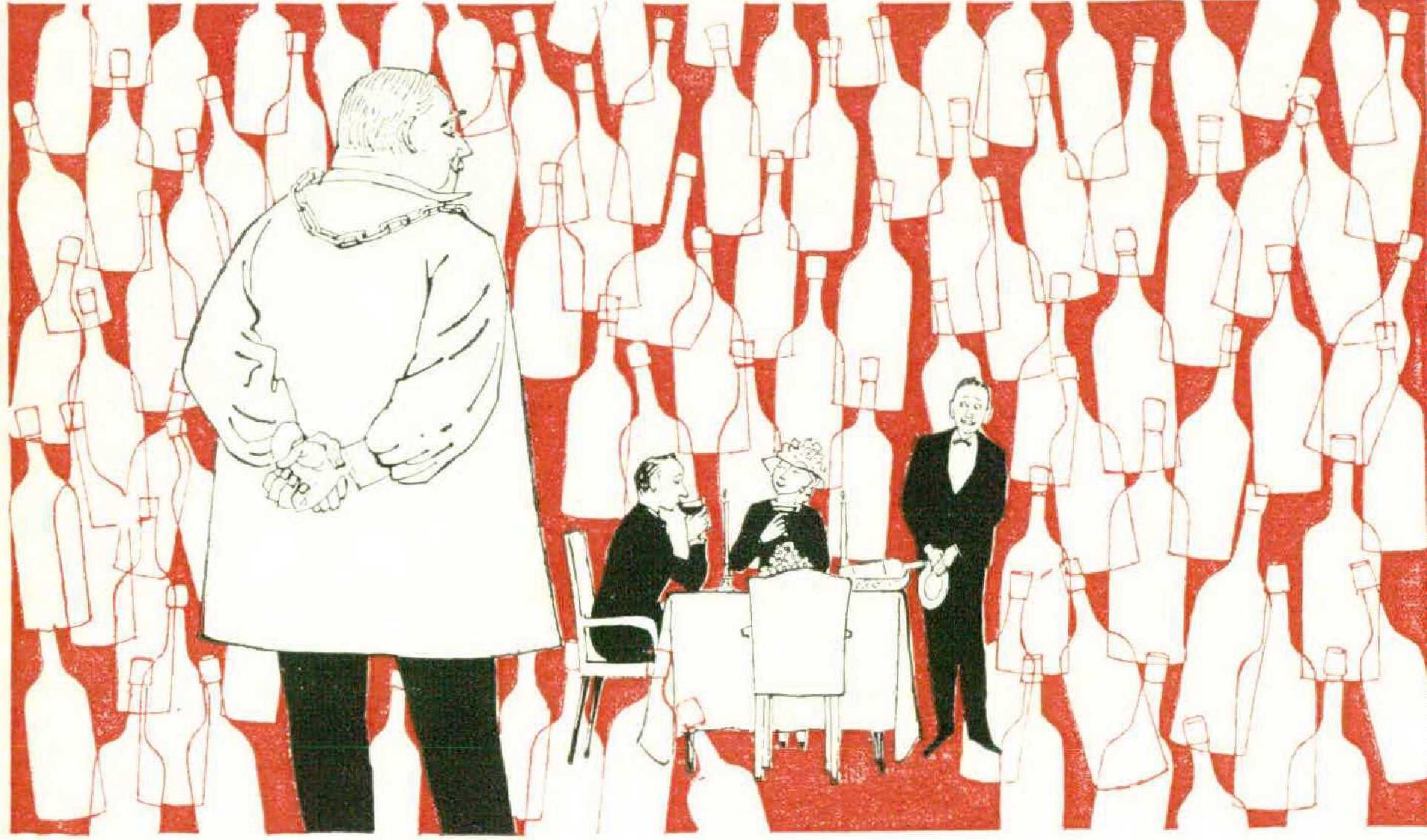
My husband and I dined there one Friday evening. It was early, seven o’clock, and we were the first customers. We sat quite alone among vacant tables with four men to wait on us: a senior waiter to discuss the menu, write down our order, and light the brandy should we decide on rognons flambés; a sommelier to bear the wine card, recommend vintages, and smell the corks; a junior waiter to serve each dish and refill our wineglasses; a busboy to bring water and remove plates. This, plus bright lights, heavy napkins, and the display of pièces montées, pâtés, pâtisserie, chaudfroids, fruits, cheeses, and boiled lobsters pyramided on a center table, is grande tradition.
But grandest of all was the sommelier, M. Le Bail — handsome and resplendent with a massive silver chain around his neck and an antique tastevin hanging from it. He wore a winegrower’s dark-blue smock, exquisitely tailored, laundered, and pressed.
“Madame, Monsieur.” He bowed and smiled. Just the right sort of smile — it indicated we had been there before, he recognized us, perhaps even liked us a little, though we weren’t important clients. “A little aperitif this evening?”
“Thank you, no. But Monsieur would like to see the wine list,” said I in my Miami French; then added shamelessly, “This is our last night in Paris, and we shall require expert counsel because Monsieur wants something rare, a bottle he could not possibly find in America.”
M. Le Bail shot us a quick professional glance — possibly we were not as shabby as we looked? — then withdrew, saying it would be a pleasure to discuss the matter when we had ordered dinner.
“What did you tell him?” asked my husband suspiciously. He speaks no French but is good at reading expressions.
“I just told him you wanted something special, but when I say it in French it doesn’t come out the same.”
The junior waiter appeared briefly, bringing a basket of bread covered with a starched white napkin.
“Besides,” I continued, breaking off a crust, “we may not be important customers, but we’re the only customers, so why not make the most of it?”
Thinking of the coming bottle and our early-morning plane, we chose a rather conservative dinner. The senior waiter went to place our order, and M. Le Bail returned carrying his wine list.
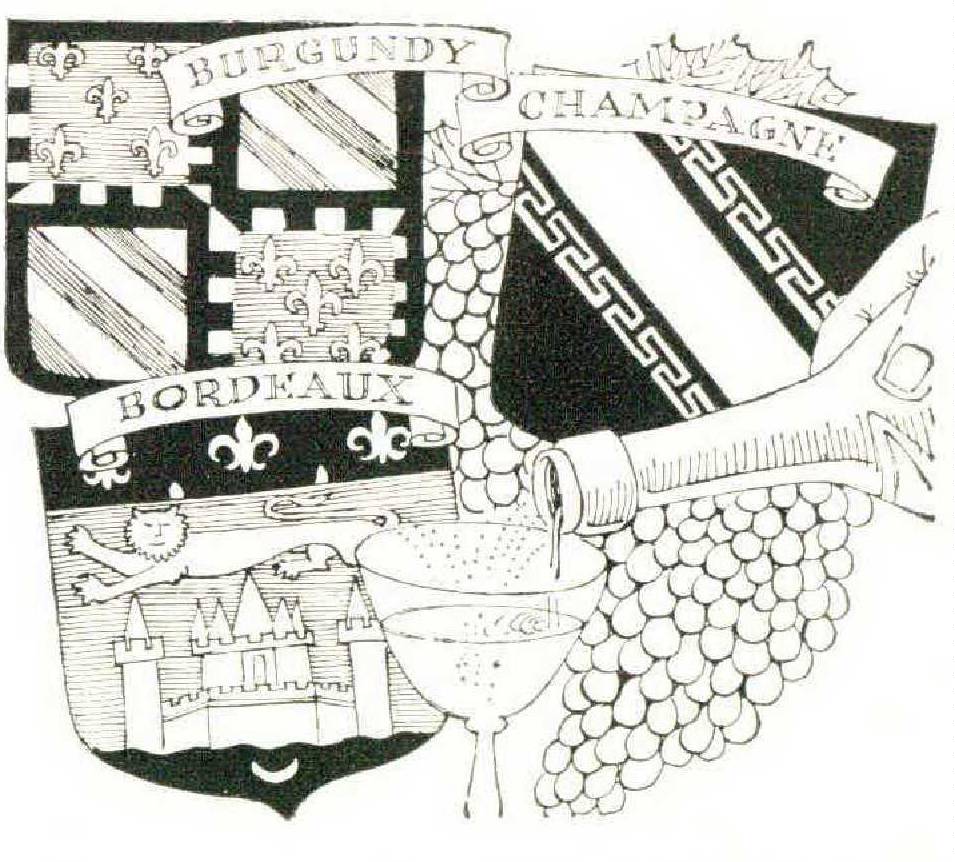
This wine list is what brought us to the Relais. Other restaurants have wine cards, but the Relais has a book bound in red leather, because some forty pages are needed to list all the wines in its remarkable cellars. Each chapter — Moselle, Champagne, Chablis, Côte de Beaune, Côtes du Rhone, and so forth - is illustrated with woodcuts of vineyard scenes. To my husband this book is more enthralling than a Shakespeare folio, for he is a wine enthusiast and can tell you all the Burgundy communes, even if he can’t pronounce them. The moment M. Le Bail handed it to him he was completely absorbed. M. Le Bail and I were virtually alone.
Filling in the silence, he began politely, “You are interested in wine?”
“Oh, yes,” said I. “Last month we spent three days in Beaune, drove up the Moselle Valley, and went to the wine fair at Colmar.”
This was not quite the answer he expected, and it thawed him a little. “Colmar! I was there myself for the opening.”
We compared notes on the wine fair. He told me he attended officially for the wine stewards’ union and as head of the Concours du Meilleur Sommelier, so I asked him what the contest was.
“It is a national competition, Madame, open to sommeliers from every part of France. Winners in each district come to Paris each year for the finals.”
“You mean a championship, just as in golf or tennis? And you are the head of it?”
“Precisely, Madame” — he put his hand over his tastevin — “and I am not only the director but the founder.”
M. Le Bail had thawed; I had him now, but he had me, too. I listened, fascinated, while he explained the three categories of competitors, compagnons-sommeliers, maîtres d’hôtel verseurs, and patrons-reslaurateurs. All compete before local juries in Lille, Colmar, Angers, Paris, Bordeaux, Dijon, Lyon, Marseilles, and Perpignan, and are graded on a point system: up to twenty points for technical knowledge of wines, brandies, and liqueurs; twenty points for style in presenting and serving wines; thirty points for liqueur identification; thirty points for beauty and eloquence of reasoning in favor of liqueurs at the end of the meal.
At that moment my husband emerged from the wine list and said that since I had ordered sweetbreads and he had ordered chicken we were committed to white wine, and while Chablis was a possibility, tonight he personally felt like something more full-bodied, a little less steely. Pouilly-Fuissé was out of the question because we had three cases of Drouhin’s at home. This speech was obviously not meant for me, so I translated.
Bending over the book, M. Le Bail produced a gold pencil and pointed to a Meursault-Charmes 1959.
“Too flowery for my wife,” said Monsieur, taking the bit in his teeth.
I translated this and murmured, “Twelve points, dear.”
“What are you talking about?”
“Later,” I muttered, as M. Le Bail’s pencil came to rest at PulignyMontrachet.
My husband said this was noble (I translated), more than noble, it was to him the king of white Burgundies, never would he forget the bottle we had at Beaune; and M. Le Bail said yes, though perhaps “queen” would better describe a white wine which, no matter how glorious (I translated), could never have the masculine richness of the reds — but how about a CortonCharlemagne instead ?
“Seventeen points for refutation of counterarguments,” I said under my breath, and my husband said (I translated) he was tempted, but that Corton, though further north, was still on the Côte de Beaune, and that he had hoped M. Le Bail could offer him something entirely different.
M. Le Bail adjusted the silver chain around his neck and announced that if Monsieur (I translated) wished to leave the Côte de Beaune entirely, he, Le Bail, could promise him something most unusual, a bottle available nowhere else in Paris. It came from the Côte de Nuits, from Chambolles, no less, and though unclassified, some experts considered it superior to many of the classified Meursaults. It was a Musigny — but a white Musigny!
There was a short pause — rather dramatic, I thought.
“I have never heard of it,” said Monsieur, yielding like a prince, “and I would appreciate the chance of trying a bottle.”
When I told M. Le Bail this he smiled, took his gold pencil, and made a hieroglyph on a small pad of paper. “You will never regret your choice, Monsieur,” he said generously, and went off to attend to the wine.
The junior waiter, who had been standing in the wings for some time, now came with the first course.
“What’s all the foofaraw about points?” asked my husband, breaking off a piece of bread and covering it with terrine de Body.
Between slices of saumon fumé, I told him about the contest. “So you see what you’ve been up against. The man’s a big shot in the Union des Sommeliers and bead of the wine stewards’ championship besides.”
“I may be only a tourist, and an American at that, but I am still the customer,” he said firmly, and took another bite.
The busboy brought a bucket of ice on a stand; our Musigny, wrapped in a white napkin, was already in it. “M. Le Bail thought you might be interested in this, Madame,” he said, and handed me a little gray book with a big black title, Code du Sommelier.
“It’s a handbook for the journeyman wine steward,” said I, leafing through it. “and it shows all the different glasses, and tells you the right temperatures for serving wines, and which were the greatest years, and what to offer when your customer has ordered truffles or escargots.” I speared another slice of salmon. “And this separate sheet gives all the rules for the national championships. You can see here that the juries are made up of representatives of the Sommeliers’ Union, of the National Committee for French Liqueurs, and of winegrowers’ associations, as well as of press, radio and television, and reputable gastronomes.”
“Just how does one get to be a reputable gastronome?”
Before I could think of a snappy comeback, the senior waiter came to see if everything was satisfactory. I told him it was.
“So M. Le Bail has spoken of his famous concours?” he asked, catching sight of the Code du Sommelier. “Ah, Madame, that is really something to see; those finals on television — what suspense!”
I tried to picture it, but could not. “It’s the tests I don’t quite understand,” I admitted. “What, for example, is liqueur identification? Don’t the bottles have labels?”
“Assuredly, Madame, but a sommelier’s senses should be trained to a point where labels are unnecessary; color and odor are enough. I myself did not compete, but here is one of last year’s contestants, and he can tell you how difficult it is.” He turned to the junior waiter, who was standing by with a silent butler and napkin, waiting to brush up our crumbs. “Come!” he added rather sharply, “and explain to Madame.”
Pale and wispy, the junior waiter was obviously not the sort of person whose opinion is in demand. He began slowly, “It is very, very difficult, Madame, because there are so many of them, you see.” Suddenly he became conscious of his silent butler, which seemed to embarrass him, so he set it carefully on the edge of the serving table. “Four different kinds of yellow liqueurs alone: Chartreuse, Izarra, Verviene du Velay, and Vielle Cure" - this gave him confidence, and he rattled on faster and faster — “also green Chartreuse, green Izarra, green Verviene du Velay, and green Vielle Cure. I’m not even counting crème de menthe, which is also green but sometimes white like Cointreau; so if you miss one in the series, it will throw the others all off, too. And, of course, all you can do is sniff and hold the glass up to the light, because if you did taste even one, your tongue would get so numb you couldn’t taste the others.”
“I had no idea,” said I, weakly, as the senior waiter bowed out to check on our next course. Taking back his silent butler, the junior waiter began brushing our table, but not silently, for some hidden spring had been released within him, and once asked to speak he now could not stop.
“I did quite well during training here at the Relais; M. Le Bail himself was coaching, and naturally some of us younger fellows felt we ought to compete. Every morning he’d fill all the glasses and set them in a row and make us practice. I could identify sixteen different liqueurs in three minutes.”He smiled briefly at the memory, then sighed. “Oh, Madame, I was too well trained. Here at the restaurant, you understand, there is lots of light, everything is in order. But they held the examination in the cellars of the Eiffel Tower.”In his eyes I could see sinister caverns, deepest gloom. “There were only two tiny light bulbs, and when I held up the glasses I could not tell green from yellow — even the Benedictine looked different. It was a disaster!”
“Dreadful!” I said.
“Yes. And then, too, you can imagine how nervous I was. Nervousness, of course, disorganizes the senses completely,” he continued solemnly, “and in my opinion, candidates lose up to fifty percent efficiency because of nerves.”At the word “nerves” he gave a little start and hurried off to the kitchen.
It was time to open the Musigny, and now that he had the field to himself, M. Le Bail was bearing down on us. corkscrew in hand.
I watched M. Le Bail draw the Musigny from the bucket and dry the bottle carefully. Though preoccupied, I could not help admiring his elegance and distinction in cutting the foil and inspecting the cork, cleaning it, and pulling it; nor was I likely to forget the delicate way he turned away from us to smell the cork, slip a few drops into his tastevin, and put it to his lips. He turned back, poured an ounce into my husband’s glass, and stood, bottle at the ready, waiting for Monsieur’s verdict.
Very slowly Monsieur took the glass and passed it under his nose. He held it up to the light, brought it back to his nose, and inhaled deeply. He took a sip and rolled it around on his tongue for a while. He took another, and drew in a bit of air between his teeth to develop the aromas. Finally he spoke.
“Tell M. Le Bail,” he said, “that we are deeply indebted to him for recommending this bottle.”
I did, and we all bowed.
When my turn came, all I had to say was “Superb!”, because the main event was over. I could see in Le Bail’s face that we had, in some way, passed; and we sipped our wine in an atmosphere of mutual admiration and chatted with him almost like old and valued clients. We learned that there are approximately five hundred full-time sommeliers in Paris alone; that concours champions win a handsome diploma plus a two-week all-expense trip for two through the great vineyards of France; that M. Le Bail’s cellars were not directly under the station but three blocks away, and anyone ordering noble, historic bottles, which were never kept on hand, had to telephone in advance so he could send out an expedition. I thanked him for lending me the Code, and he very kindly said I could keep it; then, seeing the junior waiter approaching with the second course, he wished us bon appétit and went back to his post near the door.
Toward the end of the second course more customers came — a man and a woman seated at a table far across the room and, nearby, a party of four Frenchmen discussing the menu like a business deal. Coldly and critically, we appraised the way they sat down and unfolded their napkins, read the wine list, and broke their bread, for we now understood that where great traditions are in force the same rules apply equally to waiters and customers; elegance of service demands style in being served. So, admiring the folds of M. Le Bail’s smock, the cut of his black trousers, the gleam of his silver chain, we watched him propose an aperitif to the couple across the room and heard them damned and déclassé when in loud American voices they asked for whiskey with lots of ice. The Frenchmen certainly knew how to order a meal, but there was something a little too businesslike about them.
Nevertheless, we had lost our luster as the only customers. The senior waiter and M. Le Bail had other fish to fry. The busboy no longer changed our plates quite so quickly. All that remained of our retinue was the junior waiter, covertly watching every bite we took.
For the last half hour the junior waiter had been terribly professional, yet the very intensity with which he brought bread, refilled glasses, produced the salad, presented the cheese hinted at something suppressed, a tale to be told, though naturally he would not speak unless spoken to, nor would his position allow him to attract our attention in any way. So when he had served our fraises et framboises rafraîchies and we had said how delightful they were, I asked him about his hardest test in the concours.
“Madame has already heard of my difficulties with those liqueurs, but, after all, that was a question of nervousness and lack of illumination. However, when Madame hears about the gastronomic menu she can perhaps put herself in my place, and ask herself what she would have said in the same circumstances.” He drew a breath and grasped his napkin with both hands; it was clear that this one rankled.
“They gave me the menu, and I was to choose appropriate wines. It began with fruits de mer followed by langouste Thermidor, two crustaceans in a row, which posed a very serious problem. Should I recommend two different white wines? If I did, I ran the risk of overbalancing the rest of the menu. And then it seemed to me that I ought to hold the dinner down to three wines, because, Madame, this is a new era, and clients don’t order five and six bottles the way they used to when he” — his eyes rolled toward M. Le Bail — “was a young man. Consequently I chose a Graves, since I thought it would harmonize with the fruits de mer and the langouste as well.”
He paused, I nodded.
“Next came duck — a bird, of course, but having dark flesh, which naturally required a red wine. I therefore selected a big RomanéeConti that would not only complement the caneton but would lead upward through the salad to the cheese.” He looked at me; his eyes called for justice.
“I see your logic,” I said, and gave Monsieur a rapid summary.
Sure of his audience, the junior waiter continued in a low and passionate voice. “When it came to the dessert I decided on a nice Sauterne whose sweetness would echo the sweetness of the dessert itself. What else could I do? Under the circumstances Champagne was out of the question. And that was my choice — the Graves, the Romanée-Conti, and the Sauterne — and I still don’t think it was as bad as all that.”
“Of course not.”
“But they flunked me, Madame. Flunked, for placing a Burgundy between two Bordeaux! Ah! Ah!” Overcome with rage, he rushed out to the kitchen for coffee without waiting for an answer.
“Trapped by grande tradition,” said the oenophile, when I told him.
The busboy removed our plates.
The meal was finished: we had reached the point described by Le Code du Sommelier as “the instant when the pleasure of the table enters the domain of memory.” The Code goes on to say that “knowing how to conclude is an art and, once again, le sommelier will put all of his knowledge at the disposition of the client to guide him in his choice,” so we were ready for M. Le Bail when he came over to offer a digestif. No eloquence was needed to talk Monsieur into a glass of Armagnac, but I could eat or drink no more.
“Perhaps a little Cassis or a crème de menthe on ice?” suggested M. Le Bail, suavely.
With a flourish I wheeled out my counterargument. “Ah, M. Le Bail, I am a martyr to Bacchus. My system has never recovered from the wine fair at Colmar.” For emphasis, I made the traditional gesture of French gastronomy: hand over the liver, shoulders raised high. “And though you tempt me greatly, I fear that tonight I cannot support a liqueur.”
Quick as a flash came the refutation. “But surely Madame realizes they are called digestifs for a reason?”
He had me cold. Desperately I searched for a counterrefutation. “That may be true of the average digestion, but not mine. Wasn’t it Molière who said that a woman was her own best doctor?”
M. Le Bail knew his art of concluding. Bowing quite low, he replied. “It was Shakespeare, Madame, who said ‘Know Thyself,’ ” and departed.
“Who won?” asked the oenophile.
“He did, and I’m not complaining. Because this dinner was not only delicious, it’s been the most educational meal I’ve ever eaten,” said I, as the pleasures of the table began to slip into the domain of my memory, “and I just hope I can keep a grip on myself till we get out of here.”
I should have left well enough alone, but when my husband called for the check I thought of one last thing to ask the junior waiter. I turned to him while Monsieur was calculating the service. “Tell me, of all the difficulties of the concours, what do you think was the worst single question?”
Without hesitation he said, “What digestif to offer a customer who had choucroute for the entrée, Madame.”
I remembered the choucroute I’d seen in the Alsatian restaurant across the street — mountains of sauerkraut heaped with sausages and smoked pork — and a wild, cackling laugh rose in my throat. I opened my mouth to cry “bicarbonate of soda!”
But my French failed me. I did not know how to say “bicarbonate of soda,” nor did I know if it existed in France. I had lost my grip. In a strangled voice I could only say, “Better luck next year,” as we got up to go.