The Eisenhower Administration: A Self-Portrait
A Harvard historian who has specialized in American history, OSCAR HANDLIN won the Pulitzer Prize with his book THE UPROOTED,and a fter ten years’ preparation has just published his illuminating single-volume history, THE AMERICANS.In the following article he makes an assessment of the Eisenhower Administration based upon the former President’s new book and on other recent volumes written by those close to Ike in the years 1952-1956.
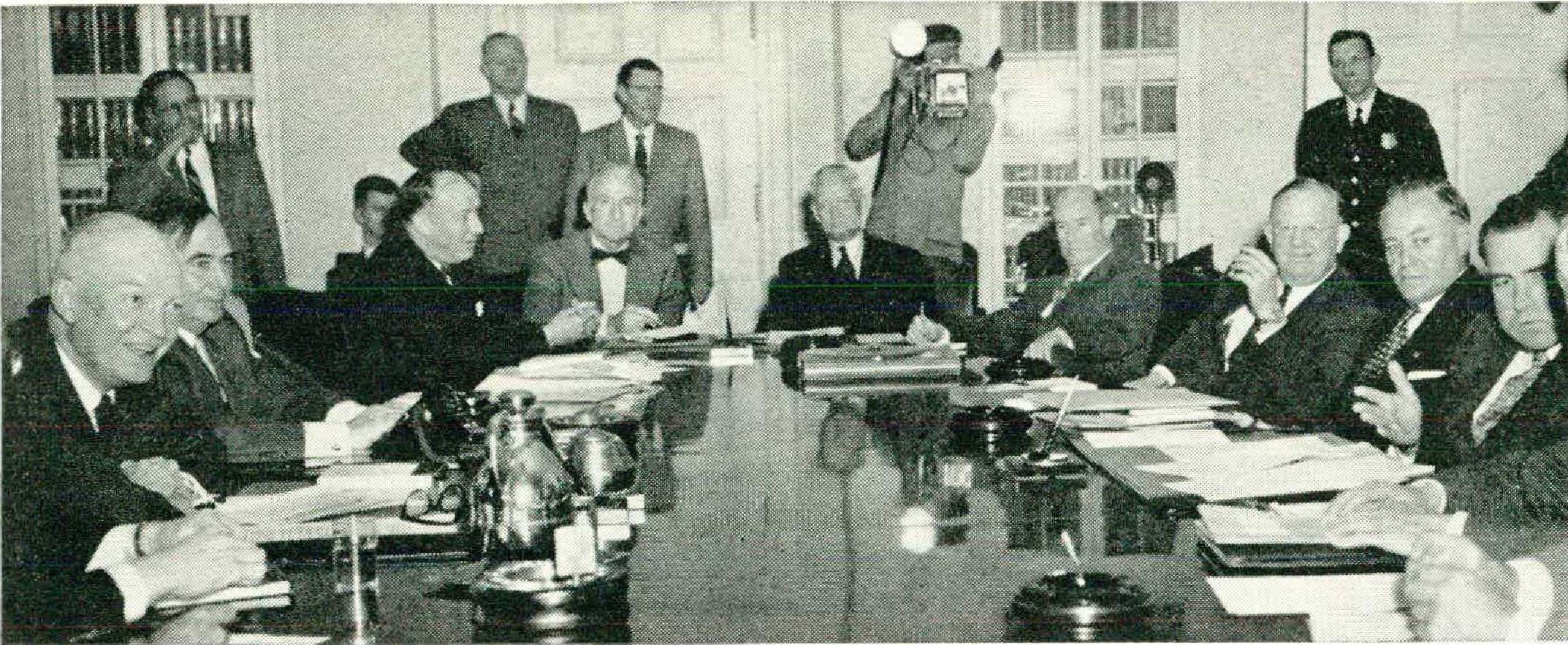
WIGHT D. EISENHOWER accepted a grave challenge when he returned from Europe in 1952 openly to seek the Republican presidential nomination. The greatest war in history had come to an end only seven years earlier and had left the world still smoldering from its damage. The ideological, economic, and social combustibles for a renewed conflict were everywhere perilously close to the blazing point; and the United States itself was engaged in a costly and seemingly interminable conflict in Korea. At home, widespread uneasiness belied the apparent prosperity of the post-war years, and the tension generated by unresolved problems presented a standing threat to political order. Few statesmen in our times have fallen heir to as difficult a situation.
Ike himself recognized three pre-eminent problems. The GOP, embittered from twenty years of defeat, had to be modernized to preserve the traditional two-party system. “Federal paternalism,” which bred disillusion and cynicism, had to be ended. And a new foreign policy had to defend human liberty without distortion by the alternating pulls of adventurism and isolationism. The times called for a revitalized Republican Party to clean up the “mess” in Washington, to eliminate the encroachments upon traditional liberties, and to safeguard the free world.
To these tasks Eisenhower brought substantial talents — patriotism, dedication to public service, and an extraordinary capacity to direct a military team derived from his experience in SHEAF and NATO. Knowing the horrors of war, he was eager to preserve peace and to prevent the United States from becoming an armed camp. His long military career had earned him tremendous popularity among men of every party; his bearing, his warm grin, an inner personal charisma drew others to him. Even his opponents preferred to direct their fire not at him but at his followers. As a result, he consistently attracted and retained widespread support. (In 1963, as in 1953, the polls reveal him to be the most popular political figure in the United States.) The ability of his Administration to draw upon these personal assets accounted for its significant achievements and also helped to explain its failures.
Ike’s accomplishments can be assessed only in the light of the hazards of the years in which he held office. It was no mean feat simply to have avoided disaster while the Communists acquired a nuclear armory and consolidated their hold on Eurasia between the Oder and the Pacific. From the start the President was eager to help preserve the peace as he had helped to win the war. His speech to the American Society of Newspaper Editors in Washington in April, 1953, was an imaginative effort to reach for a fresh positive policy, and it evoked immediate sympathy in every part of the world. His “open skies” and “atoms for peace” plans groped toward a constructive resolution of the armament dilemma. He deserves credit for the truce in Korea, for the final ratification of the Austrian peace treaty, and for the happy outcome of the difficulties over Trieste. If relations with the Soviet Union remained unstable, it was not through want of trying on his part.
Domestically, the economy remained prosperous; social tension was contained, even if it did not abate; and there were tentative efforts to deal with the problems of civil rights, housing, transportation, and education. Above all, Eisenhower made palatable to most Republicans the social welfare legislation of the preceding two decades. In the 1950s, the New Deal ceased to be an active political issue and became an accepted part of the American past. No other figure could have achieved that transformation. The extent to which Ike was responsible for the acceptance of the social changes of the 1930s may be measured by the abhorrence in which the right-wing extremists still hold him.
The effort to mute dissension and avoid conflict in both domestic and foreign policy confirmed the faith of Americans in their President. Millions of his fellow citizens were eager to be reassured; and Ike, who already commanded their confidence, strengthened it by his unruffled certainty that the dangers would pass by. He elicited the same feeling of trust as had FDR and aroused little of the antagonism the New Dealer had. At a time of great pressure, when decisions in the United States could affect the future of mankind, it was heartening to be told that all was going well.
But the kindly figure who spoke in these terms seemed content to compromise rather than exert the leadership which was his. The dangers did not pass by but, submerged or hidden, remained a threat to the republic. The shortcomings of the Administration were much less noticed than the successes; but they were also reflections of the President’s personality, and in time they were to generate dismay. We catch glimpses of these shortcomings, some of which led to failure, in the books by the President and members of his Administration.
WITH unprecedented speed, a succession of volumes has provided the data for an evaluation. In 1956, a knowledgeable reporter, Robert J. Donovan, who obviously had access to sources in the government, published Eisenhower: The Inside Story (Harper), Governor Sherman Adams, the President’s chief aide until 1958, put together his account of national affairs in Firsthand Report: The Story of the Eisenhower Administration (Harper), in 1961. A year later Vice President Richard M. Nixon’s Six Crises (Doubleday) touched on his role in the Administration. Recently, in The Ordeal of Power: A Political Memoir of the Eisenhower Tears (Atheneum), Emmet J. Hughes, for a time a speech writer close to the President, presented a perceptive analysis of some phases of the first two years in office. Still another look at Ike in action came in Black Man in the White House by E. Frederic Morrow (Coward-McCann).
To these narratives the President now adds his own story of his first term in Mandate for Change, 1953-1956: The White House Tears (Doubleday, $6.95). This book, which draws frequently upon quotations from Ike’s diary, from correspondence, and from public papers and speeches, contains no startling revelations. It is valuable mostly for the light it casts upon its author. Its emphases, its interpretations, and its omissions go far to explain Eisenhower and the motives and beliefs that guided the nation’s destiny through most of the 1950s.
The satisfaction with which Eisenhower sets forth the record of his first term tends to conceal his failures. Yet complacency and the unwillingness to make hard choices did prove costly in both foreign and domestic policy between 1953 and 1956. Before the President left office, he listened tight-lipped in Paris to an insulting scolding from the Communist boss; he came home from the Far East having suffered the indignity of a retracted invitation to visit Japan; and he found Russian influence penetrating to the Near East and Africa, and to Latin America, where it had never before had a foothold. Surely it is unjustified complacency to write that in 1956 “the rolling advance of Communism came to a stop.”
Eisenhower was unwilling, and still is, to recognize that his Administration was deeply divided on foreign policy. Contradiction and confusion were the inevitable results of the inability to reconcile the discrepancies among the various forces that shaped his diplomacy.
From the start, other objectives distracted him from his goal of peace. A deep-rooted suspicion that earlier Democratic Administrations had been too easy on Communism had substantial political value in the election of 1952 and accorded with the mood of a nation which could not understand why the fruits of victory were being withheld. It was tempting under these circumstances to call for a more aggressive posture. Hence the fiasco of the congressional resolution to repudiate FDR’s nonexistent “secret agreements” for the enslavement of Eastern Europe. Hence the talk about going beyond containment to the “liberation” of the subject peoples. Hence the implied promise that a visit to Korea would lead to a new turn in the war. Hence the brinkmanship of the eight years which followed.
The President deluded himself in the belief that he could talk liberation for the satellites and still seek peace with the Soviet Union, just as he hoped that unleashing Chiang Kai-shek for an attack upon the mainland, in February, 1953, would help end the Korean War. In fact, the two policies canceled each other out.
A third and formidable element affected the situation. The Administration took office with a promise to balance the budget, reduce expenditures, and lower taxes. But substantial savings could come only through a reduction in military expenses. Although the new look in defense was not complete until 1958, Army manpower was cut by fully one third in the eighteen months after December, 1953. To attain that objective and still maintain American strength, it was necessary to place greater emphasis than formerly on the deterrent and destructive power of nuclear weapons. The logic of massive retaliation called for a refusal to fight conventional brush-fire wars and relied instead upon the threat of a nuclear holocaust to achieve national objectives.
In his book the President seems unaware of the incompatibility of these objectives. Pursuing both peace and liberation, he confronted a powerful antagonist with but one weapon which he always hesitated to use. American representatives abroad, kept busy answering questions about McCarthyism, were in no position to wage the ideological battle for freedom; and the concern with the balanced budget inhibited any bold, novel, nonmilitary acts of initiative. The result was an incoherent foreign policy confusing to both enemies and friends and ineffective in Asia, Europe, and the Near East.
Eisenhower entered the White House heir to the disagreeable consequences of the Communist takeover of mainland China in 1949. A full-scale war raged in Korea; Chiang Kai-shek held precariously to Formosa and its adjacent islands; and the French were bogged down in a struggle with Red guerrillas in Indochina. Perhaps no President could have achieved more satisfactory results than Eisenhower did in 1953 and 1954. But the news from Laos and Saigon is still grim.
Eisenhower, for instance, does not recognize that the price of peace in Korea was the loss of Indochina. No one should have known this better than he. His State of the Union message in February, 1953, had pointed out “that there was a definite relationship between the fighting in Indochina and that in Korea,” and the next month he had warned that “a cease fire in Korea would free the Chinese Communists to reinforce their support of the rebels in the Indochina area.” Toward the end of that year, after the armistice, those effects were indeed felt; the artillery that helped reduce Dien Bien Phu was no doubt released by the settlement in the north. In the end an armistice gave the Communists a foothold in Southeast Asia which they are still actively exploiting. Eisenhower, however, confidently believes that “much good, along with much sadness, came out of the Indochinese struggle” — the formation of SEATO, for instance. How much good, recent events in Laos and Vietnam have eloquently revealed.
The President also regards the Formosa policy as a triumph. The massive Red Chinese bombardment failed to reduce Quemoy and Matsu. But the United States acquired an ambiguous commitment to intervene on Chiang Kai-shek’s behalf which hinged upon the assumption that we would be able to read the minds of the Red Chinese. We would come in if the Red Chinese attacked the offshore islands with the intention of using them as steppingstones to Taiwan; otherwise, we would not intervene. The subsequent stalemate left unresolved the larger issue of the relationships of China to the United States. They are still unresolved.
Eisenhower did not supply the consistent policy toward East Asia which the United States had lacked since 1949 and still lacks. In the whole of this vast area, Communism was a threat, to which we could respond either by active resistance or by an accommodation of some sort. The President was unwilling to make the decision. His desire for peace and for fiscal stability and the limitations of our defense resources inhibited any effort at liberation such as Chiang and Rhee and Senator Knowland called for. But neither would Eisenhower take the steps to learn to live with the enemy; he simply ruled out any suggestion that the Red Chinese participate in the great-power negotiations. To have done otherwise would have hopelessly divided his own party and made a mockery of the campaign charges that the Democrats had betrayed free China.
IN EUROPE the choices were less clear-cut. Talk about liberation continued to enliven Republican oratory; but when the moments of truth arrived in the chain of popular uprisings that began in East Berlin in June, 1953, and extended through the satellites to Budapest in 1956, discretion was the better part of valor in Washington. Significantly, Eisenhower’s account is totally silent on these matters.
As the Marshall Plan sped the recovery of Western Europe we faced the need for a more equal accommodation with our closest allies, France and England. Eisenhower entered office with three fixed ideas, derived from his experience as NATO commander: the continental European countries were to move toward unity; they were to contribute more substantially to their own defense in order to relieve the burden on the United States; and they were to make a place in their future plans for a sovereign West Germany. The device that would further all three objectives was the European Defense Community, a scheme focused on the “sludgy amalgam” (Churchill’s phrase) of a supranational army. Ike had attached so much importance to this plan in 1952 that he had been unwilling to leave Paris to become a candidate until the French negotiators had accepted it.
There remained ratification by the Chamber of Deputies, however, and it quickly became apparent to all but the Americans that the action would never come. Yet the United States made this the acid test of the friendship of any French government. The United States threw its weight behind the pathetic Laniel because no one else would take a stronger position on the defense of Indochina or in support of the European Defense Community. By the same token, Eisenhower failed to recognize in Pierre Mendès-France the one leader who might have stabilized the Fourth Republic. MendèsFrance brought the lighting in Indochina to an end, extricated his country gracefully from Tunisia, allowed EDC to die mercifully in the Chamber, and took the decisive steps that would ultimately give a firm basis to European economic and political union. But the Americans refused to come to his aid in the Geneva negotiations, were cool to him during his visit to Washington, and generally stood aloof until his downfall, brought on, in part, by disgruntled EDC supporters. Germany, by 1956, however, was in NATO without the EDC for which the Americans had fought so hard. “I was highly gratified by developments,” Ike now writes, “as was Foster and the entire administration.” But why?
The consequences of misunderstanding with Britain were more grave, although not more clearly perceived by the President. Already in March, 1953, Eisenhower and Churchill were talking at crosspurposes on the question of Suez. The English had presented the United States with their proposals for settlement and had asked for help in the negotiations with the Egyptians. The President refused to become a party to the dispute, although he expressed approval of the proposals. Churchill graciously accepted the refusal but went on to say that, even if we could not help him openly, he hoped that we would not let it appear that we were helping Egypt. “He had missed my point,” writes Eisenhower. “So far as the plan was concerned, we supported him fully.” But no action! That “support” had a different meaning on the two sides of the ocean became increasingly evident in the next three years; and the culmination of that failure of understanding which opened the way to Communist penetration of the Near East and Africa came in October, 1956, with the invasion of Suez, at the point where this book ends. No hint of that tragedy, however, casts a shadow across these pages, although it was well in process early in 1956.
IN THE outline for his first inaugural address, Eisenhower underlined the phrase “readiness to sacrifice”; and later he called for broad programs to improve the national transportation system, aid distressed areas, and raise the level of education. Very little came of these suggestions.
The major responsibility for the lack of action falls certainly upon Congress. Any Chief Executive compelled to deal with that body in the 1950s deserves sympathy. Unrepresentative of the country as a whole, bogged down in anachronistic procedures, led by mediocrities, it would have tested the tactical skill of the ablest President. Despite their own experience on the Hill, Truman earlier and Kennedy later discovered the dangers of tangling with the national legislature. Ike, furthermore, had to face a Congress in which hostile Democrats were a majority during half his term.
But he nevertheless must share the blame for inaction; his generally negative attitude toward government encouraged a complacent people to believe that problems left alone would somehow solve themselves. The reiterated insistence upon a balanced budget, the assurance that private efforts could cure recessions, and the warning that political interference produced “a mess” took the urgency out of his occasional suggestions for action. A President who doggedly believed that a strong federal government was a threat to liberty could hardly excite voters or congressmen in favor of extending federal influence in education or transportation.
The clearest demonstration of the failure to reshape the GOP came from his posture toward Joseph R. McCarthy. Eisenhower had no respect for the senator from Wisconsin but was unwilling to risk an open battle. A decade later he still does not understand the consequences of his restraint. During the campaign of 1952, for instance, deference to McCarthy induced Ike to delete from a speech a favorable reference to General George Marshall. “When this became known,” Eisenhower now writes, “it gave the opposition and some segments of the press an opportunity to charge that I had ‘capitulated’ to the McCarthyites. This was, of course, completely untrue.” The “of course” in that statement is even more staggering than the certitude that the charge was untrue. But most staggering of all is the unawareness of what Sherman Adams reported — that not only the opposition but some of Ike’s staunchest supporters were greatly “disheartened” by his action.
There were few causes for encouragement thereafter. Without intending to, Eisenhower fell in with some features of the McCarthyite line. He took up, and still repeats, the accusation that Truman’s Administration had shown “either a complacency or a skepticism toward security risks in government.” He still boasts of his dismissal of thousands of government employees and is oblivious of the results. The discovery, for instance, that the President and the Secretary of State were ready to throw the Foreign Service rank and file to the McCarthyite wolves reduced the Department of State and its Information Agency to a shambles at a critical period in our relationships with the rest of the world. The President’s position, down to the very censure of the senator, was inglorious and for a time wrecked the prospect for a new Republicanism.
Eisenhower’s attitude toward civil rights revealed another troubling deficiency in his understanding of presidential responsibility. The breakdown in inherited patterns of prejudice against the Negro made rapid progress in the decade after 1945 and culminated in the Supreme Court decision of 1954, which struck down the doctrine of “separate but equal.” The defenders of segregation at that point seemed utterly routed. But the movement toward equality then slackened, with consequences we have all regretted since Little Rock.
It is difficult to pin down Eisenhower’s personal attitude. He appointed a Negro to the White House staff, but the commission was withheld for five years; and even “at that,” says Frederic Morrow, “the swearing-in was not done in the usual style,” for the President, who usually attended such ceremonies, was not present. Hughes reports a conversation in 1956 in which the President complained that “the Supreme Court decision set back progress in the South at least 15 years.” Sherman Adams describes Eisenhower as a moderate who considered the Supreme Court decision correct but who was convinced “that progress toward school integration had to be made with considerable deliberation.” One could not “change the hearts of people by law,” the President argued — not a surprising view from one who quoted Senator Harry Byrd of Virginia as an authority on the subject.
Eisenhower never thought the matter through. He accepted the judgment of the Court and urged the District of Columbia schools to obey the law immediately. But he found it unnecessary to express “either approbation or disapproval of a Court decision.” There was no inkling — either at the time or, retrospectively, in the book — of the urgency of the issue, of the way in which its First Citizen might voice the conscience of a nation dedicated to equality and freedom, of the difference a positive affirmation might make in the border states. He might have done well to ponder more often the meaning of the promise, in his acceptance speech, to “keep nothing in reserve” in the crusade “for freedom in America and freedom in the world.”
ONLY unwittingly and by indirection does The White House Years touch upon these failures or their causes. It is thus dismaying to find calmly repeated in the book Ike’s protests against the tendency to think that we “should all eat caviar and drink champagne throughout our lives, where hot dogs and beer might be more appropriate.” Those phrases reflect a remoteness from the real people and the real issues of the United States of 1953 and of 1963, perhaps accountable for by the Army officer’s characteristic isolation from the common experience.
An undertone of complacency runs through the book, which admits to not one single mistake or error of judgment. Eisenhower’s faith in himself is a substantial element in his popularity, but he did not show the same mettle in his presidential leadership as he did in the war. Bland reassurances, comforting as they were, did not move men to action.
Perhaps Ike never doubted himself because a military commander could not afford the luxury of introspection or inner questioning. But his placid self-assurance was also the attitude of the self-made man conscious of his own success. On his first day in the White House, he smiled, remembering his beginnings. “If my chances of walking into this room had been calculated when I was born in Denison, Texas, in 1890, they would have been approximately zero. And yet the homely old saw had proved to be true: in the United States any boy can grow up to be President.” Ike liked other successful men who thought as he did, and he gave them places in his Cabinet and in the upper echelons of his Administration. Among the Democrats, he felt close to Senator Byrd of Virginia and Senator George of Georgia, but he quite clearly did not understand his own Secretary of Labor, Martin Durkin, who seemed to think that the laboring population had distinctive interests to uphold.
Eisenhower’s refusal to use the patronage constructively prevented him from effecting significant changes in Congress or in his party and reflected attitudes carried over from his military career. The armed services handled cantankerous senators and representatives not by a headlong assault, but by persuasion, conciliation, and patience. Eisenhower never realized how different the President’s role was. Deference to congressional authority and willingness to compromise again and again sapped his strength in conflicts with the Hill. Even in matters about which he felt strongly, such as the confirmation of Charles E. Bolden’s appointment or the defeat of the Bricker Amendment, he made concessions without knowing that he did so. He thereby taught the congressmen that they had little to fear from opposing him.
Ike’s book points, by omission, to still another weakness of his Administration. There is not a word in the book about the divided counsels and personal antipathies within the official family to which other accounts refer. Of some of this dissension he was no doubt unaware at the time. When he entered the White House he thought that it would be enough to select an efficient staff and to organize a coherent chain of command, so that critical problems would filter through to him for decisions which, once made, would automatically be implemented. The President himself was unflinchingly loyal to his subordinates and assumed that they would always act together as a team. He did not realize that politics was not a field within which military discipline operated.
It is quite credible, therefore, that he did not know about the imbroglio between Edward Corsi, John Foster Dulles, and Scott McLeod that sabotaged his refugee relief program in 1955 until he read about it in the papers. Perhaps he did not even know, in 1953, of Dulles’ efforts to alter the foreign policy speeches Emmet Hughes wrote for the President. If so, that would explain the frequency with which the crosscurrents that swirled beneath the surface of the Administration pulled well-intentioned programs to pieces. If he did know about these matters and is simply unwilling to discuss them now, as he was unwilling to deal with them at the time, that markedly reduces the value of his account.
The stories written by insiders make titillating reading, but they are difficult to evaluate because they reflect the emotions of the events with which they deal. Donovan expresses the disappointments of some of the President’s early supporters. Sherman Adams is apologetic, Richard Nixon defiant. Emmet Hughes writes with the bitterness of one whose point of view was disregarded; Frederic Morrow with the frustration of one not permitted to do the job he wished. And Ike himself speaks with the assurance of the successful hero who cannot believe that anything went wrong. No matter how honest the author, sentiments influence memory, the selection of material, and the interpretation of what transpired. These books therefore have informed us of little that was not already in the public record; and they may create myths that will obscure the understanding of future historians.
The haste with which the actors in public affairs have rushed into print raises some question about the propriety of these rapid disclosures of confidential information. Emmet Hughes, for instance, quotes often from his minutes of Cabinet meetings and from private conversation. It would be unfortunate indeed if the key figures in government were to be distracted from the business before them either by the urgency of taking notes for their own inside stories or by the fear of being quoted in someone else’s. The gain in public information is too slight to justify the loss in staff confidence; and future Presidents will no doubt find it wise, as President Kennedy has done, to set some limits on freedom of confidential disclosure.
When the balance is struck on the record of the Eisenhower Administration, there will be substantial entries on both the positive and the negative sides. It did not solve, or even face, all the problems that beset the nation in the 1950s; but it made a significant endeavor to preserve the peace and to maintain the well-being of the people. It would be unfortunate if these hasty volumes, of either exaggerated praise or exaggerated criticism, were to befog our understanding of those momentous eight years.