Catalina Cat
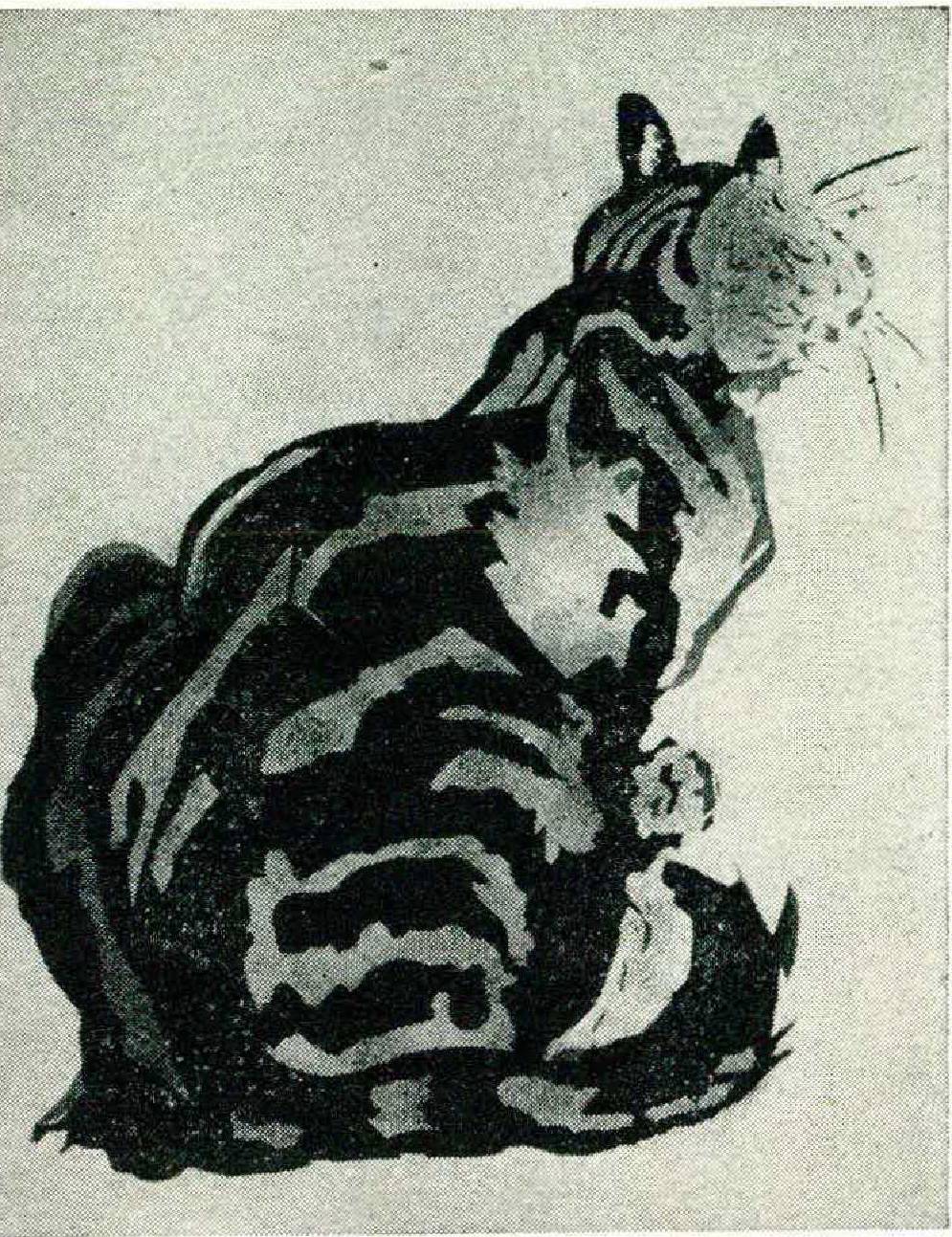
ELIZABETH R. CHOATE’Slife has been a varied one, mostly devoted to horticulture, blue-ribbon livestock, and collecting antiques. When she began living in Arizona, she became, rather by accident, a collector of cals and the owner of that independent heroine, Minette.
WE HAVE built a house called La Punta high up on a foothill of the Catalina Mountains outside of Tucson. Here, twice a year, in an ignorant sort of way, we delight in the wildlife around us. We have had calls from a tortoise, a wildcat, and even a mountain lion; and one day at high noon a beautiful pink and black Gila monster tried to get into the kitchen. We enjoy the weird cacophony of the coyotes roaming the arroyos below and the sight of a pair of great western hawks soaring gracefully above the giant saguaro cacti. But our hill is also loaded with plain house cats who eke out a pathetic existence by preying on the fauna so abundant in the Arizona-Sonora desert.
Now, it is a good thing to have some cats around a house in Arizona: they keep down the rats and mice and scorpions, and they very soon alert you to a snake or other reptile. But enough is enough, and we do not come to Arizona to be kept awake all night by fierce fights in the patio which make the midnight music of Beacon Hill sound like a soft lullaby in comparison.
For some time we have had two cats at La Punta, both desert refugees. One is a handsome gingercolored Maltese, very big and rather naughty. Unfortunately, our caretakers named him Buster.
The other one, who arrived as a starving kitten, was even more shamefully named Baby-Cat. BabyCat was thought for some months to be a girl, with green eyes and the face of a Parisian cocotte; then suddenly he turned into a courtly gentleman of the old school, black and white and sporting a tail fourteen inches long, like a graceful uncurled ostrich plume.
All was peaceful at La Punta. Granted, there were stray visitors who sought to join us. They came, and after a few horrendous battles in the patio they went away, leaving only mangled flowers, tufts of hair, and sometimes a little blood behind them. At least, all was serene until my return last fall. As I drove from the station late at night, one of the caretakers said, “Honey, there’s another cat around the place, and you had better do something about it.” The full import of this remark didn’t register at the time.
The next morning I woke early and went out to enjoy the clear calm of the desert dawn. I drank some coffee, and as the sun rose in a blaze of fire over the mountains I went for a stroll to see how things had come through the summer on the hill. Halfway down a slope a shadow moved among the rocks and prickly pears. I waited, and then I saw a small gray cat cautiously approaching. I called to it, and to my surprise it answered and came to me ingratiatingly and elegantly. She was desperately hungry and thirsty and let me touch her, although one of her ears had a deep raking scratch in it and her tail had been broken in two places.
She was so thin that her backbone felt like the teeth on a bucksaw, and her skin was like tissue paper from dehydration. It took several days before she would let me pick her up, and then I discovered that she had many cactus spines, both large and small, deeply embedded in her flesh. She sat on my lap nervously, but she seemed grateful to have me pull them out. At first her broken tail was a pitiful sight to me, but as she grew gayer and happier it began to look jaunty and more like a soft bowknot.
This was no ordinary cat. She had a small head with large gray-green eyes, and her coloring was gray tiger with a pink undercoat; between her ears she boasted a pink lucky spot. It was plain that she had some ancient and distinguished blood in her ancestry. At the same time, there was more than a hint of the wild about her, for the silky texture of her coat, her alert head, large feet, and lean legs were almost identical with those of the margay cat, which is a native of Central America.
The pencil markings around her eyes curved outward onto her cheeks, giving the impression that she was privately amused. This was most evident when she relaxed, because then she would puff out her cheeks like a chipmunk with a mouthful of nuts, half close her eyes, fold her paws one over the other in classic lion pose, and assume the expression of a laughing sphinx, thus leaving me to speculate more than ever about her family tree.
Because of her complete independence and resourcefulness, she reminded me of Jennie Baldrin, the heroine of Paul Gallico’s incomparable story The Abandoned. But I decided that she looked of French rather than of the Egyptian or Scottish descent that Jennie boasted, so I named her Minette after another of Mr. Gallico’s cats. I once overheard a friend of mine, Jan Ciecianowski, talking comfortably to one of my dogs in Polish, and when I seemed surprised, he said, “But, my dear, all animals understand Polish.” Unfortunately, I do not speak Polish, but Minette and I were very satisfied to communicate in French. I would call, “Minette, où est-tu? Viens toi,” and she would come running with a soft answer, “Oui, je suis ici, que veux-tu?”
MINETTE ate hungrily four times a day, and after two weeks I wondered why she did not begin to get fatter. She had found a very clever place to live under the woodpile. The air space there is well insulated from the burning sun; a hill and an adobe wall protect it from the violent winds that sometimes sear the desert. It was from this well-chosen spot that she always came when I called her.
From her size I judged Minette to be about four months old and vaguely wondered whether I should have her “nocolated and oporated,” as we say in New England. These hazy thoughts suddenly became concrete when we were visited one night by a big red tiger tomcat with whom Minette appeared most friendly. He was a husky, handsome fellow, and his intentions were obvious. The next morning I called a veterinarian and reluctantly had to ask him the facts of cat life. I felt like an imbecile because, although I have raised more than one hundred and eighty litters of dogs, I did not know how early a kitten became a cat. Dr. Hinds told me that five months was about average, so I relaxed for the time being.
Minette was getting tamer all the time, and now she was coming into the house to eat and to reconnoiter. Baby-Cat did not seem to mind her advent; in fact, he was very polite to her. But when I say that Buster resented her intrusion into his ivory tower, I am putting it mildly. He became infuriated, he glared, his ears went back, and he spat and growled in a rude and fearsome way. Minette stood her ground, but she continued to live in the woodpile.
The patio at La Punta is brilliantly lighted from all angles for the express purpose of showing up any nocturnal visitors, especially snakes. One evening I glanced down the path, and there to my horror was Minette, accompanied by two very young and fat kittens. I certainly had been a slow coach not to have realized all along why she did not gain any weight. To Buster this was the coup de grace. He rushed out and prepared to slaughter the kittens. Luckily they escaped to the haven of the woodpile, by a whisker. The next evening one of my guests came into the kitchen saying, “I have some bad news for you. There is another kitten in the woodpile.” This was bad news indeed, because this third kitten was as ugly as sin and as wild as a coyote.
What kind of impossible mess was this? I could not have wild kittens growing up all over the place, nor could I allow Buster to commit murder right under my nose. I stayed awake for hours that night trying to map out the best thing to do. By morning I decided that there was only one solution. I bundled the boys off to the animal hospital for a day or two until the kittens could be caught.
This was the first of many noisy cat trips that I was to make. The boys howled so loudly on the way that I was afraid I would be stopped by the police on suspicion of kidnapping. I did not have to ring the bell at the hospital; I had been heralded from half a block away. Mrs. Polich, the lady at the office, was most businesslike and filled out an admittance card for each cat. I became hot with shame when I had to tell their names. “Not very original, are they?” she said.
It seemed to me that it took forever for those kittens to learn to eat and drink. I put food out by the woodpile, and Minette was pleased by this. She had a special soft sound that she made to call the kittens to her; it was halfway between a purr and a meow. Curiously, she used this same sound when she talked to me.
I started on a different approach and put food on the doorstep. Presently a little gray kitten arrived. I moved the food inside the house, and in she came. This time I felt like a double-dyed traitor, because I knew that she was Minette’s favorite. She was, indeed, a duplicate of her mother, right down to the pink spot on her head. But there was no time for sentimentality.
It took days to entice the last kitten into the house. He was a beautiful red tiger, the image of guess who? When we finally shut the door on him, he flew around the room, caroming off the doors and walls like a classic shot by Willie Hoppe.
I was so thankful to the Humane Society for finding homes for all the kittens that I gave them a donation to help them in their good work, which seemed to flabbergast them.
For two weeks the boys had been living the life of Riley at the hospital, eating and sleeping, and sleeping and eating. Now the coast was clear, so I paid their bill of forty-four dollars and brought them home, to the music of loud complaints from both.
It was during this kitten-catching period that Minette and I became really fond of one another and that I decided to keep her for my own. In the absence of the boys she began to frequent their favorite spots, a thing she had not hazarded before. She sat on Buster’s lookout post on the terrace; she slept in Baby-Cat’s aerie on top of the cupboard in the living room; and she luxuriated on my bed, which seems to be the Mecca of all the cats. As she gained confidence she became smarter and more engaging and easily learned several tricks, like sitting up, which the boys had never achieved.
She possessed feminine artfulness to a marked degree and practiced her wiles on me daily. When she went hunting all night in the desert I worried about her, because there is nothing more delectable to a coyote than a meal of fresh cat. I would call to her hourly all night and get no response. However, in the dawn she would be right there, pretending to be very offhand, placing her feet daintily and fluffing out her tail. She would drop her eyes and say, “Je t’ai entendu, mais tu sais bien que j’étais en train d’attraper un rat, et je n’ai pu bouger.”
I thought that I ought to teach her to wear a collar, but the first time I put one on her she tore and bit at it like a wild thing and fled to my bed, where she got it off instantly. This behavior disappointed me, but the next time I put it on her I was amazed at her reaction. She puffed out her cheeks with pleasure and paraded up and down in front of the boys, saying, “Look at me, you poor bumpkins. No one ever gave a collar.”
Very soon all three cats became fast friends and played nightly variations of their favorite games of Pounce, High Spy, and Fisticuffs all over the house, not to mention the out-of-door real business of cat and mouse, which as practiced at La Punta must have originated with the Lord High Torturer of the Spanish Inquisition.
Minette was much wilder and tougher than either of the boys. She had developed fierce strength and courage, and she was the swiftest hunter on the hill. She relished moths and grasshoppers like peanuts. It took her a matter of seconds to catch a lizard or a mouse. Squirrels, rabbits, and rats were all proudly deposited outside the kitchen door. I christened this spot Corpse Corner as I scrubbed up the dreadful remains every morning. This was a grisly chore that I imposed on myself because I was afraid that some of my guests might get up early and be so upset by the sight that they would immediately pack and leave the house.
By now my time at La Punta was running short, and again I had to make a decision. Minette had been such a devoted mother that I felt miserable at having her spayed, and yet what other choice did I have in order to protect her from the endless attentions of the sheikhs that roam our hill?
Sadly I took her to the hospital and made arrangements for her to spend a prolonged convalescence there. It did not take long for her to work her charms on nice Mrs. Polich. I had provided Minette with a sage-green corduroy cushion, and at Christmas Mrs. Polich presented her with a ball and a toy and a roast chicken.
I was afraid that when Minette returned to La Punta Buster selfishly would not allow her to share his outdoor sleeping box, so I ordered another one made at the lumber company. This was not as simple as it sounds. I asked if they had any doghouses for small dogs. “How small is the dog?” they wanted to know. “It is really a cat,” I told them. I thought I had got around that one pretty neatly, but when the man telephoned to say that the house was completed, he coughed twice and said, “The item you ordered is ready.”
When I returned to La Punta in the spring, my heart sank, as Minette paid me no attention. I was tired from my journey, so I went into my room and prepared to go to bed. No sooner had I run the first drop of water in my bath than a clever gray paw opened the door, and in came Minette, saying softly, “Mon Dieu, c’est toi, chérie; je suis enchantee de te voir” She arched her back and twined affectionately about my feet, demanding a fresh drink of water, just as she had done a hundred times before. When I finally turned out my lamp, a cool breeze gently stirred the curtains, and Minette was curled in her accustomed place at my side.