The Shadows Lengthen
RENÉ MACCOLL is the globe-trotting chief foreign correspondent of the London DAILY EXPRESS and writes frequently for the pages of Accent on Living.
In the fall of 1927, when I was a police reporter on the Sun in Baltimore, Maryland, I lodged in an apartment on St. Paul Street, which was virtually within the precincts of the Union Station. The clamorous goings-on, inseparable from the operation of a railroad, were my nightly ration. My landlady, possessed of an almost intolerable archness, would occasionally contrive to waylay me upon the stairs, in her hands an outstretched platter of cookies or, peradventure, a fancy cake whose icing was already adrift.
Awakening, groggy indeed from the effects of some fearful attempt on the part of colleagues the previous , night to ameliorate the impact of the eighteenth amendment to the Constitution, then in merciless force, I was wont to rise about 11 A.M., bathe, shave, dress, and then make my way, aboard a bus, up Charles Street to Sun Square, where the noted newspaper which gave the square its name was at that time sited.
There would follow a brief sojourn during which the city editor, pausing only to cast a glance upon me eloquent of utter mistrust, would ejaculate from an extreme corner of his lips the geographical situation of the police precinct which I was to cover that day and press into my hand a dozen or so streetcar tokens, the better to permit me to go about my duties in some sort of style, before he turned back to matters of genuine moment.
The next port of call, as I clutched my streetcar tokens, would be the Childs Restaurant hard by the Sun offices, for I had yet to breakfast. And there, in the front window of the restaurant, would be in progress a vignette of poetry, drama, and grace, the memory of which warms me to this day.
A beautiful, youthful blonde waitress would be standing in ample view of the passers-by. She was stationed before a heated griddle, and she was, in fact, engaged in making griddle cakes. She would pour some of the batter out of a jug, and it would start to set a bit. Then she would slip the spatula beneath the cake and toss it high into the air, her glorious blue eyes following it intently as it sped heavenward. Down it came, to be deftly retrieved and then replaced upon the metal for the final seconds, during which time the voluptuous operator would already be at work on another.
Invariably there would be a group of male aficionados standing in the street staring rapturously at this process, impelled whether by hunger, love of witnessing an impeccable technique in play, or sheer admiration of a pretty girl it would scarcely be profitable to hazard a guess. I would usually linger a moment to cast a passing glance at the scene before pushing through the revolving doors to assuage the appetite which was by now reluctantly surfacing through the retreating memories of the night before.
Nor was the griddle-cake tosser the only possessor of notable looks in the various Childs restaurants of that era. While the girl in the window may conceivably have had the edge on the rest of the waitresses within, I can with assurance go on the record as stating that it was, in the matter of degree, merely the difference between the ultimate winner of the Miss America title and the remainder of that band of beauties who constitute the runners-up.
Amid the many social revolutions which have, since that day, convulsed the American scene, the departure from the contemporary scheme of things of pretty young waitresses is among the more deplorable. Today the Childs waitresses are a completely different proposition. Not that I would hear a word against them. Polite, diligent, and attentive, yes. But no longer youthful. They are likely nowadays to prove a grandmotherly crew, white-haired, bespectacled, circumspect of gait.
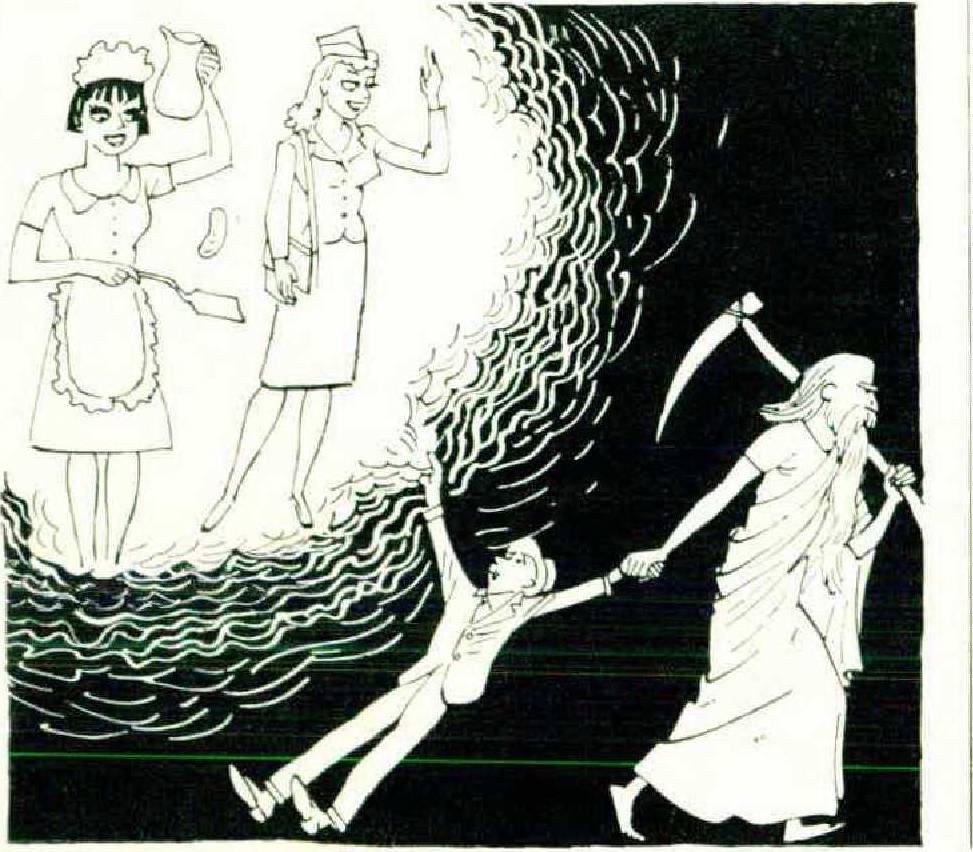
And in the unlikely event that the present-day management might roguishly suggest a spot of window buckwheat-cake tossing, one suspects that the first couple of dozen asked to oblige might well plead arthritis or some kindred malaise as all too valid grounds for begging off.
But today I think I see, perhaps inevitably, the same sad process repeating itself, this time at preposterous altitudes and unimaginable speeds. As recently as the end of World War H. an airline stewardess was a veritable goddess incarnate. As I recall, she had to pass a pretty stiff examination — to be a fully qualified nurse and whatnot — as well as to be the possessor of what have vulgarly come to be known as “vital statistics" in the most formidable of brackets. I seem to recall, further, that there was a compulsory retirement age of comically low limit —but one that, even so, was rarely reached, since these scorchers swiftly cast their spell on bemused male passengers of enormous wealth and promptly abandoned their duties aloft to grace a Texas palace or Manhattan penthouse.
This was the era when the very act of air travel was still regarded as glamorous. There remained a mystique about the thing; overtones of Blériol, Fonck, Guynemer, Lindbergh, Doolittle, and such. A man buying an airline ticket, as recently as the 1940s, felt that he was, if not one of the elite, at least one of the marked.
The wildly handsome stewardesses of that time were by no means reluctant to enter into the spirit of the thing. Togetherness was the touchstone of travel up in the wild blue yonder, and rare it was to find oneself alone for long if the seat next to one were left unclaimed. A ravishing chit in uniform, all teeth, eyes, and hips, would soon appear and plump down prettily, prepared to make the most agreeable kind of small talk. I recall in particular a Might I made in 1948, between Key West and Miami, on which the stewardess who joined me soon after takeoff was little short of sensational in appearance and stacking. It developed, as we prattled merrily away together, that I was the second Britisher whom she had lately encountered. The first, she related, had been a member of Parliament, and she mentioned the name of someone who was rather famous in the British headlines of the period.
“We got to be very good friends,” quoth this vision, with a tiny reminiscent blush. “He said that he was going to give me an entirely different outlook on life.” She paused, then added, “And he sure did.”
But today the few have been replaced by the many. Travel has been wrecked by tourism. And the girls have changed too. I read a piece the other day in which an aggrieved stewardess was quoted as saying that “Nowadays we get treated as little better than waitresses.” Her point was that with the prodigious jacking up of speeds, there isn’t an awful lot of time left over between New York and London, once the seven-course dinner by Maxim’s, irrigated by vintage champagne and so forth, has come and gone.
It must be some years since I last saw a stewardess sit down cozily with a male customer. Probably strictly against regulations, if 1 only knew. But it must also be confessed that nowadays such a gesture of bonhomie would scarcely retain the old-time magic.
For the air girls now find common ground with the waitresses at Childs in more than one way. Waists up there are starting to bulge; piano legs are making an appearance, where before the gams were as shapely as those seen in the stocking ads; features are plainer; hair grayer; expressions glummer; manners brusquer.
I hate to see it. First Childs, now the jets. While waiting the other clay at Orly Airport. I caught sight of a folding aluminum wheelchair, glittering in a corner of the ticket hall. Until recently one would have assumed that this was reserved exclusively for the use of the more infirm passengers.
But the way things are going, I wonder.