Shop Talk
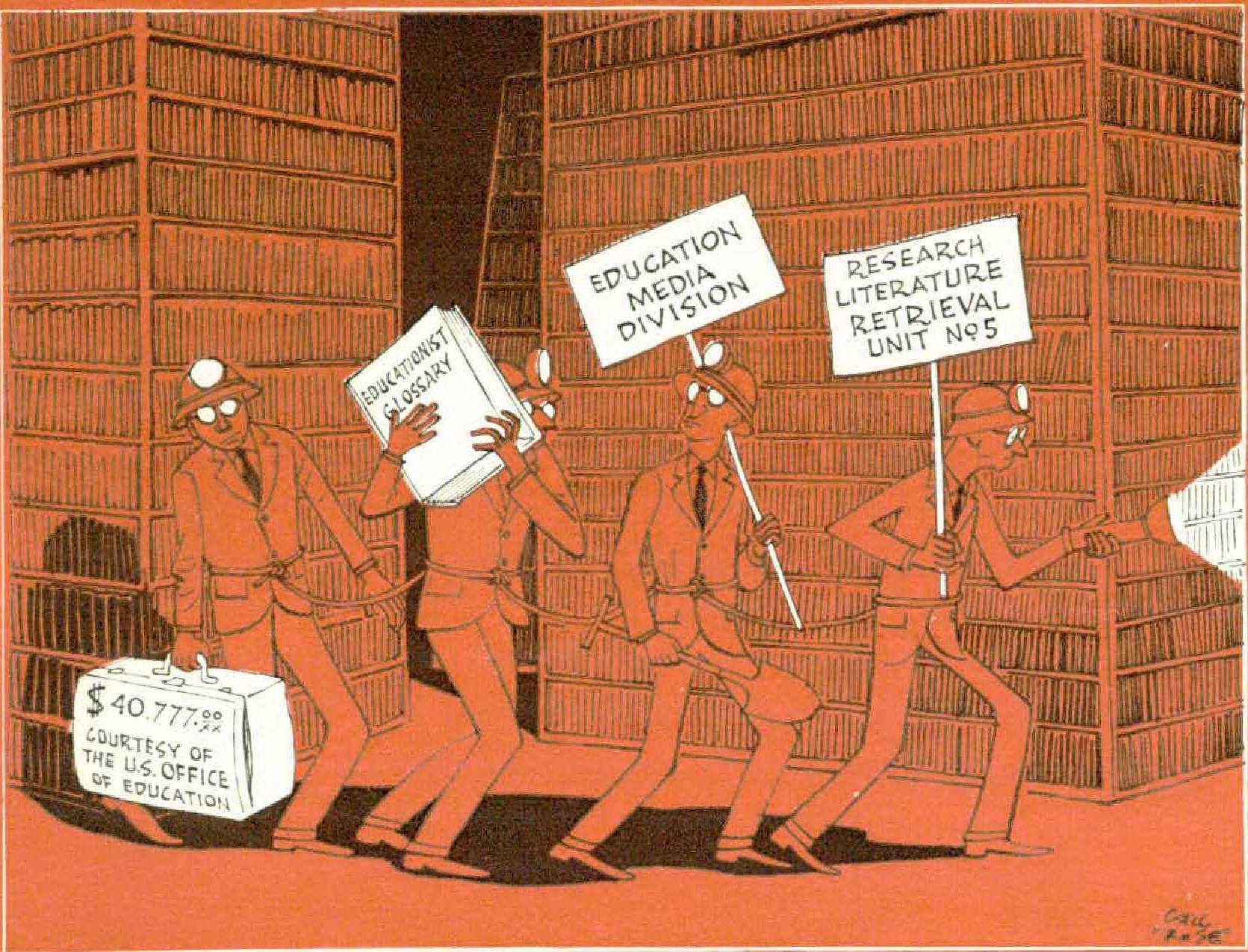
There follows the first sentence of a news release which recently came to hand on the stationery of Western Reserve University: “A grant of $40,777 to Western Reserve University Center for Documentation and Communication Research for research literature retrieval in education media was made during July (1962) by the U.S. Office of Education. . . .”
The release went on to mention other grants but no further details about this one, and a host of questions leap to mind. What, for example, does “during July” mean? Would “in July” be incorrect? Why? Or was it “for July”? Or did it take a whole month of day-in, day-out granting to achieve what the U.S. Office of Education had in mind?
I am frank to confess that I do not know what is meant by “research literature retrieval.” Even less do I understand these three nouns when their meaning is restricted by “in education media.” What are education media — or, better, what aren’t?
One doubts that anything called a Center for Documentation and Communication Research would have an unkind word to say about education media. No use starting a family row. But it does sound strangely as if various kinds of research literature — and the Center wouldn’t want to disparage research literature, either, one supposes — as if valuable research literature is being retrieved in education media.
Now, all parties concerned here could just as well have credited the education media with the retrieval and worded the announcement to read “by” education media (I wonder if they realize how hard it is not to say “educational” once in a while instead of “education”) instead of “in” education(al) media, but the facts must have dictated otherwise. Hence, we are forced to conclude that “in” really means “from” in this instance: research literature retrieved from education media. Such retrieval is obviously a good thing, or else the U.S. Office of Education would not be putting up money to do it.
By the same reasoning, education media are no fit place for research literature, which is something we might well have suspected all along. The next question arises, naturally: if the research literature must be retrieved from education media and money appropriated to that end, why was the literature ever permitted to get into the education media in the first place? Who was responsible? What steps are being taken to prevent a recurrence of the practice?
About the act of retrieval itself, we are completely in the dark. We can only guess whether it is carried on by an individual, by a trained retrieval team, or by some scanning machine which rejects all other literature— good, bad, and indifferent — and retrieves only the research variety. We know nothing about the difficulties: whether the literature is relinquished graciously or whether the retrieval is resisted, possibly by process of law or costly delaying tactics. It would be interesting to know how retrieval costs in education media compare with salvage operations in anti-education media, or perhaps non-education media. The costs have undoubtedly risen, along with the general index of prices, in recent years, but it is all too plain that we have no real way of appraising the merit of the $40,777 grant; such a sum might imply frills and nonessentials, or it might be too niggardly for a first-class job of retrieving.
Experience has taught me over the years that educationists have small patience with those who are ignorant of their terminology in all its niceties. I daresay the same is true of documentationists and communicationists, although I have had little to do with these last-named juntas. But I have learned that ordinary English words take on arcane meanings for the educationists, known only to those members of the lodge with sufficient summer-school credits. What “retrieval" means — if, indeed, that is the operative word in the succession of nouns that I have quoted — could be quite the opposite of what one might expect. Perhaps it means bestowal, or prevention, encouragement, denial, or bowdlerization. Whatever it is, we do not know.
But it is to be hoped that the educationists will indulge rather than assail our ignorance. We remember that it was only three or four years ago when the United States Commissioner of Education himself, director and granter in chief of the Office of Education, declared that he had never heard of Aldous Huxley or George Orwell and that he felt, consequently, unable to offer an opinion as to whether their books were unfit for the shelves of a public library.