The Horst Commercial
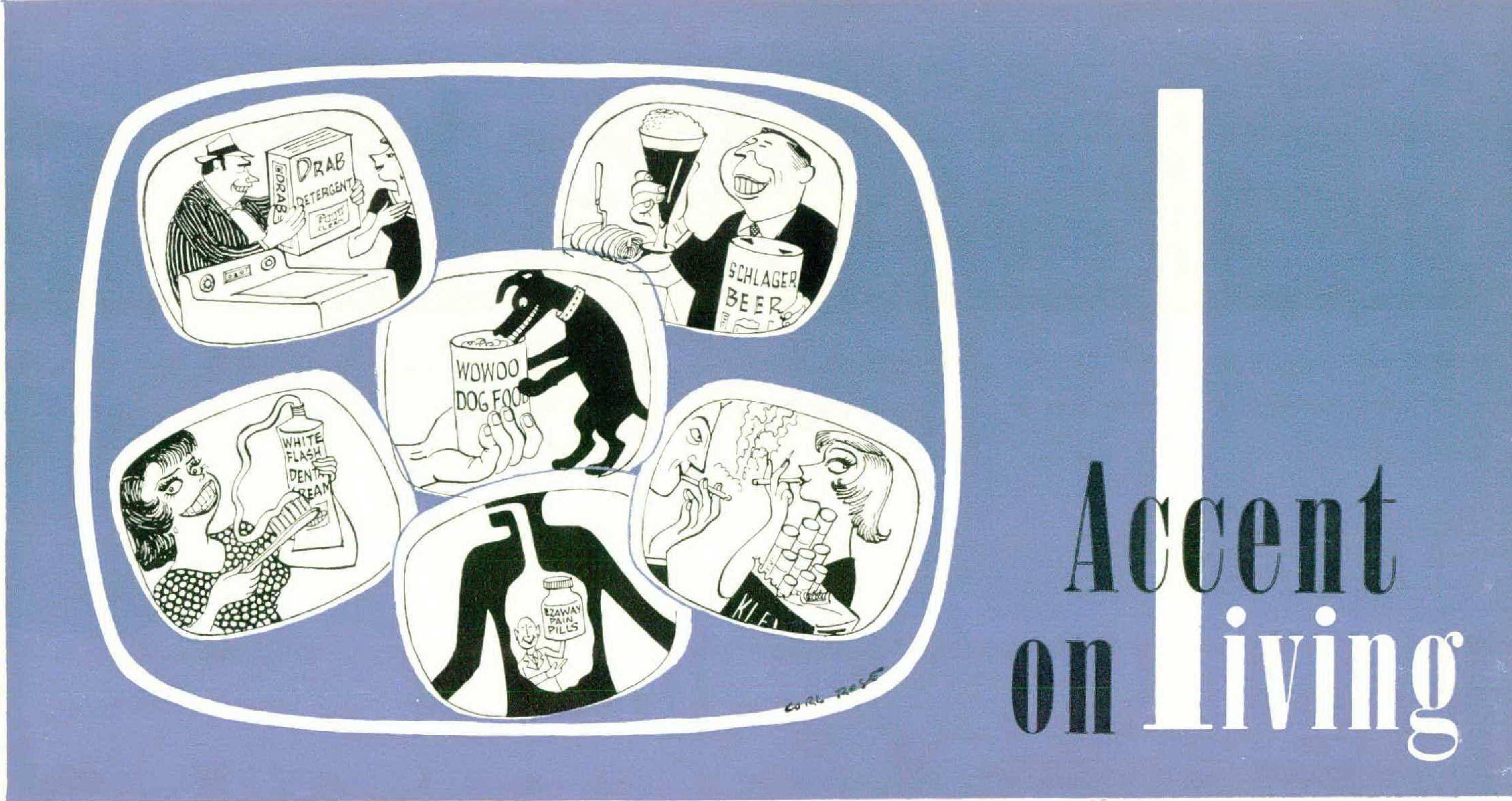
To pick the most unattractive of all TV commercials is necessarily to make certain arbitrary judgments. It’s a hard choice in any case. The squeamish will wince at the woman who proclaims her need of “protecting the lining of my stomach,” with details of the problem and its relief. Those who would cling to a tiny remnant of ordinary manners are no doubt troubled by the cooking-oil colloquy between a guest and his hostess at a pretentious dinner party (a regular tablecloth, candlesticks, and all that):
Guest, declining, of all things, a second chicken croquette: “No, thanks, I find that fried food is hard on my dye-ges-tion.”
Hostess, tendering platter aggressively: “You needn’t worry about my croquettes. I cook them in. . .”(Follows a stentorian discourse by the hostess on the cooking oil she uses.)
The ungrammatical commercials are too numerous for comment. So are the deliverymen or repairmen who favor the housewife with timely advice on various gadgets and kitchen materials. They sound — and look — like the hoodlum enforcers for a slot-machine syndicate, and something of the Lady Chatterley in the housewife makes her attend them rapturously. The concept of the advertisers and their agencies on this kind of situation is that the repairman is always a gravel-voiced illiterate and that the housewife naturally pays more heed to him than to the poky old imbecile who happens to be her husband.
A winner among the bad-diction commercials would be a baffler to choose. Who’dja, how’dja, why’dja, when’dja, whudja — these are all in the lingua franca of the TV commercial and, as often as not, of the shows that it punctuates. The announcers and the fake scientists and doctors — the latter now in mufti instead of white, but full as ever of weird diagnostic lore and utterances — speak in the fulsome tones of the elocution school. The others — men, women, and children — are shrill and nasal, the women usually bossy and petulant into the bargain. The sounds they make are apparently normal and acceptable to each other; all are obviously without the least taste or culture, even as you and I. Such is the advertising agency’s view of the TV audience and the typical American household.
From Boston’s Channel Seven, on December 7, the twentieth anniversary of Pearl Harbor, comes a nugget that exemplifies the pitiful role of the newscaster-commentator who is obliged to interrupt himself with a pitch for the commercial, or, for that matter, with the commercial itself. In one breath he is dealing with the affairs of state, in the next a cure-all for stopped-up drains. So it was, then, marking the Day of Infamy, that Channel Seven’s luckless newsman was made to say, “Channel Seven will remember Pearl Harbor — after this word from Downyflake.” There is perhaps nothing in this calling for forfeiture of a license, but it does seem to suggest a station whose writers, editors, and managers are a sad lot of ninnies. But what could one say of the Ballantine Ale executives and the agency that produced for them a film showing the genial host dazzling his friends by serving The Product with an impressive-looking roast of beef? The host is sharpening his carving knife on a carborundum stone, and after a final whack he lays down the stone, picks up a fork, and sets about slicing the roast, without the least thought of first wiping off the blade. This might be well enough if he were using a steel, but he wasn’t: he was simply a carborundum addict.
Bad though many of them were, the worst of the commercials stands out readily enough as one looks back at the TV season — a series of films sponsored by Colgate-Palmolive in behalf of a laundry detergent. These are the noisiest and most disagreeable commercials of them all: a family of four who, with friends and relatives, are victims of a large, loudbarking, destructive, stupid dog. The dog is forever jumping up on people and leaving muddy footprints all over the house; it knocks down the aged grandmother, at which the children — who inherit the rudeness of their parents — laugh in delight. It’s the only laughter to be found in the series, all the action in this nerve-twanging household being shouts and screams and barking.
Each episode ends with the housewife expounding the silliest advertising boast of the year: how The Product “fights dirt backwash.”The husband, naturally enough, does not know what this means, so the wife gives him a tongue-lashing explanation. Ordinary detergents, says she, wash the dirt out, and the dirt goes right back in. But The Product “fights” this tendency. It must have been a drab day in the offices of Norman, Craig & Kummel when they thought that one up.