A Poorer Mousetrap
I’m starting a new business. This is a risky thing to do these days, especially for a person with my lack of ability and experience. But I’m not worried about failure, because in the business I have in mind my inadequacies will be my greatest assets.
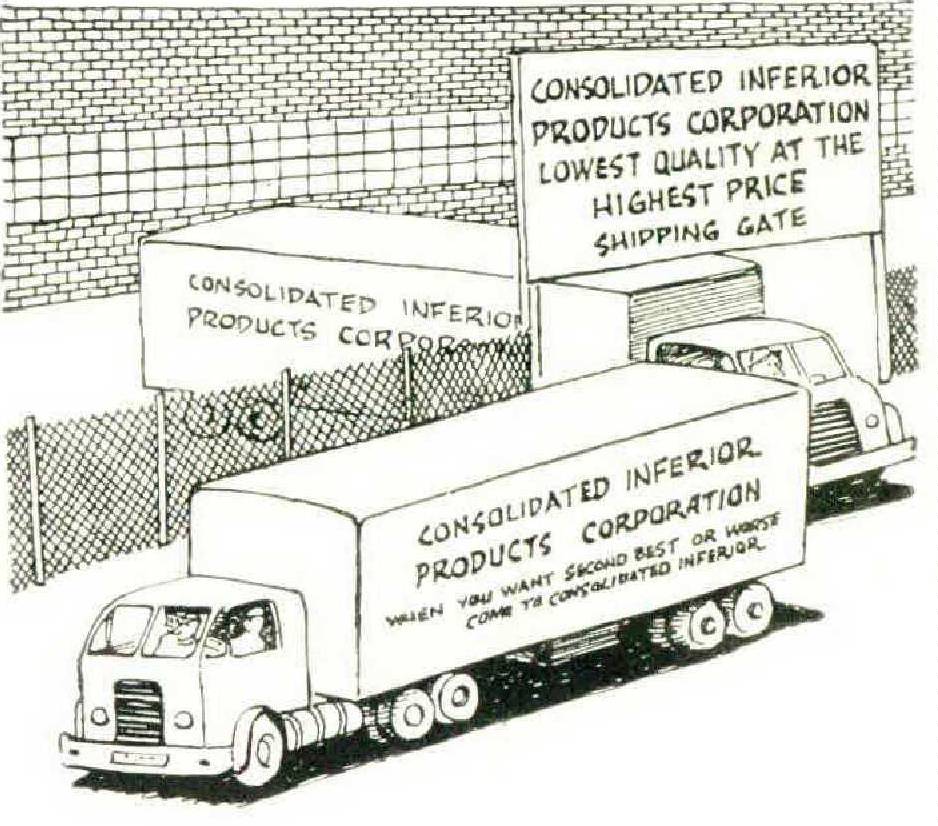
My company will be called OldFashioned, Ordinary, Brand X, and Others, Inc. We will manufacture a wide range of faulty products which can be used to compare unfavorably with the merchandise advertised on TV.
One easy telephone call to OOBX&O will save advertisers hours of laboratory testing. Say, for example, the Euphoria Detergent Company wishes some suds to compare with their own on a TV demonstration. Their advertising manager calls me.
“We’re setting up a new TV campaign for Euphoria next month,” he will explain. “We want to show an ordinary detergent sudsing out of the washer onto the floor and leaving the laundry a good solid mouse gray.”
“We have just the thing for you,” I’ll tell him. “We call it ‘OldFashioned Brand X Detergent.’ It’s guaranteed to have no suds control at all, to make clothes dirtier than they were before laundering, and, as an added advantage, to rot them completely after only three washings.”
Our catalogue of products will also include a slow-dissolving headache tablet which upsets the stomach, a high-cholesterol margarine which tastes like lard, hot-smoking harsh cigarettes loaded with tars and nicotine, coffee without flavor or aroma packed in a can that rattles, a deodorant guaranteed to let you down, a shampoo designed to leave the hair lank, dull, and hard to manage, and a toothpaste with a sugar additive to cause decay.
If my company catches on, we can diversify even more. For one thing, we can organize an insurance subsidiary. We will charge high rates and require rigid health examinations. We will have only one claims agent. His office will be located high in the mountains of Tibet. It will take customers a good four months to get in touch with him when they wish to make a claim. The agent will then delay another six months before he grudgingly makes an inadequate payment.
The actual business setup of OOBX&O will be ideal. Our costs of manufacture will be negligible. We can use out-of-date machinery and cheap materials. For packaging, a plain battered container, either blank or marked with X, will lie perfectly adequate. We will not spend one penny for advertising, because rival manufacturers will take care of it for us on their commercials.
We will be in good shape, too, in personnel. We can hire incompetent workmen at low wages. Only two of our employees will have to be responsible men: the inefficiency expert, who will make sure that the work is performed as carelessly as possible, and the non-quality control man, who will maintain a rigid check to prevent any good products from slipping through. After all, our customers will have a right to expect uniformly poor merchandise.
Despite our low production costs, we will charge exorbitant prices. This will make it possible for advertisers to refer to our product as “the high-priced brand.”
With all these advantages, I believe that Old-Fashioned, Ordinary, Brand X, and Others, Inc., will be a smashing success. I’m already making plans to place its stock on the market. I should have no trouble getting the capital I need. After all, the stock will be an overpriced, wildly speculative new issue in an unknown company with inexperienced management and almost no growth potential. According to Wall Street experts, that’s exactly the kind everyone is snapping up these days.