The Empty Night
In 1955, Alfred A. Knopf published a book of short stories, THE BLACK PRINCE, which introduced a writer of original talent, SHIRLEY ANN GRAU. Since that time, Miss Grau has written two novels, THE: HARD BLUE: SKY and THE HOUSE ON COLISEUM STREET,and her stories have been reprinted in the O. Henry and Martha Foley collections.
by SHIRLEY ANN GRAU
TODAY my own children sleep in the same small bedroom I had, the small corner bedroom that looks down on the front porch roof. If they bother to look out, they sec no more than an empty yard and an occasional car passing down the road. Not stopping. And if they see a glow at night, it’s nothing more than the new neon signs in town, a couple of miles away. If they even bother to look. They know nothing about it. They have nothing to remember.
Sometimes when I’m doing the room, picking up their clothes or straightening their closets, I find myself staring out that front window. And each time I’m surprised to see that the yard is empty, that the burned mark on the grass is gone. The mark that lasted only a week or so until the new growth came up, that summer nearly thirty years ago.
In spite oF myself, I always seem to stand a few minutes, remembering. It’s as if, having seen it a certain way once, I can’t ever seem to see it different again.
In those days my grandfather’s house was full. I here were my sister and I. There was my mother. (My father had taken a job out in Oklahoma somewhere. In those Depression days an engineer had to look long and hard before he found a job, and he took it no matter where it was. This particular place was no more than a road camp, and no place at all for children, so my mother
brought the two of us back to her home.) There was my grandfather, of course. His wife had died years before, and he had never remarried. He lived alone with a series of Negro housekeepers, none of them very good. Whenever we came visiting my mother always complained: “Honestly, Father, what do they do to the house? And the cooking is just dirty!”
My grandfather always shrugged. “Man alone doesn’t need much.”
They were pretty careless, those gals. Once a whole family of bats got into the upstairs. I can remember seeing them hanging fast asleep from the top of the tester bed.
But that was before Margaret came.
It all happened just a month before we arrived. Margaret’s husband was working on the new roof for my grandfather’s barn. It was a fierce shimmery white August day without a breath of air stirring under the afternoon sun, and it may have been the heat that made him dizzy. He slipped and fell, and by the time the other men had climbed down he wasn’t breathing.
That evening my grandfather saddled his horse and went directly over to New Church, where they lived. (The shortest way was too bad a road for a car, and anyway, he always liked to ride.) He had to ask for the house, but he found it finally, recognized it by the crowd of people on the front porch. He went inside and he had a talk with Margaret and he saw just how bad things were. Her husband’s people had moved north and she’d lost track of them. She herself had been an only child, her mother dead just a couple of years. Her father had been a white man, the surveyor who had come through thirty-five years before with the new road, the first direct highway in the state. He’d been around only a couple of months, and he probably didn’t even know he’d left a child. So there wasn’t any family for Margaret to go to, and there wasn’t any money now that her husband was dead.
Standing in the crowded kitchen of the house at New Church, my grandfather offered her a job. “I need a housekeeper,” he said. “Somebody who don’t let the windows open so long the bats come in to roost. Somebody who can cook for my family that’s corning to live with me.” He paused and looked around a room crowded with black faces. “I can’t pay much, but it’s a way for you to live. And there’s room for the kids.”
She came within the week, bringing her children, two girls and a boy. They slept in the little back bedrooms, the ones that were over the kitchen in the ell that ran back from the main part of the house.
When my mother, my sister, and I came, a month later, the house was neat and clean, the porch and the front walk were swept, there were flowers in a vase on the dining-room table. And there was Margaret in the kitchen. She was tall, and thin, and very dark, in spite of her white father. She wasn’t pretty; her face was too angular for that. The dark skin pulled taut over high cheekbones and a straight jaw. Her eyes were wide-set and very large. She wasn’t young any more and her figure was thick around the waist and hips. It may have been childbearing — she had had five and three lived — but then Negro women always aged very fast.
Things looked peaceful and settled and altogether nice at the house. Only they weren’t at all like that. Something happened the very first few minutes we were in town to give us a warning.
We came on the train from Birmingham. It was supposed to pull in at 1:10, but it got steadily later and later. First there was something wrong with a switch, then there was something on the track, then the crews were just finishing work on a trestle. It was nearer four o’clock when we finally stepped off the train and looked around. There wasn’t much to see. A single weed-grown siding, an empty loading platform, a dusty yellow and brown painted station, two rooms big. One was the office — a ticket window, a couple of wooden counters, and behind them a desk and some rusty filing cabinets and a telegraph. The other was the waiting room, with a waist-high partition down the middle dividing it into white and colored sections.
Jesse Colton, the station manager, his red face streaming with sweat, came out and shook hands with my mother, silently, and nodded to us. Then he lifted our baggage into the patch of shade next to the little building.
“Well” — my mother’s voice was hoarse with dust and tiredness— “we seem to be so late that my father’s given us up.''
“His car’s right there, large as life,” Colton said. “He’s been around. Seen him go up to the drugstore not ten minutes ago.”
My mother said, “Now, really!” and marched out into the middle of the street and stared up toward the drugstore.
“Went to get a present for his niggers, I guess.” Mr. Colton snickered, loud enough for my mother to hear.
She turned and glared at him, all the unspoken answers quivering on her lips. He only bent over quietly, rearranging the bags.
Just then my grandfather came. He had five large suckers in his hand. One for me, one for my sister.
My mother, still furious at having to wait even two minutes after waiting for hours on the train, said, “And who are the rest of those for?”
“Margaret’s kids,” my grandfather said. “I told ‘em I’d bring something.”
While he put our luggage in back, he left the three bright-red suckers on the hood of his car. Jesse Colton stared at them and his light-blue eyes were angry. “Candy for nigger kids —
“Jesse,” my grandfather said, “your telegraph wants you.”
Mr. Colton stood and watched us as we drove away, pulling out his big blue handkerchief to wipe his face. Then he turned back into the station, to tend his chattering instrument, spitting in the dust as he went.
ALL of this worried my mother, though she didn’t say a word until she and my grandfather were sitting on the porch that night after dinner. My grandfather had taken out his plug — he always chewed — and bitten off a chunk. Then he tipped his rocker back and stared out at the dusk.
My mother moved back and forth with little short jerks of her rocker. “You noticed what happened in town, didn’t you, Father?”
He nodded.
“That bothers me.”
“Margaret’s a fine housekeeper,” he said, “good cook.”
“Jesse Colton and those,” my mother said doubtfully“You know what they’re like when they get started.”
“I reckon I know what they’re like.”
“Don’t you think — somebody else?”
“Abigail,” my grandfather said, “and I had the money to give her, I would. But I plain don’t.”
My mother unfolded her little painted fan and waved it at the gathering mosquitoes. You could feel her disapproval stiff and unyielding in the evening, almost like a thing alive.
My grandfather sighed. Explaining never did come easy to him and he always hated to try. “I didn’t have to have the roofing done then.” He jerked his head toward the barn. “A month wait made no difference to me. I didn’t have cause to send him up in that heat.”
“They didn’t have to go,” my mother said, “except that people keep working same in summer as winter.”
He said quietly, to himself, “And I had sense, he wouldn’t be dead.”
“Honestly, Father —”
He turned around, as if he’d just heard her for the first time. “Abigail, it don’t much matter why, but he was killed on my place. There ain’t anything I can do for his wife, outside of giving her a place to stay. And if I give candy to his kids, that’s nothing to anybody.”
My mother said, “You know what I meant, Father.”
“The town don’t tell me what to do.”
That was all. After a bit my mother called us in to bed, and we kissed my grandfather good night and smelled the sharp sweet odor of his plug tobacco.
IT WAS a nice house, a lot nicer than most of the ones we had lived in. My grandfather’s father had built it in the eighties with sharp gables and a black slate roof and wide porches and lots of gingerbread everywhere. Cherokee roses climbed all over the south side, reaching way up to the lowest part of the gables. There was Confederate jasmine on the lattice by the dining room; every spring it turned solid white with tiny star-shaped flowers. Behind the house, outside the kitchen door, there was a scuppernong vine on a trellis. In a few weeks we were climbing up there (the trunks were thick and solid under your weight) to lie on the very top, on the soft younger shoots, and eat the yellow grapes.
The quick days blended one into the other, and pretty soon there was the interruption of school. I hated it—the peanut smell of the desks, the urine smell of the halls, the sweaty smell of the other children, the daily inspection for nits, the hawk-faced woman who fussed about keeping the window shades in a precise straight line.
Once there was a scuffle in the halls with another girl who’d whispered “Nigger lover!” I managed to kick her in the stomach, hard, before we both scurried away at the approach of a teacher. There wasn’t anything else. They just left me alone.
I didn’t really mind, I didn’t particularly want to make friends. If we’d been in town, it might have looked different, but living a couple of miles out, we seemed a long way from everything. Anyway, there was quite a crowd of us, my sister and ! and Margaret’s two girls and a boy — Henry, Crissy, and Milly. We were all about the same age too. Milly was a couple of months older than I Crissy was a little younger than my sister, and Henry stuck right halfway between us.
Nobody stopped us. Nobody told us what to do. The five of us ran over the fields as much as we pleased, going wherever we wanted to go. Sometimes when we’d pass houses or come where people could see us, we’d find that they were studying us in a not very friendly manner. And if we happened to go so far that we were in the outskirts of town, people would yell us away from their yards.
I didn’t take notice of that. Any more than I noticed who was with me. After all, I was always by myself, no matter who was with me or where I was I was that age.
And there was plenty to watch and to do. There were the animals we might find, the smell of the wind and the feel of the ground, the color of the leaves and the pattern of the grass underfoot. Once we even found a little still, hidden in a marshy tangle of catbrier and green creeper — my grandfather made his liquor there.
When it got too cold for us to be abroad so much, we sat in the kitchen and played cards or learned to sew, while my mother read and my grandfather worked over his accounts and Margaret did the mending.
It was a hard winter. The frost began early, and there were even four or five snowfalls to drift between the furrows of the fields and pile up against the shady sides of buildings. And it was even harder because the country was dirt poor. There couldn’t have been many rabbits or squirrels left in the woods, so many people had been after them with snare and gun. And the deer (Margaret said they had been a plain nuisance a few years before) had just about disappeared. It was that sort of time.
In our house, the high-ceilinged rooms that were so lovely in summer were bitter cold with only the heat from the fireplaces. While I never actually saw water freeze inside, lots of mornings I did see my breath hanging in the air like smoke. We always went to bed with our nightgowns over our woolen underwear and maybe a sweater or two. You were warm, even if you were so stuffed you could hardly move. In the mornings we would just slip off the gowns, and slip on our dresses, quick as we could, our teeth chattering, our fingers trembling. By then the good steady fire of the evening before would be nothing more than a few red coals in the black of the fireplace and the wind would be whistling down the chimney, riffling through the ashes. We always dashed straight down to the kitchen.
The gas stove would be on, its oven door open wide to heat up the room, and the fireplace in the corner would be blazing too. Margaret would be there, black and warm and cheerful in a quiet way. My grandfather was gone by then; he always began work very early. And my mother always slept late. It was just the children and Margaret, and every morning we all had breakfast perched at the big round table.
As it came out that was what offended people so. The sight of us all sitting down at the same table. Once or twice I can remember people coming to the kitchen door looking for my grandfather, stopping stark still in their tracks, and staring at us as if they’d seen a ghost. Once it was the man from the farm-equipment company come to sell my grandfather a tractor. He left without even seeing him. My grandfather only laughed when he heard: “I wasn’t about to buy one anyway.”
But Margaret was nervous. You could see it frightened her whenever there was a knock and all of us were sitting around the table. She’d put her hands in her apron pockets to stop them moving around and give her something to hold onto. And she’d open the door with a jerk and answer their questions quick as she could with a Yes sir and a Yes ma’am. After they’d gone, it would be quite a while before she could talk to us, even, in her natural voice.
That winter finally ended, the ground thawed, and the crab-apple and the peach blossoms popped out. Leaves came, sharp crisp green, and the whole world looked washed and new. There was a month of cool weather; then the sky changed color and the sun got fiercer and the days got steadily brighter and very hot. Spring had gone, and the long summer was beginning.
My grandfather planted less than ever; crops weren’t worth anything, and stock wasn’t either. He was just waiting it out. But there were those who couldn’t wait. We saw a lot of tramps that spring, and a lot of drifters. A couple of times a week, regular as anything, somebody would come asking my grandfather for work. At least twice it was a whole family, packed into a little truck — mattresses and chairs and tables — looking for a place to stay. Though there were some empty houses on the place (sharecroppers’ cabins, that’s all they were), my grandfather always told them that he didn’t have a single empty spot and they had better move on to find lodging.
My mother thought he was being cruel. She gave them food and money too, if she had any, which wasn’t often. “I know there are a couple of empty cabins, Father,” she told him reproachfully.
“And what they got to live on, honey? With no work for them.”
My mother was always vague about details. “Well, they could have a garden.”
“To live off?” He snickered. “You plain know better than that.”
“Well,” she said, “well.”
“If one stopped, they’d all stop,” he said. “They’d clean us like locusts, and there’s hardly enough for around here.”
“But where do they go?”
“I don’t know,” my grandfather said. “I can’t take care of the world.”
Still, it bothered him. Sometimes after a truck had stopped and then passed on again, he’d take off’ on a walk and not be back until long past suppertime.
“There ain’t anything I can do about them,” he’d tell my mother all over again. “I got all I can do with my people.”
THAT same spring the Klan came back. Just when most people thought it was gone for good, because it hadn’t been heard of in several counties around for some fifteen years.
“Well,” my grandfather said, “can’t say I ain’t been expecting it.”
First they were over in Riverside, where they burned a cross in front of a lawyer’s house. He had taken a Negro case and won it on the appeal.
Then there was a dry-goods store in Edgmont. Nobody could figure that one out. “Some sort of personal grudge,” my mother said.
The following week they set fire to a haystack on the edge of the Negro section of our town. And they beat up a Negro man who ran out to see.
Then they went after Robert Curtis, who’d been living with a part-Negro woman for six or eight years and who had three redheaded children by her. The Klan crashed right into his house and dragged him out to the front porch and shaved his head, clean as an egg. While they were doing that, the Negro woman took her children and sneaked out the back. When the Klan found she was gone, they were so furious that they smashed in every single one of the windows.
“Goddamn,” my grandfather said softly, when he heard the news. “They gone plain crazy.”
The very next day, he collected the five children who lived in his house and took us from room to room — I can still remember that raggedy little procession.
He wanted to show us, he wanted to warn us of some changes. He had put a gun within easy reach in every room of the house. There was an S&W 38 in a little wood box on top of the upright piano in the living room. The gun rack in the hall, which had always been locked, was open. The bar was still across the front, but you could just lift it off in a second now, without a key. And the funny old muzzle-loader that had belonged to my grandfather’s grandfather, that had always hung on the kitchen wall with its powder horn slung beside it — that was gone. In its place there was a shotgun from the collection in the hall.
He knew what was bound to happen with the Klan loose in the country. He was going to be ready.
He also brought in a couple of hounds from his hunting pack and turned them loose in the fenced yard. “They going to be kind of hard on the flowers,” he said, “but I got to have a little warning.”
They gave it to him too, and they gave it correctly. One hot June night I heard them start up right under my window. I was out of bed in a couple of seconds, scurrying for the stairs. Even so, my grandfather was ahead of me. He was fully dressed; he must have slept in his clothes.
He was taking a shotgun out of the hall rack when he heard me and glanced up. “What are you doing?”
“The dogs started.”
He shook his head. “If the other kids wake up — any of them — you keep them quiet. Tell them nothing’s wrong.” He took a second shotgun and walked toward the front door.
Then I saw Margaret standing at the top of the steps, not three feet from me. She was standing so dark and quiet that I hadn’t noticed her before.
“What’s nothing?” I asked her.
We walked to the front window and she pointed down the road. There was a car there, without lights, parked a couple of hundred yards away. You could just see the moon shining off the hood.
Margaret said flatly, “Takes ‘em a while to all come up.”
Staring down the dark road, where I could see nothing, I could imagine them, white robes and torches and whips and clubs.
“Oh, Margaret,” I said, “you better get out and hide.”
If I’d been older, I never would have said that. I saw the hurt flicker across her face. “Where I got to run to, child?”
“Margaret” — my grandfather’s voice carried over the racket the hounds were making — “will you call those damn dogs? Put ‘em in the kitchen and give them something to eat.”
She slipped down the steps quietly, without answering, a dark shadow.
I was in the hall alone. I listened, but neither my sister nor any of Margaret’s children appeared to be moving about. Because I didn’t know what else to do, I went into my mother’s room. She had the large center bedroom, and even the moon falling straight in the window didn’t light up the farthest corners. But I did see her. She was sitting in the little mahogany rocker right by the window. There was something long and dark across her white robe — a rifle or a shotgun.
I went over.
“Mercy,” she said quietly, “little pitchers do have big ears. Why are you up?”
“It’s a shotgun,” I said, as if that was the only thing that mattered.
“Yes,” she said, “I believe it is.”
“Oh.”
“Go back to bed, honey.”
There wasn’t anything else to do. I went back to my room. The window was wide open, and the summer air came spilling over the sill. I sat down there to wait.
THE night was very quiet. The dogs were inside. The road was empty. There was just the little fleck of moonshine off the roof of the parked and waiting car. After a bit I got to believe that nothing was going to happen. My neck was aching and my head seemed heavy and as big as a balloon — I was just going to rest it for a minute on the sill.
I must have slept more than a few minutes; the moon, which had been shining straight into the window, had slipped down behind the bank of trees on the edge of the far field. When I finally did jerk my head up, it wasn’t because there’d been a noise — everything was very quiet. But they’d come.
What woke me was the flickering yellow light of the torches. Real pine-knot torches that streaked the air with murky turpentine smoke. And I was looking at the Klan, at the masks with peaked tops and the full-length white robes. And one long curled black whip.
There were about a dozen Klansmen standing just outside the picket fence, and they were staring, all of them, at one particular spot on the front porch. All those peaked caps pointing in one direction.
I stuck my head out and craned my neck and stared until I wished my eyes were periscopes. I just couldn’t see down on the porch proper. All I could see was the little new tendrils of Virginia creeper snaking across the roof.
The Klansmen moved and shifted about. They spread out, in a single line, along the fence, for all the world like men who are watching a parade. It was very quiet. Nobody even whispered. There was just the sputter of torches, and far away, across how many fields I don’t know, some dogs were barking, sleepily.
The Klansman in the center, the one whose robe had a great green cross painted on it and who had something long and shiny, a kind of necklace, hanging about his neck, moved over to the gate and started to open it. He lifted the latch; then, at a light sound from the porch, stopped and looked up, peering uncertainly out of his hood.
“You boys looking for something?" my grandfather asked.
He was sitting on the porch. In the still night air I could hear the creak of the cane as he shifted himself in the chair. He began to rock gently, and I could hear another sound — the slow sighing give of the floorboards.
“Do your burning,” my grandfather said. “I’m watching.”
The Klansman lifted his arm straight up, like a Pope. A couple of men left the group and got something that had been lying on the ground a few yards away. They picked it up, began hammering it into the soft ground just across the road, directly in front of the house.
The man in the center, the one whose robe had green markings, held up a large rolled sheet of paper. And slowly, with wide elaborate gestures, he drew back his arm and tossed it toward the porch. It landed with a thud on the bare boards.
“I expect I know what’s written on that,” my grandfather said.
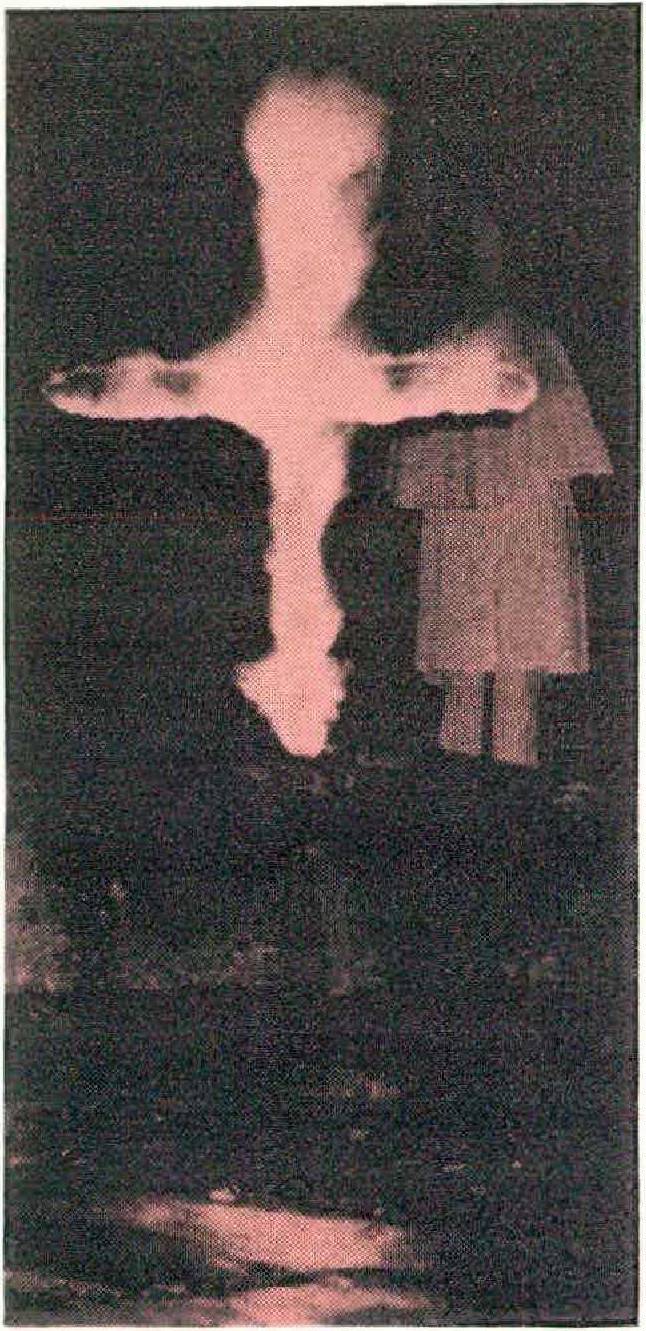
Now I could see the thing they were building across the road. A wooden cross with rags wrapped around it. One man got a can and began to splash kerosene over it.
“Not talking,” my grandfather said. “Now that means I know you all and you’re plain worried I might recognize you.” The steady even creak of the rocker went on. “Now, I used to belong when I was a kid. Only one day I got tired running through the country, sweating behind a piece of my mama’s sheet.” He chuckled gently.
The Klansmen shifted along the fence. Somebody touched a match to the cross. It shot up, and the whole front yard was brilliant and white as day. There was a little murmur among the Klansmen, a kind of very small shout.
The porch chair stopped rocking. “A right pretty fire,” my grandfather said. His heavy steps shook the porch as he walked across it. I couldn’t hear over the sizzling of the burning cross, but he must have struck a match against his thumbnail. A piece of burning paper flew from the porch and landed in the middle of the front walk. In the seconds before it flashed up and disappeared, I could see it was the scroll of grievances that the Klansmen had tossed up to him.
“Mine’s a kind of puny fire,” my grandfather said, “but I reckon it’ll serve.”
One of the Klansmen back in the road shouted “Yah —” And others opened the gate and pushed through and down along the walk. They stopped by the black piece of burned paper, nudged it aside, trampled it down with their feet.
The chair on the porch crashed over. He must have kicked it aside. “You had your fun,” he said, “now get out.”
They didn’t move, but they didn’t come closer either.
“It’s my house,” he said, “and it was my father’s house. And the people in it — black or white or green - they’re none of your goddamn business.
I don’t owe you no accounting, but I’m telling you this — the whole lot’s staying.”
The cross began to die down, as suddenly as it flared up, and the night began edging back in from the sides of the yard.
“He was killed on my place,” my grandfather said. He didn’t say a name; he didn’t have to. “And there’s nothing going to get me turn his kids out.”
The Klan scuffled around and tipped their peaked caps toward each other, whispering.
“I gave you warning.” my grandfather said. “Now get the hell out of here.”
They were still whispering. They spread out slowly, across the grass. They seemed to be getting ready to rush.
There was a brushing and the sound of metal coming to rest on wood. He’d have brought the shotguns up and balanced them on the porch railing.
Immediately after, there was a soft thud from the second story. I could see now. My mother had brought her shotgun up, and it was resting on the windowsill. She herself was hidden behind the white curtains, which had turned hazy bright and glowing. The shotgun was pointed straight down into the yard; the flickering yellow kerosene light ran up and down the steel. It held perfectly steady, the twin barrels leading back into the luminous, impenetrable curtains.
The Klansmen glanced up, and hesitated.
“Blow the top of your head off,” my grandfather said. “It’s double-aught buckshot. Loaded it myself.”
The dogs off in the distance were still barking; they must have found a coon or a rabbit. In the kitchen our own hounds gave a howl or two, lonesome and wailing.
“Double-aught buckshot,” he repeated. “I got two more here with me, waiting till you’re close as I like.” He stamped his foot, so hard that the porch shook, the way you’d scatter chickens. “Get off my land.”
They went, slowly and grudgingly, stopping to whisper in little groups and to look back over their shoulders. My grandfather didn’t say anything more and he didn’t seem to be moving around; he was waiting and watching. The barrels out of my mother’s window lifted slightly as the Klan moved out of range, but they stayed on the sill, waiting too.
You could see the white robes drifting off down the road, getting blurred and indistinct in the distance as they headed for the cars. They did not put their lights on, and now that the moon was down you could only follow by their sounds. One by one you heard the engines sputter and start, then the shifting and reshifting of gears as each backed and turned in the narrow road. Finally they all moved off toward town.
TIE cross was still burning, but only in little scattered spots along the frame. The front gate was hanging open, dangling from one hinge; it had got broken somehow. And the yard looked scuffed and trampled by hundreds of feet.
I left the window, scurried past my sister, who was still asleep — it really hadn’t made any noise to speak of, the whole thing. First I went to my mother’s room. I didn’t bother knocking, just yanked the door open. “Ma,” I started to say.
She was back in bed, propped up with pillows, her little reading light on, going through a copy of the Ladies’ Home Journal. “Please do say ‘Mother’ and not ‘Ma,’ honey.”
“Yes, ma’am.” I didn’t see a sign of the shotgun. I wondered if she’d stuck it under the bed. “I didn’t know you’d be reading.”
“It’s a way of passing time until Margaret gets breakfast. I really don’t think I could go back to sleep, do you, honey?” She smiled so gently. And I realized that she had asked me a perfectly grown-up question. We had seen it together, and somehow or other I had come out of the ranks of the children. Just because I had seen.
“I’ll go downstairs, I think.”
“Don’t go out until your grandfather comes back,” she said. “He’s having a look around the house, and he might not recognize you in the dark.”
I pattered down the stairs, my bare feet slapping on the boards. My grandfather was just walking in the front door, a shotgun in each hand.
“Well,” he said, “now you seen it.”
He put down one gun and started to unload the other. He hesitated, seemed to think better of it, and put them both down, loaded, on the top of the hall table.
“They coming back?”
I guess my voice must have shaken a little. “Honey,” he said, “the next night rider comes to my door is going off with one of these barrels in him.”
“I’m not scared,” I told him. “Not really. I just never saw them before.”
As if he hadn’t heard, he turned and looked out the open front door. You could see the cross clearly, could see the way little ripples of fire still ran along its arms.
“The flickering of that thing is just plain starting to bother me,” my grandfather said. “Don’t it you?”
“Yes,” I said, and then because I wasn’t sure that was the right answer, I said also, “No.”
“Do you reckon you could get the little fireplace shovel out the parlor?”
I got it. He picked up one of the shotguns, and we went out. I wondered what the night was holding. It was all around us now, close, looking at us, watching us. I could feel things moving around inside its cover as I went down the walk, following the plaid of his shirt and the sharp angle of the barrel across his left arm. I had been hunting with him often enough to notice his position — he was carrying his gun at the ready. I shivered. I couldn’t help it.
He stopped to look at the broken gate. He swung it back and forth; the last hinge snapped, and he held the gate in his hand. He studied it for a minute, then laid it down carefully on the grass. “Well,” he said, “that’ll have to be put back.”
“Looks like.” My voice sounded small and shaky in the night.
“Got to fix that too.” He pointed. Some of the pickets were broken, and the whole line of fence sagged in toward the house.
He patted the top of my head encouragingly, “We’ll prop it up someway or other.”
We passed through the broken gate and into the dust of the road, dust that was stirred and heaped into little ridges and hollows by the shuffling feet. There were little wet spots where the kerosene had splattered.
He kicked the base ol the cross, hard, a couple of times. The toe of his heavy leather work shoe made a loud flat clunk. On the third kick, the cross toppled. Falling, it jarred into bright flames again. The dew-wet grass sizzled. He grabbed the base, the part that had been underground, and dragged the whole thing out into the road.
“Use your shovel, gal,” he said. “Let’s put it out.”
He began kicking the soft powdery road dust into the flames. I took the little fireplace shovel and, hunkered down in the road, began tossing dirt.
It didn’t take us long. The kerosene flames went out easily, and in a couple of minutes there was only a dirt-covered shape, with little bits of black charred stuff showing at the corners.
It was really dark now, with only the light from the open front door reaching down the path to us. We both turned and looked at the house, with its trampled dooryard, its sagging broken fence. The light in my mother’s room was still on, but she had drawn her shade and there was only a tiny thread showing around the edges. There was a little glow from the back of the house too, and a smell of frying. Margaret would be getting breakfast.
My grandfather nudged the cross a little with his toe. Then he straightened up and looked over the rolling fields that stretched off on all sides of us. It was so quiet you could feel the ground breathe, you could feel the pulse of the earth under your feet.
“Don’t worry, honey,” he said. “There’s nothing out there but dark.”
So we went inside. From the porch, I looked back. All around the little tunnel of light, it was simple plain black. There wasn’t a sound, there wasn’t a breeze, there wasn’t anything. Except what I knew. I didn’t tell him — I don’t think I could have—but for me the nights wouldn’t ever be empty again.