O. K. Balogun
The daughter of the Canon Residentiary of Chichester Cathedral, VIRGINIA. BNOWNE-WILKINSON has taught at an English university and, very recently, at a university in Nigeria. She is non) at work on a novel and has given up her lecturing in order to devote full time to tenting. This is her first appearance in the ATLANTIC.
I FIND my teeth gritted together, my face set hard. Yet I am only reading, something I know and like, alone. What am I resisting? I am sitting on the balcony outside my bedroom with a tray of coffee beside me. As it is only a quarter to eight, the air is still cool. Probably the sun won’t make itself felt before ten o’clock, when I begin teaching, so I’m free of both duty and discomfort for more than two hours.
The small sound of bare feet on the concrete floor causes me to raise my eyes. The boy stands there, bowing slightly, his huge black eyes fixed on my face. He doesn’t mean to be ingratiating, and I should be thankful that he likes being polite, an unusual taste among local servants.
Has Madam finished with the tray? Yes, thank you.
A few minutes later I hear the swish and sing of the mosquito net being drawn back on its runners over my bed while the water runs into the bath from the electric geyser, ready for him to wash the ‟clots,” as he calls them. It’s wonderful to have them washed and ironed every single day, to cook only when I want to, to have the whole background of my life so completely taken care of that I can give all my time to reading and writing. And all at a cost of about 5 per cent of my salary.
I bend my eyes again to my book, Middlemarch. I like long, solid Victorian novels, especially the witty and critical ones, and especially in this most unsolid environment, where everything seems about to blow away at any moment out of the perpetually open windows. A little breeze stirs the pages. I look up for a moment at the white block of flats opposite. Nothing but open windows, with a flutter of curtain here and there, and a sound of saucepan lids.
Under the ragged palm trees strolls the garden boy, his long, dangerous-looking machete dangling from his hand, his chewstick dangling from his wide, thick mouth. He has a shallow, impertinent face, as if someone had put his chin on the table and hit him hard with a mallet while his bones were still soft, leaving him short from crown to jaw and wide from cheekbone to cheekbone. When I meet him on the stairs at midday, I myself hot and tired from a paltry two hours’ teaching, he sheltering from the heat and performing his daily task of sweeping the staircase, he will get imperceptibly in the way, so that I have to pass close to him while he looks me up and down with a hundred thousand years of male dominance in his subhuman stare and exudes with his reek of palm oil and historic sweat a drawled, ‟Good uffernoon, Madam.‟
Out in the garden, he asserts the right of even a bandy-legged little man without property, authority, or any predictable future to take his time over whatever they pay him five pounds a month to do. Above his full-skirted khaki shorts, discarded by a master four times his size, and the grimy singlet, more holes than substance, a little round yellow hat like a scone perches in happy defiance of the impressive native robes that sweep slowly by on the bicycle of a chief clerk.
By the time I have to go and teach, it has begun, quite suddenly, to be hot, and though the sunlight is not bright there is a glare that makes me put on my sunglasses as soon as I leave the house and take the path to the garages. It seems silly to get the car out for a journey of less than half a mile, but the way home will be uphill and the temperature will be between eighty and ninety. I drive past the boys’ farms and their quarters, which I try not to see. They are smaller than the garages, more like pigsties than anything else. The women, cooking on their open fires outside, wave to me as I go past, and now the road, developing a tar surface, quickly becomes suburban. There is a notice on the wide grass verge saying ‟No Farming.”
In the distance I can see the bush receding from green to blue, but on either side of me the neat white houses owe more to English ideas of respectable comfort than to any tropical needs, and each tries to hide behind a high transparent hedge. One of them belongs to friends of mine. He lectures in accountancy, she helps me with my dressmaking. I turn into their drive in the hope of finding her at home.
She comes out at once with her great coronet of red-gold hair glittering in the sun.
“Talk of the devil! Can you come in before lunch and see those new dress patterns I got?”
I say I would love to.
“Sorry I can’t ask you in sooner, but I’ve got ever so many things to do before then. I must see that the boy polishes the floor, and then go into town and get my bitties — you know, just a few frozen vegetables and some pickles. I got what I call the big things on Monday, as usual. And then I’ve the lunch to get. I don’t know how I’m going to manage it all.”
I nod. The engine is still running.
‟Right, then,” she says. “I’ll expect you half twelve, or more like one.”
I drive on to the Arts Block, where I find my class waiting for me, glumly.
I say good morning to them as I take my place at the table they are sitting around, but their six black thick-featured faces just stare toward the center without a reply. The girls always look a little uncomfortable under the stress of this ungracious custom. They come from good families and from boarding schools, run for the most part by nuns and missionaries. The men, in many cases, have been clerks and teachers for some time and have gained the necessary qualifications for entry to the University College by correspondence. Even those who have come straight from school will have led a free, assertive life in the holidays at home, where they will have been regarded as the pride of the village and will often have been made village elders at the age of fifteen or so.
Two and a half years ago, when I first came, this deliberate lack of response used to rile me. It was as insufferable as the jeering, prurient stare of the big class of general students, who used to lean back on their benches eying me insolently while I tried to make Milton’s theology intelligible to
them.
From Anglophobe, Afrophil English people they had gleaned the idea that everyone who came from England to lecture to them was a deadbeat who couldn’t get a decent job at home and came to Africa to earn three times what he was worth and find out what it was like to have servants and a car. Against the background of this treasured conviction, one lectured to a small group of people who knew themselves to be true intellectuals and the future leaders of their nation, a small group of people who had read about as much as one had read oneself at the age of fourteen and who had never seen another country.
But, happily, this stony beginning is only an external survival from the bad old days. Since
then, an unchallengeable testimonial has been found in the person of an Englishman with a large car and a highly paid job with many allowances who was once my pupil in England. Informal relations have been established between me and the individual members of the honors class, who have been several times to my flat for a little of that blend of cramming and light refreshment that all leaders of student opinion claim as the right of every student. It is only in certain circumstances that they feel it necessary to re-erect a foot or two of the old barrier.
The circumstances are, in fact, only one circumstance - the presence of their hero, O. K. There he sits, his oddly pointed head and vivid, vindictive little face bowed toward the table, sending forth waves of prohibition that prevent them from returning my greeting or raising their eyes.
The students are reviewing for their final examination. This morning I tell them to spend twenty minutes planning an answer, which should take forty minutes to write out in full, to some question that I dig out from the back of a notebook. Instead of writing it out, they will spend the forty minutes discussing their notes.
After a short period of doodling, five pencils begin to work steadily. O. K. Balogun, without any hesitation, takes a fountain pen from his pocket, unscrews the cap, writes four half-lines firmly on a large sheet of paper, which he then pushes away from him into a conspicuous position in the middle of the table, screws the cap on his pen again, clips it back in his pocket, looks at me for a moment through his round spectacles, and then, leaning back with folded arms, stares out of the window.
As he did at the moment of the first flare-up, two and a half years ago. I was new then and coming up to the peak of my disillusionment. In my first few weeks, the questions I had been asked about everything I lectured on or tried to discuss were, ‟Is this relevant? Shall we get this in the exam?” While the questions implied by the up-and-down look were, “What makes you think you’re fit to teach us? What guarantee have we that your information and opinions are sound?” — meaning, acceptable to the London examiners.
On the day O. K. Balogun folded his arms and jerked up his chin at me, I boiled over. I had been lecturing on Matthew Arnold. They wanted me, I imagine, to tell them when he was born and whose influence “we may discern in his work.” What I was in fact doing was trying to show where the skin of his poetry fitted and where it hung loose. It interested me; I was enjoying something for the first time in weeks.
When I had finished, I asked if there were any questions. It was then that O. K.. barked in his high voice, ‟Yes, I disagree entirely with what you say. It’s entirely destructive, you see. It’s easy enough to tear a great writer to pieces —”
He speaks very fast, and his pronunciation of English (possibly for political reasons) is even worse than the average Nigerian’s, so I couldn’t understand much of the ensuing accelerando.
I hung onto the last shreds of self-control long enough to say, “Well, in the first place, Mr. Balogun, you’ve either not understood me or not listened to much of what I’ve been saying if you suppose that I’m trying to tear Arnold to pieces. In the second place — well, what’s your opinion of these two poems?”
Silence.
‟Tell us what you think of them and why.”
We had the same speech again, faster and longer this time, and while he delivered it, he glanced around the table at the faces of his disciples. At the end something clearer did emerge. His remarks tended toward certain conclusions which, though they were very vaguely defined, I recognized as deriving from an essay by T. S. Eliot.
My anger began to find its way to the surface like scum when I reminded Mr. Balogun that it was his own opinion 1 had asked for. He cut in with a remark of which I remember only the insolent tone. Before I knew where I was, I had jumped to my feet and banged my books together with all possible force, and exclaiming something preposterous about the impossibility of attempting rational discussion with people who had no idea what it was, in a loud and furious voice, I dismissed the startled class. Startled and, I imagine, delighted.
When they had gone, I found I was sweating and shaking. So much bewilderment, contempt, and indignation, suppressed for five or six weeks, had burst forth in that unfortunate moment that I was rocking like a steel-framed building in an earthquake. I sat down with my head in my hands and more or less thought about it. “Ignorance . . . bumptiousness . . . pigheaded incompetence” were the words that ricocheted from wall to wall of my mind for uncounted minutes before they fell as dead leaves do when the wind drops and allowed one clear thought to emerge: What a relief to have stopped the farce of polite interest in opinions that were worth nothing. From now on I would not attempt university work anymore, but teach as if this place were a cram school. It was what they wanted and the only thing they had the mental equipment to take in.
My display of thoroughly unacademic feeling gave me many pangs of discomfort, of course, and I felt guilty at having made such a definite contribution to the prevalent atmosphere of antagonism. Diffused throughout the university since long before I arrived, it came to a head a week or two later in a riot that resulted in the students’ being suspended in a body for the rest of the term, after destroying several hundred pounds’ worth of university property. For all that, my explosion was a good thing for me personally: realism began there.
SEVERAL months later I was irritated to find myself sitting next to O. K. Balogun at a supper party. Our host was a young history lecturer who, unlike the majority of our colleagues, was actively interested in his work. He gave his spare time not to dawdling by the dirty little swimming pool up at the staff club but to the pursuit of his great love, anthropology, spending all the time he could on preparing a survey of the creeks of southwest Nigeria. O. K. came from this area and had given him a lot of help in tours that he had made by canoe and on foot during the vacations.
I was annoyed with Clifford for inviting me without warning me that O. K. would also be there. It was the sort of thing he would do. I liked him, but he shared the touch of self-righteousness common to all the Afrophil members of the English community. It was hinted in the sandals, the beard, and the strictly local decor of his flat.
There were two other students there, a historian and a scientist, both, it soon became clear, to be numbered among O. K.’s disciples. Clifford talked easily to them about student politics, which he evidently knew as intimately as they did. O. K. spoke little. The position he had made for himself among his fellow students had taught him early in life the value of unexpected, cryptic utterance. When he spoke, it was in that rapid machine-gun mutter I knew so well. At every short burst the other heads turned in his direction, and there was a pause afterward for him to continue if he would. The exaggeration of his usual manner was easily explained. He had just failed his finals. His immediate circle had received their degrees, and he was having to accept the intimacy of the outer ring.
When they had gone, Clifford filled up my glass and said, ‟I know you don’t like him, but it’s stupid of you, you know. He’s bumptious, of course, but he’s got spunk. And which of the others have? Perhaps half a dozen in the whole nine hundred. All the rest amble like sheep toward the fold, where they hope to ‛satisfy the examiners,’ so that they can go straight into a government post with two thousand a year and a big car. Poor devils, I don’t blame them. Every one of them has got his whole family’s savings invested in him. But that’s all the more reason for cherishing someone who’s got here without involving himself in all those obligations and can spare the mental energy to read for the sake of reading and talk for the sake of waking the others up. He has a lot of influence, you know.”
‟I know,” I answered gloomily.
Clifford crowed with rather boyish laughter. ‟Why do you think that’s such a bad thing?”
‟You seem to think any influence is better than none, but I don’t. He likes them to come to him with all their questions instead of asking themselves. And the answers he gives them are always secondhand, and garbled at that. People who should know better, such as you, make me want to spit —encouraging him to think that sort of thing is brilliant.”
‟I don’t think he’s got ability only. I admire him for overcoming great difficulties to get here.
I think he deserves encouragement.”
‟What difficulties?”
‟His father died when he and his brother were very young, and an uncle brought them up. He didn’t really want to be bothered with them and was pretty unkind to them. He even stood in their way when they tried to win scholarships to school and university. Finally, they ran away and haven’t been home since.”
‟What’s the brother like?” I asked.
‟Oh, steadier, duller. In government service by now. He’ll persuade O. K. to come back.”
‟Something tells me he will —just,” I said, feeling I could foresee the long period of uncertainty and beseeching that the demands of face would necessitate. O. K. had broadcast far and wide his intention of going straight into journalism.
‟Leave the poor little blighter alone!” exclaimed Clifford. ‟I can’t think why you’ve got your knife into him like this. I suppose it‟s his nationalism. You’re like the rest of them; you hate these people to show us they’ve got brains and are willing to fight to re-establish their own ancient culture.”
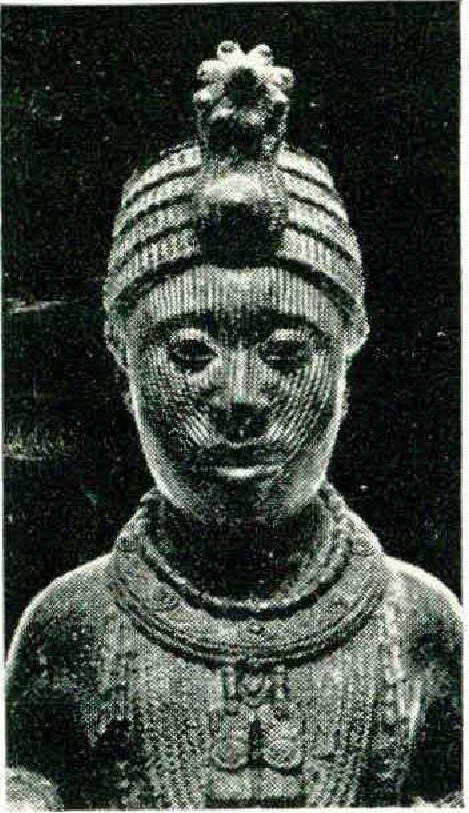
‟Good God!” I shouted. “Where’s this ‘ancient culture’? At Ife? Twenty good bronze heads, probably Portuguese. A few dancing masks. Traditions of human sacrifice and the exposure of twins. And fight? Who’s had to fight? ‛Don’t, cant in defense of savages’ — Dr. Johnson.”
All the same, I had to admit to myself as I drove home that all this put O. K. in rather a different light.
A DAY or two after Clifford’s supper party I flew back to England for three and a half months. I was pleased on my return to find what a difference even one leave could make. It had been possible to see one’s life here in perspective for a few weeks and to reassure oneself that other things continued to flourish elsewhere and would always be waiting to be taken up again. Besides, one thing that Nigerians enjoy and do tremendously well is welcoming people they know. They beam as they say, ‟Wel-come!” They inquire after your family, of whom they know nothing. They make you feel that you have been not home but away.
I faced my classes cheerfully, with a firmly planned program and the idea that I could keep everyone up to the mark quite gently and avoid battles. Last year’s irresponsibles of the secondyear honors class now wore the supercilious looks of the final honors class, and among them sat O. K., wearing a slightly adjusted version of his old leadership, a sort of distinguished rogueelephant visitor air. I made no comment on his presence. I simply told them what my lectures would be about and on what dates I would expect essays to be handed in.
The first was within ten days. On the eve of the day in question, O. K. presented himself at my front door at 9 P.M. I was surprised.
All he said was, ‟Good evening,” and waited to be asked in.
When I’d given him a glass of beer he unbent so far as to tell me what he had come to see me about, his essay. He couldn’t possibly hand it in yet.
‟The subject interests me so much, you see. I want to make a big job of it.”
If he could treat the subject on a large scale, I said, so much the better. ‟Then you’ll just let me have it as soon as vou can?”
‟Yes.”
There was silence. His glass was empty, and I hoped he would go. But he didn’t move, and I thought I had better offer him more beer, which he accepted. Under its influence, he began to talk at some length about himself and his hopes for the future. He meant to return to writing leads for the Nigerian, which he did every vacation, as soon as possible.
‟I’m glad you decided not to at once,” I said. ‟Much more sensible to take your degree first.”
‟I don’t think so,” he said, his full, reticulated lips pouting more than usual. ‟It was my father who insisted.
‟Your father?”
‟Yes. I was working on the Nigerian, and he heard, back in the village, that I didn’t mean to come back here, you see, and he came to Lagos and followed me to work every day, telling me I must try for my degree again. Every day when I came out of the office, there he was waiting for me, and he followed me home through the streets talking at the top of his voice. He did that every day for a month until I turned around and said, ‛All right. I’ll go. Now go home.’ But he stayed and watched me and came with me in the lorry right into the college compound to make sure.”
O. K. told this story with the utmost gloom. Perhaps that was why I laughed. Clifford had been sold a pup, but, after all, I had always known he was the sort of person who would be, simply because he was the type of Englishman who wants to be sentimental about Africans.
‟Your father won’t object to your working on the Nigerian once you’ve got your degree?” I asked.
‟Oh, no. It’s a good job. But I don’t think he’ll like my next move.”
I tried not to rise to that, but when the pause had become embarrassingly long I felt obliged to say, ‟And what will that be?”
‟Well, when I’ve saved enough money, I want to start a paper of my own.”
After another pause, he went on. “All the newspapers we have in this country are in the pocket of someone or other, you see. We haven’t a single independent paper. And they’re all hopelessly Europeanized, you see. They talk about England as if it was the most marvelous place, where everyone wanted to go.”
‟Well, don’t they? Why does everyone clamor for scholarships to go to England?”
‟They oughtn’t to. They all want English art, English books, English pictures, and so on, you see. My paper will teach them to know they’ve got a far greater culture of their own.”
‟But do you really know your own national art, Mr. Balogun? Do you really do anything about it? Did you go to Fakaye’s exhibition in the town last week?”
He looked blank.
‟It was arranged by the British Council,” I said.
‟Oh, yes, I heard,” he said. “I was too busy. Anyway, I don’t think he’s very good.”
‟If you’d ever seen any of his work, you would,”
I said. “Would it surprise you to know that very few Africans went to the exhibition and that not one bought anything? Everything was sold — to Europeans. And as much more commissioned — by Europeans.”
‟Fakaye’s no good,” said O. K., grimacing and tossing off his beer. He got up and helped himself to another cigarette. I looked around for my lighter but found that he had it already.
‟Anyway,” he said, “before I start my independent paper I think I’d better get some experience in the other parts of the newspaper business, and for that I suppose I’ll have to go to England. Could you arrange for me to join the staff of a good English newspaper, say the Daily Mail or the Times, for a year?”
I told him just what it was he was asking for. He was not a bit abashed. He sat looking at me intently through his spectacles, his sharp, avid face set upon his ambition.
‟I do know someone who runs an interesting monthly on his own and is very much interested in Africa,” I said at last. “I could ask him if he’d take you on for a year, if you like. Would that do? ‘
‟Yes,” he said.
‟I can’t promise anything, of course.”
He nodded, apparently not taking it in. ‟I think he’ll get his notions about Africa straightened out when he knows me,” he said.
In the night I woke, and a breath of wind brought the African night sounds into my room. For the first time I didn’t feel the lurch of homesickness but a sort of reproach, as if the endlessly urgent shrilling of the cicadas, the raucous complaint of the bullfrogs, and a faint, distant drumming from some village came before me in the ghostly folds of the billowing mosquito net as the face of someone who wanted to like me and be liked in return but had no natural grace. The alien country didn’t claim me, but it did, in a surly way, need me.
The essay, of course, never came, but that was a long time ago.
TIME’S up,” I say. ‟Now let’s hear what you put down.”
I go around the table clockwise, beginning with the girl on my left, who reads her notes out in a soft voice that I can hardly hear. This is part of the mannerliness of the well-brought-up Nigerian girl and cannot be cured. She has quite sensible things to say, but rather tame. While she speaks, the slim fingers of one hand move expressively, with a flutter of pink palm. When she pauses here and there I nod, and each time she supplies the assent — ‟Uhu!” — for me.
I ask for comments from the others, which come fiercely. Their idea of a discussion is an indignant debate in which the speaker must be slapped down. Every contribution begins, ‟I disagree,” or, ‟The previous speaker has said — but—” Time being short by now, I take a reef here and there in arguments we have wound our way through on too many other occasions and pass on to the next man, knowing how long he is going to take.
He can’t get going at once or speak quickly. He has to shuffle his papers, moisten his lips, look at me, look back at his notes, and then begin ponderously, ‟We have before us the question of — Sooner or later he will say, ‟Before we can answer that question, we must define poetry.”
‟No, Mr. Esua,” I interrupt quickly, when we get there. ‟I shouldn’t do that if I were you.”
It takes him some seconds to get his bearings again, but he eventually goes on. ‟In order to see how far Hopkins succeeds in fulfilling his aims, we must first ask ourselves what those aims were.”
At last we reach O. K., who has listened, or not, with his head bowed over his pages, inscrutable. He now holds up his four lines of notes and from them makes a long, rapid, largely unintelligible speech. What I can gather of the argument is circular, and is designed to contradict a number of my own most frequently repeated opinions.
When the class breaks up, he stays behind to ask if he may speak to me. We sit down again. I gather it is James Joyce we are discussing to begin with, but after about three quarters of an hour we reach the expected account of the forces that will certainly prevent O. K.. once more from passing finals. In one category we can place the deficiency of the examination and the prejudice of the examiners; in the other we have his nervous temperament, his constitutional inability to settle down to anything that seems to him a waste of time, his feeling that he ought to be writing short stories, and his complete indifference to the fashionable ideal of success. What is it all for? Does it make people happy? The sort of people who admire a degree and a big car fill him with a contempt that simply paralyzes his faculties.
I agree that lie would certainly do better to enjoy his reading and writing and his life as a student for their own sakes, but I also mention sour grapes.
O. K. either does not know what they are or is just waiting for another chance to speak. for he breaks in: ‟All the fellows keep bringing me old finals papers, and I have to answer all the questions for them. My essays are out all the time, being read by one fellow or another.”
‟Look,” I say. ‟This is where the success ideal comes in. If you weren’t so anxious to have the fellows sitting at your feet, you’d take finals in your stride. You’re imitating the civilization you despise: that’s how we get our nervous breakdowns.”
‟I laugh,” he says (laughing), ‟because you think I’m neurotic.”
I rise to my feet and say wearily, “I wasn’t talking about you. But that’s the trouble, isn’t it? You can’t take in anything that isn’t you.”
I walk to the door, and he follows, chuckling to himself.
‟By the way,” I say, ‟I hear you didn’t reply to that newspaper offer from England. Why was that?”
He gestures, and sighs for words. ‟Nigeria’s the place for me. England just corrupts Africans. I shall wait for something bigger. One of the leading newspapers would be different — more cosmopolitan. That’s what we need, now that we’re becoming a world power.”
On the way home I stop at Linda’s, as bidden. She’s sitting at her dressing table, pinning up her lovely red hair, which she has just washed.
‟These awful boys!” she says as I enter. ‟Do you know what it did this morning?” — nodding toward her steward, who is sweeping the balcony with his bunch of twigs.
She tells me what he did while I sit on the bed and smoke a cigarette. Mostly I think about O. K., but occasionally sentences get through to me of the sort I collect.
‟Well, at length an exhausted Linda dropped into her chair. I had to be revived with strong liquor, I can tell you.”
Fortunately, she doesn’t need any comments from me; she’s too busy with her hair.
‟My mother always used to say to me, ‛Linda.’ she used to say, ‛I’ve given you one wonderful thing and that#8217;s — I may not have been able to give you riches,’ she used to say, ‛or very good health, and you’ll find life hard, you take my word for it. You’ll have your little ups and downs. You’ll have your little weepies, and no one will know, because you’re my daughter and you’ll face the world with a brave smile. But I have been able to give you one thing, and that’s your hair.’ ”
She puts the last clip in place and pats it. ‟You’re very silent. A drink’s what you need. Come on down with me. and I’ll fix one for each of us. Look at that!” she adds, her voice changing suddenly to scorn. She points out of the window to a long, straggling line of students meandering along the road in the hot sun. They have spent the morning in the chemistry labs and arc going back to their halls for lunch.
‟Just look,” says Linda. ‟Can you see that lot turning into scientists? What they need is a good stiff dose of England, only they wouldn’t appreciate it. They can’t take in civilization, so what’s the use?”