Barbados
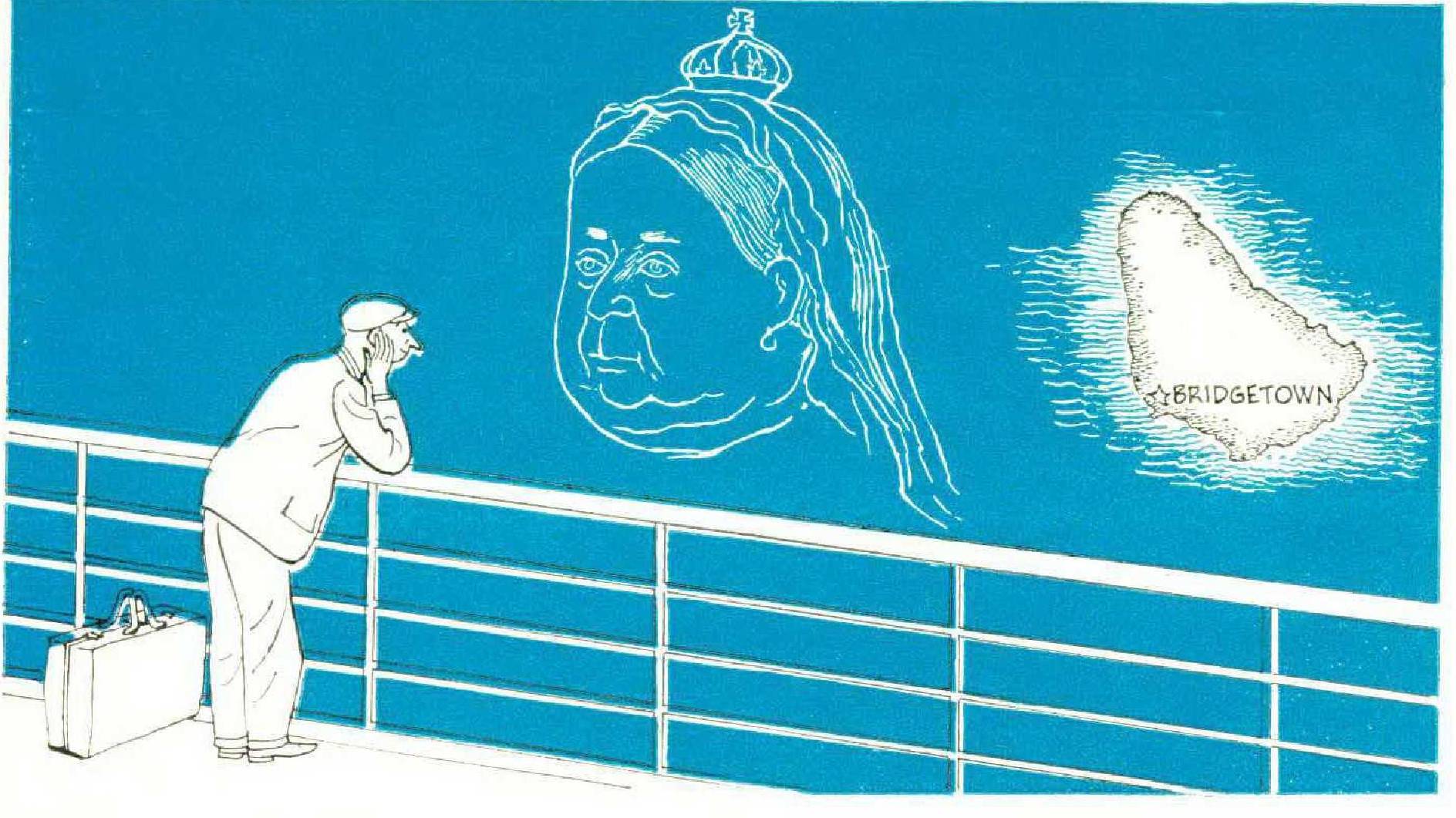
Barbados was my destination. I was in search of an island where tourists and resort life had not seriously disturbed native character and a hostelry something like those made vivid for me when, as a child, I was greeted by my grandparents on their return from the West Indies and heard their reports of idle ambience in the subtropical sun. Doubling that such places were still in existence, I was prepared to find only hotels that had succumbed as a matter of course to the wall-to-wall anonymity of Statler Modern or the streamlined enervation of Hilton International.
As we dropped anchor off Bridgetown early one morning, candy-pink clouds came piling over the island. Except for this tropical flourish, we could have been standing off some British Channel port — Plymouth, perhaps — where downs undulate back from the shoreline. The miniature warehouses along the water’s edge were glumly Victorian; the Anglican spires and clock towers rising over middle-class bungalows and villas were as cozy as an etching over a mantel. The cliché that accounts Barbados ‟Little England” was, I could see, utterly true. But dehydrated Bermuda looks British, too, just as gimcrack Capri looks Italian, and I was wary of preserved characteristics. I had too often experienced the boredom of places that have become resorts — and merely resorts. To hold my interest for more than a day, resort life had to take place in relation to some vital background.
At the rail of the Sports Deck, I stood watching the swift buglike approach of a half-dozen little flatbottomed boats. The boys in them were already shouting, ‟Two bits, mon, two bits!” Beside me, large women in forget-me-not prints and sweaters studded with rhinestones began to pick coins from their husbands’ open palms. Inflation had come to the island: the boys ignored nickels and dimes and dived only for quarters and flfty-cent pieces, which they stored in their mouths.
I was anxious to disembark. The nightclub atmosphere that seemed, even in the daytime, to charge to the hilt all of the ship’s public rooms had become burdensome, and my attendance at high-noon cocktail parties substituting for breakfast had begun to take a somatic toll. I would miss, of course, the hair-trigger adjustments of the air conditioning in my Boat Deck cabin, the mirrors reflecting mirrors that kept my single quarters crowded, the blended pastels, the deep carpeting, and the strains of Muzak that brought me waltzing from the shower.
As the launch took my party ashore, we passed through cool shadows from black hulls and crossed the bows of ships so old they seemed to be rotting into the water. We had come into the marina at Bridgetown, known as the Careenage, and it was like entering a chapter from Joseph Conrad. Pigs squealed on open decks, derricks lifted oil drums with symphonic clankings, cooking smells from one smoking galley were mixed with those from another. Above the confusion, captains in shirt sleeves stood on their respective bridges and with impenetrable remoteness watched our launch and its bulging cargo of bourgeoisie.
A dispirited steel band in T-shirts marked ‟Pepsi Cola” greeted us with familiar Belafonte airs. Within a few minutes my companions were off to hotels cut to the spit and image of the ship they had just left, and I was on my own. At the customs shed a cockney-voiced lady official dressed like a girl guide accepted my filled - out forms and, with an old dip-andwrite pen, approved my sojourn. I carried my bags to a taxi and directed it to a hotel I shall call the Ocean Grand, simply because I knew it was one of the oldest on the island and the most likely to fit my secondhand childhood recollections.
A few miles from Bridgetown, the taxi turned off the coastal road. We came into a circular garden punctuated by enormous clumps of canna blossoms and drew up under a portecochere. My first full sight of the Ocean Grand was as sharply detailed and as unreal as a remembered dream. Had I seen a postcard, or perhaps a snapshot, taken years ago? Or had my childhood’s several mental pictures assumed one definite shape? There it was, an old casino in a park, flags and pennants flyingover turrets and a dome, baskets of flowers hanging the length of a broad veranda, a blending of patina green and tarnished silver, cupolas with round black windows that might have been made with a biscuit cutter. A strain of outlived gaiety was apparent in the ironwork crenellations and pistachio-colored filigree, and yet the sheer impracticalities of the building gave it a note of expensive dignity that set it apart.
A boy came smartly to take my bags, and I followed him across the grass-matted veranda into a large reception room. Oar-shaped fans whirled and hummed above wicker chairs and wicker tables, on which were scattered copies of the London Times, the Toronto Star, and the New Haven Register. The manager, in a frock coat, escorted me to my room along what seemed a half mile of well-trod carpeting. When we came to my door, he put into my hand a key on a holder as big as a pear and, with chipper politeness, wished me a pleasant stay.
The room was bright, cooled by air flowing from window to transom. Everything in it, even the wicker chairs and towering wardrobe, had been painted a hundred times in one tone of institutional gray. But the gray was made tolerable by warm squares of red, yellow, and blue reflected from a stainedglass border around the window. Over the bed, a vaguely disquieting tent-shaped bower of mosquito netting arched gently from the ceiling. The general impression was one of no nonsense: basic cleanliness, if not austerity, with emphasis on a crispness of linens and a sense of privacy without isolation. Looking out over red roofs to the Caribbean and watching three white cats, directly below my window, solemnly stalking one another in the sun, I felt free at last of the insistent press of the show-window appointments that had surrounded me ever since I had left New York. At least one of my goals in coming to Barbados seemed to have been realized.
Still, the modest ‟high season” rate of my room and bath — thirteen dollars per day, including three meals — did not lead me to expect the groaning board of exotic fare my grandparents had so fondly detailed.
At the entrance to the dining room, other newcomers, who appeared for luncheon in Bermuda shorts, were being gently sent back to their rooms by the headwaiter. I was relieved that I had chosen to wear city clothes. The dining room seemed Otherwise informal, except for the obvious fact that most of the guests chose to dine alone, yet within speaking distance of one another, so that inter-table talk was constant. This struck me as an ideal arrangement since it did not enforce togetherness but allowed for its option. The food was simple, good, and, on the margins, imaginative. The Continental bias of the chef seemed a little desperate at times, but menus were resourcefully varied. When one balked at the Gallic listings that masked fairly familiar entrées, one could choose the genuine local delicacies of flying fish and steamed dolphin. The Continental note was also struck in the arrangement of guests: family groups on long stays by the windows; transients like myself amid a cluster of Rousseaulike foliage, where, protectively colored, we could stare without being conspicuous.
The Ocean Grand had no swimming pool, no nightclub, no gambling room, no television lounge. In the absence of these opportunities for entertainment, the only choices were to read in the Reading Room or to write in the Writing Room or to play bridge under Japanese lanterns on the veranda. There was a bar, a small one entirely bare of decorative bamboo and dyed sea fans. Before dinner, its only inhabitant was likely to be the bartender listening to cricket —Barbados versus Trinidad on a portable radio. After dinner, the crowd would be made up of two gray-haired ladies sipping crème de menthe.
But to wake up to a nineteenthcentury morning in the subtropics is a pleasure not to be calculated in terms of the loss of questionable twentieth-century amenities. The English breakfast on a tray is enormously fortifying, and the morning sounds of dishes and silver and singing chambermaids make an appropriate music.
After breakfast, a leisurely walk along walls heavy with bougainvillaea brings the guest to the hotel’s beach, where he can swim in tides whipped white by the steady trade winds, then dry out on wooden benches which stand in rows before a bell-shaped pergola. The benches are all but empty now, but it is not difficult to imagine them years ago when the wintering gentry sat here in parasoled rows while a band, befrogged and betasseled, played Strauss waltzes. Attending daylight concerts is no longer the social thing to do, but on appointed nights a firemen’s band plays for the natives: and on mornings like this, Negro nannies in peaked while caps sit in the shadow of the bandstand while they keep an eye on their charges.
Three times every day a Volkswagen bus belonging to the hotel transports its guests to Bridgetown. Driving those three or four miles is like driving along any seaside road in England: a double row of architecturally hybrid villas with names like Supermare, Land’s End, Mon Repos, and a procession of bicycles, little cars, and open-sided buses that you cannot believe are going to squeeze by. Dogs and children wander out into the road carelessly with wide-eyed stares; the sense of a street as part of a route between one place and another has taken hold but lightly.
Bridgetown itself is a great warehouse of a place, ugly, loud, smelling of potatoes, grain, beans, and brine. It has a large Anglican cathedral and a post office as elaborate as the House of Commons. The English signature, strongly marked in architecture and general prospect, is even more clearly apparent in the bearing of the citizens. They have the same sort of politeness in the street that one encounters in London and, by and large, the same sense of propriety in dress and public appearance. Local color — the bandanna, the frilled sleeve, and the bongo drum appears on the travel posters and hardly anywhere else. The business day moves briskly, and by midafternoon endless hordes of chic Negro schoolchildren (pinafores, straw hats, and pigtails on the girls: flannel caps, long ties, knickers, and knee-length socks on the boys) traipse from their schools to the midtown point where buses painted like circus wagons bear them to all parts of the island.
The shops are very plain. The two-hundred-dollar linen tablecloth the visitor might buy comes from under the counter and is carried away in a wrapping of butcher’s paper tied with a string. Except for tourists who come off cruise ships for a day’s frantic search for bargains, the shopping area is given over to the natives, and it is to their tastes that the merchants cater. Luxury items, the same shapes of leather and silk and gold that can be found anywhere from Honolulu to Istanbul, are sold in the small swank boutiques of the deluxe hotels.
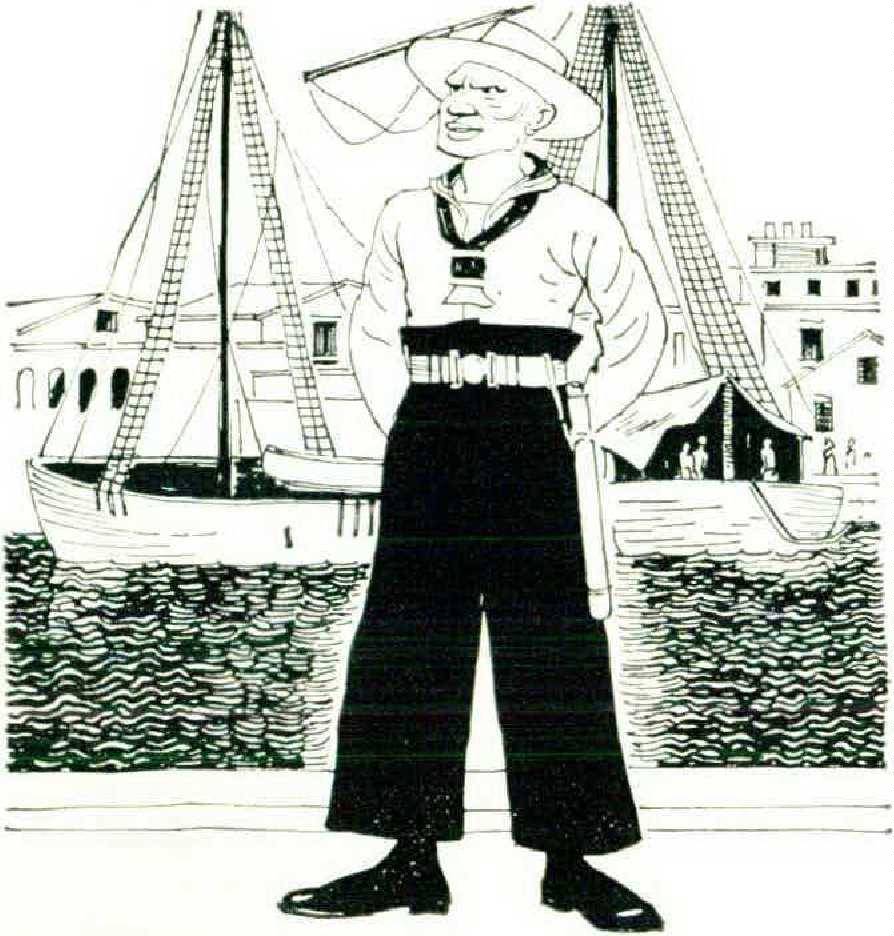
The rewarding thing in the teeming port is simply to let the camera of the eye take its snapshots: barefooted women wheeling carts of manycolored soft drinks called ‟balloon juice”; an old Negro, elegant in white linen and a Panama hat, his handkerchief daintily protruding from his sleeve; The waterfront policemen, dressed like members of Lord Nelson’s crew, standing importantly under masts in the Careenage; a ramshackle juke joint with its genteel enticement, ‟Hot Tea Within”; whole families sitting on their laundry-bag luggage waiting for their schooner to sail; the ballet showmanship of the white-helmeted policeman who keeps traffic whirling around Trafalgar Square; the ‟sailor hags” in red silk dresses and red satin shoes who bang around the waterfront bars; a youngster of ten who lifts his cigarette and asks you for a ‟friction” and means, ‟Have you got a light?”; sentimentally tinted photographs, hung in banks and shoeshine parlors, of Princess Margaret, the island’s ‟cheese girl,” or sweetheart.
Beyond Bridgetown, exploration on foot is difficult. Though the island is hardly much larger than Martha’s Vineyard, its flatness (the highest point. Mount Hillaby, rises to only about a thousand feet) gives a sense of distance to any prospect. Its huge sugarcane fields tend to look very much like Iowa cornfields. In crossroads clearings among them stand communities made up of a few houses and stores, and often mint-fresh hospitals and clinics. A great number ot new houses are being put up, many of them under the direction of a builder who has apparently found inspiration for a Greek revival in his conception of the Acropolis. At a distance, these dwellings, especially in their halfcompleted state, remind one of the Erechtheum, except that the caryatids are missing. Older native houses are often inexplicably Scandinavian in feeling, with carved eaves and bright colors blended together by the weather.
Within minutes of any of the few concentrated resort areas, one is completely in a world and a way of life that has little to do with resorts. Good-looking and active, the Bajans give the impression of never having succumbed to the torpor of poverty that is the way of so many other island peoples. The invigorating nature of their climate may have something to do with it, the constant sunny wind and the brief rains that come, as they say, ‟a bucket a drop.
In any case, they look over the tourist who is looking them over, with easy pride, and continue about their business. To rove their coral island is to get far away from the sense that a visitor’s stay in the subtropics is doomed to the hermetic confinement of buffet lunch by a swimmingpool.
When it came time to depart, I was the only outgoing passenger on the launch taking me to another ship anchored in Carlisle Bay. I gave my last Beewee dollars to a Negro nun at the entrance to the customs shed, and stepped aboard. Anglican bells were ringing the midafternoon over the flotilla of masts in the Careenage. The gloss of old imperial England had given character to my first impressions of Barbados, and now it was distinctly coloring my last. Yet the gentle bells seemed somehow too foreign, too Christian, too civilized as I watched the commotion of a cluster of natives on one of the docks, where a fisherman was hacking slabs of flesh from the bloody side of a huge dolphin and selling them on the spot to Negro women who bickered and bargained for choice cuts. The creature’s face, grotesquely contented, seemed to smile until I was out of sight.