The Porcupines in the Artichokes
“Let me, in conclusion, assure the distraught hostess that some of my best friends are writers, and adjure her, for God’s sake, not to bring them and me together at a party at her house.”
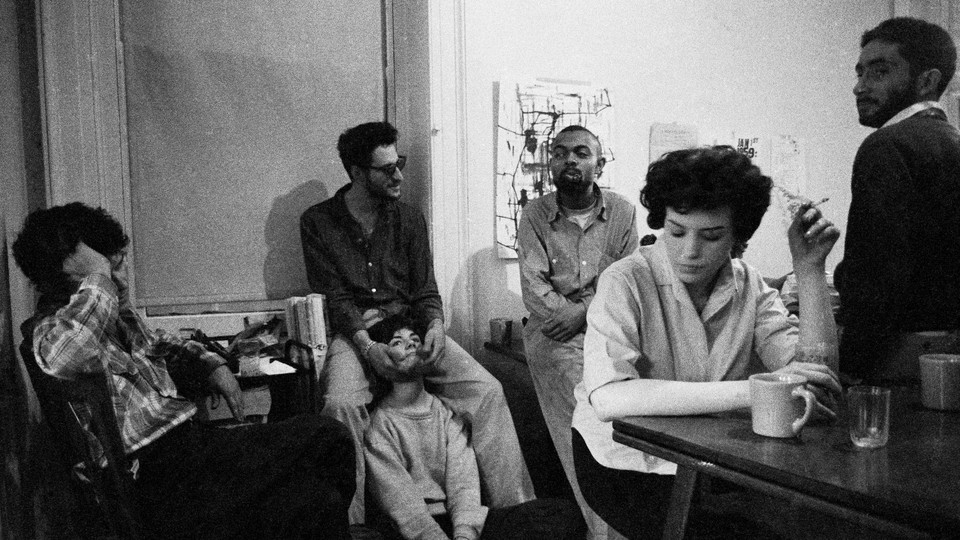
I HAVE writers the way other people have mice,” a disturbed hostess has written me. “What can I do to keep them from arguing, fighting, and throwing highball glasses after dinner? One doesn’t dare mention names, such as Herman Melville and Harold Loeb, or the fight is on. What would you suggest?”
Well, now, it isn’t easy to entertain writers and have any fun. You might begin by saying, over the first cocktail, “I don’t want any writers to be mentioned this evening.” Do not make the mistake of adding, “From Washington Irving to Jack Kerouac,” because that would instantly precipitate an argument about Washington Irving and Jack Kerouac. You might begin by saying, “The porcupines are getting our artichokes.” This could, of course, lead to literary wrangling and jangling, but everything is a calculated risk when writers are present, even “My grandfather almost married a Pawnee woman,” or “I wonder if you gentlemen would help me put the handle back on my icebox.” A writer, of course, can turn anything at all into a literary discussion, and it might be better not to say anything about anything.
I myself have found, or rather my wife has found, that you can sometimes keep writers from fighting by getting them into some kind of pencil-and-paper game. You could say, for example, “There are thirty-seven given names and nicknames, male and female, in the word ‘miracle.’ I want you all to see how many you can find.” This almost always takes up a good hour, during which the writers are mercifully silent.
My wife, during a party in August, when writers are at their worst, brought out the pencils and paper and said, “I want you all to write down the names of as many animals and birds as you can think of with a double ‘o’ in their names.” This worked fine for about half an hour, during which the literary men wrote down: moose, goose, mongoose, raccoon, baboon, loon, rook, coot, spoonbill, kangaroo, cockatoo, rooster, poodle, bloodhound, woodchuck, woodpecker, woodcock, whippoorwill, and cuckoo.
The trouble started, as my wife should have known it would, when the papers were gathered up and the scoring began. Every writer, in a room full of writers, wants to be the best, and the judge, or umpire, or referee is soon overwhelmed and shouted down like a chickadee trying to take charge of a caucus of crows. Nobody can ever remember exactly what happened at any drinking party invaded and taken over by writers, because, as the bowl continues to flow, their eloquence and invention take on the sharp edge of temper and cussedness. My wife gave up the hopeless task of scoring and turned it over to a lawyer guest when the question of the validity of habitat names set all the crows to cawing at once. It was decided that brook trout, moor hen, stool pigeon, and the like were out. Then there turned up, on this paper and that, what the lawyer, raising his voice, called behavior names—whooping crane, which was allowed after near fisticuffs, hoot owl, which also made it, and moo cow, which was shouted down, along with brood mare. The lawyer-judge, full of Scotch and a love of definition, tried to put into separate categories saber-toothed tiger, hooded falcon, smooth-haired fox terrier, hookworm and bookworm, hoop snake and coon dog, and it was soon evident that the task of arbiter was too much for him.
There are always two or three writers, in this kind of game, who deliberately louse things up by taking and holding an untenable position. One of these obstinate fellows had written down pool shark, and another had come up with booze hound, and they defended their stand on the ground that my wife, in the beginning, had not stipulated real animals and birds. The shouting about this died down when micro-organism turned up on the paper of a stuffy textbook writer, who defended it on the ground that a double “o” is a double “o” whether hyphenated or not. Everybody turned on him, and somebody threw an ash tray.
At this point my wife drew me aside, which isn’t easy to do at a yelling party, since I am a writer, too, and told me, “You’ll simply have to get them to singing.” I tried to get them to singing, but it was no good, because the whooping-crane man and the brook-trout man suddenly began attacking each other’s books, viewpoint, style, and implementation. In a sense, the crane of whooping crane and the brook of brook trout saved the situation, if wreckage can be saved by further wreckage. All of a moment a whooping literary argument was on. It concerned the merits and demerits of Rupert Brooke, Stephen Crane, Tennyson’s “The Brook” and Tennyson himself, Hart Crane, and Bret Harte; also The Heart of the Matter, The Heart is a Lonely Hunter, and The Death of the Heart, thus involving Graham Greene, Carson McCullers, Elizabeth Bowen, Kenneth Grahame, The Wind in the Willows, Gone with the Wind, Kenneth Tynan, Kenneth Burke, A Biography of Kit Carson, Burke’s Speech on Conciliation with the Colonies, Marc Connelly, Mark Sabre, If Winter Comes, Robert Frost, W. H. Auden, J. D. Salinger, J. B., A. E. Housman, AE, A. J. Liebling, B. F.’s Daughter, and, if my memory serves, Herman Melville, Harold Loeb, Washington Irving, and Jack Kerouac.
That night three highball glasses, two friendships, and a woman’s heart were broken. There is really only one safe rule for a hostess to go by. Do not ask writers to your house, especially in the summer, and in three other seasons of the year — spring, autumn, and winter.
I was going to end my advice to hostesses on that wintry note, but after tossing and turning in bed for two or three minutes one night, which is all I can do at my age without falling asleep, I decided that I had not been helpful enough to the lady in distress who wrote me. She should, then, hide any flat package a writer brings to her party. It is likely to contain a long-playing record which he intends to plop on her phonograph when everybody else wants to argue, and there are things worse than writers’ arguing, such as a recording, in Ooglala Sioux, of a group of Indian squaws chanting in an endless monotone, with a background of tom-toms, a dirge mourning the miscarriage of a chief’s daughter or daughter-in-law. If it isn’t that, it will be a recording of “The Waste Land” in Gaelic, or a recitation of “ Evangeline” by the writer’s five-year-old niece. Don’t let your writer guests get their teeth into poetry, for God’s sake. Prose is bad enough, but poetry is worse. Somebody is sure to misquote “ Under a spreading chestnut tree,” by changing the “a” to “the,” and the hecklers will be at him like dogs on a bone. Somebody will then bet somebody else that he can’t correctly finish “The light that never was . . .” and he will be right, because the challenged man will say, “on land or sea,” when it is really “ on sea or land.” The hostess should conceal all flat packages and return them later, the later the better.
It is high time that a note of hope, or at least of wan cheerfulness, creep into this discourse. Don’t get the idea that writers never agree about anything, because they do, approximately twice during the course of an eight-hour evening. Their form of agreement goes roughly like this: “ You are right, you are right, you are absolutely right! The trouble is, you don’t have the vaguest idea why you are.” The writer who is thus agreed with will, of course, disagree with the agreer, like this: “You are completely wrong, and so was I. It is remarkable how you always reveal the weakness of a point by insisting that it is well taken.” Here the point, whatever it may have been, is lost sight of in an exchange of what might be called abstract double talk, or backfiring Dada. Now nobody in the room knows what the writers are not talking about, including the two men themselves.
My experience of writers at parties goes back to the year that Jurgen was published and has been confined to endless talkers born between the years 1885 and 1905, the wives of some of whom have not got in more than ninety words edgewise since 1922 —at parties, that is. When the writer husband is hung over, the wife is allowed to talk, and she often does, though knowing full well that her spouse isn’t paying any attention. The literary men roughly in my age group become more articulate, and less coherent, as the years go on. but their age does not keep them away from parties. Now and then those who are in their sixties or seventies confuse Spoon River Anthology with Of Time and the River, but otherwise it is hard to tell them from the younger men.
Among the American writers I have stayed up with all night were — to name only those who are, alas, no longer with us — Robert Benchley, Heywood Broun, Scott Fitzgerald, Thomas Wolfe, and Sinclair Lewis. Benchley was, as everybody knows who knew him, the Great Companion, who often talked about the mystery and lure of heaven when the bright stars were waning. Broun was usually in some area of politics, justice, and fair play. Once, around two in the morning, he asked me not to cross a picket line that had been set up in front of Twenty-One, and I had to tell him that that was where we were. “Under the circumstances then,” he said in that unforgettable voice, “I think we should have another drink.” Fitzgerald talked about the dear dead past, the Unattained and the Unattainable, for he was the romantic to the end, and the farthest removed of all male writers from such subjects as the conquest of an old-time movie actress in the back seat of a Hupmobile in the year when Teddy Roosevelt stood at Armageddon and battled for the Lord. Wolfe discoursed for twelve hours about love, and writing (his own), and Carolina. Lewis was all over the written and unwritten areas of his time, and went in for some excellent mimicry of his colleagues. All these unforgettable nights except one — I met the wondrous Sinclair Lewis in Bermuda — were spent in New York City. In London, the British writers have a strange way of going home from a party before daybreak, and the one whose early departure I always most regret is Compton Mackenzie, as good an actor and imitator as he is a writer, whose impersonation of Wordsworth I would go three thousand miles to see, and have more than once.
It was the late incomparable John McNulty who had the perfect answer to the problems of the writer-beleaguered hostess. McNulty was a piano-playing man, and he once said, “The thing to do in mixed company is play Dear Old Girl.” He would stop the fight about Jim Tully or James Branch Cabell by going to the piano and sliding into Dear Old Girl in his famous silent-movietheater style, and every guy in the room bitween the ages of eighteen and eighty would lean on the piano and join in the chorus. That undying song, first published in 1903, I think, leads naturally into Let Me Call You Sweetheart, I Want a Girl Just Like the Girl, Down by the Old Mill Stream, and all the rest, with no space for rock and roll, or rockers and rollers, or for the voices of writers raised in argument instead of melody.
Let me, in conclusion, assure the distraught hostess that some of my best friends are writers, and adjure her, for God’s sake, not to bring them and me together at a party at her house. We write such lovely letters to each other, it would be a shame to spoil it.