The Morals of Extermination
Philosopher, author, authority on city planning, and an outspoken American, LEWIS MUMFORD reminds us of the destruction which daily threatens mankind if the fateful experiments with nuclear weapons continue uncontrolled. In this period of direct negotiation with Khrushchev, it is imperative for both sides to remember the grim alternatives.
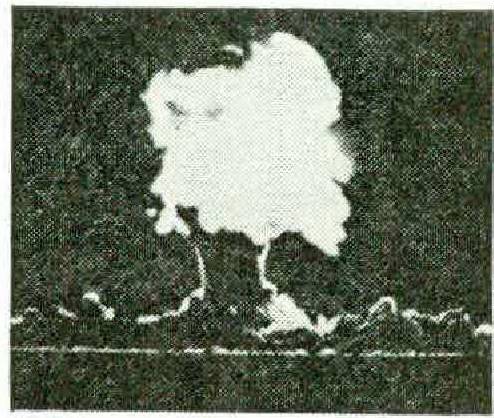
SINCE 1945, the American government has devoted the better part of our national energies to preparations for wholesale human extermination. This curious enterprise has been disguised as a scientifically sound method of ensuring world peace and national security, but it has obviously failed at every point on both counts. Our reckless experimental explosion of nuclear weapons is only a persuasive salesman’s sample of what a nuclear war would produce, but even this has already done significant damage to the human race. With poetic justice, the earliest victims of our experiments toward genocide — sharing honors with the South Pacific islanders and the Japanese fishermen — have been our own children, and even more, our children’s prospective children.
Almost from the beginning, our investment in nuclear weapons has been openly directed against a single country, Soviet Russia. In our government’s concern with the self-imposed problem of containing Russia and restricting by force alone the area of Communist penetration, we have turned our back on more vital human objectives. Today the political and military strategy our leaders framed on the supposition that our country had a permanent superiority in nuclear power is bankrupt, so completely that the business probably cannot be liquidated without serious losses.
As things stand now, we are not able to conduct even a justifiable police action, as a representative of the United Nations, with the backing of a majority of the nations, without the permission of Russia and China. When they refuse permission, as they did in Korea, the limited war our strategists fancy is still open to us turns into an unlimited humiliation, as the painful truce that continues in Korea should remind us, for every original issue remains unsettled. But if we challenge that veto, our only recourse is to our absolute weapons, now as fatal to ourselves and the rest of mankind as they would be to Russia and China. The distinguished army combat generals who have publicly recognized this state of impotence have been forced out of the armed services.
This situation should give us pause. While every scientific advance in nuclear weapons and intercontinental missiles only widens to planetary dimensions the catastrophe we have been preparing, our leaders still concentrate the nation’s efforts on hastening these advances. Why, then, do we still listen to those mistaken counsels that committed us to the Cold War, though our own military plans have wiped out the possibility of war itself and replaced it by total annihilation as the only foreseeable terminus of the tensions we have done our full share to produce? By what standard of prudence do we trust our lives to political, military, and scientific advisers who have staked our national existence on a single set of weapons and have already lost that shortsighted gamble, even if they become desperate enough to use these weapons or remain blind enough to believe that they can conceal that loss by not using them?
What was it that set in motion the chain reaction of errors, miscalculations, delusions, and compulsions that have pushed us into the impossible situation we now occupy? Every day that we delay in facing our national mistakes adds to both the cumulative dangers that threaten us and the difficulty of undoing them.
THE first step toward framing a new policy is to trace our path back to the point where we adopted our fatal commitment to weapons of mass extermination. This moral debacle, it is important to remember, was not a response to any threat by Russia or by Communism; still less was it imposed by Russia’s possession of similar weapons. Actually, the acceptance of extermination antedated the invention of the atom bomb.
The principles upon which the strategy ot extermination was based were first enunciated by fascist military theorists, notably General Douhet, who believed, like our own Major Seversky, that a small air force could take the place of a large army by confining its efforts to mass attacks on civilians and undermining the national will to resist. This reversion to the vicious Bronze Age practice of total war was a natural extension of fascism’s readiness to reintroduce terrorism and torture as instruments of government. When these methods were first carried into action, by Mussolini in Abyssinia, by Hitler in Warsaw and Rotterdam, they awakened horror in our still morally sensitive breasts. The creed that could justify such actions was, we thought correctly, not merely antidemocratic but antihuman.
In the midst of World War II a moral reversal took place among the English-speaking Allies, such a transposition as happened by accident in the final duel in Hamlet, when Hamlet picks up the weapon Laertes had poisoned in advance in order to make sure of his enemy’s death. The fascist powers became the victims of their own strategy, for both the United States and Britain adopted what was politely called “obliteration bombing,” which had as its object the total destruction of great cities and the terrorization and massacre of their inhabitants.
By taking over this method as a cheap substitute for conventional warfare - cheap in soldiers’ lives, costly in its expenditure of other human lives and in the irreplaceable historic accumulations of countless lifetimes — these democratic governments sanctioned the dehumanized techniques of fascism. This was Nazidom’s firmest victory and democracy’s most servile surrender. That moral reversal undermined the eventual military triumph of the democracies, and it has poisoned our political and military policies ever since.
Civilized warfare has always been an atrocity per se, even when practiced by gallant men fighting in a just cause. But in the course of five thousand years certain inhibitions and moral safeguards had been set up. Thus, poisoning the water supply and slaying the unarmed inhabitants of a city were no longer within the modern soldier’s code, however gratifying they might once have been to an Ashurbanipal or a Genghis Khan, moral monsters whose names have become infamous in history. Overnight, as it were, our own countrymen became such moral monsters. In principle, the extermination camps where the Nazis incinerated over six million helpless Jews were no different from the urban crematoriums our air force improvised in its attacks by napalm bombs on Tokyo. By these means, in a single night, we roasted alive more people than were killed by atom bombs in either Hiroshima or Nagasaki. Our aims were different, but our methods were those of mankind’s worst enemy.
Up to this point, war had been an operation conducted by military forces against military targets. By long-established convention, a token part, the army, stood for the greater whole, the nation. Even when an army was totally defeated and wiped out, the nation it represented lived to tell the tale; neither unarmed prisoners nor civilians were killed to seal a defeat or celebrate a victory. Even our air force, the chief shaper of our present policy, once prided itself on its pin-point bombing, done in daylight to ensure that only military targets would be hit.
As late as the spring of 1942, as I know by personal observation, a memorandum was circulated among military advisers in Washington propounding this dilemma: If by fighting the war against Japan by orthodox methods it might require five or ten years to conquer the enemy, while with incendiary air attacks on Japanese cities Japan’s resistance might be broken in a year or two, would it be morally justifiable to use the second means? Now it is hard to say which is more astonishing, that the morality of total extermination was then seriously debated in military circles or that today its morality is taken for granted, as outside debate, even among a large part of the clergy.
More than any other event that has taken place in modern times this sudden radical change-over from war to collective extermination reversed the whole course of human history.
Plainly, the acceptance of mass extermination as a normal outcome of war undermined all the moral inhibitions that have kept man’s murderous fantasies from active expression. War, however brutal and devastating, had a formal beginning and could come to an end by some formal process of compromise or surrender. But no one has the faintest notion how nuclear extermination, once begun, could be brought to an end. Still less can anyone guess what purpose would be accomplished by it, except a release by death from intolerable anxiety and fear. But this is to anticipate. What is important to bear in mind is that atomic weapons did not bring about this first decisive change; they merely gave our already de-moralized strategy a more effective means of expression.
Once extermination became acceptable, the confined tumor of war, itself an atavistic pseudoorgan, turned into a cancer that would invade the blood stream of civilization. Now the smallest sore of conflict or hostility might fatally spread through the whole organism, immune to all those protective moral and political restraints that a healthy body can mobilize for such occasions.
By the time the atom bomb was invented our authorities needed no special justification for using it. The humane pleas for withholding the weapon, made by the atomic scientists, suddenly awakened to a moral crisis they had not foreseen while working on the bomb, were automatically disposed of by well-established precedent, already three years in operation. Still, the dramatic nature of the explosions at Hiroshima and Nagasaki threw a white light of horror and doubt over the whole process; for a moment a sense of moral guilt counteracted our exorbitant pride. This reaction proved as short-lived as it was belated. Yet it prompted Henry L. Stimson, a public servant whose admirable personal conduct had never been open to question, to publish a magazine article defending the official decision to use the atom bomb.
The argument Mr. Stimson advanced in favor of atomic genocide — a name invented later but studiously reserved for the acts of our enemies — was that it shortened the war and saved perhaps more than a million precious American lives. There is no need here to debate that highly debatable point. But on those same practical, “ humanitarian” grounds, systematic torture might be employed by an advancing army to deter guerrilla lighters and to blackmail the remaining population into accepting promptly the torturer’s terms.
That only a handful of people ventured to make this criticism indicates the depth of moral apathy to which our countrymen had sunk in less than a dozen years. Those who used this illustration, however, were not surprised to find that the French, themselves the victims of Hitler’s carefully devised plans of torture and mass extermination, would authorize the use of military torture in Algeria a decade later. Our own country had forecast that depravity by our national conduct. This conduct still remains without public examination or repentance, but, unfortunately, retribution may not lie far away. Should it come, Civil Defense estimates have established that it will at Once wipe out forty million American lives for the one million we once supposedly saved.
Let us be clear about cause and effect. It was not our nuclear weapons that committed us to the strategy of extermination; it was rather our decision to concentrate on the methods of extermination that led to our one-sided, obsessive preoccupation with nuclear weapons. Even before Russia had achieved a single nuclear weapon, we had so dismantled our military establishment that we lacked sufficient equipment and munitions to fight successfully such a minor action as that in Korea.
THE total nature of our moral breakdown, accurately predicted a half century ago — along with the atom bomb — by Henry Adams, can be gauged by a single fact: most Americans do not realize that this change has taken place or, worse, that it makes any difference. They have no consciousness of either the magnitude of their collective sin or the fact that, by their silence, they have individually condoned it. It is precisely as if the Secretary of Agriculture had licensed the sale of human flesh as a wartime emergency measure and people had taken to cannibalism when the war was over as a clever dodge for lowering the cost of living — a mere extension of everyday butchery. Many of our professed religious and moral leaders have steadily shrunk from touching this subject; or, if they have done so, they have naïvely equated mass extermination with war and have too often given their blessing to it, for reasons just as specious as those our government has used.
It is in relation to this gigantic moral collapse that our present devotion to nuclear weapons and their equally dehumanized bacterial and chemical counterparts must be gauged.
When we abandoned the basic moral restraints against random killing and mass extermination we enlarged the destructive capacities of our nuclear weapons. What was almost as bad, our pride in this achievement expressed itself in an inverted fashion by our identifying our safety and welfare with the one-sided expansion of our weapons system. Thus we surrendered the initiative to our instruments, confusing physical power with rational human purpose, forgetting that machines and weapons have no values and no goals, above all, no limits and no restraints except those that human beings superimpose on them.
The one thing that might have rectified our government’s premature exploitation of atomic power would have been a public assize of its manifold dangers, even for wider industrial and medical use. As early as the winter of 1945-1946 the Senate Atomic Energy Committee made the first full inquiry into these matters, and the physicists who appeared before this committee gave forecasts whose accuracy was fully contained in the tardy hearings that have just taken place before a joint congressional committee. Almost with one voice, these scientists predicted that Soviet Russia would be able to produce a nuclear bomb within live years, possibly within three. On that basis, the nations of the world had three “safe” years to create through the United Nations the necessary political and moral safeguards against the misuse of this new power.
There was no salvation, the more alert leaders of science wisely pointed out, on purely national terms. Naturally, Russia’s totalitarian isolationism and suspicion made it difficult to arrive at a basis for rational agreement, but our own sense of holding all the trump cards did not lessen this difficulty. All too quickly, after the Russian rejection of our generous but politically unsound Baruch proposal, our country used Russian hostility as an excuse for abandoning all further effort. Even before we had openly committed ourselves to the Cold War itself—a now obsolete preatomic military concept — our leaders preferred to build a threatening ring of air bases around Russia rather than to pursue with patient circumspection a course directed toward securing eventual understanding and cooperation. So the difficult became the impossible.
As late as 1947 this situation, though grave, was not disastrous. Our very mistakes in turning to mass extermination were capable, if openly and honestly faced, of leading both ourselves and the world back to the right path. Up to then, our totalitarian weapons system had not yet consolidated its position or threatened our free institutions; the organs of democratic society, invigorated rather than depressed by the war, had not yet been enfeebled by official secrecy, repression, suspicion, craven conformism, or the corruptions of absolute power, shielded from public criticism. Meanwhile, unfortunately, the strategy or mass extermination, which did not bear public discussion or open assessment, was rapidly taking shape.
For a brief moment, nevertheless, our leaders seized the political initiative, though they were handicapped by ambivalent intentions and contradictory goals. Our contribution to organizing the United Nations, though it had been originally proposed by the United States, was as cagey and inept as Russia’s, for the frustrating Council veto was an American conception. Under a more imaginative leadership two other, admirable American proposals came forward, UNRRA and the Marshall Plan. Both these agencies had great potentialities, for at first we had the intelligence to offer their benefits even to Communist countries.
Had we followed these efforts through, they might have permanently increased the whole range of international cooperation. In wiser executive hands, these initiatives would not have been prematurely terminated. Rather, they would have been employed to reduce world tensions and to win general assent to a program for giving all nations the prefatory exercises in magnanimity and understanding essential to the re-establishment of moral order and the control of our demoralizing weapons. But even in their brief, limited application these agencies did far more to fortify the assisted nations against oppressive Communist dictatorship than all the billions we poured into NATO and SEATO to build up futile armaments for wars neither we nor our allies were capable of fighting. Witness our long series of backdowns and letdowns: Czechoslovakia, Korea, Vietnam, Poland, East Germany, Hungary, Egypt.
IN OUR commitment to the strategy of extermination, under a decision made when General Eisenhower was Chief of Staff, the United States rejected the timely warnings of the world’s leading scientists and the common counsels of humanity. Instead of holding a series of world conferences in which the dangers of nuclear energy could be fully canvased, not alone by physicists but by thinkers in every threatened field, our official agencies deliberately played down these dangers and used every available mode of censorship to restrict the circulation of the knowledge needed for such an appraisal. In this obstinate desire to exploit nuclear power solely for our national advantage, our government relied upon insistent publicity and indoctrination to build up a false sense of security. Instead of regaining our moral position by ceasing the reckless experiments whose mounting pollution justified a world-wide apprehension, we flatly denied the need for any such cessation and allowed Russia, after it had come abreast of us, to take the moral lead here. Even at a recent United Nations conference, which clearly demonstrated the dangers, our own representatives helped vote down the Russian preamble to the conclusions of the conference, which called for a cessation of all further nuclear testing.
To explain this obstinate commitment to the infamous policy of mass extermination one must understand that its side reactions have proved as demoralizing as its central purpose. Within a bare decade, the United States has built up a huge vested interest in mass extermination — in the weapons themselves and in the highly profitable manufacture of electronic equipment, planes, and missiles designed to carry them to their destination. There are tens of thousands of individual scientists and technicians engaged in nuclear, bacteriological, and chemical research to increase the range and effectiveness of these lethal agents, though we boast we already have a stockpile of nuclear weapons capable of wiping out the entire planet. There are also corporate bodies — the air force, the Atomic Energy Commission, great industrial corporations, and extravagantly endowed centers of research — whose powers and presumptions have been constantly widened along with their profit and prestige. While the show lasts, their careers depend on our accepting the fallacious assumptions to which they have committed us.
All these agents now operate in secret totalitarian enclaves, perfecting their secret totalitarian weapons, functioning outside the processes of democratic government, immune to public challenge and criticism or to public correction. Whatever the scientific or technical competence ol the men working in this field, their sedulous restriction of interest and the limited conditions under which they work and have contact with other human beings do not foster wisdom in the conduct of life. By vocational commitment they live in an underdimensioned and distorted world. The sum of their combined judgments is still an unbalanced judgment, for moral criteria have, from the start, been left out of their general directives.
Is it any wonder that even in the narrow segments of science where they claim mastery our nuclear officials have made error after error? They have again and again been forced to reduce their estimate of the “ permissible” limit of exposure to radiation, and on the basis of knowledge already available they will have to reduce these estimates still further. Thus, too, they made an error that startled themselves, in their undercalculating the range and the lethal fall-out of the hydrogen bomb, and they sought to cover that error by concealment and calumny, at first denying the plight of the Japanese fishermen they had injured. Some have even used their authority as scientists to give pseudo-scientific assurances about biological changes that no one will be able to verily until half a century has passed. Furthermore, in matters falling within their province of exact knowledge, the judgment of these authorities has repeatedly proved erroneous and mischievous.
All this should not surprise us: neither science nor nuclear energy endows its users with superhuman powers. But what should surprise us is the fact that the American nation has entrusted its welfare, safety, and future existence to these imprudent, fallible men and to those who have sanctioned their de-moralized plans. Under the guise of a calculated risk, our nuclear strategists have prepared to bring on a calculated catastrophe. At some unpredictable moment their sick fantasies may become unspeakable realities.
Does anyone really think that, unless a miracle supervenes, there can be a more favorable outcome to the overall policy we have been pursuing? If this policy had a color of excuse before Russia had achieved her first nuclear weapon in 1949, it became thoroughly discredited in Korea in 1950 and became suicidal as soon as Russia’s superiority in rocket missiles was established. The fact that Russia now has equal or better weapons of extermination and has joined us in these same insane preparations doubles our danger but does not halve our original guilt. Neither does it nullify our willful stupidity in now clinging to an obsolete, discredited strategy, based on a negation of morality and a defiance of common sense.
The only possible justification of our continued reliance upon weapons of total extermination would be that they do no present harm and would never be used by either side under any extremity of provocation. Can any mature mind comfort itself with either hope? Even our experimental explosion of nuclear bombs, at a rate of more than two for Russia’s one, has poisoned our babies’ milk, upset the delicate ecological balance of nature, and, still worse, defiled our genetic heritage. As for the possibility that nuclear weapons will never be used, our children in school know better than this every time they are put through the sadistic mummery of an air-raid drill and learn to “play disaster.” Such baths of fear and hostility are gratuitous assaults against the young, whose psychological damage is already incalculable; their only service is to bar more tightly the exits that would permit a real escape.
There are people who would defend these plans on the grounds that it is better to die nobly, defending democracy and freedom, than to survive under Communist oppression. Such apologists perhaps exaggerate the differences that now exist between our two systems, but they err even more seriously in applying to mass extermination a moral standard that was defensible only as long as this death was a symbolic one confined to a restricted number of people on a small portion of the earth. Such a disaster, as in the bitter-end resistance of the Southern Confederacy, was still relatively minor and retrievable; it the original resolve to die were in fact an erroneous one, in a few generations it could be corrected. Nuclear damage, in contrast, is cumulative and irretrievable; it admits no belated confession of error, no repentance and absolution.
Under what canon of sanity, then, can any government, or any generation, with its limited perspectives, its fallible judgment, its obvious proneness to self-deception, delusion, and error, make a decision for all future ages about the very existence of even a single country? Still more, how can any one nation treat as a purely private right its decision on a matter that will affect the life and health and continued existence of the rest of mankind?
There are no words to describe the magnitude of such insolence in thought or the magnitude of criminality involved in carrying it out. Those who believe that any country has the right to make such a decision share the madness of Captain Ahab in Moby Dick. For them Russia is the White Whale that must be hunted down and grappled with. Like Ahab in that mad pursuit, they will listen to no reminders of love, home, family obligation; in order to kill the object of their fear and hate they are ready to throw away the sextant and compass that might give them back their moral direction, and in the end they will sink their own ship and drown their crew. To such unbalanced men, to such demoralized efforts, to such dehumanized purposes, our government has entrusted, in an easily conceivable extremity, our lives. Even an accident, these men have confessed, might produce the dire results they have planned, and more than once has almost done so. To accept their plans and ensuing decisions, we have deliberately anesthetized the normal feelings, emotions, anxieties, and hopes that could alone bring us to our senses.
NO ONE can guess how a sufficiently wide recovery of moral responsibility and initiative might be brought about. Neither can one predict at what moment our nation will see that there is no permissible sacrifice of life, either in experimental preparation of these vile weapons or in a final conflict whose very method would nullify every rational end. Certainly it seems doubtful that popular pressure would bring about such a change in government policy, except under the emotion of a shattering crisis, when it might well be too late. But great leadership, exerted at the right moment, might clear the air and illuminate the territory ahead. Until we actually use our weapons of extermination, there is nothing that we have yet done that cannot be undone, except for the existing pollution of our food and our genetic heritage with strontium 90 and carbon 14. But we must make a moral about-face before we can command a political forward march.
Yet if once the American nation made such evaluation of the morality of extermination, new policies and appropriate decisions would quickly suggest themselves. This would do more to effect an immediate improvement in the relations between the two powers now committed to preparing for mutual extermination than endless parleys between their heads of government.
A moral about-face does not demand, as those whose minds are congealed by the Cold War suppose, either a surrender to Russian Communism or a series of futile appeasements; neither does it mean any increase in the dangers under which we now live: just the contrary. Those who see no other alternatives are still living in the pre-nuclear world; they do not understand that our greatest enemy is not Russia but our treacherous weapons, and that our commitment to these weapons is what has prevented us from conceiving and proposing the necessary means for extending the area of effective freedom and, above all, for safeguarding mankind from meaningless mutilation and massacre.
No dangers we might face once we abandoned the very possibility of using mass extermination would be as great as those under which we now live; yet this is not to say that a bold change of policy would be immediately successful, or that before it had time to register its full effects in other countries it might not tempt Russia to risk measures to extend over other areas its own monolithic system of minority single-party government. But need I emphasize that these possible penalties could hardly be worse than those our government meekly accepted in Czechoslovakia, Poland, and Korea, at a time when we still hugged the illusion of wielding absolute power through our monopoly of nuclear weapons? While sober judgment need not minimize these transitional difficulties and possible losses, one must not underestimate, either, the impact of a new policy, wholly concerned to re-establish the moral controls and political cooperations necessary to enable mankind to halt the threatening misuse of the extraordinary powers that it now commands.
Even in a purely military sense, this changed orientation might produce the greatest difficulties for those Communist governments who misunderstood its intention and sought to turn it to their private national advantage. Russia would no more be able to escape the impact of our humane plans and moralized proposals than it was able to avoid the impact and challenge of our nuclear weapons. If we rallied the forces of mercy, humanheartedness, and morality with the vigor with which we have marshaled the dehumanized forces of destruction, what government could stand against us and face its own people, however strong its cynical suspicions and misgivings?
This is not the place or the moment to spell out a new policy which would start with the complete renunciation of weapons of mass extermination and go on to build constructive measures addressed to all those tasks which the Cold War has caused us to leave in abeyance. Fortunately, George Kennan, the only official or ex-official who has yet had the courage to admit our earlier miscalculations, has already sketched in, with some boldness, the outlines of a better policy, and his proposals might be amplified and enlarged in many directions once we had overcome our official obsession with Russia and our fixation on mass extermination as an ultimate resource.
But the key to all practical proposals lies in a return to human feelings and sensitivities, to moral values, and to life-regarding procedures as controlling factors in the operation of intelligence. The problems our nation has tried to solve by mechanical weapons alone, operated by a detached and de-moralized mechanical intelligence, have proved insoluble by those means. A great leader would know that the time has come to reinstate the missing human factor and bring forth generously imaginative proposals addressed to mankind’s survival and working toward its further development.