Gertrude Stein in America
Poet, teacher, editor, and literary critic, JOHN MALCOLM BRINNIN was born in Halifax, Nova Scotia, and educated at the University of Michigan and at Harvard. His most recent book, DYLAN THOMAS IN AMERICA, was published under the Atlantic—Little, Brown imprint in 1955. This is the second excerpt from his forthcoming book, THE THIRD ROSE, a fullscale biography of Gertrude Stein, her life, her writings, her associates, and the cultural movements of which she was a part.
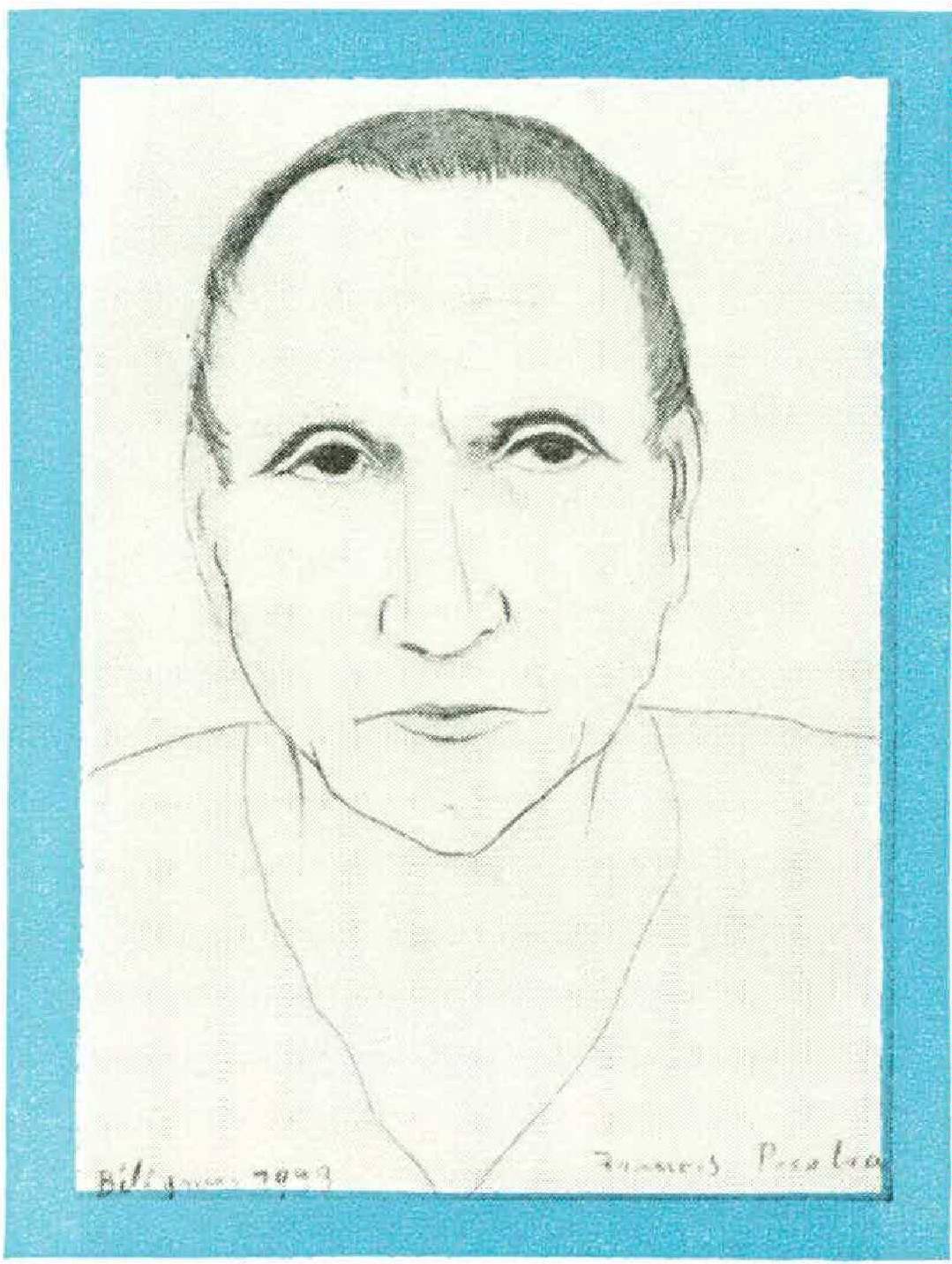
GERTRUDE STEIN would not go back to America, she had always said, until she was a lion, a real lion. Now — on October 24, 1934 - as the S.S. Champlain slid through morning mist, and, port-side, Staten Island dimly floated past, and the Statue of Liberty beckoned, she was about to see the proof writ larger than she had ever dreamed.
When the press launch drew alongside and a horde of reporters climbed aboard, she met them with a large show of confidence. Anticipating their questions — they were, after all, the very same questions she had been asked for twenty years — she took them off guard. “ Suppose no one asked a question,” she led off, “what would the answer be?” And when they asked, “Why don’t you write the way you talk?” she replied, “Why don’t you read the way I write?”
“ I do talk as I write,” she insisted, “ but you can hear better than you can see. You are accustomed to see with your eyes differently to the way you hear with your ears, and perhaps that is what makes it hard to read my works.” When one of the reporters asked if she had been upset by comparisons of her writings to the babblings of the insane, she said no, not one bit, because there was an important difference. “You can continue to read me, but not the babblings of the insane. Besides,” she added with a softening glance, “the insane arc frequently normal in everything except their own phase of insanity.”
Those who had come to challenge her were themselves challenged. Taking the initiative, she answered them with a confounding simplicity and won them with easy good humor. When they asked if she believed she had introduced anything new into writing, she answered, “ I have not invented any device, any style, but write in the style that is me. You have material in yourself and in humanity and you apply it, that’s all. I describe what I feel and think. I am essentially a realist.” About influences her work may have had on American writers she was succinct. “If you can influence yourself,” she said, “it is enough.” And when, finally, they asked about “all those repetitions,” she answered, “No, no, no, no, it is not all repetition. I always change the words a little.”
In their notebooks the reporters detailed her costume, her thick woolly stockings, round-toed, flat-heeled Oxfords, her cerise vest and mannish shirt of crcam-and-black stripes, her coarse tweed suit, and the baffling hat she wore — a sort of deerstalker’s cap modeled after a thirteenthcentury one Alice Toklas had seen in the Cluny Museum — and hurried back to their desks. The afternoon papers blossomed with references to the “Sibyl of Montparnasse.” “the high priestess of the Left Rank,” and every story about her bore the inevitable Steinese caption. Typical among them was:
GERTY GERTY STEIN STEIN
IS BACK HOME HOME BACK
More than six months later, “wedded to America,” as she told the Paris newspapermen who covered her return to France, she could look back upon every evidence of being the lion she had hoped to become and upon the renewal of a love affair with her native land that remained passionate to the day of her death.
She had seen the news of her arrival announced in lights crawling around the New York Times Building, had found herself so famous in the big city that she was addressed on the street more often than if she were in Bilignin. She took New York traffic in stride, never hesitating as she stepped from any curb into the midst of it. When an anxious friend asked her why she acted with such bravado, she answered, “All these people, including the nice taxi drivers, recognize and are careful of me.” She had crisscrossed the nation by air from Massachusetts to California in a series of some forty-odd appearances, each of them surrounded by fanfare and adulation. At the Hotel Algonquin in New York, where literary and theatrical celebrities had long been the rule, she had aroused more comment and interest, according to Manager Frank Case, than anyone else who had ever stopped there.
Nothing could have pleased her more. “ I was very surprised to see how gentle people are today. Everyone is so courteous and polite, so friendly. I am not speaking of the people I know, I have not seen anyone yet. I mean the people in the streets — they seem to recognize me. And they come up to me and say, ‘Miss Stein?’ And I say, ‘Yes,’ and then we talk in the most friendly fashion, not at all as if they were seeking out some one who had attained some notoriety. I find it perfectly charming.”
She had enjoyed reunions with many old friends, among them Scott and Zelda Fitzgerald, with whom she had spent part of Christmas Eve in Baltimore. She had seen Sherwood Anderson, first at his brother-in-law’s home in Fall River, Minnesota, and later in New Orleans, where they spent a long evening eating oranges and reviewing the marvelous turns of events that had brought them once more together. A happy meeting, it was their last.
Of new friends, the first in her affection was Thornton Wilder, who was then teaching at the University of Chicago. After the great success of her first lecture there, the University’s young president, Robert Maynard Hutchins, asked her to return to conduct ten sessions of a seminar made up of thirty selected students. In one of these sessions she made the most forceful answer to an essential question she had ever spoken. When, according to Thornton Wilder, one of her students asked her for an explanation of her most famous line, “Rose is a rose is a rose is a rose,” Gertrude fixed her attention on the young man and launched into eloquence. “Now listen!” she said. “Can’t you see that when the language was new — as it was with Chaucer and Homer — the poet could use the name of a thing and the thing was really there? He could say ‘ O moon,’ O sea,’ ‘ O love’ and the moon and the sea and love were really there. And can’t you see that after hundreds of years had gone by and thousands of poems had been written, he could call on those words and find that they were just wornout literary words? The excitingness of pure being had withdrawn from them; they were just rather stale literary words. Now the poet has to work in the excitingness of pure being; he has to get back that intensity into the language. We all know that it’s hard to write poetry in a late age; and we know that you have to put some strangeness, something unexpected, into the structure of the sentence in order to bring back vitality to the noun. Now it’s not enough to be bizarre; the strangeness in the sentence structure has to come from the poetic gift, too. That’s why it’s doubly hard to be a poet in a late age. Now you all have seen hundreds of poems about roses and you know in your bones that the rose is not there. All those songs that sopranos sing as encores about’ I have a garden; oh, what a garden!’ Now I don’t want to put too much emphasis on that line, because it’s just one line in a longer poem. But I notice that you all know it; you make fun of it, but you know it. Now listen! I’m no fool. I know that in daily life we don’t go around saying ‘ is a . . . is . . . is . . .’ Yes, I’m no fool; but I think that in that line the rose is red for the first time in English poetry for a hundred years.”
IN SPITE OF momentary wonderings at why so little of her past seemed to return as she crossed and recrossed the continent, Miss Stein decided that America had become, as she said, “ my business,” and she wanted to be involved in all of it. She had been entertained at the White House. “ Mrs. Roosevelt was there and gave us tea,” she wrote with vastly mitigated enthusiasm, “she talked about something and we sat next to some one.” With George Gershwin she had sat on a piano bench while he ran through the score of his new opera, Porgy and Bess. She had been guest of honor at an epicurean dinner at Miss Ellen Glasgow’s in Richmond, Virginia. After she had watched the last lap of one of the marathon dances, which had become a national craze, she wrote to Carl Van Vechten: “A most extraordinary thing, they are like shades modern shades out of Dante and they move so strangely and they lead each other about one asleep completely and the other almost, it is the most unearthly and most beautiful movement I have ever seen it makes the dance nothing at all.” She had ridden in a police car of the homicide squad on official duty on Chicago’s South Side. She had discussed theories of education with Robert Maynard Hutchins and Mortimer Adler, theories of drama with Charlie Chaplin, who reminded her of her favorite matador, Gallo, “who could not kill a bull but he could make him move better than any one ever could and he himself not having any grace in person could move as no one else ever did.”
Bird’s-eye views of American terrain (she traveled almost entirely by air) had been a surprise and an affirmation. She felt for the first time that she knew what the ground really looked like and related what she saw to cubism. “When I looked at the earth I saw all the lines of cubism made at a time when not any painter had ever gone up in an airplane. I saw there on the earth the mingling lines of Picasso, coming and going, developing and destroying themselves. I saw the simple solutions of Braque, I saw the wandering lines of Masson.” Thinking about this, she was moved to make one of the few assertions of her lifetime in which she directly related her own career to the world of the painters. “Straight lines and quarter sections, and the mountain lines in Pennsylvania very straight lines,” she said, “it made it right that I had always been with cubism and everything that followed after . . . once more I knew that a creator is a contemporary, he understands what is contemporary when the contemporaries do not know it yet, but he is contemporary and as the twentieth century is a century which sees the earth as no one has ever seen it, the earth has a splendor that it never has had.”
Paradoxes trailed in the wake of her passage across the United States, and not the least of these was the fact that the most obscure writer of the century had, for a time, become the most famous. Her name had studded the conversation of the more literate segment of the population for years, but now, suddenly, it had also become a household word on every level of society. References to her cropped up interminably in movies, musical revues, comic strips, and random newspaper stories; a high school newspaper in Utica, New York, put out a special Gertrude Stein number; on the Pathé newsreel, movie audiences could see and hear her reading “ Pigeons on the grass”; she was quoted as often in barrooms and in courts of law as she was in classrooms. It was an eccentric sort of celebrity, yet it was attended by far more good humor than malice. The public was able to tolerate and accept her as a person, while among the occupational literati she was widely regarded with envy, suspicion, and a curiously puritanical impatience.
Young writers, without vested reputations to guard or critical positions to defend, were apt to be her champions. One of them, William Saroyan, wrote to her in the hope of an interview when she would come to San Francisco; “Some critics say I have to be careful and not notice the writing of Gertrude Stein but I think they are fooling themselves when they pretend any American writing that is American and is writing is not partly the consequence of the writing of Gertrude Stein and as the saying is they don’t seem to know the war is over.” In the opinion of Sinclair Lewis, on the other hand, she was promoting a racket.
Whatever the true nature of its interest, the public went on reading of her comings and goings with good-humored indulgence. Even so famous a die-hard as Henry Seidel Canby — who had said earlier that, like the work of E. E. Cummings, hers was without content was moved to qualify his distaste: “I never chanced to meet her until she came home, and then found her a sensible, intelligent woman, in appearance one of the executive type of highly civilized Jewish women so familiar in philanthropic and art-management circles in New York. . . . Yet,” he had to admit, “I still cannot read her without losing my temper.” Nevertheless, Canby was newly aware of her power even as a writer and went so far as to suggest that the young editors of Time, in their efforts to differentiate their new magazine from the declining Literary Digest, were “subtly and unconsciously influenced by the experimenting goingon in the early 1920’s, and perhaps directly by Gertrude Stein’s twists of sentence order.”
NOT the least of paradoxes was the fact that the sale of her books continued with the exception of Three Lives, which for a time was the best seller in the Modern Library — to be vastly out of proportion to her fame. Random House brought out handsome editions of Portraits and Prayers, Four Saints in Three Acts, and Lectures in America, but sales were sparse and all of the titles could shortly be found on bookstore tables reserved for publishers’ overstock and remainders. If neglect on such an essential level puzzled observers who could not reconcile it with her astonishing notoriety, this did not puzzle Gertrude. She knew that her publicity came from the fact that perhaps one person in a thousand could say that she was doing something of value and that the voices of all of the others were not strong enough to drown out the one that spoke with conviction. It had become a cliché to accuse her of writing nonsense, and a very tiresome one. The stubborn point on which her reputation rested and from which her publicity issued was simply the point of conviction that made itself heard above the reams of goodhumored ragging and the choruses of mockery.
No one had ever made better copy for a depression-ridden population than this earthy, articulate mother image from Paris. She had an undeniable way with reporters of every stripe and could beguile them into putting aside all the prejudices with which they had approached her. At the sight of her comfortable and comforting presence, at the first sound of the inflections of her soft American voice, they were quite put off. Since many of them still came expecting to meet “a languid woman . . . smoking cigarettes, sipping absinthes perhaps and looking out upon the world with tired, disdainful eyes,” they were at first surprised, then altogether disarmed. In this aura of good feeling they wrote more copy than they had planned and turned in engaging accounts of the woman at whom they had expected only to jeer.
In New York, twelve full columns of largely front-page space had been devoted to her within twenty-four hours of her arrival. A number of these stories were carried throughout the country on news-service wires. Local papers took the cue, and when she turned up in one city after another, she was nearly always front-page news. An account of her visit to Boston began: “ Put away any notion that Gertrude Stein is either slightly cracked, or a literary sideshow faker of the kind Barnum liked to handle. This pleasing, thick woman with the close-cropped iron-gray hair, the masculine face and the marvelously pleasant smile, voice and manner, is doing something she thinks is good and no abracadabra, simon-pure, could come from her wittingly.”
Once, when she was being interviewed by several reporters at one time, she noticed that a photographer sitting in on the conference followed what she was saying with particularly close attention. “IPs funny,” she said to the reporters, “but the photographer is the one of the lot of you who looks as if he were intelligent and was listening. Now why is that?” Turning to the photographer, she asked, “You do, you do understand what 1 am talking about, don’t you?” With words she might have put into his mouth and which, in Everybody’s Autobiography, she did put into his mouth, he answered, “ Of course 1 tin. You see. I can listen to what you say because f don’t have to remember what you are saying. They can’t listen because they have got to remember.”
In St. Paul she came across the account of an interview written as if it were the report of a wrestling match, in which the reporter quoted from her works sentences which were among her favorites. The story was well written, she thought, and the cribbed sentences were aptly and amusingly related to what she had said in the course of the interview. At a luncheon party that same day she told her hostess she considered the article the best writing about her that she had read. The hostess was appalled. She explained that the local literati were in an uproar about the piece because it was vulgar and could only reflect badly upon the taste of St. Paul. Complaints had reached the cars of the paper’s editor, and the young reporter was expected to lose his job. Gertrude was unable to talk to the young man herself, but the hostess sought him out and reported Gertrude’s feelings. With tears in his eyes, she reported back, he said that Gertrude had saved his life.
AMERICA could not take her seriously, but since it could not ignore her, it made her into a popular darling. Her style — or, at least, journalistic versions of her style became a nationally recognized trade-mark. But among intellectuals she still carried less weight as an artist than as a symbol. She was, after all, the intimate of Picasso and Matisse and the School of Paris. Individuals who had never read a line of her work beyond the Autobiography defended her with a vehemence that often merely disguised ignorance. She represented the questing American spirit in Paris, that exportable product which, at a distance, constituted a bulwark against native Babbittry. For the middlebrow, to deny Gertrude Stein meant denying the new era of all things marvelously irresponsible and inscrutable, meant lining up with George Babbitt as he Scratched his balding head in front of a cubist canvas. To deny Tender Buttons and Four Saints was somehow to sanction the “ booboisie” morality whose zealots had threatened to put the publishers of James Joyce behind bars, banned The, Captive from Broadway, and elevated Bruce Barton to the status of the thirteenth apostle. For the highbrow, to deny Gertrude Stein was to support critics such as Van Wyck Brooks, whose worried appraisals of the dominant literature of the century had already made him déclassé.
Gertrude never wrote answers to attacks upon her, but, face to face with an adversary, was quick to her own defense. Once, at the question period after a lecture, a woman in the audience accused her and certain of her contemporaries of sensationalism. Gertrude’s answer was blunt: “People today like contemporary comforts, but they take their literature and art from the past. They are not interested in what the present generation is thinking or painting or doing if it doesn’t fit the enclosure of their personal apprehension. Present day geniuses can no more help doing what they are doing than you can help not understanding it, but if you think we do it for effect, and to make a sensation, you’re crazy.”
Attacks, from sanctuaricd critics or from the scribes of the tabloid columns, merely swelled her progress. As people fought to get tickets to her lectures and jostled for positions in her vicinity at the many luncheons held in her honor, Gertrude Stein was becoming an American institution. She had, at the outset of her tour, decided to limit her audiences to five hundred because she felt site could not, at one time, interest more people than that. This decision in itself resulted in an increased interest no trick of publicity could have matched. At Princeton, the scene of her first college lecture, the police had to check crowds trying to fight their way into the lecture hall. After that there was never any question that audiences less than five hundred would ever assemble to hear her.
For months on end her joy was unclouded; all America, it seemed, was hers. “ I found that Americans really want to make you happy,” she told a reporter. “This does not mean that they lack sophistication, but the fact that their gentleness has persisted while they have been becoming sophisticated shows that it is genuine. In Europe, on the other hand, a person’s neighbor doesn’t really count for much.” When she was asked if she thought the country had changed during the many years she had been away, she said, “No neither America nor Americans after all when you say changed how could they change what after all could they change to, and when you ask that of course there is no answer.” And to Sherwood Anderson she wrote, “ . . . it was beautiful that American country it was it is there is nothing to be said about it but that that it was and it is beautiful. . . .”
But toward the end of her visit a question asked on the editorial pages of the Hcarst press must have struck Gertrude as the very darkest echo of her own secret thoughts. “Is Gertrude Stein not Gertrude Stein,” the editorial queried, “ but somebody else living and talking in the same body?” The writer’s implication tended to make Gertrude the victim of a psychosis and might have been dismissed as part of the general campaign of ridicule. But, in a sense the writer never could have guessed, the question was oracular, touching on the quick an issue Gertrude could not resolve.
The name and nature of identity had been part of her meditations ever since the days of her adolescent Weltschmerz. All her life she had wondered who she was. Her work was an objective register of personality, and should have been a solid answer, but she could not accept even the great bulk of it as sufficiently conclusive. “ I am I because my little dog knows me,” she said, and then deliberately checked herself. “That does not prove anything about you it only proves something about the dog.” Since she believed that “ the essence of being civilized is to possess yourself as you are,” she was worried now about what happens to people who, like herself, had become the objects of the media of mass publicity in the twentieth century. Since publicity was one of the measures of success, she would of course have to bear with it. But the problems it brought were real. Henry James had said that the theme of an artist remained interesting only so long as the artist was a failure, that so long as he was a failure he was a person. But when he succeeded, he disappeared into his work, and there was no person left. Picasso had said a similar thing to Gertrude when he was reviewing his own transition from poverty to fame. She echoed both him and James in Lucy Church Amiably when she said: “A genius says that when he is not successful he is treated with consideration like a genius but when he is successful and has been as rich as successful he is treated like anybody by his family.” She herself could not finally stand the effacement of her unique personality in the mills of notoriety and came to the conclusion that, like war, publicity “ prevents the process of civilization.”
She had always hoped there would be paintings that would live outside of their frames. But a personality that refused to be framed, especially if that personality were her own, troubled her to the point of obsession. She turned to investigations of time and of all the possible ways in which the human psyche can perceive it. Only by an act of memory, she concluded, are we conscious of time. Without memory, without a specific taking of bearings in relation to past events, the psyche is timeless. Much of her life’s work had been directed toward an appreciation or comprehension of this timelessness. Brooding anew, she assayed works which, she hoped, would prove clarifying and, perhaps, comforting. For the next years of her fame she would be devoted to meditations that might save her for herself, and for the writing that the vulgar hands of publicity or the attentions of an admiring public would almost totally neglect.