This Month
One of the dominant superstitions in the publ ishing field is that the summer months are the time for “light reading.” The vision of a hammock in the shade, a glass of lemonade, and a breeze is heavily identified, in the editorial belief, with the fluffy novel. Readers grind through the rest of the year on economics, international affairs, and Literature, the legend runs, but the very same people estivate on the witty frolic — gay, frothy, sometimes exciting but always easy to read, bringing a dimple to even the dourest cheek. No one seems to be able to write a novel of this kind, to be sure, but no reader would ever take to his hammock with anything else in the summertime.
The legend shows a want of respect by publishers, it seems to me, for books which might be generally lumped together as time-killers. Most of the time-killers are mysteries, with interplanetary fiction and Westerns supporting the flanks, and with the whole brigade of dime-store paperbacks covering the rear. (I say “want of respect ” advisedly, because whenever a publisher brings out a. really first-class mystery, he always goes into a public argument with himself as to whether it’s only a mystery or whether it isn’t actually good enough to be called a “novel.”)
The fact is that there are only two kinds of readers the year round: those who read time-killers and those who don’t. The first group are perfectly willing to accept the propositions of Edgar Rice Burroughs, Leslie Charteris, Sax Rohmer — I might as well add Algernon Blackwood, Ernest Haycox, and W. C. Tuttle — in their normal course of reading. But these readers are not mere seasonal birds of passage: the man who is smacking his lips in July over roast thag — or was it thoat? — in subterranean lucidar is not going to turn skeptic at a touch of frost. Similarly, the hard-shell who doesn’t believe the dock district of London is swarming with stranglers, Chinese necromancers, and dacoits is not to be converted by hot weat her. The reader of time-killers may draw happily on other kinds of books, but the commonsense faction won’t touch pulp writing at any time regardless of the solstice.
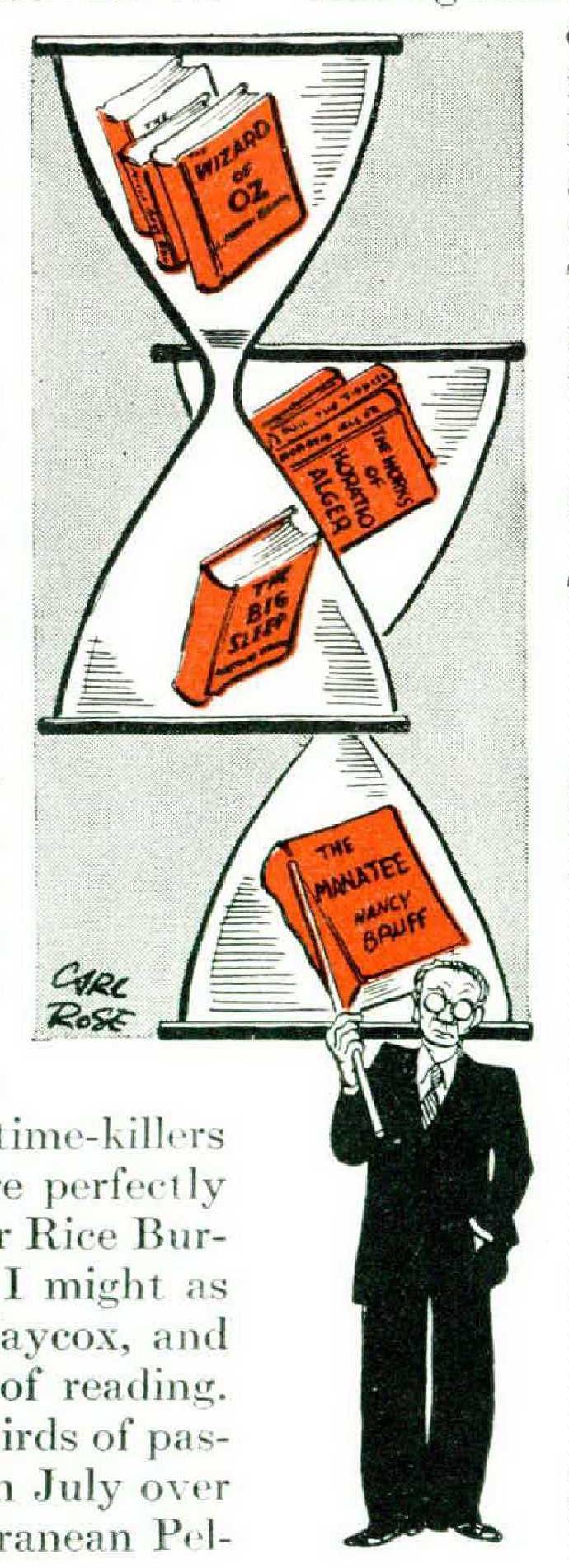
I believe there is an identifiable continuity in the reading habits of the two groups, and that both tastes could be traced, with some consistency, from early reading down to the present. Here is a short list of contrasting books and authors which might explain how today’s middle-aged reader got there. The frivolers are in the left-hand column and the common-sense faction in the right.
EARLY
The Wizard of Oz by L. Frank Baum
Aesop
The Motor Boys Series by Clarence Young
The Alger Books
PERIODICALS
Diamond Dick Young Wild West Nick Carter
The Youth’s Companion St. Nicholas Chatterbox
ADOLESCENT
Twenty Thousand Leagues under the Sea by Jules Verne
Ivanhoe by Sir Walter Scott
MATURITY
The Big Sleep by Raymond Chandler
The Manatee by Nancy Bruff
Well, it only goes to show where a common-sense standard may finallyland.
C. W. M.