The Case of the Glass Coffin
By ELINOR GOULDING SMITH
RUTHERFORD J. GAINSFORT sat at the big oak desk in his study, his head in his hands. (It should be perfectly plain to any reader of detective stories that Rutherford J. Gainsfort is a doomed man.) His stamp album, open to the page with the famous Japanese lavender (a bit of necessary erudition), lay on the desk in front ot him, but Rutherford J. Gainsfort was not looking at it. The ornate jade clock on the mantel pointed to ten minutes to eleven. (This is of no significance whatever, but it sounds as though it might be, and anyway you need a lot of false clues in these things to throw the reader off the track.)
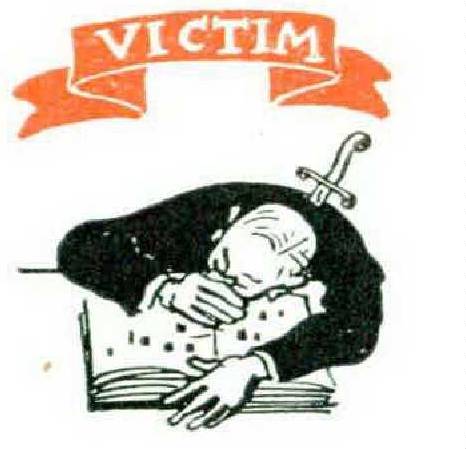
Gainsfort groaned, rubbed his forehead with the knuckles of his right hand, took a crumpled note from the inside breast pocket of his gray flannel sack coat, and smoothed it out in front of him. The note was written on pale-gray paper with purple ink, and a faint perfume rose to Gainsfort’s nostrils as he smoothed out the creases. (All notes are written on pale-gray paper with purple ink and are faintly perfumed. I couldn’t say why.)
The handwriting, which he studied carefully for the thirtieth time since he’d received the note t hree days before, was completely characterless and revealed nothing about the writer. The note said: “Dear Gainsfort, Unless you deliver the Japanese lavender before Thursday night at midnight, you will die.”
That was all. The note didn’t tell Gainsfort to whom the stamp was to be delivered, or where, or why. (You ought to be consumed with curiosity at this point — I know I am.) For two days he had told himself nervously that it was a joke — a joke in very bad taste, too, damn it, he thought. But now, at almost eleven o’clock Thursday night, he was sure it was no joke, and Rutherford J. Gainsfort was frightened. (They always get frightened too late — that’s to make it harder for the detective.)
He got a classified directory from the bottom drawer of the desk, leafed through it quickly till he found what he was looking for, and then dialed.
Martin Canby was still in his office at eleven o’clock Thursday night, but not because he was working. He was sitting at the battered, scarred desk in his office, his feet up, his shoes off, a bottle of Scotch in front of him. (The chief mystery here is: Where did he get the price of the Scotch?)
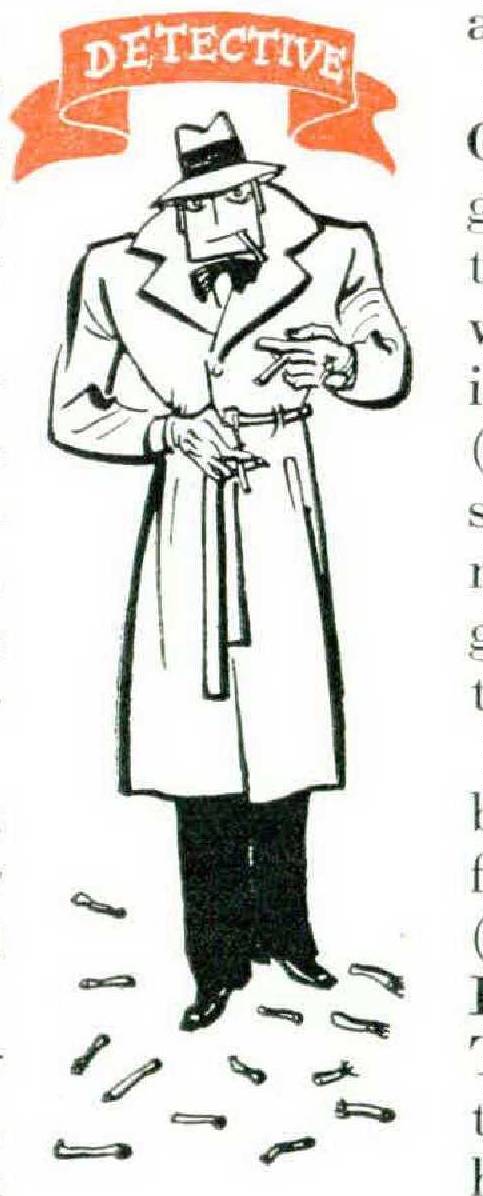
He had shaved that morning, but he had a heavy black beard that gave him an untidy look even when he was freshly shaved. And he had grav eves. His eyes were the first thing you noticed about Martin Canby, and most people, especially women, didn’t notice much else. (There. That ought to establish him as a tough guy — and fascinating, too.)
The phone rang, and Canby stirred. He didn’t pick it up till it had rung four times. (See what 1 mean? A strong-willed type.) “Hullo,” he said. “Oh, Gainsfort, huh. . . . Yeah, I’ve heard of the Japanese lavender (he’s erudite, too), but I didn’t know you had it. . . . When did you say? Three days ago? . . . Listen, I’m not taking on any jobs tonight, thanks. I’m taking a vacation. . . . A thousand? I really need that vacation, Gainsfort. . . . Hell, I’m no charitable institution. . . . Two thousand? O.K. Keep your shirt on, I’ll be right over. Oh, and listen. Listen carefully. Stay in your study till I get there. Don’t leave the room, and don’t let anyone in. Be there in fifteen minutes.”(It’s plain that Canbv has his suspicions, and there’s no telling — he may even have solved the case already.)
Canby hung up the phone, lit a cigarette, took another shot of Scotch, and went out.
He took a cab, and when he arrived at the Gainsfort mansion in the East Seventies, he glanced at his watch. It was almost eleventhirty. He noted automatically that no lights were visible from the street except a dim lamp in the doorway. He cursed under his breath. (I don’t know why — detectives just do that sort of thing.) He looked at the house for a moment more, threw down his cigarette, ground it out, and lit another. Then he went to the door.
He paused for a moment before ringing the bell, stooped over, and picked something up from the top step and put it in his pocket. (This is probably an important clue, but I’m certainly not going to tell you what it is. That might give you a chance to figure out the mystery as fast as Canby, and we couldn’t have that sort of unconventionality, could have that sort of unconventionality, could we? Then he rang the bell.
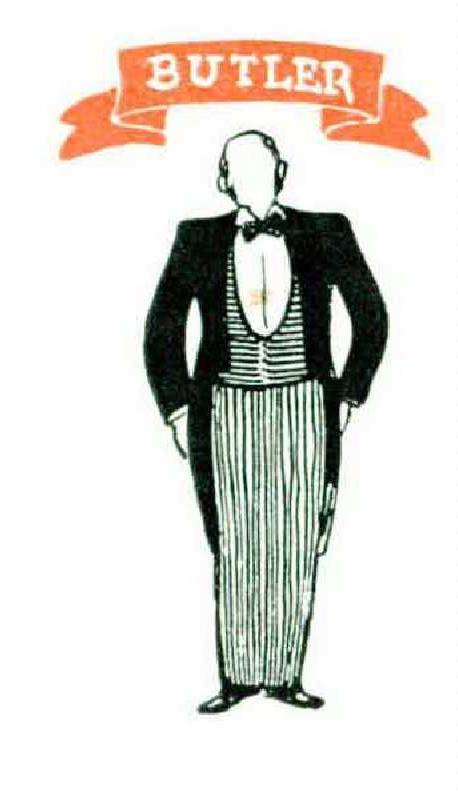
A butler with a face masked of all expression opened the door. (All butlers are expressionless, and hang around looking suspicious, but they never do the murder. They’re just there to throw you off the track.)
“Where’s the study?” Canby asked.
“Mr. Gainsfort is not at home, sir.”
“Listen,” Canby said, “cut it out. Gainsfort is home, and he’s in his study. He called me. My name is Canby.” (Detectives hardly ever call anybody Mister.)
“I’m sorry, sir,” the butler said, “but Mr. Gainsfort left word that he wasn’t to be disturbed.”
Without any warning, Canby’s right arm shot out, and in the next moment the butler, still expressionless, was lying on his back on the polished floor. (It seems to me that Canby could have found an easier way to get in, but leave it to a detective to do things in a becomingly tough way.) Canby stepped over him and looked around, He whistled once as he took in the magnificent hall.
ELINOR GOULDING SMITH is a New Yorker whose work has appeared in several issues of the Atlantic.
He started toward a door under which he saw a thin thread of light, snapped his fingers in annoyance, and went back to the butler’s motionless body. He removed some papers from the butler’s pockets, looked through them quickly, and put them all back, except one which he put in his own wallet. (Listen, I can’t tell you what these things are until after Canby has solved the case. What do you think this is? Literature?)
He went on to the door he thought was probably the study and went in. Gainsfort was slumped over the desk, his arms flung out in front of him, and protruding from his back, just under the left shoulder blade, was a tiny curved jeweled handle. A dark stain spread out around the glittering knife handle. (Blood is always spoken of as “a dark stain.”) Canby grunted. (Detectives always grunt when they find their client murdered. I don’t know whether this is to show repressed emotion or disgust at the possible loss of a fee.)
He went over to the desk and looked at everything, his gray eyes glinting and the muscle in his left cheek twitching. (In anybody else, a twitching muscle would just be a tic and would belong in the same category as a cold in the head. In a detective, it indicates a mind like a steel trap.) Gainsfort’s head rested on the open stamp album, and Canby saw, without any change of expression, that the Japanese lavender was still in place. (Nothing surprises him.) The note lay on the table, near Gainsfort’s left hand.
Canby went over to the window, pulled back ilie heavy velvet hangings, and looked out. In the earth of the garden below, there were clear footprints, both approaching and leaving the window. The window was locked from the inside. (If there are footprints outside, you can bet your last dollar the window will be locked from the inside.)
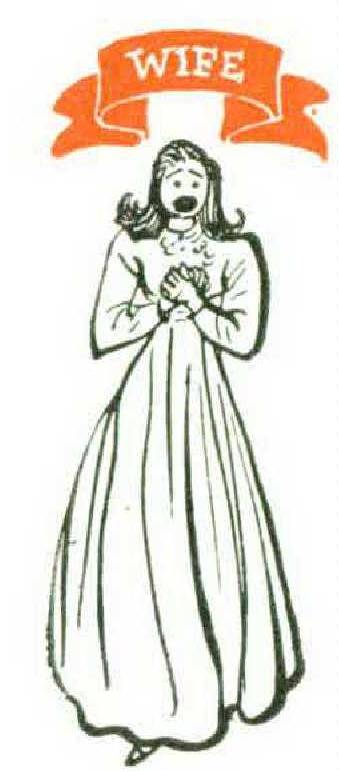
Suddenly Canby heard a slight noise inside the room and he wheeled. A woman was standing in the doorway. She was not, Canby guessed shrewdly, quite as young as you were supposed to think. She was dressed in a white negligee, with a small, high, round collar that gave her a curiously young and innocent air that went not at all with the hair that was a little too blonde, and the brilliant purplish lipstick painted heavily on her lips.
“Who are you?” Canby growled. (Detectives growl every bit as often as they grunt. In fact, they rarely sound like human beings.)
“I’m — I’m Mrs. Gainsfort,” she said hesitantly in a low voice. “Is he — dead?”
Yeah, Canby said, “he’s dead all right. You knew he was dead before you came in here. Why did you ask me?”
“All right, Mr. Canby,” she said, almost in a whisper, “I’ll tell you everything. I did know he was dead. I — I came in here to ask him something, about ten — no, fifteen — minutes ago, and I found him like this. Mr. Canby, it’s no secret that my husband and I didn’t get along. I — I was — afraid. So I ran back upstairs and waited.” Her voice was almost inaudible as she finished. (I can’t help all this repetition. You just have to have it in a detective story. If a character talks in a low voice, you have to mention it every time the character speaks. This is called “character development.”) “What are you going to do?” she whispered hesitantly.
Canby sat down on a corner of the desk and picked up the telephone. He dialed, and as he waited for an answer he spoke mildly to Mrs. Gainsfort. (They always talk mildly as the trap springs.) “It was clever,”he said. “Except for one thing, I never would have guessed.”
From hereon the story winds swiftly to its inevitable denouement. Lieutenant Robinson of the Homicide Squad arrives. He isn’t stupid, exactly, but nobody is allowed to have a mind like a steel trap except the detective. He is no help at all, but that doesn’t matter, because Canby’s lightning brain has the whole diabolical plot figured out anyway.
Naturally the Japanese lavender has nothing to do with the murder — it was just to throw you off. As for the glass coffin, well, you have to have a title. It probably turns out that the glass coffin is a goldfish bowl containing one dead goldfish which gave Canby all the clues. Or perhaps “The Glass Coffin” is the title of a book found in Gainsfort’s bathtub. I don’t know. In any case, the story winds up with Canby, suddenly and unaccountably articulate (you mustn’t carry character development too far in this sort of story), explaining the whole thing to Lieutenant Robinson.
Of course you can’t hope to get out of this wit hout hearing any number of versions of the plot: in addition to Canby’s account to Robinson, you have to suffer through the criminal’s confession, and you can tell, before the book is over, that somebody is going to repeat the whole thing to somebody else — but it won’t be me. One thing more: Canby knew plenty that I didn’t give away, and it may well be that at the very end, as Canby exits, grinning at his cleverness, there will be several items unaccounted for. The murderer, in case you care, was a man named Pottsworthy, who entered the storv as the cab driver.