This Month
Accent on Living

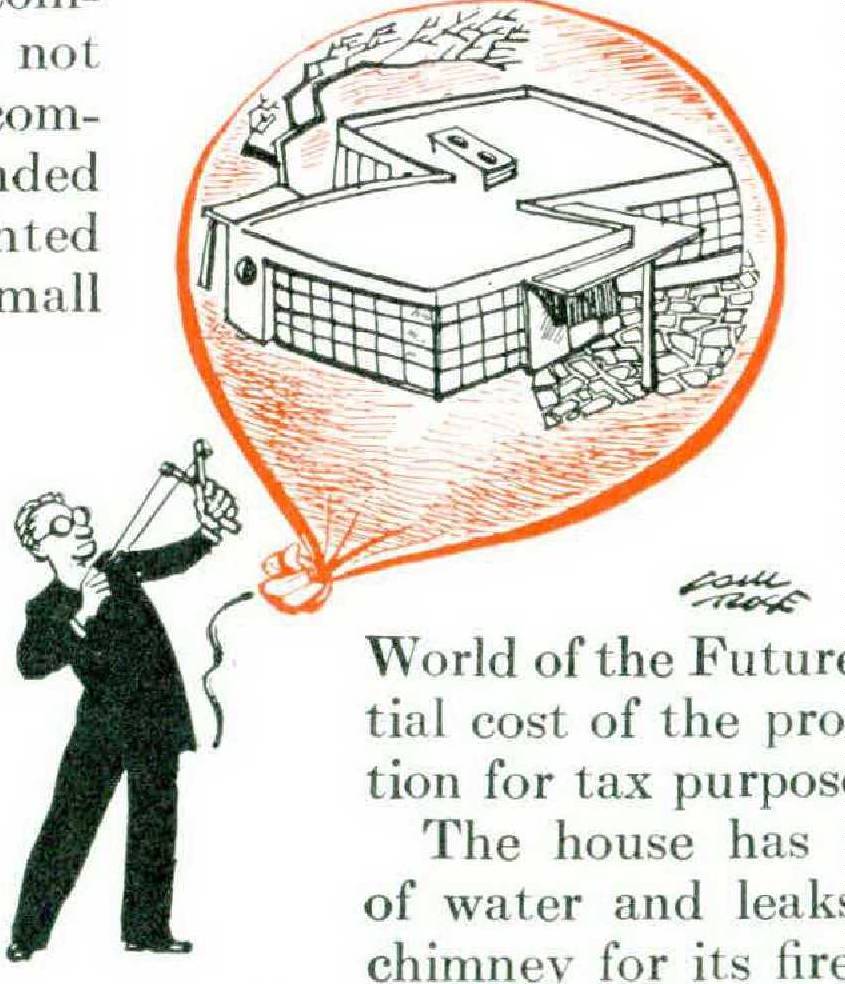
David Cohn’s case for the domestic science of the nineties (page 108) is bound to be judged against the techniques of 1947. From our own experience, we incline to size up the latter — the wonders of the present day—in terms of a “modern house” in a certain Middle Western city. The house is said to have won a prize in an architectural competition; it is said, also, to have cost around $30,000 to build, even though it consists only of a living room, dining room, bedroom, bath, and kitchen, all on one floor.
Located on a city street, the house commands no view whatever, but this did not deter the designer from giving it a complete plate-glass façade. He then surrounded the property with a high wall of painted wood, which encloses the house and a small flagstone terrace. The “view” the year round consists of the wooden fence plus the baking-hot stones of the terrace in the summer, and, in the winter, a layer of dirty snow.
Despite the high wall, the upper floors of neighboring houses afford a direct scrutiny of the interior through the plate-glass façade. This circumstance, coupled with the fact that no one would get much satisfaction from the “view” of the courtyard and wall, has caused the occupants to curtain the whole expanse of glass with heavy net. At this point, the result is a scoreless tie; the design opens up a vista and promptly shuts it off again.
In order that the wooden wall would not cut off all summer breezes, the original designer left a space of about six inches under the bottom of the panels. But the first set of occupants found that passers-by, tormented by curiosity and the opportunity, were actually kneeling down on the sidewalk outside to peer under and see what on earth was going on behind the wall. The next occupants filled in the gap, and the terrace is now really stuffy all summer in anything short of an easterly gale. Here again, Mother Nature seems to have fought at least a draw.
The house has no old-fashioned windows that open and shut; ventilation, except that given by two tiny blowers, is achieved by opening the doors. Unfortunately, the glass façade and metal doorframes did not lend themselves to the attachment of an ordinary screen door, and the house has had no screens at all. Naturally enough, it is full of flies and mosquitoes in warm weather. The glass side gets the summer sun for a full half day, and even with the doors open, the curtains drawn (and the flies making free with the place), the house is astonishingly hot. It ought to be inexpensive to heat in the winter, but so ought almost any fourroom bungalow. Score: A saving of perhaps $50 a year for the World of the Future (offset, certainly, by the high initial cost of the property and a thumping big valuation for tax purposes).
The house has a flat roof which collects pools of water and leaks. The designer put up a short chimney for its fireplace in order to give the building a squatty appearance. He succeeded, but the fireplace smokes. The property has no service areas, and although the occupants send their laundry out, they are obliged to dry the dish towels on a rack on the terrace or out on the sidewalk at the rear.
We encountered another contrast, with David Cohn’s point of view in a recent issue of an illustrated magazine, an article hymning the beauty and utility of highly functional all-purpose china and glassware of the modern period and deriding the heavily stocked shelves of the nineties. Whereas Grandmother was pleased to serve celery in a celery dish, the article chortled, an up-to-date piece of crockery would do for anything from a lamb chop to a chocolate éclair, pre-sliced bread, or corner-store hors d’oeuvres fresh from the deep freeze. Why not give each member of the household an Army mess kit in Orrefors glass or Scandinavian silver and let it go at that?
Our own taste, we fear, is more radical. Iconoclastic and bold, we prefer windows and screens, a roomy clothesyard with grass in it, and a fireplace that draws. With Mr. Cohn, we enjoy napkins, tablecloths, and, we should add, huge linen face towels. We are opposed to “all-purpose” wineglasses and streamlined dining rooms. The more silver on the sideboard and the more applecheeked domestics to polish it, the better. We like to be reminded, by a variety of fine china, that our forebears, too, lived extravagantly and enjoyed themselves without worrying too much about a few extra dishes to wash.
Our belief in the dining room of the nineties was reinforced some years ago by a carving accessory which we saw at dinner with some old-style New Yorkers. We have never seen the gadget elsewhere — an ornamented silver knob with a silver socket and thumbscrew, made to encase and adorn the end bone of a leg of lamb or, on this occasion, an outsize ham. Fit for nothing else, it was nevertheless functional; it was also handsome, lavish, and bespoke a certain stubborn opulence. We commend the item to modernists in general.
C. W. M.