Horse Cavalry
ByPfc IRA HENRY FREEMAN
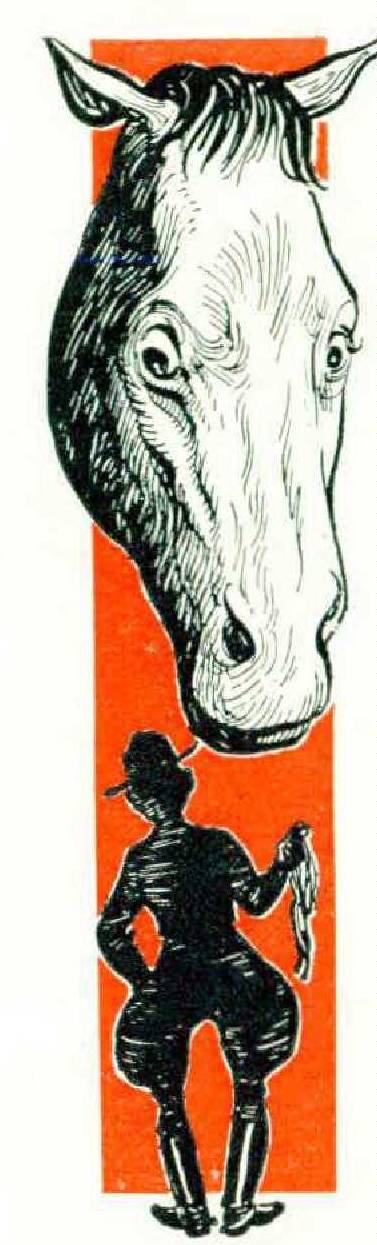
I TOOK my basic training in the cavalry— the horse cavalry, if you please. Not that the American Army uses horse cavalry anywhere in this war — anyway not since the 26th Regiment’s gallant last stand in the Philippines in 1942. The First (and only) Cavalry Division, which helped to retake the Philippines, left their horses in Texas and fought on foot. And the cavalry troops that contributed to victories in Sicily and Italy were all mechanized.
Naturally, I did not request the cavalry when I was inducted. It never entered my mind. Besides, I was born in New York and had never bestridden a horse in my life. It was just one of those Army assignments. It’s all done by machine, I am told; no human hand or brain touches your case. Somehow, when the Army’s wonderful classification machine got rolling on a requisition from Fort Riley, Kansas, for a few hundred horseman trainees, my card fell out.
In the Army, you aren’t told where you are being shipped. So it was not until we rookies piled out of the train after four days’ westward travel from the induction center at Camp Upton, Long Island, and were loaded into strongly smelling vans, that we realized we were in the Land of the Houyhnhnms.
Mounted cavalry is not abolished — not quite. There are several thousand head of Western wild stock, broken to the saddle, at Riley. There are more horses than trainees to exercise them. For, even at Riley, the majority of cavalry trainees these days are mechanized; that is, equipped with jeeps or scout cars or light tanks. During our seventeen weeks of basic, we centaurs developed a fathomless contempt for these jeep-mounted frauds, lacking our distinction of breeks, boots, and spurs.
Long before you get a chance to ride, you are taught humility in the stable police. That means a lot of things—all of them hard work from 8.00 A.M. to 5.00 P.M.; but mostly it means pitching manure. The stable sergeants were ranch boys with provincial dialects we could infrequently understand.
“Hey-yawl-buckem-graysax-ryecheer,” one of them said to us once while we were unloading bags of feed from a wagon.
“What?” we asked, and he repeated the order in his native double-talk.
“Can you make out what lie wants?” I asked my buddy, George.
“Yuh blessed bless-heads!” the sergeant roared, this time with fair clarity. “Cain’t chuh understand plain English?”
The order, we deduced at last, was: “Hey, you, buck those grain sacks right here.”
I had to admit, though, that when it came to horses, my ignorance was complete. I dumfounded my sorely tried stable sergeant on many occasions. The first time, he was pushing a cart full of oats and barley down the center of the stable, having told half a dozen of us stable police to put a measuring can of the mixture into the feed bin in each stall.
Guessing that this act was the finale of the long day’s labor, I dashed energetically in and out of the stalls to get the job done. In a few minutes we had run out of cans.
“What the hell goes on here?” the perplexed sergeant demanded. “Where are the cans?” Then he looked around and discovered the horses miserably nuzzling the tins.
“ Why, you blessed dummy!” he ranted at me, unable to believe his eyes. “Did you put them blessed cans in them blessed feed bins? Do you think a blessed horse can eat out of a blessed mess kit?”
Most of us were a little nervous about getting too close to the horses in the beginning. Some of the trainees were downright scared. The very first day of our horsemanship training we were sent into the corral, which was jam-packed with the untied beasts milling about.
“Everybody catch a horse!” the training sergeant ordered.
We shuffled timidly into the herd. When you snatched for the halter of a horse, the startled animal would whirl to punch at you with a hind hoof. As you jumped for safety, you would jostle another nag in the mob and set him to rearing, and the first thing you knew, the whole corral was bucking and kicking, with panicky soldiers dodging and yelling “Whoa!” and making the confusion worse. The noncoms in charge of our training nearly died laughing; this was the standard introduction of trainees to their mounts.
After a while, we found you ought to walk softly among loose horses and not shout “Whoa!" at them, but murmur sweet nothings as you approach. That way you can slip up to a pony and clip a halter shank onto him before he sees through your little game.
We had already been initiated as housemaids to the gee-gees; now we became their nurses. In the Army, trainees are instructed in everything “by the numbers.” The process of right shoulder arms, or about face, or making a bed, or whatever, is broken down into its component movements, which are numbered and which are performed one at a time on the command of a noncom. We began to groom horses, therefore, by the numbers.
“Back, barrel, and belly on the near side,” the cadre sergeant would call as we “stood to heel” five paces behind our horses in the deep mud of the corral. “Move in!”
Thus, we went over the whole anatomy, rib by rib, joint by joint, with curry comb and brush. Tenderly we held a muddy hoof in our laps to pick out the muck, and immediately dropped it right back into the gooey stuff. We cut the burrs from the tail, cleaned the corners of the eyes.
At last the day came for our first riding lesson. When people ask me how long it takes to learn to ride, I say two hours. Certainly, the Army wastes no more time on the rudiments.
That morning, our instructors had us cinch blankets on our horses, loop halter shanks around their necks, and lead them into a “sweat box,” as the practice ring enclosed by a high board fence was called.
“Prepare to mount,” the training sergeant called. “Mount!”
Mount! How the hell could you ascend a horse without stirrups to give you a leg-up, or some leather to catch hold of? Furthermore, we discovered at that moment how slippery a horse is. While the sergeant bellowed his disgust , we awkwardly boosted one another onto the saddleless ponies.
“Slow trot,” called the sergeant. “Ho-oh.” And at that command, given in the minor-keyed singsong peculiar to the horse cavalry, we trotted around and around the ring without benefit of either saddle or stirrup on the first ride of our lives.
“Gallop,” called the heartless sergeant. “Ho-oh.” And, incredibly, we galloped. It was impossible to cuss; we had to grit our teeth hard against the jouncing.
With only brief and rare intervals of walking the ponies, we were kept at this painful business for two hours. At one time, the torture was such that all fifty of us trainees were groaning together. That sounded so ridiculous we had to laugh, and then we were laughing and bawling in the same breath.
By the end of that first session, we were so sore we could hardly march back to midday chow. A popular practical joke that evening was to pinch a horseman trainee high up inside the thigh; the screeching victim would all but collapse.
However, in a month of daily practice we did learn to ride; not well, but in the GI manner. Which means we could slick to the saddle, in formation and at the Army cross-country pace, for four hours at a stretch, doing thirty miles a day over the endless Kansas plain without regard for weather, and turning aside for no obstacle except maybe a vertical wall over five feet high.
When we had mastered the fundamentals of the “GI seat,” we got tactical exercises. A couple of squads would hide in a draw, while scouts conned the terrain on the other side of the rise. Then we would rush at a snorting gallop over the hill, fling ourselves to the ground with rifles ready, and engage the “enemy.”
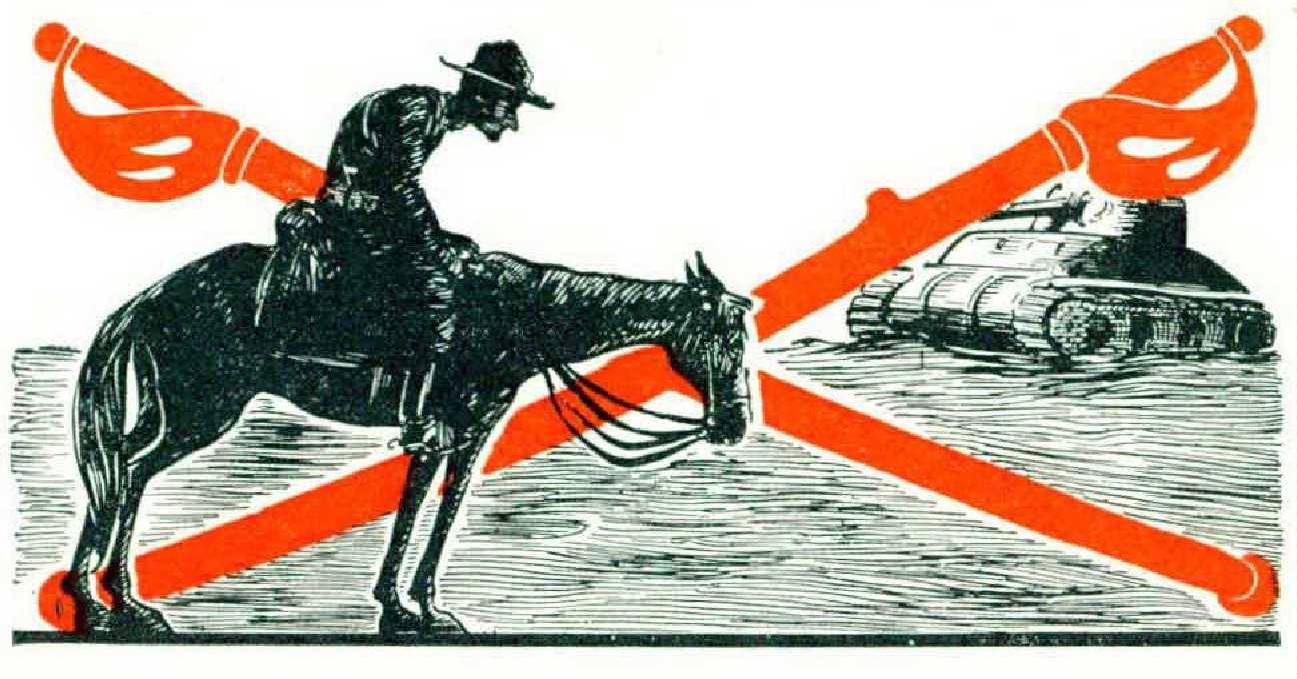
It was all kid stuff, of course, and very strenuous. Still, it was about the only thing in the Army that was any fun, and I suspect we all enjoyed it, not excluding the men well over thirty-five.
The climax of this childish circus was mounted pistol practice toward the end of our training. The idea was to gallop in a “column of troopers” (single file) in a big circle, each man holding aloft a .45 automatic pistol. As we flashed past a row of targets representing the silhouettes of foot soldiers, we were to lean ’way out of the saddle and fire in the best Wild West style. We were warned we should have to pay for the horse if we shot him.
Here, surely, were the dreams of everybody’s boyhood come true. I kicked my sorrel pony into the gallop and joyously banged away like Buffalo Bill himself. After a few happy circuits, I noticed the sergeant glowering at me with more than usual distaste.
“How am I doing, sarge?”
“I wanna tell you somethin’,” he replied sourly. “I don’t know what the hell you imagine you are, but in the Army, when we shoot from the gallop, we don’t keep yellin’ ‘Wheeeee!’”